Showing posts with label Spiritual Conquest. Show all posts

Friday, July 26, 2019

Tenayuca and Acatitlán, State of Mexico | Remnants of Indigenous Civilization in the Valley of Mexico

Ambling Beyond Our Normal Bounds


In this amble, we go beyond two of our usual boundaries — the one that focuses us on the still-vital, originally indigenous pueblos and barrios of Mexico City and the boundary of the City, itself. We go a short distance north and west of the City's most northern delegaciones/alcaldías, Azcapotzalco and Gustavo A. Madero, into el Estado de México, the State of Mexico, which surrounds the City like a lopsided horseshoe on the west, north and east. Our destination is two Mesoamerican archeological sites, Tenayuca and Acatitlán.

Our opportunity to visit the sites was provided by Arqueología viva México, led by archeologist Gerardo Orozco, who, via its Facebook page, organizes excursions to sites in and around Mexico City, as well as elsewhere in Mexico. We have wanted to see Tenayuca and Acatitlán since our early days in Mexico City, but were not able to negotiate the complexities of public transportation, via Metro and Metrobus, to get to the sites on our own. Sr. Orozco led the way, as well as sharing his professional knowledge of the sites.

Via Metrobus, we cross into the State of Mexico, an invisible line obliterated by the continuous, modern urban sprawl that has spread from the city and filled the Valley of Mexico since the late 20th century to form the Greater Mexico City Metropolitan Area. Crossing the line, we recall that before the huge expansion of the boundaries of the former Federal District in the mid-19th century, much of what is now part of the City belonged to the State of Mexico.

After Mexican Independence was won in 1821, the new government initially defined the state's boundaries to be the same as they were as a province under the Spanish. The state and preceding Spanish Province of Mexico encompassed a much larger territory than the present state. It included what are now the states of Hidalgo, to its north, and Morelos and Guerrero to its south, which were created in 1869 by President Benito Juárez. (See our page: How Mexico City Grew From an Island Into a Metropolis.)

File:Mexico (state) in Mexico (zoom).svg
The State of Mexico
is the red area.
Mexico City is the small, white triangular shape within its embrace. 

The state of Hidalgo (large) is to the north.
The states of Morelos (small) and Guerrero (large) are to the south.
Wikipedia

Boundaries in the Valley Before the Spanish Arrived


Thus, the boundary between Mexico City and the State of Mexico is highly arbitrary. The natural boundary is made up of the mountains that surround and form the Valley of Mexico (See our post: Mexico City's Many Volcanoes, Part I: Giants on All Sides). When Hernán Cortés, his troops and indigenous allies he had made while traveling west from Veracruz on the coast of the Gulf of Mexico arrived in the Valley in November 1519 (five hundred years ago this year), he found it filled with hundreds of indigenous cities, villages and hamlets, all interconnected parts of one socio-cultural, civilized, Nahuatl-speaking world.

They were not however, what historians traditionally called the "Aztec Empire". The Valley was politically and economically divided into eight tribal altepetls, city-states. Among these eight entities, the Mexica/Azteca altepetl, based in the city of Tenochtitlan, on an island in a southwest bay in Lake Texcoco, was only one among many. Moreover, it had been the dominant altepetl for just under a hundred years, since 1428. Before that, various others of the altepetls had striven for and been dominant for various periods of time since the Nahua tribes had entered the Valley between the 7th and 13th centuries.
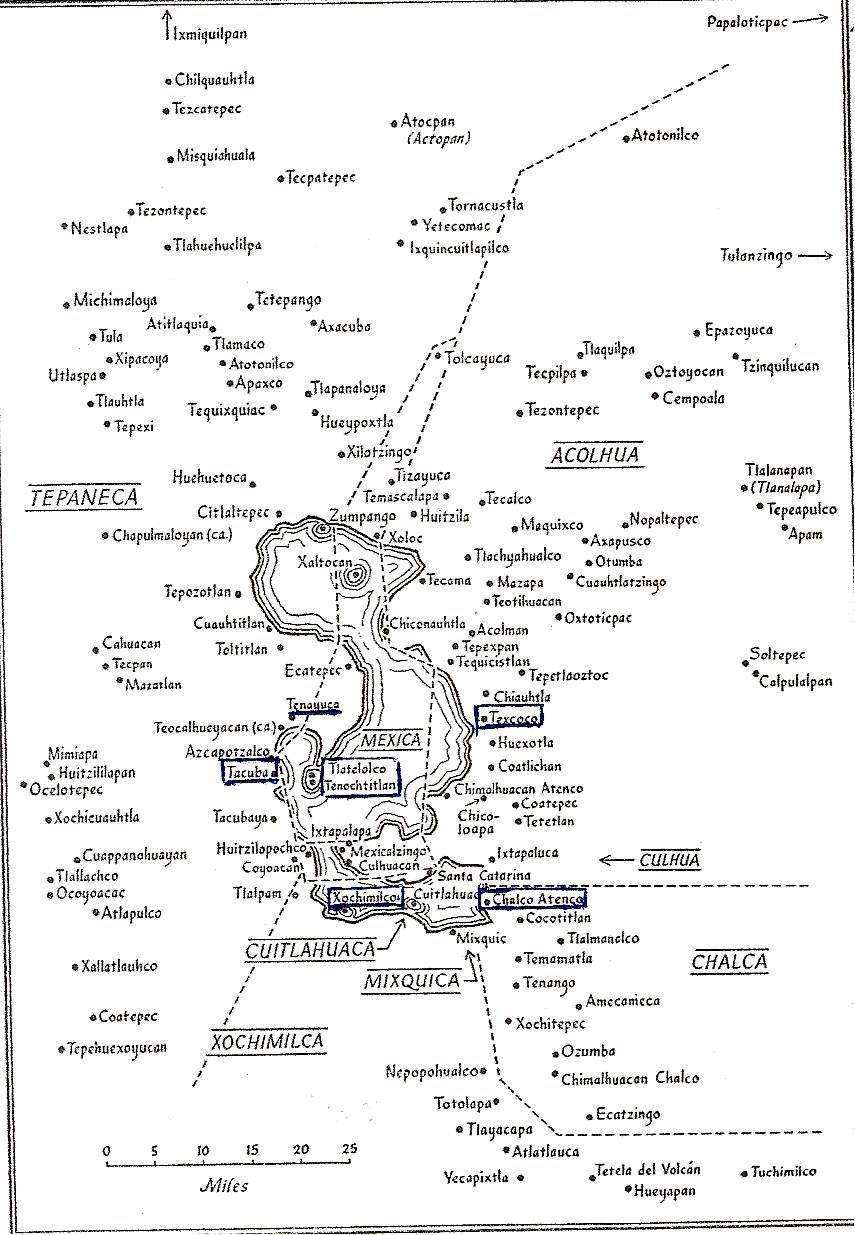
Tribal boundaries in the Valley of Mexico
at the time of the arrival of the Spanish in 1519.
From Gibson, Charles, The Aztecs Under Spanish Rule,
Stanford University Press, 1964.

The Triple Alliance


Three of the altepetls were the most powerful, having formed the Triple Alliance in 1428. It was this Triple Alliance that constituted what has been called the "Aztec Empire". In 1519, it dominated the other altepetls in Valley and other tribal city-states far beyond the Valley in what is now central Mexico. All the others paid tribute to one or another of the three. The Mexica of Tenochtitlan were the most powerful of the three and received the most tribute, but the other two were autonomous in regards to their internal government. They were the:
  • Acolhua, with their capital at Texcoco, on the east side of the lake. The second most powerful member of the Alliance, they did not pay tribute to the Mexica. Its territory is now in the State of Mexico.
  • Tepaneca, with their capital at Tlalcopan (called Tacuba by the Spanish), on the west side of the lake. Tacuba is now the cabecera, government headquarters, of  Delegación/Alcaldía Miguel Hidalgo in the City of Mexico.
The Triple Alliance was formally created after the Mexica, the Acolhua and the leaders of the Tepaneca town of Tlalcopan defeated the Tepaneca rulers in 1428. The Tepaneca had been the dominant force on the west side of Lake Texcoco for more than a hundred years. Their capital had been Azcapotzalco, which was destroyed in the war, so the capital was then moved a short distance south to Tlalcopan. They thereafter remained subordinate to the Mexica, but the rulers of their towns were allowed to continue to control internal matters and collect tribute — part was used to support themselves and part was shared with Tlalcopan.

The Other Altepetls


Two other large tribal groups were the 
  • Xochimilca, in the south, with their capital at the island city of Xochimilco, on the lake of that same name. They were among the earliest Nahua tribes to settle in the Valley, around 900 CE. They had been defeated, in turn, by the Culhua (see below) at the end of the 13th century, by the Tepaneca in the 14th century and, finally, by the Mexica in the early 15th century and their territory reduced. Their capital is now the cabecera of Delegación/Alcaldía Xochimilco.
  • Chalco, to the southeast, with their capital at Chalco-Atenco on the east end of Lake Chalco.  They were subjugated by the Mexica but rebelled from time to time. It is now a municipality in the State of Mexico.
Three smaller but still distinct tribes completed the population of the Valley. They were the
  • Culhua, with their capital, Culhuacán, at the west end of the Iztpalapa Peninsula, between Lakes Xochimilco and Texcoco. They had been a dominant force, controlling more territory, until they were defeated first by the Tepanecas in the 14th century, then by the Mexica in the 15th century. Culhuacán was then left controlling only three other towns, Iztapalapa and Mexicaltzingo on the tip of the peninsula, and Huitzilopochco (now the barrios of Churubusco), across the channel connecting the two lakes, in what is now Delegación/Alcaldía Coyoacán. Culhuacán is now divided into Pueblo Culhuacán in Delegacion/Alcaldía Iztapalapa and the adjoining Pueblo San Francisco Culhuacán in Coyoacán.
  • Cuitlahuaca, whose capital occupied an island dividing Lake Chalco from Lake Xochimilco. They never controlled much territory beyond a few nearby towns on the north and south lakeshore. It is now the cabecera of Delegación/Alcaldía Tláhuac (a shortened form of Cuitlahuac) which includes the pueblos it formerly controlled. 
  • Mixquica, whose capital, Mixquic, on the south shore of Lake Chalco was all they controlled. It is now Pueblo San Andrés Mixquic incorporated into Delegación/Alcaldía Tláhuac.
In 1521, Cortés' Spanish soldiers, together with indigenous allies both from within and outside the Valley, defeated the Mexica of Tenochtitlan and then went on to take control of all of the Valley, either by might or the voluntary submission of the other tribes. From Gibson, Charles, The Aztecs Under Spanish RuleStanford University Press, 1964.

Tenayuca


Tenayuca means "walled place" in Nahuatl. The archeological remains of Tenayuca are located in the originally indigenous Pueblo San Bartolo Tenayuca in the municipality of Tlalnepantla de Baz, in the State of Mexico. At the time the Spanish arrived, it was under the control of the Tepaneca (see above map of tribal territories), which it had been for some time before the Mexica became "the first among equals" in the Triple Alliance.

Tenayuca
lay at the northern-most end of the southwest bay
of Lake Texcoco.
During the time of Mexica/Azteca rule,
it was at the end of a long causeway
from Tenochtitlan/Tlatelolco.

Archaeological remains recovered from Tenayuca indicate that the site was first occupied in the Classic Period (100 to 600 CE), when Teotihuacan, in the northeastern part of the Valley, dominated the area. Its population increased in the early Postclassic (600-1100 CE) during the reign of the Tolteca based in Tula, outside the valley to the northwest.

It continued to increase after the fall of Tula (1150 CE), when, with the lack of a central dominating power, many nomadic tribes, generically called "chichimeca" [a pejorative term used by settled, agrarian peoples with urban centers, hence, "civilized", to denote nomadic hunter-gatherer tribes from the north] moved through the area formerly controlled by Tula and entered the Valley that was called Anahuac.

According to the Codex Xolotl, Tenayuca, itself, was founded in 1224 CE by Xolotl, ruler of a Nahuatl-speaking chichimeca tribe whose actual name is unknown. Xolotl was succeeded by Nopaltzin who married Atototztl, a Tolteca princess, in order to establish a linkage with the royal lineage of Tula, seen by all the new tribes as the epitome of a civilized society. When Nopaltzin died, his son, Quinatzin, transferred the seat of power to the east side of the lake that came to be known as Lake Texcoco and founded the altepetl (city-state) of Coatlichán. Quinatzin left a maternal uncle, Tenacacaltzin, to be lord of Tenayuca.

On or about 1337, another tribe, the Acolhua, defeated the chichimeca of Coatlichán and made Texcoco their capital city (see map of tribal boundaries above). Tenayuca allied itself with the Acolhuaswho dominated the northeast region of the Valley of Mexico in the mid-14th century.

However, in the late 14th century, Tenayuca was conquered by the Tepaneca of nearby Azcapotzalco. About a hundred years later, in the 1430s, after the Mexica of Tenochtitlan and their allies, the Acolhuas and Tlalcopan, conquered Azcapotzalco, bringing the Tepaneca under the control of the Triple Alliance, Tenayuca came under the control of Tlalcopan. It remained so until the Spanish came and conquered the entire Valley in 1521 (modified from Wikipedia).

The Temple of Tenayuca


Temple architecture that was built during the period of Mexica/Azteca dominance is based on that which originated at Tenayuca. It consists of a pyramidal base supporting two temples. The Mexica/Azteca adopted this innovative style for their own main temple, now known as the Templo Mayor, in the center of what was Tenochtitlan.

Pyramid of Tenayuca
with its stairway leading to what were two temples.

The archeological site consists of a massive pyramidal platform with a stairway rising on the western side to where the twin temples of Tlaloc (god of all waters, essential for agriculture, the basis of urban civilization) and Huitzilopochtli (son of the sun god, Tonatiuh and god of war, the Mexica's primary god) once stood. The temple of Tlaloc occupied the northern part of the pyramid while the Huitzilopochtli temple stood to the south. To the south of the stairway at ground level is a projecting platform bearing sculptures of crossed bones and projecting skulls. It is likely where human sacrifices were carried out or completed after being initiated in one or the other of the temples above.

Southwest platform of skulls and crossed bones.

Like many Mesoamerican temples, various phases of construction were built one on top of the other. In the case of Tenayuca, the size of the building increased through six phases of construction but the basic form remained unchanged. The original double pyramid was enlarged five times, the first time probably in 1299 and then successively at 52-year intervals [the cycle of the "tying of the years", when the first day of the 365-day solar calendar coincided with the 260-day divinatory calendar].

The last phase of construction probably dates to 1507 and measures 62 meters (203 ft.) wide by 50 meters (164 ft.) deep. Mexica/Azteca influence is apparent from the third stage, built in 1351, only twenty-six years after they founded Tenochtitlan. All the following stages were purely Mexica/Azteca in style, as demonstrated by the sloping, multiple tiers of the pyramid rather than the vertical walls apparent in the earlier stages.

Stages of enlargement of the pyramid
On-site Museo Xolotl

Painting of how the pyramid looked at its final stage in the early 16th century.

Wall of the Serpents


The pyramid base is surrounded on three sides by its most notorious component, a coatepantli (Nahuatl for a wall of serpents), a low platform supporting 138 stone sculptures of snakes. Their bodies were once covered with plaster and painted in a variety of colors, with their scales painted black.

Coatepantli, the Wall of Serpents


On the north and south sides of the pyramid, at ground level, are two sculptures of coiled serpents. The crests on their heads bear markings representing the stars and identify them as Xiuhcoatl (the fire serpent). All the serpent sculptures around the pyramid were associated with worship of fire and the sun.

Fire Serpent

Fire Serpent

Two hundred meters (about 220 yards) from the main pyramid of Tenayuca are the remains of what appears to have been an elite residential complex, with surviving plaster floors in some rooms. This area has been labeled Tenayuca II by archaeologists and appears to have gone through various phases of construction. Wikipedia

Acatitlán


About three kilometers (a little less than two miles) from Tenayuca, in the Pueblo of Santa Cecilia Acatitlán, is another archeological site. It consists of a small, reconstructed pyramid that was originally one of the earlier stages of construction that became enclosed within a larger pyramid. It was reconstructed in the 1960s. 

Pyramid of Acatitlán

Acatitlán was evidently a site subsidiary to Tenayuca. It is believed that after the Mexica took control of the area in the 15th century, the temple was dedicated to their god, Huitzilopochtli.

While we were visiting the site, there was a man standing on top of the pyramid, engaged in an indigenous ritual of venerating the four cardinal directions, the sun and heavens above and the earth below. 


On the man's T-shirt would appear to be the symbol of
the Mexica/Azteca Stone of the Five Suns,
representing the sequence of five creations of the world
until the Fifth Sun,
when humans with language were successfully
created by the gods, so they could worship those gods. 

Like virtually all indigenous temples in Mexico, this one was destroyed by the Spanish. The stones of the outer layers were used to construct the church of Santa Cecilia Acatitlán, which stands nearby. So here, in Acatitlán, we encounter a rare literal demonstration of the so-called Spiritual Conquest, the transformation of indigenous society into a Catholic Hispanic one, which we have been exploring since 2016.  

Church of Santa Cecilia Acatitlán,
built in the 16th century.

Wikipedia

A Glimpse at Indigenous Civilization in the Larger Valley of Mexico


Since we began our ambles in 2015, we have stayed within the boundaries of Mexico City for practical reasons of proximity and preservation of our limited energy. We have been well aware that there are still existing originally indigenous villages and archeological remains outside those arbitrary boundaries, all over the larger Valley of Mexico. We have, of course, been to the monumental site of Teotihuacan, one of the premier archeological sites in the entire world. It is located in a side valley to the northeast of the main Valley. Twenty-five years ago, during our first visit to Mexico, we went to the smaller, but still impressive site of Tula

Today, in our visit to Tenayuca and Acatitlán, we have encountered smaller sites, but ones barely outside the City. They are also sites that, unlike Teotihuacan and Tula, were still functioning communities when the Mexica/Azteca became the last people to dominate the Valley before the Spanish Conquest brought Mesoamerican civilization to an end. The Mexica/Azteca of Tenochtitlan took note of their strategic location at the north end of the bay which their city dominated in Lake Texcoco (see map of bay above) and incorporated them directly into their urban structure via a causeway connecting them to their capital. 

The archeological reconstructions of their prehispanic pyramids, set within the still-vital pueblos of Pueblo San Bartolo Tenayuca and Santa Cecilila Acatitlán, provide — like the Templo Mayor in the midst of Centro Histórico and the site of Tlatelolco, next to the Church of Santiago Tlatelolco — glimpses of the indigenous world that existed before its military Conquest by the Spanish and vivid examples of the dramatic transformation of that world that was the Spiritual Conquest that followed.

Sunday, June 16, 2019

Original Villages | Fiestas in Pueblo Iztacalco, Part II: Playing With The Paradox of Mexican Identity

Pueblo Iztacalco and San Matías, Its Patron Saint


The second fiesta we attended in Pueblo Iztacalco this year was in mid-May. The first was in mid-April, for the Viernes de Dolores, the Friday of Sorrows, before Palm Sunday. As we wrote in our post, it turned out to be about something completely different, a commemoration of La Viga Canal, central to some three hundred years of the pueblo's life.

This Saturday in May is the pueblo's fiesta for its patron saint, San Matías. St. Matías was a little known apostle or disciple, chosen by lot from followers of Jesus to replace Judas Iscariot. After Judas had betrayed Jesus to the Roman and Jewish powers and Jesus was crucified, he hung himself in remorse. [See our post on the Passion Play of Iztapalapa.] Matías thus restored to twelve the number of central disciples or apostles of Jesus, echoing the twelve sons of the Jewish patriarch, Jacob and the tribes they founded. Matías thus became one of the core group that, after his resurrection, Jesus had charged with spreading the Gospel, the Good News, that his sacrificial death and miraculous resurrection opened the way for sinful mankind to be redeemed and reconciled to God.

San Matías church is the central church of the entire original pueblo. Each of its seven barrios, Santa Cruz, La Asunción, San Miguel, Los Reyes, San Sebastián Zapotla, San Francisco Xicaltongo and Santiago Atoyac, has its own chapel, under the care of the church of San Matías.

Original Pueblo de Iztacalco
composed of seven original barrios
outlined by the black boundary line.
(Barrio Santiago Atoyac, on the west side, has been divided into north [green] 

and south [yellow] sections.
Pueblo Santa Anita Zacatlamanco [large, light green area on the north side, labeled "El Ranchito"] 
is a separate, but closely related original pueblo.)

 Site of Iztacalco's plaza and Church of San Matías, in Barrio Asunción,
is marked by 
green/navy blue star.
 Line up the middle, south to north, marks the original Canal de la Viga,
now the avenue Calzada de la Viga.

Fiesta Dynamics: Combining the Expected with the Unexpected


Attending many fiestas over the past three years, we gradually came to be aware that they manifested two contrasting dynamics at work. First, there is conformity to a traditional ritualized structure of Catholic worship. Second, there is an ánimo (energy, vitality, spirit) of playful creativity that enlivens and transforms the ritual, giving it an expression unique to the community. We have written about this combination of traditionally determined ritual structure and free-spirited variations in its enactment in three essays:
With this awareness, we arrive at each new fiesta in each new pueblo expecting to encounter certain predetermined rituals, but also expecting we will encounter surprises in how the communal ánimo of the pueblo's members has, over the years, creatively interpreted and shaped its own, unique variations of those rituals and, thus its unique public identity.

The Paradoxical Interaction of Ritual and Play in the Veneration of San Matías


Iztacalco's fiesta venerating San Matías proved to be a striking combination of ritual and play, one that puzzled, even bewildered us as it slowly unfolded before our eyes. It seemed to present a contradiction between the purpose of the ritual, i.e., the veneration of a patron saint, and the particular persona (from the Greek for mask) chosen as a disfraz (disguise) by the persons carrying it out. It was one that we had never encountered among all the disfraces, such as chinelos (Nahuatl for disguised ones) and charros (fancily dressed Spanish cowboys), we have met. It was a conundrum that took some time for us to come to an insight that, if correct, makes sense of the apparent paradox. 

We arrive at the Church of San Matías late on a sunny Saturday afternoon, expecting to witness the traditional procession of the patron saint through the seven barrios of the pueblo. It is scheduled for four o'clock. We know we will not be able to follow the procession its entire length, but we intend to witness its beginning. We find the atrio (atrium) of the church virtually empty. There are no signs of preparation for a procession. We ask a matronly woman leaving the convent adjacent to the church what she may know about the event. She knows nothing. The church doors are closed. 

Church of San Matías,
with its convent, built of tezontle, volcanic stone, to the right.

A colorful portada announces the fiesta.
The butterflies near the bottom are an indigenous symbol of rebirth.
Above them, on both sides of the covered image of San Matías,
are hummingbirds, an indigenous symbol of sacrifice,
as their drawing of nectar is equated with the drawing of blood.

The clock tells us it's a quarter to four.

Walking out of the atrio, we ask a man and a woman ambulantes (street vendors) standing by the entrance if they know anything about a procession. We are dubious that these commercially focused folk will be able to help in our religiously focused quest. The man surprises us by saying, "Oh yes, it will begin around the corner, by the side door to the convent."

We thank him for this essential information and walk around the corner of the atrio, into a side street. Down the block, we spy a white van parked and, standing around it, musicians, dressed in black shirts (hot, we think for May's summer-like heat) and white pants and holding their brass instruments. It's a banda, one of the essential ingredients for a procession. We approach them, introduce ourselves and our purpose in being here and confirm that there is to be a procession. After a few minutes, without any visible cue, they start to play. It seems the procession is about to begin, but there are no parishioners in sight, let alone a statue of San Matías. Puzzling.

Strike Up the Band

A Paradox Makes Its First Appearance


At this point, a man arrives, dressed in a bright yellow tailcoat, black pants and white shoes. He proceeds to complete dressing in his disfraz, putting a red balaclava over his head and pinning a white scarf bordered in red and yellow to the balaclava so it hangs down the back of his neck. He then tops it off (forgive the pun) with a yellow and red top hat decorated with red stars. The piece de résistance is a mask with pale skin, hazel eyes and jewel-studded eyebrows and beard. It is the style of the masks worn by chinelos and charros that are intended to be burlas, mockeries, of upperclass Spanish gentlemen. 

We have never before seen such a disfraz at a fiesta. It is that of a European or "Western" upper-class gentleman of the latter half of the 19th century. Why, we wonder, is such a persona part of a patron saint fiesta in a Mexican working-class community? It is a question that will take us some time and thought to answer.


Sporting a red and yellow parasol (literally, "for the sun") dangling more stars,
the gentleman heads off down the street,
accompanied by the banda playing vigorously.

Destination Unknown


The "gentleman" and the banda, now joined by a few parishioners in everyday clothing, head off at a rapid pace. We have no idea where they are going or why, but we hurry to keep up with them. After a couple of blocks, we wonder whether we can keep up their pace or will have to resign ourselves to being left behind, in the proverbial "middle of nowhere". We do know the way back to the church, but we will be disappointed to be left out of whatever is happening. Fortunately, while we are considering our dilemma, the group stops to rest and then continues on at a more moderate, and for us, doable pace.  

Along the way, a couple of young men, dressed similarly to the "gentleman" in yellow, but in black and white, join the procession (if that's what it is). A young boy, disguised as a charro also joins the group.

     
Note the Christian Cross. Here is the paradox: expressing one's Catholic faith
at the same time one is portraying an upper-class "gentleman". 

A Novel Means for Transporting a Saint


Walking a few more blocks, we all come to the fenced-in entrance of what seems to be some kind of open-air market, but not with the usual individual stalls of the traditional tianguisA red pickup truck is parked in the entrance gate — its bed ringed with a plethora of fresh flowers, lilies and roses. A portada-style backdrop stands at the head.    


We are perplexed and ask one of the parishioners what this is. She tells us that it the anda (platform) that will carry San Matías in the procession. She explains that we will now head back to the church to pick up the saint. 

We have seen many variations of andas for carrying saints, from huge, flower-bedecked "floats" born on the shoulders of a dozen or more men and women, to small wooden tables with pole-like handles projecting frontward and backward from the corners for the bearers to carry it, to large tricycles with huge baskets normally used by street peddlers, but we have never seen a pickup truck being used as one. Ingenious and requiring no human muscle.

After a few minutes wait, the truck moves off, followed by the banda, the "gentlemen", a handful of parishioners and us. Fortunately, the truck sets a reasonable pace for us pedestrians. In fact, it seems to be the pace of a procession. We realize that the somewhat hurried walk we have experienced was simply to meet this pickup anda so as to accompany it back to the church. It was a prelude to the actual procession.

A Procession Takes Shape, the Paradox Heightens


We head back to the church, but not by the street we came on. En route, we are joined by a person carrying a banner of San Matías and more "gentlemen". The procession appears to be taking shape as we move along.


Two more "gentlemen" of Iztacalco.
Note, again, the Cross.
(We love both beards!)

We note the Christian Cross on the top hats of some of the "gentlemen". If the disfraz of being a "gentleman", like those of being chinelos and imitating charros, is meant to be a mockery of the Spanish, the cross represents the adoption of the Catholic faith those very Spanish brought to the New World.

We have seen this paradoxical combination of ridicule of the Spanish combined with symbols of adherence to the Catholic faith innumerable times on the disfraces of chinelos. Charro symbolism does not, as far as we recall, include explicitly Catholic ones. They are, in most cases, symbols of power borrowed from classic "Western" cultures such as Egypt, Greece, Rome and European royalty, or indigenous or traditional Mexican ones, such as bronco-busting cowboys. (For examples of charro symbolism see our post, Carnaval in Pueblos of Eastern Iztapalapa.)

Arriving at the Church, the Paradox Reaches a Peak


After traveling some blocks, we come out onto la Calzada de la Viga, the four-lane boulevard that replaced the canal in the 1950s. We are a few blocks south of the church.

The Calzada is divided in two by a wide, park-like camellón (median);
both sides run north.


Shortly, we arrive at the plaza. The truck backs up to the curb. The "gentlemen" head for the church on the opposite side of the plaza. In the atrio, an entire group of "gentlemen" is waiting.

Gentlemen in waiting.

San Matías, in a glass case, is carried from the church on a small wooden anda.

A small version of San Matías,
known as a "demandita", little petition.
The size makes him very portable.

San Matías is carried from the atrio.

The gentlemen follow.
The hat of the second one bears the indigenous glyph of Iztacalco,
another curious juxtaposition of cultures.

San Matías is loaded on his pickup anda.


The "gentlemen" wait,
while San Matías is prepared for his tour through all seven barrios of Pueblo Iztacalco.


When all is ready, the pickup truck, carrying San Matías, the "gentlemen" and some parishioners start off on the procession. We bid, "Qué te vaya bien," "May it go well for you" and remain behind in the plaza, having expended our energies in the process of the prelude.

 So who are these "gentilhombres", and why are they here?


So who are these "gentilhombres" (hen-teel-OHM-bres), these "gentlemen"? The persona, we recognize, is that of a European or "Western" upperclass gentleman of the 19th century and the beginning of the 20th. As we asked ourselves when we saw the first "gentleman" in his yellow top hat and tailcoat, why is such a persona participating in this patron saint fiesta in a Mexican working-class community?

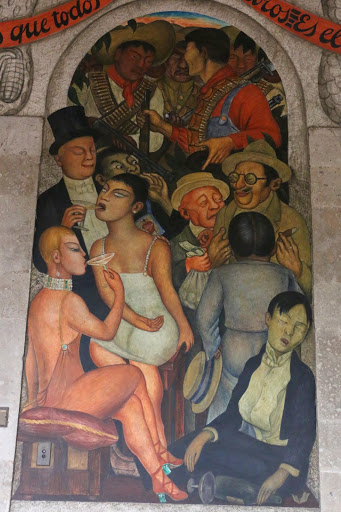
We recall that we have seen this persona before in Mexican imagery, in the work of the Mexican muralists of the post-Mexican Revolution period of the 1920s, Diego Rivera and José Clemente Orozco. (See our series of posts on the complexities and contradictions of the Revolution: Mexican Revolution: Overview of Its Actors and Chapers and The Genesis of the Mexican Mural Movement: The San Carlos Academy of Art and Dr. Atl.)

La Orgia-La Noche de los Ricos
The Orgy-The Night of the Rich
by Diego Rivera
in the Secretariat of Education

El banquete de los ricos
Banquet of the Rich


Below the rich are the laboring poor.
by José Clemente Orozco
in Museo San Ildefonso

El juicio final
The Last Judgement,
by José Clemente Orozco.

Halos float above the top hats of the gentlemen.
God is inebriated and about to lose his grip on the world.
This is the left half of the mural.
Museo de San Ildefonso

El juicio final
The Last Judgement

In the right half of the mural, devils chase the poor away
from the presence of God.

The "gentlemen", sardonically and harshly portrayed by Rivera and Orozco, were, in Mexico, the bourgeois gentlemen of the Porfiriato, the dictatorship of repeatedly reelected president Porfirio Díaz from 1876 to 1911, when the Mexican Revolution took him down. So the image has specific historical and political meaning in Mexico. These "gentlemen" are the quintessential representatives of los de arriba, those from above, the opposite of los de abajo, those from below, the peasant farmers, miners and urban laborers.

Thus, the "gentlemen" venerating the patron saint of an originally indigenous pueblo manifest the paradox at the center of Mexican life and culture, the conflict between indigenous and Spanish worlds continued in class terms of los de arriba vs. los de abajo and the partial reconciliation that has been worked out between them. A major vehicle of this reconciliation has been through a shared Catholic faith, the so-called Spiritual Conquest. Here, in the procession of the patron saint of Pueblo Iztacalco, San Matías, this paradox is displayed with the ironic humor of parody.

The conflicts, contradictions and paradoxes underlying that pragmatic reconciliation remain. The "gentlemen" are a symbolic, communal expression of what is an ambivalent resolution of the paradox. They are a parody of the Spanish and Hipanicized mestizo (mixed race) upper class, a burlesque (Spanish: burla), playfully incorporated into a formal ritual of the Catholic faith, a procession of the saint through his community.  

While the "gentlemen", by their ostentatious manner, parody the very personas they are enacting, by their wearing the symbol of the Cross, they signal their true belief in the faith by which the two worlds were joined. Ironically, these upper-class "gentlemen" are venerating a saint who, while he was brought by their cultural forefathers from Spain and imposed upon el pueblo (the people of the indigenous village), over time was transformed by that pueblo into its own, made into a santo popular, a saint of the people. The tables have been turned, at least in this playful parody. Los de arriba are paying honor to the saint of los de abajo.

The use of parody by los de abajo, the working class, with their indigenous roots, to burlesque los de arriba, with their roots in the Spanish Conquest, is quintessentially Mexican. Thus, the "gentlemen" participating in the patron saint fiesta of Pueblo Iztacalco, San Matías, are the perfect ironically playful expression of the paradox at the core of Mexican identity.
"And the haughty man shall be brought down, and the mighty man shall be humbled..." (Isaiah 5:15)
Delegación Iztacalco
is the small, dark green area
in the northeast of the City,
just southeast of Delegación Cuauhtémoc,
site of Centro/Tenochtitlan.


Delegación/Alcaldía Iztacalco
with its barrios and colonias.
The original Pueblo Iztacalco in marked by the green and yellow star.