Showing posts with label Spanish Conquest. Show all posts

Tuesday, January 29, 2019

Original Villages | Coyoacán's Chapel of the Immaculate Conception of Our Lady, the Virgin Mary, Part I: Small Church with a Big History

Indigenous Coyoacán 

Es fácil traducir esta página en español: vaya a la columna a la derecha. En la parte más alta hay una ventana etiquetada "Translate". Desplace la flecha abajo hasta encuentra "Spanish". Click en ese y inmediatamente todo el texto estará traducido en español por Google. Con certeza, habrá errores, pero creemos qué el sentido se quede bastante claro.
When we wrote our initial post about Delegacion/Alcaldía Coyoacán, we began with a tour of its well-known, tourist-popular Center, officially la Villa Coyoacán and neighboring barrios. Originally, this was an indigenous urban center that had been in existence for at nearly two hundred years when Hernán Cortés, his Spanish troops and indigenous allies arrived in 1519 in the Valley called Anahuac. At that time, it was controlled by the Mexica (aka Azteca) of the island city of Tenochtitlán.

However, Coyoacán had been established by the Tepaneca. Like the Mexica, the Tepaneca were a Nahuatl-speaking people who had entered the north of the Valley around the year 1000 CE,  some three hundred years before the Mexica. By 1350, they had taken over the territory down the west side of Lake Texcoco as far as its southwest corner, where they built a village they likely named Coyoacán, Place of the Coyotes. The Tepaneca altepetl (city-state) was centered in Azcapotzalco, farther north along the southwest bay of Lake Texcoco.

Then, in 1428, the Mexica defeated Azcapotzalco and took control of its territories, including Coyoacán. As a major center in the southwest of the Valley, Coyoacán was crucial to the Mexica's political and economic control of that area and of the trade routes going south over the mountains, which they then also used for the military expansion of their empire.

Southwest Bay of Lake Texcoco.

Coyoacán
(spelled here Coyohuacan)
lay near the west shore at 
the south end of the bay of Lake Texcoco,
near the channel from Lake Xochimilco
(bottom center of map).

In the early 1400s, when the Mexica of Tenochtitlán
won control of the Valley from the Tepaneca
they built a causeway to Coyoacán,
via the island village of Huitzilopochco. 

Hernán Cortés Transforms Coyoacán from an Indigenous Altepetl to a Spanish Village


In August 1521, Hernán Cortés and his forces defeated the Mexica of Tenochtitlan, bringing the so-called Aztec Empire to a sudden end. While Cortés awaited the razing of Tenochtitlán and the building of the Spanish Ciudad de México atop its ruins, he took over this center of Coyoacán as his temporary headquarters. 

He chose Coyoacán as his base because its leaders and residents, being Tepaneca, had allied with him in his attack on Tenochtitlán, giving him free access to the entrance to the causeway that ran from there to the capital city, hence providing him with a strategic pathway for his assault of the island city.

Cortés named the town la Villa Coyoacán. Declaring it a Villa had specific political purposes under Spanish law. When Cortés landed on the mainland in February 1519, he immediately had his soldiers declare the establishment of la Villa Rica de la Vera Cruz, intending thereby to officially create a Spanish village according to Spanish law, with rights to elect its own leaders and to make direct appeals to the king. The "residents" of this Villa then elected Cortés the equivalent of mayor.

This was Cortés's way of claiming independence from the Governor of Cuba, who had charged him with an exploration of the mainland coast, not to land and attempt to conquer it. Thereafter, he bypassed the governor of Cuba and communicated directly with King Charles, reporting his victories and seeking the king's official approval and support. Declaring Coyoacán a Villa was a reinforcement of his claim to independence from the governor of Cuba and his right to act on behalf of the king in governing the newly conquered people and their territory.

During the three years that Cortés was based in Coyoacán, awaiting the construction of Spanish government buildings in the former Tenochtitlán, he had constructed an ayuntamiento (city hall) and residences for himself and his soldiers in la Villa. Thus he began the transformation of Coyoacán from an indigenous village into a Spanish villa whose colonial architecture and ambiance make it so picturesque and popular today.

History of La Capilla de la Concepción de Nuestra Señora, the Chapel of the Conception of Our Lady

The Construction of the First Christian Church in Nueva España, 


Being a devout Catholic and seeking to transform the defeated indigenous into believers in the True Catholic (Universal) Faith, Cortés also had a chapel built dedicated to the Virgin of the Immaculate Concepción. It was located just east of the center of the Villa. As such, it was the first Catholic Christian Church built in Mexico and evidently is the oldest continually existing church in the continental Americas.

Panama, called Darien by the Spanish, had been explored by them beginning in 1510, but Panama City was not founded until 1519. Apparently, a chapel was built sometime in the following decade, but later abandoned. The oldest existing church in Panama City is its cathedral, begun in the late17th century and completed over a hundred years later. The original chapel of la Concepción was remodeled in the late 17th or early 18th century and given a Baroque facade and gold retablo (reredos) behind the altar. It is familiarly referred to as La Conchita, "the Little Shell"

Chapel of the Immaculate Conception, 
"La Conchita", "The Little Shell".

The facade is in Baroque style, from the late 17th century.
Both the shape of the top of the doorway
  (archo mixtilíneo, arch of mixed lines),
and the diamond-patterned wall are mudéjar,
i.e., Muslim, designs adopted by the Spanish.
The chapel was completely restored between 2011 and 2015.

La Conchita Located Atop the Earliest Settlement in Coyoacán


As it happened, during the recent renovation of la Capilla de la Concepción Inmaculada (2011-2015), archeologists discovered that it had been constructed atop the site of the earliest settlement that was to become Coyoacán. Under and around the current plaza in front of La Conchita, they found remains of an initial settlement dating from around the year 200 CE. It was likely built by the first people to establish agriculturally-supported settlements in the Valley, the Otomí, who had domesticated the cultivation of corn in the Balsas River Valley, just over the mountains to the east (now in the State of Puebla). Hunter-gatherer tribes had been in the Valley since at least 9,000 years ago.

Some four hundred and fifty years later, in the 7th century CE, this settlement was considerably enlarged. Archaeologists have found evidence that it was taken over by the Tolteca, who had, earlier in the same century, taken over the village they called Culhuacán, The Place of the Old Ones, on the peninsula separating Lake Xochimilco, to the south, from Lake Texcoco to the north. At the same time, the Tolteca were developing the city of Tula, north of the Valley (now in the State of Hidalgo), which became the dominant power center in the area for five hundred years, until the middle of the 12th century. Within a few years, the Tolteca of Culhuacán crossed the narrow channel connecting the two lakes and took over the settlement in Concepcion, giving them control of the strategic waterway. They built a temple on the site that is now that of La Conchita.

Subsequently, in the 12th century CE, the site was abandoned for reasons the archaeologists haven't deciphered. This abandonment seems curious, as the Tolteca of Culhuacán remained a dominant power until near the end of the 14th century. It is even more intriguing that the major Tolteca city of Tula was also abandoned around the middle of the 12th century.

In any case, apparently not until two hundred years later, in the 14th century, was the area taken over by the Tepaneca. They built a new urban center just to the west of the first settlement, where the present Villa Coyoacán stands. They likely gave it the name Coyoacán. When the Mexica defeated the Tepanecas in 1428, they took control of this relatively new Coyoacán and expanded it even further.
Based on an article, Evidencias arqueologícas en el Centro de Coyoacán, Archeological Evidence in the Center of Coyoacán, by Juan Cervantes Rodado, María de la Luz Cabrera and Alejandro Meraz Moreno, in the magazine Arqueología mexicana, issue of Sept-Oct 2014, pp. 43-48.
So La Conchita is doubly important, as the 1,800-year-old site of the first settlement that was to become Coyoacán and as the earliest Christian church in Mexico, if not in all of the Americas.

Early Years of "La Conchita"


In 1519, Cortés had brought with him from Cuba a Dominican friar, Bartolomé de Olmedo, whom he placed in charge of the chapel. In 1524, a group of twelve Franciscan friars or monks arrived in Nueva España to evangelize, i.e., convert the indigenous to Catholicism, the so-called Spiritual Conquest. (Of an earlier group of three who arrived in 1523, only one survived, Fray Pedro de Gante Peter of Ghent, Flanders.) These friars were given charge of la Capilla. In 1529, Dominican friars arrived in Coyoacán and established the convent and church of San Juan Bautista, St. John the Baptist, in the center of la Villa. (See our initial Coyoacán post).

Coyoacán after the Spanish Conquest
(here spelled Coyohuacán)
and surrounding settlements with original indigenous names,
with convents and churches established by Franciscans and Dominicans.


El Convento de la Concepción de Nuestra Señora
is marked, with its plaza, just to the right of center.
San Juan Bautista is just to its west (left).

The dashed blue line to the east shows the location of the shore of Lake Texcoco in the 16th century.

Original indigenous settlements and roadways (in red) are overlaid on streets of modern Coyoacán, (in white).
From La evangelización del área coyoacanense en el siglo XVI,
The Evangelization of the Area of Coyoacán in the 16th Century, by Jaime Abundis
from Arqueología mexicana, Sept-Oct 2014 issue.

The Franciscans and Dominicans worked in concord in the center of Coyoacán until the Franciscans left in 1534 or 1535. They did so because indigenous leaders of Coyoacán demanded from the Audiencia — a royal commission established by King Charles to rule Nueva España in order to remove control from Cortés — that some of the land that had been taken by Cortés from them be returned.

The Franciscans chose not to oppose this demand and moved to nearby Huichilopochco (now called Churubusco) where they established a new church and convent dedicated to la Asunción de Nuestra Señora, the Assumption of Our Lady (upon her earthly death, that of the Virgin Mary directly into Heaven, where she was crowned Queen of Heaven). (On the map above, Huichilopochco is outlined in blue dashes, indicating it was an island. La Asunción is marked near its northwest shore.)

We have not yet been able to find out what happened to la Capilla de la Concepción after the Franciscans left. We know it was rebuilt in its present form during the Baroque period in the late 17th century. In any case, it is now a chapel under the direction of the Church of San Juan Bautista, itself a parish church.

La Conchita Rescued From the Edge of Collapse and Restored to Its Full, Original Beauty


When we arrived in Coyoacán in 2011 and began exploring the historic area, we found La Conchita in a state of great disrepair. A large fissure ran down the middle of its elaborate Baroque facade as if the building were about to split in two. Wooden braces supported the doorway. It seemed to be abandoned.

 La Conchita's facade in fall of 2011.
Note the fissure above the door and those running up each side,
through the floral-shaped windows.

Large fissure runs up the middle of the facade.

Archetypical symbols of the Sun and Moon,
shared by both indigenous religions and Christian Catholicism.
They represent complementary active, "masculine" powers
and receptive, nurturing "female" powers of creation
and the eternal cycle between light and dark
in all their forms.

In Catholicism, the sun is the prime symbol for the Divine Power,
God, the Father and Creator.
The Moon is a symbol for the Virgin Mary, "Our Lady",
Mother of Jesus, the Christ (Anointed Savior of humankind) and Son of God.

The wall pattern of diamonds is mudéjar, i.e., of Muslim origins.
The pillar is a specifically Baroque style.
(See our post: Mexican Baroque Art:
Representing Divine Ecstasy, Evoking Awe

However, most fortunately, later that year a major renovation of the chapel was undertaken by the National Institute of Anthropology and History (INAH) — the government institution responsible for the preservation and maintenance of Mexico's thousands of indigenous and Spanish colonial sites. For four years, La Conchita was hidden behind a wall of plywood.

During the restoration work, in May 2013, about 150 skeletons were found below the floor of the sanctuary. Many were of Spaniards given Christian burials, but at lower levels, skeletons of indigenous were found, along with a Toltec altar, documenting that the Toltecas had, indeed, lived there for five centuries. As is often the case with the original Catholic churches built in Nueva Espana, La Conchita had been built atop an indigenous temple site.

Burials discovered below the floor of La Conchita.
From. El Barrio de La Conchita
post on blog of Sergio Rojas
July 24, 2013

Restored Jewel


Finally, in 2015, the plywood walls were removed to reveal the chapel now standing in beautifully restored condition. However, when we paid a visit, it was closed. There was a guard, but he had no information when or if it was ever open.

Restored facade of
Chapel of the Immaculate Conception, 
"La Conchita", "The Little Shell".

So this fall of 2018, we were excited to see on Facebook an announcement of a celebration of the Immaculate Conception of Mary on her feast day, December 8, at La Conchita, la Capilla de la Concepción. No schedule of events was posted on the announcement, so we just decided to show up as early as we could that Saturday morning and see what would come to pass.

Few people are around the plaza in front of the chapel when we arrive, but we are delighted to see that the front door is open. Going in, we find a baptism in progress, in front of a gleamingly restored golden Baroque retablo (reredos), in an otherwise unadorned sanctuary.


Our Lady
of the Immaculate Conception


Franciscan friars,
one of a group of small paintings that fill the retablo.

Leaving the sanctuary and wondering what might happen next, we notice an announcement of fiesta events conveniently posted on the door of the chapel. It is now past 10 AM. Dances by two groups, one by "Moors", the other by "Concheros" are listed as having taken place at 9 AM. Apparently, we missed them.

While we are most happy to finally have had the opportunity to see the restored sanctuary, there are no more events listed until a 1:00 Mass. We are wondering whether to leave and return in the afternoon when, suddenly, a small procession appears, walking toward the chapel up one of the sidewalks that cross the arboleada (tree-filled) plaza.

This tells us that there is definitely going to be a fiesta of some form. It turns out to be quite unusual and well worth our staying. To experience the fiesta, see Part II of our posts on La Conchita.

Friday, November 24, 2017

Mexican Muralists | Diego Rivera´s Murals in the National Palace, Part I: "History of Mexico"

Confronting the Daunting National Palace


We admit it. Although we initiated our Ambles around the City in the Zócalo, the huge plaza in Centro Histórico that is the heart of Mexico City, we have stayed away from the National Palace dominating its east side. Similarly, we had stayed away from the Metropolitan Cathedral, on its north side, until we were able to come to terms with, and write about Mexican Baroque architecture, of which the inside of the Cathedral is the quintessential example.

Like the Cathedral, the National Palace is intimidating in its grandeza, grandeur, and off-putting because of its associations with the history of Mexican authoritarian governments. The fact that this symbolic center of Mexican democracy is called a palace is indicative of the paradox of Mexican government: is it, or is it not, a democracy?

The Palace—first of Cortés, then the Spanish Viceroy,
then of the Mexican government—has been
rebuilt and expanded many times over nearly 500 years.
The third story was added in the 1920s, after the Mexican Revolution. 

Nevertheless, as we were recently publishing some posts on Diego Rivera and Frida Kahlo borrowed from our spouse, Jane's "Jenny's Journal of Mexican Culture", we decided it was time to cross the threshold into the Palace to see Rivera's mural of the History of Mexico. We had also read that one could see through a window on the floor a part of what was once the private prayer room of Moctezuma the Younger in what had been his "New Houses". After destroying the house of Moctezuma, Cortés built the Palace on that site.

At the Center of Mexico's Heart, Tranquility


Visitors to the Palace enter via a side door on the north side, on Moneda (Coin) Street (the former mint was just behind the Palace). We had often glimpsed the inner courtyard as we passed by on our way to other destinations in East Centro. It looked inviting. When we finally enter, we find a beautifully landscaped, tranquil garden, an oasis in the very center of the City's bullicio, hubbub.

Inner courtyard,
in the rear of the Palace.

Formal, front courtyard,
used for Presidential speeches and other formal events.
Rivera murals are in the stairwell from this courtyard and on the second floor.

Diego Rivera's Vision of Mexico's Complex and Complicated History


The History of Mexico
by Diego Rivera
1929 to 1935

Our initial reaction is one of being visually and mentally overwhelmed.
There are a huge number of figures, all apparently jumbled together,
with no obvious organization.

Then we notice five arches overhead. Looking more closely,
we see that within each are group portraits of various people,

apparently in 19th century dress, recent Mexian history at Rivera´s time.

Below these five groups, across the middle of the mural,
we realize there are a series of scenes of Spanish colonial life.

At the bottom, within a triangle, is a portrayal of the Spanish Conquest.

So, to "read" the mural and grasp Rivera's vision
of Mexico's compleja y complicada, complex and complicated, history,
we must start at the bottom, and move upward. 

Part I: The Violent Spanish Conquest (1519-21)


The Spanish Conquest of the Aztecs/Mexicas

The History begins in the bottom, triangular space.
It portrays the Spanish attacks on indigenous warriors.
This section of the mural also requires visually separating it into parts in order to truly "see" it, 
i.e., take in and experience it in a comprehensible manner.

Starting from the left, we see Spanish soldiers and some of their indigenous allies
attacking Jaguar Warriors, an elite Aztec/Mexica corps. 

Middle portion of the Conquest section of the mural.

We are viscerally struck by the military and cultural differences
between the Spanish cavalry and indigenous warriors in symbolic garb. 

Right-hand portion of the Conquest section.
Rivera pulls no punches in portraying the violence of the Conquest.

Part II: Life in Spanish Colonial New Spain (1521-1823)


"Reading" from the left, across the middle band
we see portrayals of Colonial Nueva España, New Spain.

At left, an indigenous man is branded as a slave.
At right, the Franciscan Diego de Landa Calderón burns Mayan books in the Yucatán.
Above them, indigenous workers build Nueva España, New Spain, for the Spanish.

Next, under a canopy, the Viceroy and the Archbishop
oversee autos de fe, trials and executions of supposed heretics,
i.e., persons not maintaining the Catholic Faith.

In the fourth scene (we'll return to the third shortly),
Spanish friars carry out the conversion and baptism of the indigenous peoples,
the so-called Spiritual Conquest whose vestiges we have been exploring in many posts
on the Original Indigenous Villages of Mexico City.

In the fifth scene, indigenous men labor as virtual slaves in the mines.
Mexican silver financed the expansion of Spanish power in Europe.

In the third, middle, scene, at the center of the grand mural,
Father Miguel Hidalgo, proclaims the War for Independence from Spain.

Immediately to the left of Hidalgo is Ignacio Allende (in Spanish Army uniform);
to the right is Jose María Morelos, who took leadership of the rebellion
after Hidalgo and Allende were captured and executed.

Far left, with red crown, is Agustín Iturbide,
Spanish Army general who joined the almost elimnated rebels in 1821,
defeated the Spanish, and had himself declared Emperor of Mexico.

To the right of Iturbide is Guadelupe Victoria
 (in red vest, holding the Mexican flag),
a rebel who, after Iturbide was deposed, became the first President of Mexico.

The other figures are other persons who played roles in the War,
but their identification is beyond us.

Part III: Mexico of the 19th and early 20th Centuries


The top row of the mural, under the arches, portrays scenes from 19th and 20th century Mexican history, primarily one of foreign army interventions (the U.S. and France), and civil wars between wealthy conservatives—supporting the privileges and powers of the Army and the Catholic Church—and liberals seeking a democratic, egalitarian government (the mid-19th century War of Reform and the early 20th century Mexican Revolution). For some reason, Rivera did not not present them in chronological order. He placed the Mexican Revolution at the center, above the War for Independence.  We present them in historical order, to make the story more comprehensible to extranjeros, foreigners. 

Defense of Chapultepec Castle
from U.S. forces in 1847
during the War of the U.S. Intervention (aka 
Mexican-American War in the U.S.).
It is the American eagle arriving, holding arrows in its claws.

The fall of the castle, which served as the military academy,
was the last battle in the U.S. capture of Mexico City.

President James Polk intitiated the war to gain California from Mexico,
which had refused to sell it. 
So, losing the war, Mexico's was forced to surrender half of its territory,
virtually all of the currnent U.S. Southwest and west. 

Benito Juárez and the Laws of Reform

Conservative President Santa Ana
a Spanish Army general who had joined Iturbide to win the War of Independence,
but then joined the rebellion to overthrowm him as Emperor,
had been president several times since 1833. 
He had lost Texas in 1836 and the War of the U.S. Intervention in 1847,
and had gone into exile abroad each time.
Nevertheless, he was called back from exile by conservatives 
to be president once again in 1853 to oppose a liberal uprising.

In 1855, liberal forces succeeded in deposing him. 
They established a new government and issued a series of Laws of Reform, 
mostly written by Benito Juárez, a lawyer and President of the Supreme Court
 ( the moreno, dark-skinned Zapotec indigenous man, holding laws in his hand). 
These laws took autonomous power from the Army and property from the Catholic Church.
(Note fat friar, Army general and Bishop, and others with their hands in the kitty.)

In 1857, conservative generals, in turn, overthrew the liberal govenment. 
Upon the surrender of liberal president, Ignacio Comonfort, Juárez became president.
He took the government to various cities in Mexico 
and engaged in the War of Reform (1857-61).
Defeating the conservatives at the end of 1860, Juárez and his government
returned to Mexico City on Jan. 1, 1861.

Figures on each side of Juárez are other persons in the Reform Period (1855-1876).

The French Intervention
1861-1867


In reaction to the liberal victory in the War of Reform, 
conservatives went to Emperor Napoleon III of France 
and asked that he select some European royal to become Emperor of Mexico.
Prince Ferdinand Maximilian Joseph of Austria, younger brother of Emperor Franz Joseph I,
accepted Napoleon's offer and came to Mexico to become Emperor Maximillian I.

The liberals, led by Juárez, waged war against him. 
In 1866, Napoleon, under pressure from the U.S. and others factors in Europe,
 withdrew French troops, leaving Maximillian with only the support of 
conservative Mexican generals and their troops.
The next year, in mid-May 1867, Maximilian
(red-haired, bearded figure, far right) was captured and executed a month later.
.
Mexican conservative Generals Miguel Miramón and Tomás Mejía were executed with him.
The fleeing eagle is evidently that of the Austrian Empire.

Mexican Revolution (1910-1917)

President and dictator Porfirio Díaz (1876-1911), 
(at left, in military uniform, many medals and presidential sash)
was overthrown by forces led by Francisco Madero 
(light-skinned, bearded man, wearing presidential sash, right of center).
Madero was overthrown and assassinated in Feb. 1913, by Victoriano Huerta
(military figure, at right of Díaz, wearing presidential sash).
  
Then, Venustiano Carranza (white-bearded figure, wearing presidential sash, lower right), 
Pancho Villa (dark-skinned figure in sombrero behind Carranza), and
Emiliano Zapata (mustached figure in sombrero, upper right)
waged war to overthrow Huerta in 1914.
Carranza subsequently fought and defeated Villa and Zapata, 
becoming President in 1917, and ending the formal series of wars. 

Mexican Revolution and Beyond

In 1920, Carranza was overthrown and assassinated by his former general, Álvaro Obregón, 
because Carranza overlooked him in choosing a successor.
In 1924, Plutarco Calles (far left figure holding eagle standard) became president. 
After the assassination of Obregón, who had been reelected president in 1928, 
Calles maintained power as "chief boss."
In 1934, Lázaro Cárdenas (at right of Calles, wearing presidential sash) 
became president and sent Calles into exile. 

The mural was finished in 1935, just after Cárdenas took power.
He was seen as a liberal, even socialist, 
who implemented many of the labor and land reforms sought by the Revolution
and written into the new Constitution of 1917, but not carried out.
In back,
Emiliano Zapata (killed by agents of Carranza in 1919) and an
industrial worker in blue overalls, hold the banner "Land and Liberty".

This represents Rivera's hope for a true, communist revolution,
such as he portrayed in his mural, "Ballad of the Revolution"
in the Secretariat of Education.

Rivera's Vision of a True, Marxist-Communist Revolution


The Mexican Revolution was a very ambiguous series of conflicts between los de abajo, those from below (represented by Pancho Villa and Emiliano Zapata) and los de arriba, those from above, represented by Carranza). The outcome was, likewise, ambiguous. Carranza became president, but was forced to accept a Constitution that included a list of "rights", such as to work and an education, sought by the popular forces. Much power, however, was given to the president, such that, despite a Congress and a Supreme Court, he could essentially ignore the liberal articles of the Constitution. 

Like many other Mexican artists and intellectuals, Rivera was a communist and was disappointed by the authoritarian path the post-revolution government was taking. (In 1936, he painted a mural entitled "The Dictator", in which he portrayed Calles as a Fascist; the mural is now in Bellas Artes.) He continued to hope for a real revolution of the agrarian and working class that would overthrow the capitalist powers. As he had done in his "Ballad of the Revolution", here in the National Palace, the very seat of government, in the stairway to the left of The History of Mexico, he also painted a vision of that hope.


A Strike,
like one that actually occurred in the Cananea copper mine,
in the northern state of Sonora, in 1906.
The mine was owned by a U.S. company,
and the strike was suppressed by Mexican soldiers
and volunteer "rangers" from Arizona.
The men who have been hung are labeled
"anarchist" and "communist".

Call for a Communist Revolution of Workers (hammer) and Farmers (sickle),
suppressed by soldiers wearing gas masks (like those used in World War I)

Corrupt, immoral Capitalist Class,
focused entirely on money (scrutinizing stock market ticker tape, upper left).
Note the priest, engaged with a prostitute, at left.

Karl Marx and the Communist Manifesto
(at very top of mural).

"All of the history of human society, up to today,
is a history of the struggle of the classes.
For us, it doesn't have to do precisely
with transforming private property,
but to abolish it.
It doesn't have to do
with blurring the differences between the classes,
but of their destruction.
It doesn't have to do
with reforming the present society,
but of forming a new one."
Karl Marx

Needless to say, Rivera's vision was never realized in Mexico. Led by Calles and then Cárdenas, the Party of the Institutional Revolution (PRI) (an oxymoron of a name) consolidated power into a one-party political system, not unlike what also actually happened in Russia. This system lasted until 2000, when Vicente Fox of the National Action Party won the presidency. However, the PRI returned to power in 2012, led by Enrique Peña Nieto. The mixture of democratic forms with authoritarian ways of operating, which goes all the way back to the beginning of an independent Mexico, is ongoing.

Wednesday, November 1, 2017

Centro's Four Indigenous Quarters | Santa María Cuepopan, Part II: San Hipólito, Church at the Crossroads of History

Church at the Crossroads of History


In our prior post, Santa María Cuepopan; Part I - Battleground and Sacred Ground, we began our exploration of the northwest quarter of ancient Tenochtitlan, called Cuepopan, where, after the Conquest, the Franciscans built a church to St. Mary, and added her name to that of the barrio. We visited the 16th century church built by the first Franciscan to come to Nueva EspañaBrother Pedro de Gante, Peter of Ghent.

There is another significant church in the quarter, which is now the southern half of the Colonia Guerrero. It is the Church of San Hipólito, St. Hippolytus. The church is a huge Baroque stucture, marking it as built in the 18th century. It sits mear the western limit of what was Cuepopan, on the northwest corner of a major intersection, where Avenida Hidalgo crosses Avenida Balderas, which marks the original western boundary of both the Mexica Cuepopan and the original Spanish Mexico City. The diagonal Paseo de la Reforma, extended north in the 20th century, also crosses here, creating a major intersection.

We first passed the church six years ago during our initial visit to Mexico City to explore whether it was a place where we would want to live. We happened to stay at a modest hotel on the south side of Avenida Hidalgo, whose name changes to Puente de Alvarado, Alvarado's Bridge, west of the intersection. At the time, we wondered both about the history of the huge church and the curious name Puente de Alvarado. As the church building dates from the mid-eighteenth century, it didn't appear to have any connection with the era of the Conquest. Baroque architecture not being one of our favorite styles (see our subsequent post, México Barroco | Baroque Art: Representing Divine Ecstasy, Evoking Awe), we didn't investigate further. 


San Hipólito sits at the northern end of Avenida Balderas,
where it intersects with Avenida Hidalgo and Paseo de la Reforma

San Hipólito.
The church is difficult to see from the street 

because it is surrounded by puestos, vendor stalls, 
and—due to the sinking of the former lake bed—it sits ten or more feet below street level.

Legend of the Indian Farmer


However, one day, a little over two years ago, when we were just starting this blog, Mexico City Ambles, we were exploring the area of West Centro Around Balderas, trying to get the lay of the land. As we passed by, our eye was captured by a striking bas-relief scupture on the wall enclosing the atrio (atrium) in front of San Hipólito.


We were struck by the raw power of the image, a virtually nude, evidently indigenous man somehow entangled with an eagle—his face expressing terror or anguish or both. We didn't understand these very Mexican symbols. Our focus was just on trying to orient ourselves, so we took the photo and moved on. Later, we filed the photo away in our Internet archives.

Now, returning to the neighborhood of Cuepopan with the goal of trying to decode its clues to the transition from Mexica Tenochtitlan to Spanish Mexico City, we remembered the sculpture and its haunting image. Once again, we go to Wikipedia en español, where we find:
"In the atrium of the chapel of San Hipólito is a monument sculpted by architect José Damián Ortiz de Castro (Mexican architect, 1750-93) consisting of an eagle lifting an Indian in his talons; below is an inscription that reads:
'Such was the carnage that the Aztecs did at this place to the Spaniards on the night of July 1, 1520, thereafter called the Sad Night (or Night of Sorrows), that after entering this city in triumph the following year, the conquistadores decided to build here a chapel that they called Chapel of the Martyrs and dedicated it to St. Hippolytus, as the taking of the city occurred on August 13, which is the day this saint is celebrated. The chapel was put in charge of the city council which agreed to build a larger church, which was started in 1599 and exists today.'"
The sculpture portrays the Legend of the Indian Farmer who is carried away by a huge eagle to a cave on a mountain top where he encounters the Emperor Moctezuma. The legend was recorded in the latter half of the 16th century by the Domincan friar, Fray Diego Durán in his Historia de las Indias de Nueva España, History of the Indians of New Spain.  

Durán (1537-88) arrived as a child with his family from Spain to Nueva España in the mid-1540s. In 1556, at the age of nineteen, he joined the Dominican order. He became fluent in Nahuatl and dedicated himself to collecting native stories and customs in order to instruct other friars regarding the culture of the people they were seeking to convert.

Legend of the Indian Farmer
"[...] An Indian farmer was tilling his corn fields, with all the peace of the world, when down from aloft came a most powerful eagle and seizing him with its talons, carried him aloft by his hair, while those who saw him go lost sight of him.
"Carrying him to a high mountain, the eagle put him into a very dark cave and there [...] he was given some roses and some smoking tinder which they blow on to light a fire, and a voice said to him:
'Take these and rest, and look at that miserable Motecuhzoma who is without feeling, intoxicated with pride and conceit, who having everything, has nothing.... And if you want to see how out of himself he is because of his pride, strike him in his thigh with the burning tinder, and see how he does not feel it.'
"[...] the Indian touched him with the burning tinder and Motecuhzoma pretended not to react or feel the fire of the tinder.
"The voice that spoke said: 
'See how he does not feel and how callous he is and how inebriated? Well, know that you were brought here by my command for this purpose.
'Go out, go, return to where you were brought from and tell Motecuhzoma what you have seen and what I have commanded you to do. And so that he understands that what you say is the truth, tell him to show you his thigh and show him where you hit him with the tinder and he will find there the mark from the fire.
'And tell him he has angered the god of whom he is a servant and that he himself has sought the evil that shall come upon him and that his command and pride are finished. May he enjoy what little that is left and be patient, because he himself has sought the evil.'
"And saying these words, he commanded the eagle that had brought him to leave and return him to his place."
Wikipedia en español: Templo de San Hipólito.
This tale poignantly conveys the pathos of the defeat of the Mexica by the Spanish under Cortés and their indigenous allies. Durán is regarded as a trustworthy relator of the tales told him; hence, it would appear that by fifty years after the Conquest, the indigenous people had created explanations for themselves and/or their new rulers that justified and rationalized the overthrow of their prior rulers and culture. 

The Church of San Hipólito sits at the physical and historical crossroads of that revolution.

Night of Sorrows


On November 8, 1519, the Mexica huey tlatoani (head speaker) Moctezuma Xocoyotzin (Moctezuma the Younger) allowed Hernán Cortés, his Spanish soldiers and indigenous allies to enter Tenochtitlan.

Moctezuma Xocoyotzin (the Younger) meets Hernán Cortés
on the causeway from Iztapalapa, Nov. 8, 1519


Tile mural on wall of Jesús Nazareno Church, on Pino Suárez Ave., in Centro Histórico,
reproduced from a 17th or 18th century oil painting.

After a time of mutually acting as good host and guests, a confontation occurred between one of Cortés indigenous allies back on the Gulf Coast (now Veracruz) and Mexica tribute collectors. In the fight, a Spanish captain was killed. When Cortés learned of this, he retaliated by taking Moctezuma prisoner in his own palace.

Subsequently, the Spanish governor of Cuba sent an expedition to arrest Cortés for going beyond his orders, which were simply to explore the west coast of the Gulf, not invade the land. So, in May of 1520, Cortés returned to Veracruz to confront the expedition and, in fact, convince its members to join him in the Conquest of Mexico. While he was away from Tenochtitlan, he left a lieutenant, Pedro de Alvarado, in charge.

Alvarado, fearing, or using as pretext the fear that, with Cortés away, the Mexicas would rise up against the Spanish and their allies, took the occasion of the Mexica religious Festival of Toxcatl, on May 20, honoring the god Tezcatlipoca, god of the night, in the main square in front of the Templo Mayor to surround, attack and massacre many priests, nobles and others in attendance. It is known as the Templo Mayor Massacre.

Massacre at the Main Temple
by John Charlot, French painter,
The first mural executed in the Antiguo Colegio San Ildefonso,
at the time, the National Preparatory School
October 2, 1922, to January 31, 1923.

Mexica drawing of their siege of the Spanish in the main Palace 
after the Temple Massacre

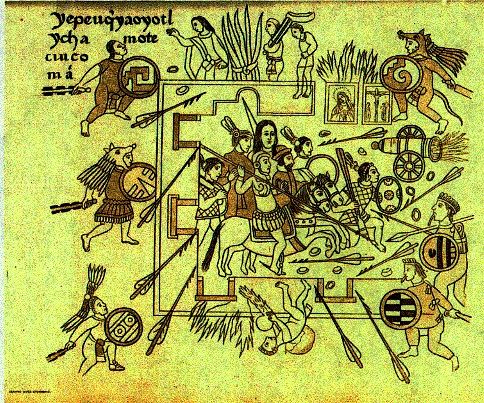
Cortés somehow managed to sneak back into Tenochtitlan and reenter the palace where the Spaniards were holed-up. On June 26 or 27, he ordered Moctezuma to go out on the roof of the palace and try to calm his people. The ruler was killed, according to Spanish accounts, by a stone launched by a slingshot, a common weapon among the indigenous, that struck him in the head. Indigenous accounts charge that the Spanish murdered him.

Night of Sorrows
José Clemente Orozco

In any case, on the night of June 30-July 1, 1520, Cortés and his men attempted to sneak out of the city via the causeway to Tacuba, carrying as much as possible of the gold Moctezuma had given them in an effort to appease them. At the moveable bridge over one of the many canals surrounding and permeating Tenochtitlan, they were overtaken by Mexica soldiers and a battle ensued. Hundreds of Spanish soldiers were killed, together with thousands of their indigenous allies. With the help of Tlaxcalan military leaders, Cortés escaped and made it to the shore in Tacuba. It is said he wept under an ahuehuete tree, a species now called the Montezuma cypress.

It was thought that Alvarado was lost, but he also managed to escape. Hence, the avenue west of San Hipólito is now Alvarado's Bridge. The canal is now Balderas Avenue. San Hipólito stands next to the bridge's location.

Church as Memorial and Monument to Spanish Victory


After Cortés recouped his forces with his indigenous allies in Tlaxcala, over the mountains east of the Valley of Mexico, he returned to the Valley of Mexico in the spring of 1521, prepared to put Tenochtitlan under siege. He launched a complex campaign of seizing the towns that controlled access to the causeways and aqueducts leading to the capital, and of building and launching a fleet of brigadines, small, two-masted ships, to control Lake Texcoco. He then had his troops fight their way up each causeway toward the city. Finally, on August 13, 1521, the last Mexica forces, surrounded in Tlatelolco, surrendered and their empire came under control of the Spanish.

As told above, at the site of the battle of The Night of Sorrows, Cortés ordered the construction of the Chapel of the Martyrs and dedicated it to St. Hippolytus, as the taking of the city occurred on August 13, which is the day this saint is celebrated. In the 18th century, it was enlarged to its present Baroque form. During the Colonial period, up until Independence, it was the focus of a holiday,  known as the Paseo del Pendón, the Parade of the Royal Banner, held every August 13, San Hipólito's day, commemorating Spanish rule of Mexico. Headed by the Viceroy, the bishops and civil and military authorities, the parade went from the National Palace, which had been the site of Moctezuma's Palace, to San Hipólito Church. It followed Tacuba Street, the route of the former road to the causeway and of Cortés's escape.

From San Hipólito to San Judas Tadeo, Saint for Hopeless Causes


When Cortés and his soldiers and indigenous allies were trapped and thousands killed during the Noche Triste, Night of Sorrows, they likely felt their cause, the Conquest of the Mexica, was hopeless. It is said that Cortés cried. However, whatever despair he felt he quickly overcame, for he almost immediately began to systematically plan a siege of Tenochtitlan.

Little more than a year later, that siege brought the fall of Tenochtitlan. Hopelessness then came to the surviving Mexica. It is voiced by a Mexica poet of the time:
On the roads lie broken spears
We have torn our hair in grief.
The houses are roofless,
Their walls are red with blood.
Maggots swarm in the streets and squares.
The walls are stained with brains.
The waters are red as if they were dyed,
And if we drink the waters, they taste of brine.
In our distress, we beat the adobe walls,
And our inheritance is a network of holes.
The shields were our shelter,
But shields do not stop desolation.
We ate salty grass,
Pieces of adobe, lizards, mice
And earth turned to dust, even the worms."
Anonymous Tlatelolco poet, translated from nahuatl into Spanish by Angel Garibay, (quoted by S. Ramirez in his Collected Works). See in English Broken Spears, the Aztec Account of the Conquest of Mexico.
See also Mexico Ambles post: Templo Mayor: The Buried Heart of Mexico
So San Hipólito symbolized both a Spanish loss and their subsequent victory and the end of the indigenous world.

It is, therefore, most interesting that in recent years San Hipólito has been transformed in a de facto manner by worshipers into a temple devoted to San Judas Tadeo, St. Judas or Jude Thaddaeus, one of the Twelve Apostles, who has become, in the 20th century, the saint for hopeless causes. We do not think this transformation of the identity of San Hipólito is coincidental. It is quintessentially Mexican.

San Hipólito has had a shrine to San Judas Tadeo—thought to be the only one in Mexico City—for at least three hundred years. Perhaps it was there because of the dire events leading to the construction of the church. In any case, in the latter half of the 20th century, worship at the shrine so increased that, in 1982, the statue of the saint was moved to the main altar. On October 28, St. Jude's Day, crowds of up to 100,000 people attend an hourly series of fifteen masses. Also, on the 28th of every month, masses attended by large crowds are held for the saint.

For a number of years, we have wanted to witness this obviously significant event in Mexico City's popular culture, but have been put off by the reported size of the crowds and the reputation that many participants are from the margins of Mexico City society, especially poor youth, often involved in the world of drugs and petty crime. But this year we decided to challenge our anxieties and go to San Hipólito on October 28. As frequently happens in our Ambles into lugares populares (places of the people, i.e., working class and poorer neighborhoods) of the City, we were happily surprised to find the event's negative reputation was not what we experienced.

While there were a number of young men and women in the crowd, they gave no sign of being "fringe", and the majority of participants were working class and middle-class Mexican families: grandparents, parents and children, even babies.

Crowd outside San Hipólito,
waiting their turn to get into one of the masses honoring San Judas Tadeo, St. Jude, on October 28

One devotee of San Judas

Many people were carrying statues of the saint in various sizes,
from small...

... to life-sized,
carried 
on his head by a young man.

One of the sequence of hourly masses held in San Hipóloto on October 28 
to honor San Judas Tadeo.
There are no pews, which makes more room for standing worshipers.

San Judas stands below the Virgin Mary, in the center of the retablo (reredos).

Worshipers,
a very respectful, friendly crowd.


Turning the Tables on Los de Arriba, Those Above


It seems to us that the informal but definitive transformation of San Hipólito into the Templo de San Judas Tadeo is a manifestation of the power of los de abajo, those from below, that is, everyday Mexicans, also self-identified as "el pueblo", "the people", to overturn the official reality of los de arriba, those above.  Los de abajo, el pueblo, the working class and poor, are the heirs of the Spanish racial prejudice against, and exclusion of, los indios, an economic, social, and cultural split that has pervaded Mexican society since the Spanish Conquest up to the present day.

The Spiritual Conquest, whose still-present manifestations we have been exploring, was aimed at converting los indios into ladinos, adopters of Spanish Catholicism and culture. The transformation of the Church of San Hipólito into the Church of San Judas Tadeo once again tells us that the strategy only partly succeeded. Los indios adopted the religion. Most adopted the language and other customs of Spanish European "Western" culture. They even interbred with the Spanish, producing what is now the majority population of mestizos (mixed blood). But insofar as they bear the consequences of Spanish discrimination, the present-day descendants of los indios continue to demand not just recognition by los de arriba but a respected place within Mexican society.

Their popular toma, takeover, of San Hipólito is also another expression of how everyday Mexicans, el pueblo, have transformed Spanish Catholicism into the distinct faith of the Mexican people. San Judas Tadeo may be understood as something of a male version of the Virgin of Guadalupe, the making of a Spanish Catholic saint into a Mexican one. El pueblo, the people, have made what was originally a monument to "justly fallen" Spanish soldiers into their own temple of hope. Their successful takeover is their victory in what is the last battle of Cuepopan.

San Judas as a Mexica/Azteca warrior
(carrying a smaller version of the Spanish original)

See: Santa María Cuepopan; Part I - Battleground and Sacred Ground