Showing posts with label 20th century Mexico City. Show all posts

Friday, December 8, 2017

New Villages - Old Traditions | Coyoacán: Colonia Ajusco, the Lord of Miracles and Religión Popular

One Sunday last August, we visited the Colonia Pedregal de Santo Domingo in our home Delegación Coyoacán. The occasion was its reception of el Señor de la Misericordia, the Lord of Compassion, from its neighboring Colonia Ajusco, for a week's visit during His annual summer tour of the borough's traditional pueblos and barrios. A year ago, we had followed el Señor almost every Sunday to witness most of his entregas (handings over, deliveries) from one pueblo to the next, but we had missed both Santo Domingo and Ajusco.

The size and complexity of the procession leaving Santo Domingo this August to meet the procession from Ajusco was impressive, as was the one from Ajusco bearing El Señor that arrived at the meeting point, a major avenue bordering the two colonias. This told us that both communities maintain vital traditional Catholic practices like those of the original indigenous pueblos just to their north—most notably Tres Reyes, home of the Lord of Compassion, which has been continuously occupied for 4,000 years.

The Pedregal: On Stony Ground


However, we doubted that either Colonia Pedregal de Santo Domingo or Colonia Ajusco were original indigenous pueblos. The word pedregal, stony ground, in Santo Domingo's name not only triggered the doubt but provided the key to their history. In Mexico, pedregal refers specifically to terrain covered with a thick cap of lava rock from volcanic eruptions. Like Santo Domingo, the names of many colonias (neighborhoods) in southwestern Coyoacán and its neighbor to the west, Delegación Álvaro Obregón, bear the prefix Pedregal de, Pedregal of ... followed by a saint's name.

This is because in the first century CE, the cinder cone volcano named Xitle, on the slopes of the older and much larger series of volcanos now named Ajusco, erupted with a series of lava flows that buried both the urban center, Cuicuilco, and a large area near the southwest shore of Lake Texcoco. We have written about this in our post: Cuicuilco, Volcanoes and the Fragility of Life in Mesoamerica. Colonias in that area, such as Pedregal de Santo Domingo and Ajusco, rest atop this volcanic rock.

Circular 'pyramid' at Cuicuilco.
Note depth of surrounding excavation trench below current ground level;
it is all pedregal, lava, that flowed onto the site when Xitle erupted.
Colonia Ajusco is two miles northeast of the Cuicuilco 'pyramid'.

The historical significance of this fact is that the area was barren, untillable—a natural wasteland for nearly two millenia. Meanwhile, indigenous settlements developed along what the Spanish were to name the Magdalena River to the west and the Mixcoac and Churubusco rivers to the north. Other settlements, like Tres Reyes, developed along the southwest shore of Lake Texcoco. When the Azteca/Mexica arrived in the Valley of Anáhuac in 1225, these early settlements were flourishing—as they also were three hundred years later when Cortés and his Spanish troops showed up (1519).

In no way, then, are Colonia Pedregal de Santo Domingo—or Colonia Ajusco and similar neighboring colonias—original pueblos. The question, then, becomes when and how did these pueblos come to be? The answer lies in the explosive growth of Mexico City in the last half of the 20th century.

As we have written in our background page, How Mexico City Grew From an Island to a Metropolis, rapid population growth took place across Mexico from the 1950s through the 1980s—the result of continuing high birth rates and, with better health care, decreasing rates of infant deaths. Unable to maintain themselves in their rural pueblos, many rural dwellers arrived in Mexico City seeking work to sustain themselves and their families. Utterly without resources, they established squatter settlements on any available open land, including Coyoacán's pedregal region. Gradually, over the years, with Mexican ingenuity, they developed these settlements into working-class neighborhoods that became part of the urban landscape, virtually indistinguishable from the older pueblos around them. This is how both colonias Pedregal de Santo Domingo and Ajusco came to be.

Contemporary Traditional 


Having made it to Santo Domingo this past summer, we were delighted to see an announcement of a patron saint fiesta early in November in Ajusco, which gave us the opportunity to visit and learn more about this colonia. The church's patron is Christ in His manifestation as el Señor de los Milagros, Lord of the Miracles. The colonia takes its name, Ajusco, from the mountain—at 13,000 feet, it is the tallest inside the city´limits. Rising some 6,000 above the Valley floor, on the southern boundary of Delegación Tlalpan, it is on clear days impressively visible from Coyoacán, but it is a good ten miles away from Colonia Ajusco.

Mt. Ajusco
looking south from Coyoacán, across Delegacion Tlalpan.
At 3,930 meters or 12,894 feet in altitude,
Ajusco is the highest mountain in Mexico City,
rising almost 6,000 feet above the Valley of Mexico.

So, on the sunny, mild, mid-November Sunday morning, at about 10 o'clock, we head by taxi to Ajusco. It is less than fifteen minutes from our apartment, south down Division del Norte to Avenida Azteca, a wide boulevard that runs southwest across lower Coyoacán towards ancient Cuicuilco. Arriving at Calle Rey Moctezuma, King Moctezuma Street, where the announcement says the procession will begin, we find the street closed, as usual, for a fiesta.

We pay, thank our driver, get out and walk down the block. A few people are standing around, but there is no sign of a procession. We ask a lady about this, and she tells us to go around the corner into another street where she says the Aztec dancers are preparing.

A young dancer prepares his headdress,
meticulously inserting feathers into the base. 

A number of women and men, including youths and some children, are being served breakfast under a tarp at one side of the street. This is the community's thank-you to them for participating. Others are moving about with parts of their dance attire in hand, but with no evident prisa (hurry). It does not appear that the procession will be starting anytime soon.

We notice some dancers entering and leaving the hallway of a building, so we enter to take a look. It is not a house, because there are a row of rooms along a long hallway. In one room, dancers are getting dressed. In another room, we spot ofrendas (offerings).

One ofrenda is el Señor de los Milagros, Lord of the Miracles.

Jesus the Christ as Señor de los Milagros

Another ofrenda takes us aback. It is most definitely not Catholic.

Coatlicue
(Coh-aht-LEE-cooee,
i.e., she who wears the skirt of snakes)
the Mother Goddess
of the Azteca/Mexica and Nahuatl-speaking peoples
(Image on the ofrenda is a photograph of the statue that resides
in the National Museum of Anthropology and History)


In front of both gods sits an
ofrenda of flowers in the shape of a cross.
The cross is at once the Christian symbol of Jesus Christ's self-sacrifice,

reconciling sinful humans to God,
and the indigenous symbol of the four cardinal directions
that organize and orient us within our world. 

The four candles also mark the cardinal directions.

The circle in the center represents our bounded human world.
The central candle is the axis mundial, world axis,
the vertical connection with the gods in the heavens.
As such, this symbolic construction is likely one of the oldest and most archetypical
symbols in human culture, going back to pre-historic, hunter-gatherer times.

We immediately recognize that here in Ajusco—built in the last fifty years—we are once again in that intermediate world created by the Spiritual Conquest of the Catholic friars in dialogue with the antecedent indigenous culture. Catholicism did not replace that world. Implicitly, if not explicitly, each adopted a form of cohabitation with the other. But, we wonder, how did that centuries-old combination come to be celebrated here in the new 'pueblos' (villages) of Ajusco and its neighbor, Santo Domingo. We know we will need to do more research when we return home. For now, we will just watch and enjoy the fiesta.

The Fiesta: A Gathering of Saints and Their Pueblos


Leaving the building, we wander around watching the dancers' preparations when we hear the sound of a brass banda back on Calle Rey Moctezuma. Looking toward the intersection, we see it pass, along with people carrying an anda, a platform, bearing the statue of a saint, surrounded with flowers. We hurry to catch up with it.

San Sebastián Martir de Xoco
brought from the original indigenous pueblo of the same name,
which we have visited just north of Coyoacán,

in Delegación Benito Juárez

Turning into Rey de Moctezuma, we see that there has been a lot of activity while we were with the dancers. Each side of the street is now lined with andas, platforms, bearing a great number of saints. This is going to be quite a procession! 

Señor de los Milagros
of Colonia Ajusco.
The rear wings are those of a mariposa, a butterfly,
an indigenous symbol of resurrection and rebirth.

There is a very large anda bearing el Señor de los Milagros, the Lord of Miracles, elaborately decorated with fresh flowers, from the church of that name in Ajusco, the host of the fiesta. However, there are also a number of other flower-bedecked Señores de los Milagros! We wonder where they come from. We notice that one bears the name of a private family as its sponsor. 

Three other Señores de los Milagros
At least one is brought by a private family.

Some of the saints awaiting the procession. 

We recognize several from other pueblos' fiestas.
They, and their people, have come to honor el Señor de los Milagros,
and His people in Ajusco.
There is clearly no distinction being made between los pueblos originarios of Coyoacán
and the new colonias of the Pedregal.

 From upper left:
Virgen de Guadalupe, Virgen de Candelaria (from Pueblo Candelaria), San Miguel Archangel, 
San Domingo and San Francis (from Colonia Santo Domingo);
Señor de la Misericordia (from Tres Reyes), Santa Ursula (from Santa Ursula Coapa),  
San Mateo (from San Mateo Churubusco) and San Lorenzo (from San Lorenzo Huipulco)

Comparsa de Concheros


comparsa, fiesta dance troupe, of concheros, lute players, arrives.

Corporación de Concheros de México,
United Society

We have met la Corporación before,
in Santa Cruz Alcapixca, Xochimilco,
Fiesta of the Holy Cross, in early May.

Their tradition of dress

and synthesis of indigenous and Christian traditions
is distinct from and, they claim, older than that of the Aztec dancers
getting dressed around the corner.


The Procession


A priest appears
to bless the procession
and its participants.

 El Señor de los Milagros leads the procession.

The cofradia, brotherhood, of the Church of the Lord of Miracles
 bears the anda and its weight.

Other saints are born behind el Señor.
Here: another Lord of Miracles,
the Virgin of Guadalupe,
St. Michael the Archangel, and
the Lord of Chalma
(a revered version of Christ from the State of Mexico).

San Domingo and San Francisco, another Lord of Miracles
Two Niños Jesus, Child Jesus.
The left one, its bearers tell me, is from a pueblo in the State of Puebla, miles to the east.
The second is from Coyoacán´s Barrio Niño Jesus.

Of course, everyone moves to the sound and rhythm of la banda.

After traveling through the narrow streets of Ajusco,
the procession enters the wide Avenida Azteca.


This in one of the largest processions we have seen in our two years of visits
to traditional neighborhoods in Mexico City.

Another comparsa of conchero dancers,
many dressed in Azteca style of loin cloths and bare chests
follows.


Church of the Lord of Miracles Receives All the Saints


Reaching the intersection of Avenida Azteca with Calle Rey Moctezuma, the procession turns north, away from where it began south of the Avenue. A short way up the block, we turn left into another side street. There stands the Church of the Lord of Miracles.

Church of the Lord of Miracles
The portada says, "You have shown us the grandeur of your miracles, Lord."
The atrio (atrium) is filled with the visiting saints
and their bearers.

One by one, the saints are carried into the church,
accompanied by the Aztec dancers.

Some of the saintsfrom life-sized to tiny.
We estimate that 
there were twenty or more.
.

Four Lords of the Miracles
along with other versions of the suffering Christ,
line one wall of the sanctuary.

Two Niños Jesús, St. Francis and the Virgin of Candelaria
stand at the front. 

The Church's Lord of  Miracles
is carried up to his place of honor above the altar.

The Lord of Miracles,
returns to His Sanctuary.

Outside, in the atrio,
la banda rests
after their major contribution to the procession.

Resting dancers

As always,
some of el pueblo, the people

The Place of the Church of the Lord of Miracles in the Development and Life of Colonia Ajusco


Seeking to understand more of the history of Colonia Ajusco as a new neighborhood with old customs, we did our usual online research. Not expecting to find much about a relatively new, working-class area of Mexico City, we were surprised to find a good article on the colonia in Wikipedia en español. It, in turn, referenced an academic paper specifically on the religious institutions and life of Ajusco, including that of the Church of the Lord of Miracles: El Pluralismo Religioso en la Colonia Ajusco (México, D.F.) ("Religious Pluralism in Colonia Ajusco, Coyoacán, Federal District").

Its author is Dr. Hugo José Suárez, a professor of sociology at UNAM, the National Autonomous University of Mexico, whose University City campus, not coincidentally, is located on the Pedregal of Coyoacán, immediately west of Santo Domingo and Ajusco. The paper has also been published as a freely downloadable book, full of illustrative photos, Ver y Creer: Ensayo de sociología visual en la Colonia Ajusco (Seeing and Believing: Essay of Visual Sociology in Colonia Ajusco). Dr. Suárez uses his photos to illustrate his observations about Ajusco. Depicting the everyday life of the community, they are worth looking at.

Rural Mexicans Moving to the City Bring Their Faith With Them


Dr. Suárez documents the origins of Ajusco (and its neighbor, Pedregal de Santo Domingo), beginning with the occupation of some of the barren pedregal by people from neighboring Pueblo Candelaria in the 1950s. Then a second wave took place in the 1960s as a result of the country's population explosion (see our page: How Mexico City Grew From an Island to a Metropolis), when people moved in from rural Mexico.

 Rectory of the Resurrection is another major Catholic church in Colonia Ajusco. It was organized by Jesuits beginning in the early 1970s. As a Jesuit congregation, it has a strong social activist focus and has been a leader in addressing multiple major community needs. Another large congregation in Ajusco, the Rectory of Our Lady of Guadalupe, is operated by priests of the Congregación of Oración of San Felipe Neri (Congregation of Prayer of St. Philip of Neri), who arrived in the neighborhood in the 1960s. Its focus is more on the personal religious life of its members, with prayer and study groups in members' homes.

Notably, since both congregations were founded (and are hence governed) by religious orders, they are termed 'rectories', in contrast to parochial churches. Parish churches are governed by the Metropolitan Diocese of Mexico City, which supplies their congregations with 'secular', or diocesan, priests. As such, the two religious orders present in Ajusco are maintaining the tradition of such orders founding churches in the original indigenous pueblos five hundred years ago.

It is also noteworthy that the Church of the Lord of Miracles was neither founded by the diocese as a parish church, but nor was it initiated by a religious order. Instead, it is a chapel founded by lay residents of Ajusco in 1958, making it the oldest Catholic church in the colonia. With the arrival of the Jesuits in the 1970s, the congregation sought affiliation with the Rectory of the Resurrection. But as Dr. Suárez relates, theological differences led the congregation instead to seek affiliation with the Parochial Church of the Three Holy Kings, Tres Reyes. Hence, the church is officially a chapel of Tres Reyes and is served by a priest of that parochial church. Calle Moctezuma, a mere half-block north of the chapel, is the boundary between Ajusco and Tres Reyes. 

This relationship explains why even though Ajusco is not an original indigenous pueblo, Tres Reyes' Señor de la Misericordia, Lord of Compassion, visits the Lord of Miracles as part of His summer tour of pueblos. For us, it also explains why the procession for the Lord of Miracles—with its large number of visiting saints on their flower-bedecked andas—is so elaborately similar to that of the Lord of Compassion. It almost equals the procession for the return of the Lord of Compassion at summer's end to Tres Reyes. This is the fiesta where, as a resident told us, "echamos las casa por la ventana" ("we throw the house out the window")—i.e., there are no limits to what is expended in producing the fiesta. That is to say, it bears the full devotion and pride of el pueblo, the people of the village.

Religión Popular


So it is that la Fiesta del Señor de los Milagros—sponsored and executed by a community that came into being only in the late 1950s—nonetheless carries equal importance and pride, hence style and size, in colonia Ajusco as do the three Fiestas del Señor de la Misericordia (His saints' day in April, His departure for other pueblos in late May and His return the first Sunday in September) in Tres Reyes, Ajusco's adoptive parish. It is an expression of what Dr. Suárez calls religión popular, religion of the people. It is not organized and managed by priests. It is organized and maintained over the years by a mayordomía, a committee of lay persons who, in reality, run the church and determine its role in the community. Our hunch is that this religión popular identity of the members who created the Chapel of the Lord of Miracles is what led to their not allying with the Jesuit-led, social gospel oriented Rectory of the Resurrection and their alliance with Tres Reyes.

Their role, for the Chapel of the Lord of Miracles, as for the Parochial Church of the Three Holy Kings, is, first and foremost, to maintain the traditional practices. First and foremost, this means the fiesta for the patron saint, but also other fiestas first established by the Franciscans and other religious orders as a means of evangelization and conversion of the indigenous inhabitants of what is now Mexico—whether it was in the pueblos around Lake Texcoco, or by an unusual bishop in the pueblos around Lake Pátzcuaro. The outcomes of the Spiritual Conquest live on in Ajusco, as they do  throughout Mexico.


Delegación Coyoacán (purple)
sits in the middle of Mexico City.

Pueblos and Colonias of Delegación Coyoacán

Colonia Ajusco is light red area just southwest of center (blue Star)
Colonia Pedregal de Santo Domingo is yellow area just west of Ajusco.
Pueblo Tres Santos Reyes is the large green area immediately north of Ajusco.
Pueblo Candelaria is yellow area north of Ajusco and east of Tres Reyes.

The National Autonomous University of Mexico
University City campus
is just west of Santo Domingo.

Tuesday, May 2, 2017

A "General Store" Display of 20th Century Mexico: Carlos Monsiváis's "Corner Store" Musuem

Time for a Change


Exploring history via cityscape, and vice versa


For the past two years Mexico City Ambles has been exploring the City. As our ambles evolved, it became apparent that in exploring this urban space, we were also exploring time, the city's history. The Spanish Colonial Ciudad de México was built atop the Mexica (aka Aztec) city of Tenochtitlan and the landscape around it was dramatically changed by draining Lake Texcoco, so the City was no longer an island.

When Nueva España gained its independence from Spain in 1821, another process of modification of the City began, which was accelerated during the Porfiriato, the thirty-five year rule of President Porfirio Díaz (1876-1911). The Mexican Revolution (1910-17) and the political changes that it triggered brought other changes to the cityscape. So our ambles have been a dialogue between space and time, architecture and history.

However, our ambles forward in time inevitably led to a kind of historical deadend in post World War II Mexico City. Although there are many architecturally remarkable late 20th century and early 21st century buildings in the City, they are glass and steel skyscrapers which, along with multi-lane highways full of cars, are manifestations of the globalization of Mexico City that began in the 1950s and was greatly accelerated in the 1990s with the establishment of the North American Free Trade Agreement.

Paseo de la Reforma
seen from Chapultepec Castle.

A view from the 19th century to the 21st.
Six White Columns are
Monument to the Boy Heroes
who resisted the U.S. Invasion of Mexico (1846-48)
Photo by Carlos Cortés
Wikipedia

With the economic opening of Mexico to the world, and in particular, the United States, multinational companies moved into the City, many erecting skyscrapers along Paseo de la Refoma and then, other main arteries, that are little different from their clones in any other major city of the world. We saw no apparent way to approach the late 20th century from our perpective of seeking out how the unique history of Mexico is embodied in its buildings, cityscape and public art. Perhaps, like the author of a late 20th century book, we had arrived, at the end of history. But we did not want it to be the end of our Ambles.

Returning to the starting point


So we returned to our and Mexico's geographic and historic beginning point, el Centro Historico, to explore a related question that also meant turning back in time to the moment when indigenous Tenochtitlan became Spanish Mexico City. We wondered: how did the Mexica city of Tenochititlan get transformed into the Spanish Colonial Ciudad de México? It was not a simple matter of tearing down the first and building the second on top.

We discovered that the answer lay in searching out the remaining landmarks, usually 16th century churches built by Franciscans and other religious orders of monks, that continue to stand in the original indigenous quarters of the city and the many villages around what had been Lake Texcoco that predated the Spanish invasion. This has been our focus and passion for the past year. 

However, that search also brought a complication. While we are continuing this exploration of the landmarks of the so-called Spiritual Conquest, the process is constrained by the fact that the best time to visit these now-hidden villages is when el pueblo, the village people, hold their annual patron saint fiesta or some other fiesta determined by the Catholic religious calendar, such as Easter. This takes the scheduling of our ambles out of our control and puts it under the control of the religious calendar.

That requires frequent checking of the calendar we are building of the sacred year, cross referenced to all the delegaciones (boroughs) and their colonias, neighborhoods, and the patience to await the next opportunity offered. This also means accepting that when we arrive in a barrio on the fiesta day listed on some website, there may be no such fiesta. The always amable, considerate, residents tell us, "Oh, we haven't had that for, maybe, five years. But we do have a fiesta on such and such date" (three months from now) or, "We already had our fiesta this year. It was last month."

Seeking Another path


So we have been pondering in what other ways we might focus our ambles in order to add to our chronicles of the City while we await the next fiesta. It occurred to us that one vehicle might be the museums. Mexico City touts itself to tourists (and chilangos, city residents) as having one of the greatest number of musuems of any city in the world, over 150.

These include not only the world-famous Museum of Anthropology and History, San Ildefonso, which houses Orozco's powerful murals, and the "Blue House" of Frida Kahlo, but also such museums as that of the Old School of Medicine, and museums of chocolate, beer, the economy, light, cars, trains and miscellaneous "objects", among many others. Hence, the wheat, so to speak, needs to be separated from the chaff. Also, the mission of Mexico City Ambles is to be a window into lesser known, even unknown areas and dimensions of the City, not a clone of the normal tourist guidebook pointing the reader to the obvious destinations. 

But, we thought, it was worth a shot to reconsider the list of musuems. After all, our historical perspective has led us to explore, among others, the Palacio de Bellas Artes, San Ildefonso and the Museum of National History (Chapultepec Castle).

Museum of the Corner Store


Consulting a "complete list of museums" provided by an online magazine, MXCity, we came across el Museo del Estanquillo. We were familiar with the building, an ornate French Second Empire building that sits in Centro Histórico, at the corner of Madero (honoring Francisco Madero, president during the Mexican Revolution) and Isabel la Católica Streets (honoring Queen Isabela, the first Catholic queen of a united Spain), a couple blocks west of the Zócalo.

Museo del Estanquillo

We included a photo of the wonderful oval windows protruding from its quintessentially French mansard roof in our post about 19th century Porfirian architecture in Centro. The building spoke dramatically of the Francophile passions of Porfirio Díaz and his bourgeois supporters.


We had also been intriqued that the Museum housed the permanent collection of Carlos Monsiváis, a Mexican writer, critic, political activist and journalist who died in 2010 and, at the time, received eulogies from virtually every leading Mexican author and political critic. He was clearly respected and beloved by his intellectual and political compatriots. We were curious as to what kind of collection he had and also what the meaning of estanquillo was. But being focused at the time on the late 19th century, the era of the building, we did not pursue finding out what was inside or the meaning of the name.

So, on a recent sunny weekday, we take our Line 2 of the Metro to the Zócalo and, coming up to the street, head west on Madero to Isabel la Católica (a symbolic crossroads of the 15th and the 20th centuries). Before we left home, we had looked up estanquillo. It has several uses, but in reference to the building, it means, "corner store". Examining the building more closely this second time, we notice that a bookstore occupies the ground floor, with its wide entrance diagonally facing the corner. We stick our head in the door to take a look at this "corner store". We ask the staff person at the door if we can take photos. Happily, he says, "Yes." 

Ceiling beams are ornate, Neogothic and Beaux Arts combo.
We are confident Porfirio Díaz loved them.

We then ask him if he knows the history of the building. He calls another man over who says it was originally "La esmeralda", a jewelry store, built near the end of the 19th century. We know from our investigation of 19th century Centro, that a number of ornately decorated French-inspired and French-stocked stores opened in the area near the end of that century. 

Thanking our hosts, we return to the street and find the museum entrance, a single glass door at the end of the building on the Isabel la Católica side. A narrow, utilitarian hallway leads to a stairway and an elevator. On one wall is a large photo of Carlos Monsiváis.

Carlos Monsiváis
We notice he seems to be looking at some kind of model scene with miniature figures.
We wonder what that is about.

A poster by the elevator informs us that there are currently three exhibts, one on each of the three floors above us. We take the easy way up. Figuring we will start at the top and work our way down, we go to the fourth floor. Getting off, we see that the exhibit is of Nota Roja, literally Red Reports, police stories and graphic photos in the newspapers of the early to mid-20th century about such violent events as murders and fatal car accidents. Evidently, as a journalist and chronicler of the city, Monsiváis was interested in the underside of city life. Good for him, but this is not our thing, so we go down in the elevator and happen to end up on the "first", i.e. second floor (in Mexico, the ground floor is the planta baja; the "primer piso", first floor, is one flight up). 

Los rituales del Carlos. Homenaje a Monsiváis y sus manías - Carlos' Rituals, Homage to Monsiváis and His Manias


The words "rituals" and "manias" in the sign identifying the exhibit give us pause. Given Monsiváis' interest in Nota Roja, manifested on the top floor, we wonder what other idiosyncratic inquietudes, interests, he had.

Mexican Types and Archetypes: 19th Century


We don't have long to worry. We are greeted by drawings and illustrations in various forms that are a kind of overview of the history of independent Mexico. A sign on the wall quotes Monsiváis about the struggle for and defense of its national soverignty having been a key theme in the history of Mexico. This section of the exhibit is subtitled "Mexican Types and Archetypes".

Father Miguel Hidalgo,
"Father" of Mexican Independence
from Spain (1810)
José María Morelos,
who led the fight for Independence
after Hidalgo and Allende were
captured and executed (1811).

A maquette of Father Hidalgo ringing the bell of the church in Dolores, Guanajato,
calling the pueblo to begin the rebellion against the Spanish viceroy.
This action is repeated every September 15 by the nation's president,
governors and mayors
in their respective jurisdictions. 

The prints of Father Hidalgo and Morelos, who are certainly Mexican archetypes—the "insurgents" who gained Mexican Independence from Spain—are somewhat different from others we have seen. Hidalgo is usually portrayed in a priest's frock with bald head and gray hair at his temples. Otherwise, they are traditional images.

However, the maquette portraying the "Grito", Shout for Independence, is something different. As a miniature, it has an almost playful quality, like a child's set of play figures. We are also reminded of the miniature scenes of everyday life made of clay and found in the shaft tombs of western Mexico. Thousand of years old, they convey the same sense of honoring daily life in a playful manner.

Triumph of the Republic
President Benito Juárez (top, right), another Mexican archetype,
and other Heroes of the Reform,
a period of liberal government, 1857-75.

President Porfirio Díaz (1876-1911), sits on the Presidential Silla, Chair, 
like a king on a throne,
within a classic Greco-Roman temple,
surrounded by numerous goddesses.

An archetypical image if ever we saw one.

So we are presented with four glorified (at least by their supporters) archetypical leaders of Mexico, three liberals and one liberal turned reactionary conservative. 

Mexican Types and Archetypes: 20th Century


"Grand Fandango and Revelry of the Living and the Walking Dead
in the Cemetery of Sorrow,
with Music and Drink"
By José Guadalupe Posada

Suddenly, instead of the exalted (and fallen) heroes of the 19th century, we are confronted with an image of skeletons having a party. It is the work of José Guadalupe Posada, an engraver and printmaker whose adult life (born 1852, died 1913) spanned the years from the Porfiriato dictatorship to the opening years of the Revolution. In his political cartoons, he was a fierce critic of the hypocricies and damage to el pueblo, the common folk, that characterized the Porfiriato. 

Diego Rivera and José Clemete Orozco, while they were students at the Academy of San Carlos art school at the turn of the century, were enamored by his implicitly revolutionary work, which they saw daily as they passed Posada's shop on Moneda Street, just a block from the Academy and behind the National Palace, where Díaz held court.

Mexican Revolution (1910-1917)


Francisco Madero,
President 1911-13

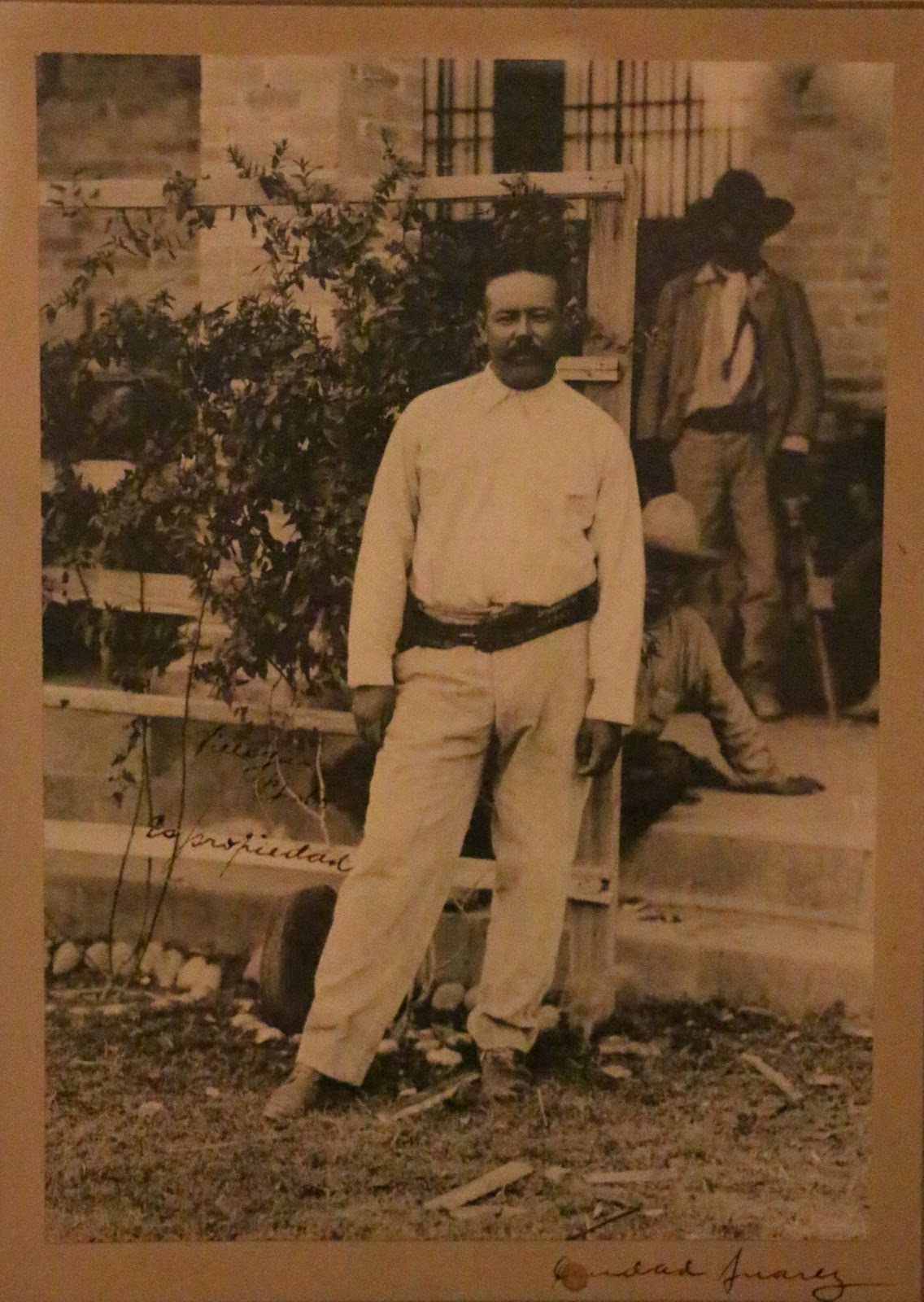
Francisco "Pancho" Villa
Emiliano Zapata

Venustiano Carranza,
in light gray uniform and hat to left of center.

Zapata and the Revolutionaries
By Leopoldo Mendez

So we are plunged (at least imaginatively) into the Mexican Revolution (1910-17), with its archetypical heroes: 
  • Francisco Madero, a well-to-do intellectual liberal who started the Revolution, became its first president and was overthrown in a coup de etat and assassinated by General Victorino Huerta; 
  • "Pancho" Villa, a mestizo, of mixed Indian and Spanish blood, from the north; an outcast who became a bandit and then a brilliant general of a peoples' army;
  • Emilano Zapata, also mestizo, from the southern state of Morelos, and leader of a campesino (traditional, indigenous and mestizo farmers) uprising to retake land expropriated by wealthy criollos, pure-blooded Spanish; 
  • Venustiano Carranza, well-to-do northern rancher who sought political power under Díaz, was rejected by Díaz, so when Madero was killed, he organized troops to overthow Huerta in 1914 and then, when Villa and Zapata would not agree to his being president, took them on, defeated them and then became president (1917-20).

The U.S. Meddles in Mexico


Next, Monsiváis confronts us with some broadsides protesting U.S. interventions during the Mexican Revolution. They recite the text of corridos, politically oriented ballads.

In 1914, President Woodrow Wilson ordered the Navy
to blockade the port of Veracruz
to prevent the possible delivery by Germany
of war supplies to Victoriano Huerta,
who had, with U.S. support,
overthrown President Francisco Madero in Feb. 1913.
Wikipedia


Here, the Uncle Sam moon gobbles up the Mexican sun.
This is based on an archetypical indigenous Mexican image 
of the eclipse of the sun by the moon, seen as their marriage
which, in one myth, gives birth to Mother Nature.
                     
The Pursuit of Pancho Villa

On 9 March 1916, Villa attacked
Columbus, New Mexico
, apparently seeking supplies.

In response, President Woodrow Wilson sent 5,000 Army troops,
under the command of John Pershing, to pursue Villa in Mexico.
Employing aircraft and trucks for the first time in U.S. Army history,
Pershing's forces chased Villa until February 1917.
Villa, being a guerrilla, always escaped. Wikipedia

Ballad of the "Good Neighbor"

President Franklin D. Roosevelt,
with Eleanor Roosevelt,
tries to change the U.S. relationship with Mexico
and Latin America
by announcing a "Good Neighbor" policy
of no further U.S. intervention. Wikipedia

The broadside portrays Mexican dubiousness.

A cartoon, in 1930's Art Deco style,
portrays a dapper Uncle Sam
trying to woo Mexico,
presented as an attractive maiden.
By Ernesto García Cabral

In 1938, President Lázaro Cárdenas
(1934-40)
expropriated control of Mexican oil fields
from U.S. and British companies.
The U.S. government protested
but ended up acceding because of
the beginning of WW II.

Most Mexicans view Cárdenas as an
archetypical hero because of this
achievement vis-a-vis the U.S.

By Alredo Zalce (1908-2003),
leading Mexican artist.

President Vicente Fox (2000-2006)

Fox, a former Coca-Cola executive,
was the first president from a party
other than the Party of the Institutional
Revolution (PRI), which had ruled Mexico
since 1930.

The PRI administration of
Carlos Salinas (1988-94)
achieved the signing of the
North American Free Trade Agreement,
essentially tying the Mexican economy
to that of the U.S.

By José Hernández

Some Mexican types


Monsiváis (or his curator) then takes us on another twist in the theme of Archetypes and Types, returning to cartoons, but with a far different style and message than those of José Posada. 

Mexican Family
By Andrés Audiffred

1920s-30s upper middle class, urban family
with child dressed as archetypical
19th century charro, cowboy.

On national political holidays,
dressing children this way
is still the custom. 

"The Last Breakfast"
a spoof of Da Vinci's "The Last Supper"
attended by a wide range of Mexican "types"
By Eduardo del Río, aka "Rius"
Mexican cartoonist who died on Aug. 8, 2017, age 83.

La Familia Barrón
The Barron Family, 
created in 1937 by Gabriel Vargas (1915-2010)

Windshield washers and newspaper vendors are still features of intersections.

"Disco bar"
Minature created from newpaper cartoon series, "La Familia Burrón"
The Burron Family, 
by Gabriel Vargas

Then yet another sharp turn:

Portrait of a Mexican
By Roberto Montenegro (1885-1968)
1930

We are stunned by its powerful realism.
(We will have to investigate the work of Roberto Montenegro)

The City as Personal


The next part of the "Rituals and Manias" of Monsiváis, takes yet another sharp turn, to the cotidianiedad, the everday life, of city residents, and its continuities reaching from earlier centuries right up to the mid-20th century.

Miniature of a botica shop,
selling herbal and other types of medicines,
precursor of a pharmacy.

Butcher shop

Fruits and vegetables shop

Clockwise from upper left:
19th c. water carrier, 20th c. softdrink deliveryman,
Palm Sunday: indigenous woman
weaving palm fronds for sale (just as they do today),
Public scribe (they still work in Plaza Santo Domingo),
Tianguis (open-air market; today's stalls have plastic shading),
Sereno, (night watchman; one patrols our neighborhood on a bicycle).

The exhibit ends with a Gallery of Portraits of famous Mexicans of the 20th century


Mexican personajes, public personalities, of the 20th century

Clockwise from upper left:
José Vasconcelos, first secretary of public education after the Revolution,
initiated program of creating public murals.
Drawing of Vasconcelos (why snakes protrude from underneath him is a mystery)
Diego Rivera drawing Elena Poniatowska, leading Mexican author,
David Siqueiros,
José Clemente Orozco,
Graciano Sánchez, post-revolutionary agrarian leader,
Juan Rulfo, novelist and short story writer.

Twists and Turns of an Idiosyncratic View of Mexico, and of Mexican History


So Carlos Monsiváis (or the curator of this exhibition of parts of the author's collection) has taken us on a tour that is the intersection of his idiosyncratic view of Mexico -combining serious portraits with cartoons and toy-like maquettes- and the twists and turns of modern Mexican history, from the War for Independence through the Revolution to its ambivalent relationship with its northern neighbor, Uncle Sam, and from leading personajes, public figures, to the everyday life of city residents shopping in neighborhood tiendas, shops. 

After an initial sense of disorientation, we find that we are both charmed by its quirky alternation between serious and playful perspectives and enlightened by a very Mexican portrayal of Mexico and the many facets and faces that make it uniquely Mexico. El Museo de la Estanquillo is definitely a corner store or, better, a general store of Mexican life. And quite worth a visit.