Showing posts with label José Clemente Orozco. Show all posts

Monday, December 14, 2015

Mexican Revolution and Mexican Muralists - Part VIII: José Clemente Orozco at the College of San Ildefonso - Continued

Continuing our encounter with the murals painted by José Clemente Orozco for the National Preparatory (High) School in the Antiguo Colegio de San Ildefonso, we climb to el primer piso, the first upper floor. After our confrontation in the stairway with the primal conflict of the Spanish Conquista of the indigenous, we are abruptly brought back across four hundred years to the pre-Revolutionary days of the early 20th century.

Those Above Versus Those Below

Here the theme of conquerors versus conquered is transformed into a more modern version, that of los de arriba vs. los de abajo, those above vs. those below.


Los aristócratas

The Aristocrats is in the same style of caricature as Orozco's Banquet of the Rich on the ground floor. His brush, it might be said, is even mightier than the pen. The postures and the faces say it all.


Note the blue and red hats.
We will see more of these colors

Beneath the feet of "these of the above", in a corner, almost invisible in the darkness, lies the object of their scorn, an apparent pile of grey rags.
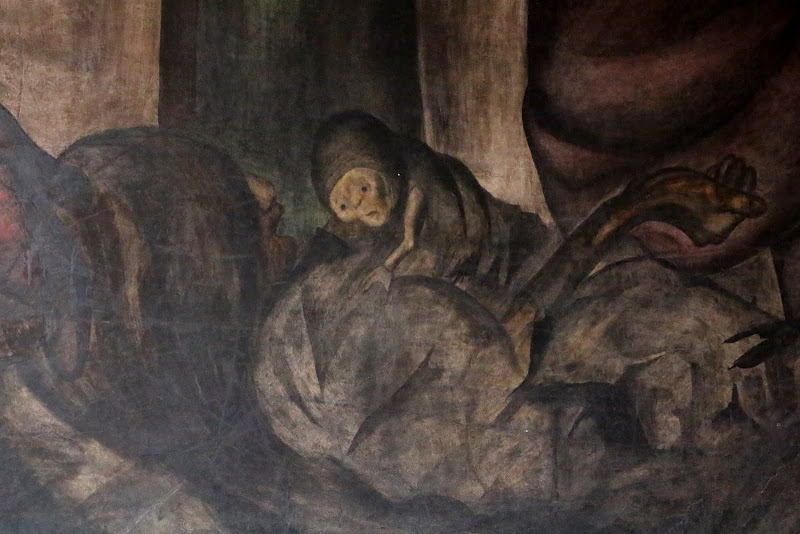


The almost shapeless form is a woman lying on her back, one hand upturned in classic begging posture, the other holding a skeletal, desperate baby.

The Law, Justice, God and Liberty

From this scathing portrayal, we move on to meet other murals in the same caricature style, but more symbolic in their content.

La ley y la justicia
The Law and Justice

A drunken Law and Justice dance. The scales that should impart fairness seem about to fall from Justice's hand. Her skirt is stained by a bloody hand print, possibly raised in a failed protest.


El juicio final
The Final Judgment

And next to terrestial Law and Justice, the Final Judgment. A cross-eyed Father God, looking annoyed and/or otherwise out of sorts, his World slipping from his hand, sits above the adoring bourgeoisie, with halos over their stovepipe hats and bonnets. 


And to God's left, devils pursue and hound the poor, who flee from the Lord's presence.


La libertad
Liberty

And just beyond, Liberty, wearing her Red Cap, hangs from the fly space of a theater, like a Deus ex machina meant to come to the rescue and break the bonds of servitude, but she is inept, toothless and semi-conscious at best. It is a sad comedy, a burlesque of the Revolution.


El acecho
The Stalker

Orozco's last charicature is an even more sardonic take on the Revolutionary rhetoric of Liberty and Justice for All. A rotund member of the bourgeois, identified by the watch fob over his vest and his fine shoes, disguises himself as a poor man, even a Christ figure with his crown of thorns. He holds out the promise of the Red Cap of Liberty to the poor worker, who, himself has an almost simian face. Behind the distracted worker, el acecho, the stalker is poised to stab the laborer to death.

One recalls Orozco's words about the Revolution,
"Buffoons and dwarfs, trailing along after the gentleman with the noose and dagger, in conference with smiling procuresses."
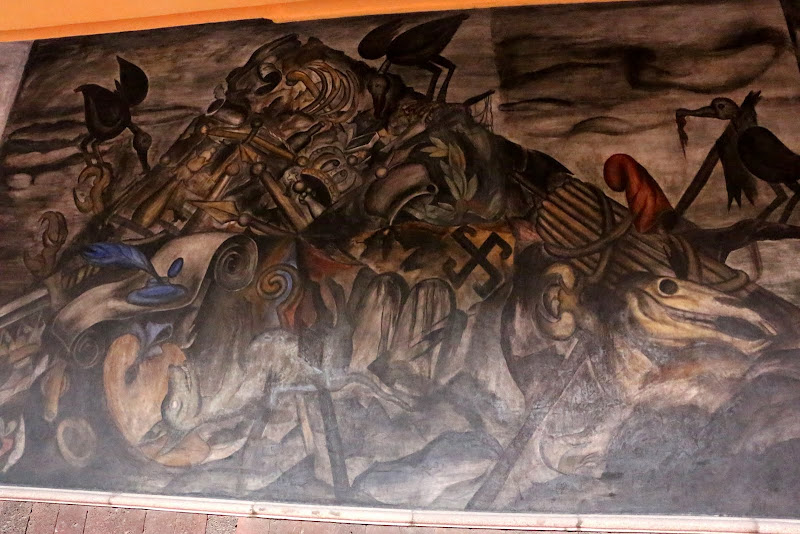

Basura social
Social Garbage
Note: Liberty cap

Then Orozco hits us with a symbolic ton of bricks, his words in images:
"The world was torn apart around us. Troop convoys passed through on their way to slaughter. Trains were blown up. Wretched Zapatista peasants who had fallen prisoner were summarily shot down. People grew used to killing, to the most pitiless egotism, to the glutting of sensibilities, to naked bestiality." 
Painted in 1926, Orozco presciently places the Nazi swastika near the center. The National Socialist Party had been founded in Germany in 1920.

Included in the pile are other symbols of power: the Sacred Heart of Jesus, a bishop's crosier, a king's crown, the Mosaic tablets, an olive wreath, an Aztec eagle warrior, the Roman fasces, bundle of sticks, which became the symbol of Italian Facism after World War I, the skull of a horse.

In this dismal landscape only two points of color survive, the blue feather pen of the written law and the ubiquitous Red Cap of Liberty. Three crows feed on the refuse: the one on the left perched on the claw of a dead eagle, the symbol of Mexico, buried under it all.

We wonder how Orozco could have gotten away with painting such a devastating, damning portrait of the Revolution, together with his sardonic burlesquing caricatures, in the government's own National Preparatory School, where the future leaders of the post-Revolutionary regime were to be formed. With that question, and wondering what more Orozco could have in store, we climb to the topmost floor.

Of Revolution and Humanity, Earth and Sky


La familia
The Family

Here we meet a quieter, more realistic, but subtly moving set of images of the Revolution. The Mexican family—all in Orozco's favoite "colorless" greys and tans—sits close together, subdued, stoic. One woman cares for an ill or exhausted but substantial man, while a second cradles a newborn, everyday embodiments of the iconic Virgin of Guadalupe and the Virgin Mary. A couple, faces invisible to the viewer, hence anonymous yet universal, embrace and look toward an unfinished pyramid-like edifice. Beyond is a stunning, impossibly intense, cobalt blue sky.

We have seen this blue before, here in San Ildefonso. First, in the firmament of Diego Rivera's Creation, then, in Orozco's disturbing Revolutionary Trinity, on the ground floor, and in a less saturated mode, as the backdrop for his burlesque theater version of Heaven on the floor just below us. In the series of murals here on the top floor, this blue becomes the counterpoint to the earthly, subdued, human, painful realities of the Revolution.


La despedida
The Farewell

Son bids farewell to mother, husband to wife, as they depart for the war. Here the blue, painted on a wall, is only a pale echo of the sky.


La bendición
The Blessing

Another son receives the blessing of his old mother. The plows that are his work and that he is also leaving behind, sit inactive. The sky conveys a pure, infinite force of nature.


Trabajadores
Workers

Laborers begin to leave their tools, and their women. Behind a red wall, the azure sky.


Los revolucionarios
The Revolutionaries

Here we meet another Revolutionary trinity, but a realistic one—weighed down by their arms, the loss of what they are leaving behind and their possible future. Two women—one with a baby in her rebozo, the other carrying some load—accompany them. Here there is no blue sky.


Las mujeres
The women

The women left behind, one with a baby, one crying. The plows sit, unemployed. But there is that impossibly blue sky.


El sepulturero
The gravedigger

What simpler image could there be of the inevitable outcome of war, of violence, than a gravedigger. His preparatory work evidently done, he sleeps while awaiting the culminating act of burial. But the sky is blue.


La familia
The Family


Feeling sobered, as subdued as the paintings, we return to gaze again at The Family. Stoic, solid, bonded, comforting one another in the midst of life's challenges, losses and hopes. And the sky is so blue.

Once again in our tour of San Ildefonso, we feel how far we are—how far Orozco has brought us—from Rivera's idealized Ballad of the Revolution, painted at virtually the same time on a similar top floor, around a similar patio of a similar former colonial building just two blocks away. Two visions of a Revolution, but worlds apart.

See more on the Mexican Revolution and Mexican Muralists
Part I: Bellas Artes 
Part II: The Academy of San Carlos and Dr. Atl 
Part III: Secretariat of Education, José Vasconcelos and Diego Rivera 
Part IV: Secretariat of Education and Diego Rivera's Vision of Mexican Traditions 
Part V:  Secretariat of Education and Diego Rivera's Ballad of the Revolution 
Part VI: Diego Rivera at the College of San Ildefonso 
Part VII: José Clemente Orozco Comes to San Ildefonso 
Part VIII: College of San Ildefonso and José Clemente Orozco - Continued 
Part IX: David Siqueiros, Painter and Revolutionary 
Part X: David Siqueiros Cultural Polyforum 
Part XI: The Abelardo Rodríguez Market 
For the story of the Mexican Revoluion, see: Mexican Revolution: Its Protagonists and Antagonists 

Mexican Revolution and Mexican Muralists - Part VII: José Clemente Orozco Comes to San Ildefonso

José Clemente Orozco,
by David Siqueiros,
Siqueiros Cultural Polyforum,
Delegación Benito Juárez,
Mexico City

Secretary of Public Education José Vasconcelos had put Rivera to work creating murals in the Secretariat of Education, so he hired artist José Clemente Orozco (1883-1949) to add more murals in the Preparatory School. Orozco was forty years old.


Born in the western state of Jalisco, his family had moved to Mexico City in 1890, when he was seven. He was enrolled in the elementary school of the Teachers College in the Centro Histórico. On his way to school, Orozco recounts in his Autobiography, he would pass the printing shop where José Guadalupe Posada (February 2, 1852 – January 20, 1913) worked as an engraver, illustrating books and newspaper stories.


José Guadalupe Posada,
by David Siqueiros,
Siqueiros Cultural Polyforum,
Delegación Benito Juárez,
Mexico City

Orozco was fascinated. He felt
"impelled to cover paper with my earliest figures; this was my awakening to the art of painting."
At some point while still attending elementary school, he enrolled in evening classes at the San Carlos Academy of Fine Arts. Diego Rivera, who was three years younger, also started studying at the Academy in 1896, at age 10.

In 1897, at age fourteen, Orozco's father sent him to the San Jacinto School of Agriculture, just outside the city. Completing the three-year course, in 1900 Orozco enrolled in the National Preparatory School, planning to study architecture. But his passion for painting overtook him and he left to enroll in San Carlos. His father had died, so he supported himself working as a draftsman for architects and newpapers.

In 1911, when Francisco Madero and others had overthrown Porfirio Díaz, Orozco, now twenty-eight, got work through a journalist friend as a cartoonist with an opposition newpaper. As for taking sides in the Revolution, Orozco wrote later in his Autobiography:
"I might equally well have gone to work for a government paper instead of the opposition. No artist has, or ever has had, political convictions of any sort. Those who profess to have them are not artists."
He joined the student strike at the Academy, seeking to throw out the director and the Neoclassic curriculum. When Alfredo Ramos Martínez became director of the re-opened Academy and led students to paint plein air, in the open air, at a house he rented in the then rural village of Santa Anita Ixtapalapa (now part of the Mexico City borough of that name), Orozco initially went along. But he soon found the focus on French Impressionism too precious for his taste. Instead of their
"pretty landscapes with the requisite violets and Nile greens, I preferred black and the colors exiled from Impressionist palettes. I painted the pestilent shadows of closed rooms, and instead of the Indian male, drunken ladies and gentlemen."
He left and rented his own studio in thc City Center.

By his own account, he took no part in the various phases of the Revolution, despite U.S. newspaper accounts to the contrary. He felt Madero's presidency was "a half revolution, sheer confusion and senseless." Huerta was
"no doubt a monster, but no different from others who fill the pages of history."
After Huerta's defeat in October of 1914, the forces of Villa and Zapata on one side and Carranza on the other failed to agree on a new government at the Convention of Aguascalientes. Pancho Villa and Emiliano Zapata then directed their armies at Carranza's. In November, Carranza retreated to the state of Veracruz. Dr. Atl, the students' mentor at the Academy, convinced many of them to join him and Carranza. Orozco went with him to the city of Orizaba, helped set up printing presses and drew political cartoons against Villa and Zapata. And witnessed the horrors of war:
"The world was torn apart around us. Troop convoys passed through on their way to slaughter. Trains were blown up. Wretched Zapatista peasants who had fallen prisoner were summarily shot down. People grew used to killing, to the most pitiless egotism, to the glutting of sensibilities, to naked bestiality.
"In the world of politics, it was the same, war without quarter, struggle for power and wealth. Factions and subfactions were past counting; the thirst for vengeance insatiable. And underneath it all, subterranean intrigues went on between the friends of today and the enemies of tomorrow, resolved, when the time came, upon mutual extermination. Farce, drama, barbarity. Buffoons and dwarfs, trailing along after the gentleman of the noose and dagger, in conference with smiling procuresses."
In 1917, after Carranza had defeated Villa and Zapata and become president, and some stability returned to Mexico, Orozco, now thirty-four, seeing no future for himself in Mexico, left for the United States. Carrying some of his rolled-up paintings with him, he was inspected by U.S. Customs Officials at the border in Laredo, Texas. They destroyed sixty of his paintings because they were seen as "immoral," even though, Orozco comments, "there were no nudes."

Orozco went on to San Francisco, where acquaintances took him in and he survived with small painting and printing jobs. He later moved on to New York City, where he loved Harlem and Coney Island.

In 1922, seeing that "the table was set for mural painting," Orozco returned to Mexico. In 1923, he was hired by José Vasconcelos to paint murals in the National Preparatory School, the former Jesuit Colegio de San Ildefonso.


Inner patio of San Ildefonso
Some of Orozco's murals
can be glimpsed in the passageway on the right
Photo: Rebecca Brundage Clarkin

Orozco's first painting seems to be a continuation of both the classic imagery and idealized, hopeful theme of Rivera's Creation.


Maternidad
Maternity

Maternidad is an ethereal, semi-modern reworking of a Renaissance or even Baroque-style portrayal of a Madona and her child, now blond and naked, surrounded by hovering angelic figures. Striking both in its idealization and boldness, it is at the same time strange, as if from the Art Nouveau end of the 19th century rather than the third decade of the 20th. This and other murals Orozco painted in the Preparatory School at the time were strongly criticized, including by Catholics who saw them as blasphemous. Orozco responded by destroying all but this mural and quitting the job.

An Artistic Revolution in Style and Vision

At the end of 1924, Plutarco Elías Calles became president and announced several populist projects to fulfill the Revolutionary desires of peasant farmers for land and urban laborers for the workers' rights that had been incorporated into the Constitution of 1917. Orozco decided to return to San Ildefonso in 1926 and began painting again, restoring some of his destroyed murals, but now he worked in a starkly modern style, presenting a startling perspective on the events that, a decade before, had devastated the country.

Next to Maternidad he painted a series of murals on the Mexican Revolution very different from the optimistic, idealized ones Rivera was realizing nearby in the Secretariat of Education. In them, Orozco gave visual life to his autobiographical observations on the brutality and senselessness of the Revolution.


La Trinchera
The Trench

The vital, velvet rich reds and warm golds of Maternidad are replaced with somber greys, tans and black and a touch of blood red in the background, the colors that he has told us he loved. We are confronted with three revolutionary soldiers falling in battle. Two topple, arms extended as if crucified, against hard, harsh rock. The third doubles over on his knees, covering his eyes from the scene.  The contrast with Rivera's heroic Trinchera, in his Ballad of the Revolution, could not be more striking.


Diego Rivera's En la Trinchera
Secretariat of Public Education

Further along the colonnade of the planta baja, the ground floor, we encounter a more symbolic but almost as disturbing image of the Revolution.

La trinidad revolucionaria
The Revolutionary Trinity

This very non-Christian Trinity is composed of a central figure holding a rifle but blinded by the Red Cap of Liberty that had been the symbol of the French Revolution. The left-hand figure covers his eyes, similar to the third figure in La Trinchera. The right-hand figure has had his hands cut off. Behind him is a small, paradoxical slice of the azure Mexican sky.

Alongside this critical, to say the least, even sardonic and despondent view of the Revolution, Orozco places his view of the bourgeois upper-class.


El banquete de los ricos
Banquet of the Rich

Here Orozco is much more in synch with Rivera's view of wealthy capitalists.


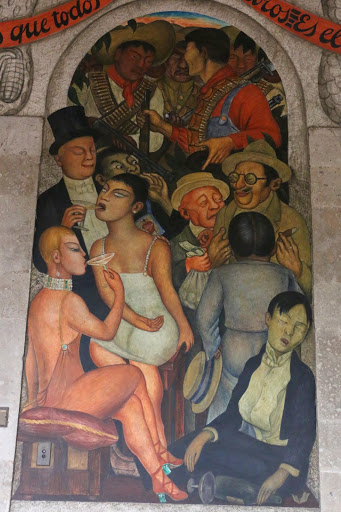
La Orgia-La Noche de los Ricos
The Orgy-The Night of the Rich
Diego Rivera
Secretariat of Education

However, the style of Rivera's "Orgy" and the figures within it seem tame, aloof, stilted compared to Orozco's over-the-top painting style and his corpulent, drunken, contemptuous diners.

With this stark introduction to both sides of the early 20th century's economic and political divides, we start up the stairs to the two upper floors, wondering what more Orozco has in store for us.

Up the Stairs and Backward in Time

Reaching the landing halfway up to el primer piso, the first upper floor, we turn to continue ascending, but become aware of a powerful presence looming over our head.


Cortés y Malinche

Hernán Cortés, the Conquistador, and Malinche, the indigenous Nahua woman given to him by her Maya master as a peace offering and who became his translator, sit naked and rigidly upright above us. Cortés stares into the distance, as if his mind is on other things, other places. Malinche drops her gaze. While they hold right hands, Cortés uses his left to block Malinche from moving forward. Below them, outside this photo (it was too dark to capture), lies the small, naked body of an indigenous man or youth, face down. Cortés´ right foot rests on the person's legs. His left foot is held poised in the air, as if about to stomp on the prostrate figure.

Artistically and emotionally, it is the simplest, most unadorned and powerful representation we have seen of the contrasts, clash, devastation and synthesis that was the Spanish Conquest of what is today called Mexico.

On the side walls leading up the stairs, Orozco continues with this potent, truly shocking theme.


Los Franciscanos
The Franciscans

It was Cortés himself who, after his defeat of the Aztecs and demolition of their capital, Tenochtitlán, petitioned the young King Charles I, who was also Holy Roman Emperor Charles V, to send friars, members of religious orders, monks, not priests of the regular "secular" church, i.e. the church in the everyday world, to evangelize the indigenous peoples of the lands he was now subduing. Charles sent Franciscans. (See our post: The Spiritual Conquest: The Franciscans - Where It All Began.)

They arrived barefoot and dressed in near rags, manifesting their vows of humility and poverty. While they strove to convert the "heathen", saving them from their violent "pagan" gods, they also became known for seeking to defend them from the worst depredations of the conquistadores and peninsulares, members of the Spanish ruling class who came to manage the new realm and extract its natural wealth using indigenous labor.   


Sobered by this confrontation with Mexico's roots exposed, we continue up the stairs, wondering even more how Orozco will unsettle us with the range and power both of his themes and his technique.


See more on the Mexican Revolution and Mexican Muralists
Part I: Bellas Artes 
Part II: The Academy of San Carlos and Dr. Atl 
Part III: Secretariat of Education, José Vasconcelos and Diego Rivera 
Part IV: Secretariat of Education and Diego Rivera's Vision of Mexican Traditions 
Part V:  Secretariat of Education and Diego Rivera's Ballad of the Revolution 
Part VI: Diego Rivera at the College of San Ildefonso 
Part VIII: College of San Ildefonso and José Clemente Orozco - Continued 
Part IX: David Siqueiros, Painter and Revolutionary 
Part X: David Siqueiros Cultural Polyforum
Part XI: The Abelardo Rodríguez Market 
For the background of the Mexican Revoluion, see: Mexican Revolution: Its Protagonists and Antagonists 

Sunday, October 18, 2015

Mexican Revolution and Mexican Muralists - Part II | The Genesis of the Mexican Mural Movement: The San Carlos Academy of Art and Dr. Atl

National Academy of San Carlos

Intertwined with the Mexican Revolution was a revolution in Mexican Art, which began within the walls of another colonial building in the heart of the Centro Histórico. It was here that a teacher of painting and some students came together and provided the fuel and fire for what was to become the Mexican Mural Movement when the military Revolution finally came to an end.

Royal Spanish Foundation and Neoclassic Aesthetic

The Academy of San Carlos was initially founded in 1781 under the name of the School of Engraving. Renamed many times in the intervening years, it remains known as the Academy of San Carlos. The School of Engraving started out in a building that had been the mint, and would later become the modern-day National Museum of Cultures. Ten years later, it was moved to the former Amor de Dios (Love of God) Hospital, where it remains to this day. The original hospital building was remodeled in Neoclasssic style. The street on which it is located was renamed from Amor de Dios Street to Academia Street in its honor.

The Academy was originally sponsored by the Spanish Crown and a number of private patrons. It was the first major art institution in the Americas. The new school promoted Neoclassicism, focusing on Greek and Roman art and architecture and advocating European-style training of its artists. To this end, plaster casts of classic Greek and Roman statues were brought to Mexico from Europe for students to study.

Interior patio

In the early 19th century, the Academy was closed for a short time due to the Mexican War of Independence. When it reopened, it was renamed the National Academy of San Carlos and enjoyed the new government's preference for Neoclassicism, as it considered the Baroque style reminiscent of colonialism. The academy continued to advocate classic, European-style training of its artists up until the Mexican Revolution. (Wikipedia)

New Aesthetic Arrives with the Twentieth Century

As the 19th century was nearing its end, new currents began to enter the school. In 1897, Gerardo Murillo Cornado (October 3, 1875 – August 15, 1964), a twenty-two year old student at the Academy, was granted a scholarship by President Porfirio Díaz to travel to Europe to study painting. He had broad, humanistic interests and obtained a doctorate in philosophy at the University of Rome. He traveled to Paris to study art. He also became involved in the anarcho-syndicalist (union) movement and the Italian Socialist Party. He apparently met both Lenin and Mussolini. In 1902, he took the name "Dr. Atl"—"water" in the Nahuatl language of the Aztecs.

Gerardo Murillo Cornado, Dr. Atl.
Photo in the Diego Rivera House Museum
Colonia San Ángel.
Returning to Mexico in 1904, Atl became a teacher at San Carlos. Shortly afterwards, he issued a manifesto calling for the development of a monumental public art movement sponsored by the government and linked to the lives and interests of the Mexican people. He advocated painting from real life and nature and using paints made from native materials, rather than following the classical training of San Carlos, which involved copying European classic paintings and sculpture.

José Clemente Orozco, an evening student in his early twenties, and other students began to experiment, breaking with the strict classical training of the Academy. In his autobiography, Orozco recalls:
"In these night classes of apprentice painters, the first signs of revolution appeared in Mexican Art. The Mexican had been a poor colonial servant, incapable of creating or thinking for himself. Everything had to be imported ready made from European centers, for we were an inferior and degenerate race. ...It was inconceivable that a Mexican should dream of vying with the world abroad... 
"In the night classes in the Academy, as we listened to the fervent voice of that agitator, Dr. Atl, we began to suspect that the whole colonial situation was nothing but a swindle foisted upon us... We, too, had a character that was quite the equal of any other. We could learn what the ancients and the foreigners had to teach us, but we could do as much as they, or more. It was not pride but self-confidence that moved us to this belief, a sense of our own being and our destiny.  
"I set out to explore the most wretched of the city's barrios. On every canvas there began to appear, bit by bit, like a dawn, the Mexican landscape and familiar forms and colors. It was only a first and still timid step toward liberation from foreign tyranny, but behind it there was throrough preparation and rigorous training." (Autobiography of Orozco)
Diego Rivera, in his late teens, was also a student at the time. In 1907, at age twenty-one, he left for Europe with a scholarship to study art. He was to remain there until 1922.

As Mexican Revolution Erupts, Academy Undergoes Its Own Revolution

The year 1910 was the 100th Anniversary of the start of the Mexican War of Independence. As part of the celebrations planned by President Porfirio Díaz, an Exposition of Contemporary Spanish Painting was organized, to be shown in a special pavillion erected on the Alameda.

The students of the Academy protested that, since it was a celebration of Mexican independence from Spain, Mexican art should be represented. Dr. Atl negotiated with the government and they were given a small grant to put on an exhibit in the Academy. Orozco was one of some fifty artists to exhibit their work. It was a huge popular success.
Dr. Atl proposed that the young artists form their own organization, the Artistic Center, which would seek to gain access to government buildings where they could paint murals on the walls. They were given permission to start in the National Preparatory School. They erected scaffolding, but did not get the chance to begin. In November the Mexican Revolution began.

By May 1911, Porfirio Díaz was overthrown and Francisco Madero became president. Students at San Carlos saw this as an opening to get the traditional curriculum. along with the current director, thrown out and have one in line with Dr. Atl's manifesto instituted. They went on strike, which lasted more than a year. That same year, David Siqueiros, age fifteen, enrolled in evening classes at the Academy.

The strike, and life in Mexico City, was interrupted by the overthrow of President Madero by his general Victoriano Huerta during the Ten Tragic Days of February 9-19, 1913. The forces that had overthrown Díaz immediately rose up against Huerta. Dr. Atl had allied himself with Venustiano Carranza, governor of Sonora and self-declared Primer Jefe, First Boss, of the Constitutional Army created from various northern states. Atl left for Europe to gain support for Carranza.

Meanwhile, the Academy continued to function and a new director was appointed, Alfredo Ramos Martínez, who had just returned from Europe where he had studied Impressionist painting. He advocated painting from nature and focusing on the beauty of the Mexican countryside. One of his first acts as director was to rent a house in the then rural village of Santa Anita Ixtapalapa (now part of the Mexico City borough of that name), where he had students paint from nature in plein air, open air.

While Ramos Martínez extolled French Impressionism, even naming the school El Barbizón after the French village beloved by the Impressionists, the students rejected the continuing European focus and began painting local scenes and people of "el pueblo", the working class and poor, who were predominately indigenous. They became enamored with the popular and folk paintings of the barrios and the murals in cantinas (bars) and pulquerías (pulque is beer made from the sap of the agave succulent). They declared that European art, especially in its Classic Greco-Roman forms, was ugly and that the Mexican "Indian" and his art was the most beautiful.

Later in life, Siqueiros wrote:
"This was the beginning of a new aesthetic. Although childlike, we launched a permanent break with the archaic and academic pedagogy of the official art academy. It was at Santa Anita that we began to discover our own country." (Siqueiros, Biography of a Revolutionary Artist, D. Anthony White)
In the context of the revolt against Huerta that was going on (1913-14), these encounters with popular, lower class, indigenous poor also politically radicalized the students, who were mostly from rich upper-class familes. They began to participate in demonstrations against Huerta. The school was closed by the government. Some students left Mexico City to join the various factions allied, for the time being, in the rebellion: Venustiano Carranza, Emiliano Zapata and Francisco "Pancho" Villa.

When Huerta was defeated in July of 1914, and Carranza entered Mexico City, the Academy was reopened and Dr. Atl, who had returned from his mission to Europe on Carranza's behalf, was appointed its director. He spoke to the students about starting their own workshops for the "popular classes", i.e., the working class and poor. He also talked about the creation of murals in public spaces.

But this was but a brief respite in the civil war. After the attempt between Pancho Villa and Emiliano Zapata and Carranza to agree on a government failed at the Convention of Aguascalientes, in October of 1914, Villa and Zapata mobilized their armies against Carranza. In November, Carranza retreated to the state of Veracruz. Dr. Atl convinced many of the students at the Academy to join him and Carranza there.

Students Dispersed by War

Both Orozco and Siqueiros went with Atl to Veracruz. Orozco helped run a printing operation producing propaganda for Carranza. Siqueiros joined a group of adolescents who formed a batallion that went to the western part of Mexico to fight against Pancho Villa. Because of their age, they became known as the Batallón Mamá. When they arrived in Jalisco, Siqueiros was assigned to the staff of General Diéguez because he could read and write. He also participated in direct combat. 

After Carranza had defeated Villa and Zapata and forced them to retreat, Villa to the north, Zapata to the mountains of Moreles to the south, he returned to Mexico City, became provisional president, and after the approval of the Constitution of 1917, Mexico's elected president.

Orozco, disenchanted with war, went to the United States to try his success as a painter. Siqueiros was sent to Paris by Carranza to be a military attaché at the embassy, but actually giving him an opportunity to study European art. There, he met and became friends with Diego Rivera. 

José Vasconcelos and the Beginning of the Mexican Mural Movement

In 1921, Álvaro Obergón, Carranza's lead general, overthrew Carranza, who was killed on his way to Veracruz after fleeing Mexico City. As president, Obregón appointed José Vasconcelos, a lawyer and philosopher who had supported the Revolution, to be head of the new Secretariat of Public Education.

Vasconcelos saw as part of his mission fulfilling Dr. Atl´s call to create public murals for displaying the Mexican people, their history, the stuggles and achievements of the Revolution and a vision of their future as a new, modern nation. To implement this, he summoned three students from the Academy of San Carlos back to Mexico, Rivera and Siqueiros from Europe and Orozco from the United States.

As Orozco was to write later in his Autobiography, "the table was set for mural painting." The Mexican Mural Movement started at full steam. Dr. Atl's vision first began to be realized in real paint on real walls of public buildings in Mexico City, and then beyond. Atl, himself, continued to paint and advocate for popular folk art and murals until his death in 1964.

For more on Mexican Revolution and Mexican Muralists, see:
For background on the Mexican Revolution, see: Mexican Revolution: Its Protagonists and Antagonists

Sunday, October 11, 2015

Mexican Revolution and Mexican Muralists - Part I: Bellas Artes, Where Diego Rivera, José Clemente Orozco, David Siqueiros Meet

Bellas Artes, formally el Palacio de Bellas Artes, Palace of Fine Arts, sits at the western edge of Mexico City's Centro Histórico, along side the Alameda Central park and across the Eje Central, Central Axis, from Porfirio Díaz's Palacio de Correos, Post Office Palace, and not far from his other grand fin de siecle work, the Palacio de Comunicaciones, now the National Musuem of Art.

However, Bellas Artes is set apart from its sister edifices not only by its aesthetic, but also because its construction embodied a radical transition in Mexican history and culture. Begun by Díaz in 1904, construction was interrupted by the Mexican Revolution (1910-17) that deposed him from his thirty-some-year domination of Mexico. Construction was resumed in 1932 and completed in 1934. The exterior and interior architecture and furnishing record this dramatic political, historical and cultural transition.

Bellas Artes

The outside is full-blown Beaux Arts, an ornate elaboration of Neoclassisism defined by the École des Beaux-Arts in Paris and popular in Western Europe and the Americas in the 19th and early 20th centuries (think Grand Central Station and the San Francisco Opera). It was designed by the Italian architect, Adamo Boariwho also designed the completely different Renaissance Revival Palacio de Correos across the street. Initially called the National Theater, this was Díaz's last effort to make Mexico City into a New World Paris of the turn of the century.


Four muses of performing arts

by Italian Leonardo Bistolfi
                   

An angel plays music to revive the human spirit


To these grand classical images are added small recollections of pre-Hispanic, Mesoamerican culture. 


Aztec Eagle Warrior
and Mexican serpent
over door to the side of the main one

Aztec Jaguar Warrior
  
The glass and ceramic-covered dome, with its flowing lines designed by Hungarian architect Géza Maróti, is Art Nouveau.


Bellas Artes dome
Photo taken from Torre Latinoamericana

Bellas Artes faces Madero Street, next to the Alameda Central,
whose current design is also from the Porfiriato period.
Photo taken from Torre Latinoamericana

Crossing an Historic and Aesthetic Threshold

Walking inside, you cross a threshold into the first clear aesthetic expression of 20th century moderism, Art Deco, with its intense, spare geometry. You may also think you have entered a Mexican version of Rockefeller Center. 


The Grand, Central Dome


Side Dome and Central Dome
                      

Side Dome


Doors to Main Theater

Here, too, are echos of Mexico's Mesoamerican roots.


Art Deco version of Cha'ac,
Mayan God of Waters


Tlaloc,
Aztec God of Waters

Stylized Mask
               
Designed by Mexican architect Federico Mariscal, the ancient and the modern go together, perhaps because of their equally strong geometries,                                

Iconography of a Revolution and Its Aftermath

Looking up from the main lobby to the two balconies above, you get your first glimpses of yet another powerful aesthetic, one shaped by the Mexican Revolution and its consequences. Here, installed on the upper balcony, we will be confronted by the powerful, very modern works of Mexico's iconic muralists: Diego Rivera, José Clemente Orozco and David Alfaro Siqueiros.


El Hombre En El Cruce de Caminos (Man at the Crossroads)
Center: Modern Man, with the potential benefits of Science
Left: the end of Western capitalism with the First World War
Right: Workers of the World, called to Revolution to overturn the past

Diego Rivera


Diego Rivera (1886-1957): Revolutionary Idealism

Diego Rivera painted an initial version of El Hombre En El Cruce de Caminos (Man at the Crossroads), in 1933, in that other Art Deco palace, Rockefeller Center, under a commission by none other than John D. himself. However, Rivera, a Communist, included portraits of Marx and Lenin, understandably not to his patron's taste, so Rockefeller had the mural destroyed. In 1934, in Bellas Artes, at the bequest of the Post-Revolutionary, rather socialist government of President Lázaro Cárdenas, Rivera recreated it.


Leon Trotsky (glasses) calls Workers to the 4th International,
in opposition to Stalin
Friedrich Engles and Karl Marx are to the right


Lenin brings together the working class of all races

Post-Revolutionary Irony: Caricaturing Past and Present, Self and Others

Rivera's other contribution in Bellas Artes  — four-panel series he called Carnaval de la vida mexicana, Carnival of Mexican Life — is in a completely different style, Mexican caricature with its characteristic irony. The series was commissioned in 1936 by Alberto Pani, for his Hotel Reforma, one of the first modern hotels in Mexico City and one designed to attract U.S. and European tourists.

The paintings' blatant political content and unflattering portrayal of tourists led Pani to have it "touched up". When Rivera found out, there was an altercation between the two. Rivera won a lawsuit and restored the work, but Pani then put it into storage. The panels were finally sold to the government in 1963 and installed in Bellas Artes.


La Dictadura, The Dictatorship,
portrays a dictator with features of
Plutarco Calles, President 1924-28,
and "Jefe Maximo", "Head Boss" 1928-34.
He holds a flag that combines element of the U.S., Nazi and Japanese flags.
A "pig" policeman robs the woman he is dancing with.
A "charro", "cowboy", i.e., a government collaborator,
controls rebellious "animal" figures.

Danza de la Huichilobos
Modeled after the Carnaval of Huejotzingo in the state of Puebla.
"La Gran Victoria" is an allusion to the Mexican Army's defeat of the French
in the first Battle of Puebla, May 5, 1862, re-enacted in the Carnaval.
The French returned a year later, defeated the Mexicans and seized Mexico City

Leyenda de Agustín Lorenzo portrays a folk hero "Robin Hood" bandit
who attacked the French during their Intervention.
His bravado is also re-enacted in the Carnaval of Huejotzingo


México folklórico and turístico
A very blond, thin "norteamericana" looks on
while two bourgeois jackasses and a dog rule over indigenous chinelos dancers,
whose Moorish-style costumes, in turn, mock the Spanish conquerors.
Ever-present Death sits to the side.

One can see why these paintings didn't go over with a hotel owner seeking U.S. clientele. It's also clear that we are no longer in the age of the Porfiriato (1876-1911), with its love of 19th century, bourgeois, "classical" European refinement, so clearly portrayed in the exterior of Bellas Artes.

But Rivera's symbolic modernist statements are understated compared to that of his fellow muralist, José Clemete Orozco.

José Clemente Orozco (1883-1949):  Modernity In Your Face


Katharsis
1934-35

Katharsis, named so by a Mexican art critic, painted in situ in 1934-35, is an overwhelming confrontation with the chaos of the revolutions and wars of the early 20th century. Two prostitutes, one young, one old, lie in the foreground, beneath two men, one clothed, bald, old, the other naked and perhaps young, struggling amidst the machinery of modern war. At upper left, the masses raise their fists in protest. Above it all, the consuming flames of destruction and, perhaps, catharsis. Certainly not an heroic view of the Mexican Revolution or the war to end all wars. It is the 20th century in your face.

We will see more of Orozco's view of modernity when we visit the Antiguo Colegio San Ildefonso

David Alfaro Siqueiros (1896-1974): A Mexican Looks at World War II

The third, and youngest, member of the triumvirate of Mexican muralists is David Alfaro Siqueiros. His sculpted, almost three-dimensional murals deliver another powerful mix of hyper-realism and symbolism.


Víctimas de la guerra
Victims of War
1944
Víctima del facismo
Victim of Fascism
1944


Nueva democracia
New Democracy
1944

While these murals are a response to the Second World War, with its violence and hopes, Siqueiros painted a more direct take on the Revolution in Chapúltepec Castle, an edifice which played many roles in Mexican History and now, appropriately, is the National History Museum. We will return there soon. We will also visit the artist's last work, the monumental Sigueiros Cultural Polyforum, an entire building that is, itself, an abstract sculpture covered with murals outside and in. It was created in the last half of the 1960s, in Benito Juárez Delegación (borough) south of the city center.

Rufino Tamayo (1899-1991): Synthesis via Abstraction

Descending from the second to the first balcony, we are provided some relief from the intensity of the conflicts communicated in the works of the "Great Three". On the lower level, we meet RufinoTamayo.


Nacimiento de la Nacionalidad, The Birth of Nationality
1952
Upper left: Spanish conquistador with his sword.
Below him, the gray-green arc of the feathered serpent god,
Quetzalcóatl, with his head rising to the upper right.
Below him, the ruins of indigenous culture
Bottom, right: The half white, half brown head of a mestizo,
a mixed race, baby being born

México de hoy, Mexico of Today
1953
Abstract representation of Mexicans' synthesis, through fire,
of their indigenous past and industrialized present

Tamayo's murals are not only artistically abstract; they are also conceptual abstractions of the historic development of Mexico: the contrasting roots of its indigenous civilizations and the Spanish Conquest, and the mestizaje, the mixing of the two cultures. It is a classic example of the dynamics of thesis, antithesis and final synthesis of Hegel and Marx

The murals portray the ideological hope of the Revolution, or at least of its intellectual spokesmen such as José Vasconcelos (1882-1959) and his vision of Mexican history as producing the "Cosmic Race," the synthesis of all races. We will meet Vasconcelos when we visit the Secretariat of Public Education, which he founded, and where he had Diego Rivera create a panoramic series of murals portraying Mexican culture and the Revolution. 

Walking Through a Revolution

So we come to the end of our perambulation through Bellas Artes. Literally, moving from outside to inside, from top to bottom, it has been a walk from the Porfiriato epoch at the end of the 19th century, across the violent eruptions of the Mexican Revolution in the second decade of the 20th century, to some of the artistic, cultural and political perspectives of modern Post-Revoultionary Mexico. Quite a tour! Quite an edifice!

See also: Mexican Revolution and Mexican Muralists
Part II: The Academy of San Carlos and Dr. Atl 
Part III: Secretariat of Education, José Vasconcelos and Diego Rivera 
Part IV: Secretariat of Education and Diego Rivera's Vision of Mexican Traditions 
Part V:  Secretariat of Education and Diego Rivera's Ballad of the Revolution 
Part VI: Diego Rivera at the College of San Ildefonso 
Part VII: José Clemente Orozco Comes to San Ildefonso 
Part VIII: College of San Ildefonso and José Clemente Orozco - Continued
Part IX: David Siqueiros, Painter and Revolutionary 
Part X: David Siqueiros Cultural Polyforum
Part XI: The Abelardo Rodríguez Market
For the background of the Mexican Revoluion, see:
Mexican Revolution: Its Protagonists and Antagonists