Pueblos in the Mountains
In recent months, we have finally been able to get to pueblos some distance from our home Delegación/Alcaldía of Coyoacán in the middle of Mexico City. Three of those pueblos are to the southwest, in the mountain range of the Sierra de las Cruces, which we wrote about in our post on the volcanoes that surround the city. We have made it to Santa María Magdalena Atlitic in Delegación/Alcaldía Magdalena Contreras and to San Lorenzo Acopilco, in Delegación/Alcaldía Cuajimalpa. Most recently, we made it to San Bartolo Ameyalco, in the Delegación/Alcaldía Álvaro Obregón.
 |
| Delegaciónes Magdalena Contreras, Álvaro Obregón and Cuajimalpa all stretch narrowly from north to south on the west side of Mexico City, reflecting their mountainous terrain. The southern half of Álvaro Obregón, two-thirds of Magdalena Contreras and all of Cuajimalpa lie in the Sierra de las Cruces. |
 |
| La Sierra de las Cruces, running northwest from Mt. Ajusco (on the right, which lies in Delegación Tlalpan). The part that is in Magdalena Contreras lies south of the white building in the foreground. To the north east are Delegaciónes Álvaro Obergón and Cuajimalpa. Photo taken from our apartment in northern Coyoacán |
 |
| The northern end of Delegación Cuajimalpa which has been developed as a postmodern, international style section of the city known as New Santa Fe. |
We have been to other originally indigenous pueblos in Álvaro Obregón: San Sebastián Axotla, which maintains its indigenous roots, and San Ángel and Chimalistac,which were taken over early in the Colonial Period by wealthy Spanish for haciendas (estates) and country homes. However, they lie near the northeastern end of the delegación, literally on the border with Coyoacán and are now immersed in the modern city. In striking contrast, San Bartolo, like the other pueblos in the Sierra de las Cruces, lies well to the south, high in the mountains, surrounded by evergreen forests.
San Bartolo Ameyalco
Traveling with our faithful taxista, Sr. Sánchez, on the Sunday morning of the Fiesta de San Bartolomé, we quickly leave our familiar Coyoacán and enter Delegación/Alcaldá Álvaro Obregón. For some distance, we are still on the flat Valley floor and in the midst of the urban, working-class, commercial city. Then we start to climb. As we do, the homes become more upscale, surrounded by walls and with gated entrances. There are entire gated communities and luxury sports clubs. Once again, we are amazed at how quickly one can transition from one world to another in the City, but we also wonder what Pueblo San Bartolo Ameyalco will be like, with all this luxury just below it.
Finally, after about an hour's ride, as we climb further and begin to enter the ancient forest of the mountainside, we see a sign pointing off the main road to the pueblo. As always, as soon as we enter its narrow streets, lined by modest cinderblock homes and stores, we know we are in a pueblo, not the modern city. Inevitably, because it is fiesta time, we come to the point where the street is closed off and, beyond that point, filled with temporary puestos, stalls, whose owners are preparing them to sell food or other items. And there are the carnival rides, sitting still and empty, awaiting the evening party time. So again, we thank Sr. Sánchez for bringing us so far and so reliably to our destination, pay and tip him well, and bid him "hasta luego", "until the next time".
Walking up the puesto-filled street we soon come to the walled entrance to the church atrio (atrium). So far, all is as it virtually always is for a pueblo's patron saint fiesta.
 |
| Entrance to the atrio of the Church of San Bartolo de Ameyalco. The portada is not the usual flowers, either fresh or plastic, but a design made with beans. We have seen such portadas in other pueblos. "Protect us, San Bartoloméa" On the far side of the atrio is the original 16th or 17th-century chapel. |
 |
| The original chapel. We are sorry that it is closed so that we cannot see its interior. |
 |
| To the left of the original chapel, and down some stairs, is a larger, modern church. Its facade is also covered with a fiesta portada made with seeds. |
The Pueblo of Arrieros, Mule Drivers
Not seeing any schedule of events posted anywhere, we wander back into the street. There we encounter a traditional group of dancers whom, not long ago. we encountered for the first time in the city, while at a fiesta in Santa Ursula Xitla, in the southern Delegación of Tlalpan. They are a cuadrilla de arrieros, a team of mule drivers. We had encountered them again in Pueblo San Pedro Martir, also in Tlalpan, and most recently in San Lorenzo Acopilco in Cuajimalpa. They seem to be a phenomenon of the mountainous pueblos of the south and west of the city, evidently because, for centuries, the commercial trails leading into and out of the city had to cross these mountains.
 |
| Cuadrill de arrieros de San Bartolo Ameyalco. Their attire is the traditional white manta (muslin) shirts and pants dictated for peasant workers by the Spanish after the Conquest. It is a larger group than we have seen before. |
 |
| Three small boys lead the procession, demonstrating the ongoing incorporation of new generations into the tradition. Their sign says, "Juvenile Dance of Arrieros". |
 |
| Soon, they file into the atrio to begin their ritual. It will turn out to be more elaborate than the ones we have encountered before. |
 |
| The inevitable and essential banda follows them. |
 |
| They file down the stairs to the newer church. |
 |
| Youth form a significant portion of the group. This is not the nostalgic act of some old men. |

 |
| The sanctuary is bedecked with bouquets of flowers, typical of a patron saint fiesta. The banners say, "Glorious apostle St. Bartholomew, pray for us," and "Strengthen our faith so that we may follow Christ." |

 |
| San Bartolomé stands to one side. St. Bartholomew was one of the lesser-known apostles of Jesus. |
 |
| The arrieros offer their veneration of San Bartolomé |


 |
| They then return to the street beside the atrio to begin their ceremonial dance |

 |
| "Los peques", the little ones, are instructed in the ritual by some adolescent members given this responsibility of passing on the tradition. |
 |
| A horse is brought forward with some supplies. |
 |
| A mule is unloaded of supplies for the next part of the ritual. |
 |
| Older men begin the preparation of food. It will be shared with the community at the end of the Mass. |
 |
| Several wooden fires are built and the cooking begins. The men's aprons are quite richly embroidered, indicating their pride in participating in the arrieros ritual. |
 |
| Traditional clay ollas, pots of various kinds and sizes are being used. |
 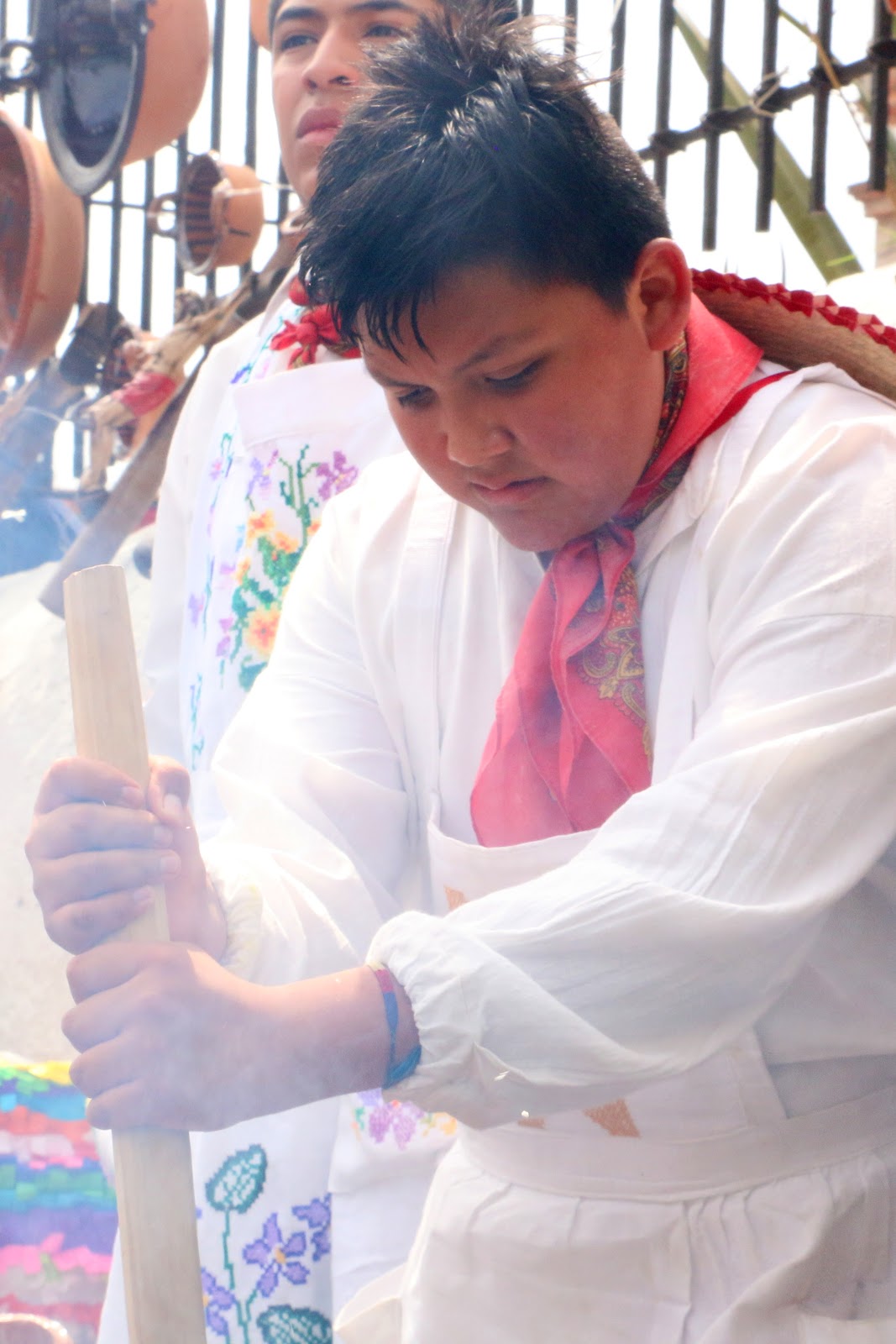 |
| Adolescents and younger boys are fully brought into the work of cooking. |


 |
| We think the yellow mass is corn masa, dough, mixed with fat, to be melted down to make atole, a corn-based drink. |
 |
| We don't know why carrots, not an indigenous vegetable, are included in the meal. |
 |
| A large cazuela is being used to prepare chocolate for drinking. |
 |
| Arrieros, young and old. The apron of the man, second from left, top, says, "Mule Drivers Dancers of San Bartolo Ameyaco, Hurry on, hurry on, my little burro." |
Comparsa de Caporales


El Pueblo
As always, we are as interested in capturing the faces of the people of the community as in the formal ceremonies.

The Strength of Tradition
What has impressed us the most about the Fiesta del Pueblo San Bartolo Ameyalco, here in the wooded mountains that surround the modern City, is the strength of their tradition of arrieros. As we noted in introducing them, we have recently encountered them in some pueblos in other southern delegaciones/alcaldías, but not in these numbers, nor with such elaborately embroidered trajes traditionales, traditional dress.
Above all, while we saw the ritual of preparation of some food for the community in San Lorenzo Acopilco in Cuajimalpa, we did not realize how central it is to the arrieros tradition, as evidenced by the extensive preparation of food as we have seen today. It was quite a production of multiple foods, obviously well-organized and carried out with deliberation and pride by the members. The group also included a large number of children and youth, incorporating them fully, thus teaching them all the components of the tradition so that they could maintain it intact into the next generation.
All of these qualities bespeak the community's deep commitment to and pride in reenacting and thereby commemorating the significant role that arrieros played for four hundred years after the Conquest in providing the only means of commercial transport into and out of the capital city. Hence, they were essential both to the life of those living in the city and surrounding villages and, on a global scale, to Spain's international commerce between Asia and the mother country via Nueva España.
Above all, while we saw the ritual of preparation of some food for the community in San Lorenzo Acopilco in Cuajimalpa, we did not realize how central it is to the arrieros tradition, as evidenced by the extensive preparation of food as we have seen today. It was quite a production of multiple foods, obviously well-organized and carried out with deliberation and pride by the members. The group also included a large number of children and youth, incorporating them fully, thus teaching them all the components of the tradition so that they could maintain it intact into the next generation.
All of these qualities bespeak the community's deep commitment to and pride in reenacting and thereby commemorating the significant role that arrieros played for four hundred years after the Conquest in providing the only means of commercial transport into and out of the capital city. Hence, they were essential both to the life of those living in the city and surrounding villages and, on a global scale, to Spain's international commerce between Asia and the mother country via Nueva España.
 |
| Alcaldía Álvaro Obrgón and its colonias and pueblos. It extends from the valley floor in the northeast up into the mountains of la Sierra de las Cruces (Mountains of the Crosses) in the southwest, which reach altitudes of 12,000 ft. Pueblo San Bartolo Ameyalco is marked by the green star. Similar mountainous pueblos are La Magdalena Atitlic in Alcaldáia Magdalena Contreras to the southeast (purple/orange star) and San Lorenzo Acopilco in Alcaldía Cuajimalpa ( red/yellow star) to the southwest. |


