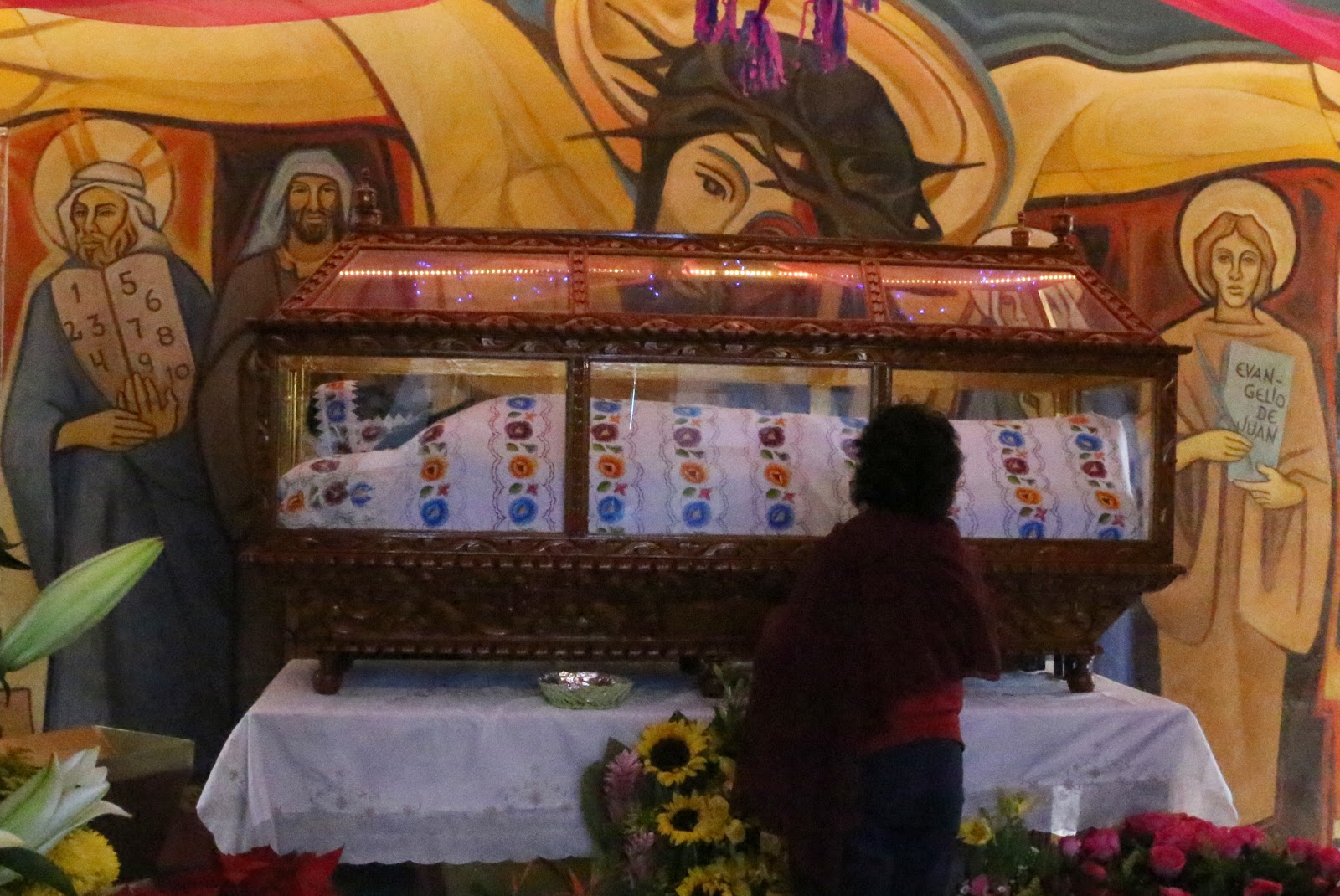
Yesterday, Saturday, October 6, we spent the first of two days attending the Fiesta of San Francisco in Coyoacán's Quadrante del San Francisco. We discovered two jewels of church architecture, one old and one new, and watched some always colorful and lively chinelo dancers. We return now, on Sunday morning, to witness two rituals listed on the fiesta announcement: a Procession of the Crosses leading to the main Mass and, after the Mass, a Raising of the Crosses.
In the context of the patron saint fiesta for St. Francis of Assisi, in early October, half a year after Semana Santa, Holy Week, with its procession of the cross on Good Friday, and five months after the Fiesta of Santa Cruz, the Feast Day of the Holy Cross, always on May 3, we are mystified and intrigued as to what these rituals centered on the Cross will be and why they are being enacted as part of the Fiesta de San Francisco. Little do we know what a powerful experience we are going to be given, one rooted in the challenge of the confrontation of the two cultures at the core of Mexican identity: indigenous and Spanish.
Arriving in the atrio of the church, we quickly realize that an event of significant proportions and, therefore, meaning, is going to take place.


Here — with the arrival of the Franciscan priest and his blessing of the Danzantes de la Virgen de San Juan de los Lagos — we begin to realize what is being enacted in this day's ritual. The Virgin embodies the same advocación as that of the far more renowned Virgen de Guadalupe. She joins two cultures, the world of the indigenous of what is now Mexico with that of European Roman Catholicism. Here, before our very eyes is a re-enactment of the mission of the original Franciscans.
The Franciscans had the insightfulness to realize that the only way to bridge the chasm between the alien cultures was to offer the indigenous people a vehicle to reconcile themselves with the Spanish Conquest and European Roman Catholicism. They opened the way for the indigenous to actively, concretely and visibly integrate their traditional attire, symbols and cultural expressions with those of Catholicism. In that way, they could maintain the continuity of their heritage and identity while accommodating to a new one.
The collaborative undertaking was accomplished by the indigenous' creative integration of their music, dance and rituals with the music, instruments and rituals of Catholic Europe. The rituals included the explicit adoption of (or viewing themselves as adopted by) particular advocaciones of the Virgin Mary and of the Christ, Her sacrificed Son, in addition to the patron saints assigned by the Catholic friars as the patron, the protector, of each community. These saints, especially the popularly adopted ones, provided, and continue to provide, direct connections with the Divine, the power that creates and maintains the world, that gives life and brings death, but can take one beyond that apparent end.
The conchero danzantes describe this achievement as one of "Conformidad y Unión", the active acceptance of and joining together with the faith and culture brought from Europe. They give it a symbolic name, "la conquista de la flor", "the conquest of the flower", i.e., of the heart.
The two cultures, now symbolically reconciled, begin their procession toward the church of San Francisco where, as one, they will celebrate the Mass for their patron saint.


There are three crosses because Jesus was crucified between two thieves, one of whom repented his sins and was promised entrance into Paradise by Jesus. That thief is the first person saved by acknowledging who it is being executed next to him.
As we said at the beginning of this post, we have seen such a raising of three crosses at the Fiesta de Santa Cruz in the Pueblo Santa Cruz Acalpixca, in Delegación Xochimilco. There, the raising precedes their being carried, on the following Tuesday, by members of the pueblo up a steep hill, visible from the church, and raised (See video of this ritual). The three crosses remain there, watching over the pueblo, for an entire year.
Then in late April, they are brought down to the pueblo, repainted and dressed with new cloths, in preparation for that year's fiesta and another initiation of the annual cycle. We have read of similar cyclical rites, with the crosses placed on a hilltop for the year, that are enacted in other pueblos in Mexico City dedicated to the Holy Cross. We expect that the same occurs in most every Pueblo Santa Cruz across Mexico and, likely, across Latin America. What we did not see in Santa Cruz Acalpixca is what happens next, here in el Quadrante de San Francisco.
One after another, women of los Danzantes de la Virgen de San Juan de los Lagos approach each of the crosses and, in various ways, show their veneration, both blessing each one and, we assume, experiencing that they, in turn, have been and will be blessed by the sacred power made present through the crosses.

The crosses are, in this belief, from this point of view, saints. They are just like all the advocaciones of the Virgin and of Jesus the Christ as an Infant, in his Passion, Crucifixion, Burial, Resurrection and other representations. They are like all those human men and women, such as St. Francis, who because of their exceptional devotion and associated miracles, have been sanctified and reside eternally in Heaven, in the immediate presence of the Divine.


In the context of the patron saint fiesta for St. Francis of Assisi, in early October, half a year after Semana Santa, Holy Week, with its procession of the cross on Good Friday, and five months after the Fiesta of Santa Cruz, the Feast Day of the Holy Cross, always on May 3, we are mystified and intrigued as to what these rituals centered on the Cross will be and why they are being enacted as part of the Fiesta de San Francisco. Little do we know what a powerful experience we are going to be given, one rooted in the challenge of the confrontation of the two cultures at the core of Mexican identity: indigenous and Spanish.
Something Big Appears About to Happen
Arriving in the atrio of the church, we quickly realize that an event of significant proportions and, therefore, meaning, is going to take place.
 |
| The single cross from yesterday stands in its place, opposite the church. |
 |
| Opposite the solitary cross, in front of the church entrance, lie two more large crosses — one draped in beige cloth, the other in green. We have seen three such crosses together before, at the Fiesta de Santa Cruz, the Holy Cross, on May 3. They are the center of an elaborate, post-Easter ritual in pueblos dedicated to la Santa Cruz. Why they are appearing here, in San Francisco in October, is perplexing. They lie between pillars covered with fresh flowers, Behind them is a row of small andas, platforms that can be carried, bearing various saints. |
 |
| Two saints, whom we can't identify, stand adorned with fresh flowers, awaiting the procession. |
 |
| Between the crosses, an altar has been laid out on the pavement. |
While at first striking a foreigner as a curious combination of objects, we quickly realize that it is a deliberately constructed, complex and deeply significant conjunction of indigenous and Catholic religious symbols.
- In front lie traditional Mexican corn tamales, the food that has fed the people of this land for millennia, wrapped in their corn husks. In one Mesoamerican creation myth, the gods made human beings from corn. Beyond is an unidentifiable, but obviously sacred object, wrapped in a cloth.
- Next are three censers, incense burners, carved in traditional indigenous form from black volcanic rock typical of Mexico and bearing copal, incense produced from the aromatic resin of the copal tree, endemic to Mexico.
- Behind the censers, a cloth embroidered with butterflies, an indigenous symbol of resurrection of life from death, covers a stand serving as an altar.
- The Virgin Mary stands on the altar, the center of veneration. The Virgin is always portrayed in the form of a particular advocación (from the Spanish/Latin verb advocar, to advocate, to speak up on behalf of someone). The term is used to identify each of the many specific "manifestations" the Virgin takes in her role as an advocate for the Faithful, an intermediary who appeals on their behalf to Her Risen Son, the Christ, in Heaven, and God the Father, the father of Her Son.
We don't recognize her advocación here, hence know her name. She wears a crown, with a cherub on each side, indicating she is some version of the Queen of Heaven, conceived immaculate from sin and assumed directly to Heaven upon her earthly death, where she received eternal life and was crowned.
- At the rear is a banner of a cofradia (brotherhood), a religious association, dedicated to the Lord of Chalma. He is a version of the Crucified Christ (originally in a black form) believed to have miraculously replaced an obsidian idol of the Nahual/Azteca god Tezcatlipoca in a cave in the town of Chalma, after the idol was destroyed by Augustinian monks who arrived there in the 1530s. Chalma is some seventy miles southwest of Mexico City in the present State of Mexico.
We have already encountered two other highly venerated black Christs believed to have been found in caves in what is now Mexico City, both at the base of el Cerro de la Estrella, the Hill of the Star, an ancient sacred site, now in Delegación Iztapalapa: el Señor del Calvario, the Lord of Calvary, in Culhuacán, and el Señor de la Cuevita, the Lord of the Little Cave, near the ancient center of the altepetl (city-state) of Iztapalapa.
Tezcatlipoca was god of the night, caves and other "dark" aspects of the world. In indigenous times, Chalma was a major site of pilgrimages from the villages of the Valley of Mexico to worship this god of darkness. With the miraculous appearance of the Lord of Chalma in that god's cave, it was transformed into a pilgrimage site to its new Lord.
Chalma remains today one of the two most visited pilgrimage sites in Mexico after the Basilica of Our Lady of Guadalupe in Mexico City. Each year, many pueblos in the City and Valley of Mexico undertake the seventy-mile walk over the mountains of la Sierra de las Cruces (Mountains of the Crosses), to the Shrine of the Lord of Chalma.
The cofradía of the Lord of Chalma present here is from the Pueblo de San Andrés Tetepilco, another original village some three miles northeast of San Francisco, in Delegación Iztapalapa. The patron saint fiesta of San Andrés is at the end of November. We hope to be able to attend that celebration in Tetepilco.
This combination of indigenous and Catholic symbols is the epitome of the syncretism by which Franciscan and other friars supported the transformation and integration of indigenous religious practices into Roman Catholic ones in order to enable the indigenous to "convert" from their religion to Catholicism via the conjoining of symbols and rituals from the two traditions which shared compatible, deep, archetypical roots and spiritual meaning.
A Puzzling Beginning
 |
| Very soon, two men carry the statue of San Francisco from the church, accompanied by the essential brass banda. The procession is evidently about to begin. |
But then, something strange happens, at least to us, an outsider. St. Francis and the banda don't head off, as would be usual, leading a procession of the other saints. Such processions usually begin at the church, circle through the streets of the saint's pueblo, sometimes coming to a rendezvous with saints arriving as guests from neighboring pueblos, and return to the church for a celebration of the Mass in honor of the patron saint.

The small Virgin we saw in the atrio is now here. Next to her is a banner reading "Danzantes de la Virgen de San Juan", Dancers of the Virgin of St. John. That gives us the name or avocación, the identity of this Virgin.
Instead, San Francisco is placed where he was yesterday, in front of the church. Then the other saints begin to be carried out of the atrio, one at a time, in a rather informal manner. The banda does not follow to set the usual rhythm. Neither do the parishioners. We are perplexed and ask one standing nearby what is happening. He says that the procession will begin three or four blocks south of the church and the saints are being taken there. Puzzled, but wanting to catch "the action", we decide to follow the departing saints to where the procession will begin. So we wind our way out of the crowded atrio, along the narrow alley and turn south on Calle Quadrante de San Francisco.
Two or three short blocks along, the street turns a corner. There we come upon the saints, lined along the sidewalk, waiting.

The small Virgin we saw in the atrio is now here. Next to her is a banner reading "Danzantes de la Virgen de San Juan", Dancers of the Virgin of St. John. That gives us the name or avocación, the identity of this Virgin.
 |
| Dancers of the Virgin of St. John, Mexico Federal District 1987 |
We have not previously encountered this manifestation of the Virgin at a fiesta. Later research on Wikipedia reveals that she is a version of Our Lady of the Immaculate Conception, brought by a friar in 1543 to the indigenous town of Mezquititlan, in the northeast corner of what is now the western state of Jalisco. The town was assigned San Juan Bautista, St. John the Baptist, as its patron saint.
Our Lady did not become important until 1632, when she is attributed with her "first miracle", bringing back to life a young girl, a member of a traveling acrobat family who fell from a trapeze onto knives stuck in the soil below, pointing upward. The Virgin subsequently was attributed with other miracles and became the focus of pilgrimages. At about this same time, many Spanish and mestizo (mixed indigenous-Spanish) people moved into San Juan Mezquititlan from the nearby town of Santa María de los Lagos and the town's name was changed to San Juan de los Lagos. The miraculous Virgin became Nuestra Señora de San Juan de los Lagos.
More and more pilgrims came, and her shrine was enlarged to its present size and Baroque form in the mid-18th century. In 1904 the Pope granted permission for the coronation of the image, recognizing it as a special representation of the Virgin Mary as Queen of Heaven. A golden crown and two cherubs were added above her. In the mid-20th century, the pope designated the shrine the special status as a basilica.
The shrine receives millions of pilgrims every year, especially around Candelaria on February 2 (commemorating the day Mary and Joseph presented the 40-day-old Infant Jesus at the Temple in Jerusalem). Thus, in Mexican traditional popular Catholicism, Our Lady of St. John of the Lakes holds a status in the range of Our Lord of Chalma and Our Lady of Guadalupe. She is another of the Santos Populares, Saints of the People that we have been becoming acquainted with in our Ambles to fiestas in Mexico City. She obviously has a following here, far from her town in Jalisco.
The Ritual Begins with the Indigenous Roots of el Pueblo, the People of Mexico
As we are puzzling over the Virgin and the other saints, people begin to arrive. They are not ordinarily dressed parishioners. They are conchero or Azteca dancers. The banner has told us they are the Dancers of the Virgin of St. John. They are similar to the dancers we have seen at many fiestas, whose centuries-long tradition we have uncovered and shared in our post: Traditional Indigenous Dancers: Concheros and Danzantes Aztecas.
Two young men carry two more banners to add to those of Our Lady of St. John of the Lakes and the Lord of Chalma. Their contrasting images signal that a powerful encounter is about to take place.
Two young men carry two more banners to add to those of Our Lady of St. John of the Lakes and the Lord of Chalma. Their contrasting images signal that a powerful encounter is about to take place.
 |
| This young man, dressed in simple indigenous attire, carries a banner made of leather, bearing a symbolic Nahua glyph and three Nahautl words written in Latin letters. |
 |
| Pachtli nite icxitoca "Come together, examine, and follow the steps of those who have gone before you (your elders)." |
In the moment, we have no idea what the Nahuatl words mean. The glyph shows footprints circling into a tree topped by a hummingbird. The tree, we recognize, is the archetypical World Tree, a universal symbol of the axis mundi, the central column of the cosmos. With its roots in the Underworld, it holds up the roof of the Heavens, thereby creating and sustaining the middle space inhabited by the natural and human world.
The hummingbird is the quintessential Nahua/Azteca symbol of sacrifice (its drawing nectar from flowers is equated with the drawing of blood). Thus, the path leading to the center of the cosmos, and of one's life, leads to self-sacrifice. In Mexica/Azteca religious mythology, human sacrifice was essential to feed the gods, who, in turn, provided the forces necessary to sustain human life. Self-sacrifice was the highest of values.
This is actually quite compatible with the central Christian belief that the sacrifice of Jesus the Christ, the Son of God Incarnate as a human being, provided the way by which sinful humans could be reconciled with God. The church, as the ongoing, incarnate Body of Christ, is the community united via that sacrifice and has the mission to continue to embody sacrifice and reconciliation in the lives of its members.
Later, when we return home to our computer, we find there is actually an online Nahuatl-English "wiktionary" where we are able to find the three words, Pachtli nite icxitoca. They translate as "Come together, follow the steps of those who have gone before you (your elders)."
 |
| The second banner is of St. Francis of Assisi, grasping the cross. His life as an ascetic monk was a quintessential model of self-sacrifice. Through his intense identification with Christ, he is even believed to have received the stigmata, the wounds of Christ's Crucifixion, on his hands, feet and side. |
 |
| Some of the Dancers of the Virgin of St. John of the Lakes. Indigenous tradition and identity is passed from one generation to the next. |
 |
| Tradition lives on. |
 |
| The Drums begin to sound. |


 |
| The concheros begin to play and sing. |

  |
| ....and dance. And if they can no longer dance, they can still play! |
A New World Takes Charge, but a Path to Reconciliation of Old and New Worlds Is Opened
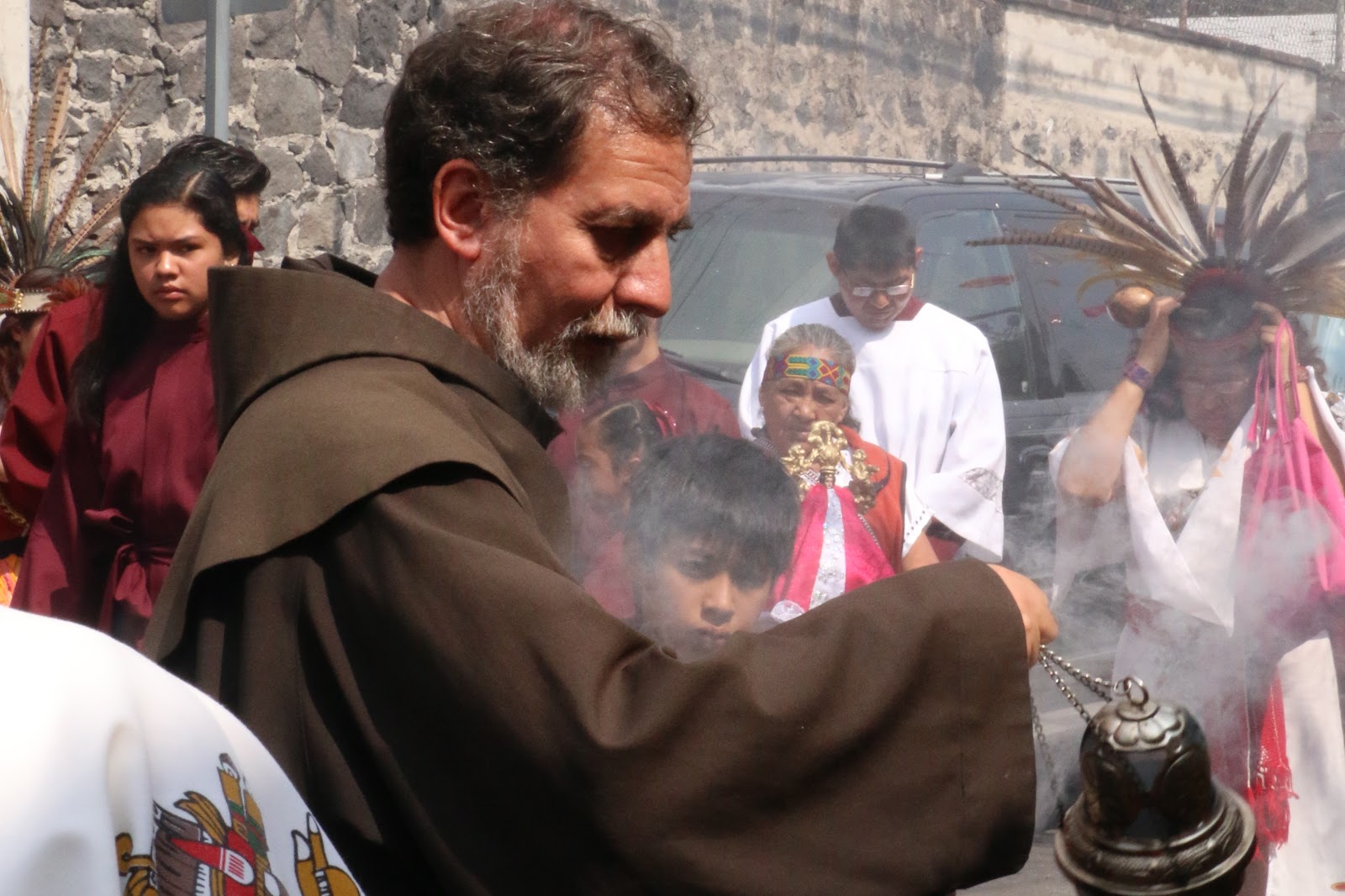 |
| As they first did in 1523, a Franciscan priest arrives to bless the indigenous danzantes. |
 |
| A prayer is said. La Virgen de San Juan de los Lagos, is held by one of her Danzantes. |
Here — with the arrival of the Franciscan priest and his blessing of the Danzantes de la Virgen de San Juan de los Lagos — we begin to realize what is being enacted in this day's ritual. The Virgin embodies the same advocación as that of the far more renowned Virgen de Guadalupe. She joins two cultures, the world of the indigenous of what is now Mexico with that of European Roman Catholicism. Here, before our very eyes is a re-enactment of the mission of the original Franciscans.
The Franciscans had the insightfulness to realize that the only way to bridge the chasm between the alien cultures was to offer the indigenous people a vehicle to reconcile themselves with the Spanish Conquest and European Roman Catholicism. They opened the way for the indigenous to actively, concretely and visibly integrate their traditional attire, symbols and cultural expressions with those of Catholicism. In that way, they could maintain the continuity of their heritage and identity while accommodating to a new one.
The collaborative undertaking was accomplished by the indigenous' creative integration of their music, dance and rituals with the music, instruments and rituals of Catholic Europe. The rituals included the explicit adoption of (or viewing themselves as adopted by) particular advocaciones of the Virgin Mary and of the Christ, Her sacrificed Son, in addition to the patron saints assigned by the Catholic friars as the patron, the protector, of each community. These saints, especially the popularly adopted ones, provided, and continue to provide, direct connections with the Divine, the power that creates and maintains the world, that gives life and brings death, but can take one beyond that apparent end.
The conchero danzantes describe this achievement as one of "Conformidad y Unión", the active acceptance of and joining together with the faith and culture brought from Europe. They give it a symbolic name, "la conquista de la flor", "the conquest of the flower", i.e., of the heart.
The Procession of Reconciled Cultures
The two cultures, now symbolically reconciled, begin their procession toward the church of San Francisco where, as one, they will celebrate the Mass for their patron saint.
 |
| First, come the acolytes of the church. |
 |
| Then the indigenous danzantes, with their chosen Virgin. |


 |
| Last, come the saints. The first is Jesus of the Sacred Heart, He who sacrificed Himself for humankind. |
 |
| Arriving at the church filled with the Faithful awaiting the Mass for San Francisco, the danzantes enter first. |
 |
| The saints follow. |
 |
| The Mass begins. |
Ritual of the Raising of the Crosses
As the millennial-old ritual of the Catholic Mass begins, we leave the sanctuary and return to the atrio. The two crosses that greeted us when we arrived earlier in the day still lie on the ground, awaiting the next ritual, the Raising of the Crosses.
When the Mass ends, the ritual begins. It is led by los danzantes.

When the Mass ends, the ritual begins. It is led by los danzantes.
 |
| The ritual begins, as indigenous rituals have begun for millennia, with the blowing of a conch shell horn, producing its eerie, to us, plaintive sound. |
 |
| Multiple drums begin to be sounded. |
 |
| The strings of los conchos are struck, emitting a simple melody. The singing begins. |

The crosses are raised
 |
| First, the cross dressed in green is raised, requiring significant effort and teamwork. |
 |
| Then the one dressed in beige is raised, with equal effort and coordination. |
 |
| The three crosses stand together. |
At the center of each cross is the form of a sunburst, one with a heart. The sunburst is the classic symbol of the Presence of the Divine, the Ultimate Power, God. The heart is the Sacred Heart of the self-sacrificed Jesus the Christ, the Incarnate Son of God. The crosses combined with the sunburst symbolize the reconciliation of God with humankind, via that sacrifice. At this intersection, humankind faces God.
There are three crosses because Jesus was crucified between two thieves, one of whom repented his sins and was promised entrance into Paradise by Jesus. That thief is the first person saved by acknowledging who it is being executed next to him.
Veneration of the Crosses: Blessing and being blessed
As we said at the beginning of this post, we have seen such a raising of three crosses at the Fiesta de Santa Cruz in the Pueblo Santa Cruz Acalpixca, in Delegación Xochimilco. There, the raising precedes their being carried, on the following Tuesday, by members of the pueblo up a steep hill, visible from the church, and raised (See video of this ritual). The three crosses remain there, watching over the pueblo, for an entire year.
Then in late April, they are brought down to the pueblo, repainted and dressed with new cloths, in preparation for that year's fiesta and another initiation of the annual cycle. We have read of similar cyclical rites, with the crosses placed on a hilltop for the year, that are enacted in other pueblos in Mexico City dedicated to the Holy Cross. We expect that the same occurs in most every Pueblo Santa Cruz across Mexico and, likely, across Latin America. What we did not see in Santa Cruz Acalpixca is what happens next, here in el Quadrante de San Francisco.
One after another, women of los Danzantes de la Virgen de San Juan de los Lagos approach each of the crosses and, in various ways, show their veneration, both blessing each one and, we assume, experiencing that they, in turn, have been and will be blessed by the sacred power made present through the crosses.

All these material representations, symbols, including the three raised crosses, are vehicles of communication with that Divine Power that created and governs the Universe and each individual's life. Communing with these saints, here, with these Holy Crosses, in this moment, is as close to the Ultimate Power as these who believe can come. Upon realizing that this sacred communion is what is being enacted and experienced before our eyes — the denouement of the ritual drama of reconciliation we have been witnessing since earlier this morning — we, believer or not, are deeply moved by the spiritual power that is conveyed.
A Small Miracle
While the crosses are being venerated, the conchero danzantes play and sing. When the blessings are finished, they play and sing on, even more loudly, in celebration of the climax of the day's ritual. In this moment, we witness what we consider to be a small miracle, totally human, but still, a miracle of faith.
Beginning with the initial gathering of los danzantes, a few blocks from the church, our eye has been caught by an elderly woman, likely in her 80s or possibly beyond, sitting in a wheelchair. She is wearing a simple tocado, feathered headdress, and under her modern coat, an indigenous dress and jewelry. She is obviously a member of the Danzantes de la Virgen de San Juan de los Lagos who, because of her age and infirmity, can no longer dance, but who is still an active participant with the group, clearly its matriarch. At that initial gathering, we requested and she granted the taking of her photo. Just minutes ago, during the veneration of the crosses, she rose from her wheelchair, and with assistance, came to the crosses and prayed to them.
Now, with the concheros playing and singing full out, we suddenly notice that she is standing with one of them and she, too, is singing her heart out.

There is, in Spanish, the noun ánimo (related, via shared Latin origins, with the English words animal, animate, animation). It means spirit, in the sense of being spirited. It is the energy of the life force that animates us all. Here, in front of us, is pure ánimo mexicano, ánimo humano, ánimo sagrado; Mexican spirit, human spirit, sacred spirit. Again, we are moved, beyond the proverbial words. We can only feel that what we are witnessing is a kind of miracle, the gift of a moment in the presence of the sacred.
¡Adiós!: Farewell to This Sacred Day
After some further playing and singing, the Danzantes de la Virgen de San Juan de los Lagos gather into a line and file into the sanctuary, now nearly empty of parishioners. Playing and singing, they move down the central aisle, approaching the altar.


 |
| Together with the saints that have gathered for the fiesta, los danzantes stand, facing the altar. |
 |
| Behind the altar is the statue of San Francisco, and below him, within the golden baldachin (canopy), is the golden sunburst of the Divine Presence. In its center, encased in glass, is the Sacred Host (sacrifice), the wafer of bread that is the Body of Christ, the Son of God, who gave Himself in sacrifice to reconcile mankind to the Divine. |
 |
| Danzantes de la Virgen de San Juan de los Lagos, with their Virgin, stand before San Francisco and the Presence of the Divine Host, in a final act of veneration. |
With the danzantes' return before the Divine Host, the Presence of the sacrificed Jesus the Christ, who thereby opened the way for humankind to be reconciled to God — with their return, the drama that we have witnessed today is completed. That drama is the symbolic path of merged ritual opened up by the Catholic Franciscans to the land's indigenous people. By this path, the two cultures that compose Mexico, indigenous and Spanish, that virtually every Mexican embodies (if they are willing to acknowledge it) have been able to reconcile. It is not the only path Mexicans have found to that reconciliation, but it is a powerful one followed still, as we have witnessed today, by many Mexicans. We say this knowing that many other Mexicans still have not yet found one.
We depart the sanctuary, the atrio, the fiesta and the calles of el Quadrante del San Franciso in awe. We feel we have experienced the clearest, most coherent and, therefore, most powerful representation of what we have been pursuing for the past two-and-a-half years, what has been called the Spiritual Conquest. Better said, as the conchero danzantes do, we have witnessed a dramatization of the path to "Conformidad y Unión", acceptance and joining, to reconciliation, an enactment of "la conquista de la flor" — "the conquest of the flower" — of the human heart.
Post Script: We subsequently learned from the Facebook page of la Capilla del Cuadrante de San Francisco that the Mass celebrated this day was the final one of Padre Porfirio and that it was the first day for Fray Guillermo Basurto, who had blessed the danzantes at the beginning of the procession, as priest of the Chapel and the pueblo of San Francisco. So it was an extra-special day for el pueblo.
Post Script: We subsequently learned from the Facebook page of la Capilla del Cuadrante de San Francisco that the Mass celebrated this day was the final one of Padre Porfirio and that it was the first day for Fray Guillermo Basurto, who had blessed the danzantes at the beginning of the procession, as priest of the Chapel and the pueblo of San Francisco. So it was an extra-special day for el pueblo.
 |
Delegación Coyoacán (purple)
sits in the middle of Mexico City. |
 |
| El Cuadrante del San Francisco (marked by the green/yellow star) |