Showing posts with label Santa Maria la Ribera. Show all posts

Monday, August 31, 2015

Seeking Restored Vitality: Colonias of the Porfiriato Have Varying Success

Perambulating through the various colonias, neighborhoods, initiated at the culmination of the Porfiriato epoch at the end of the 19th century, we have observed a process of architectural evolution that reflects the changes in Mexican upper-class values across the 20th century. In our last post, we revisited these changing "dreams of the city", or at least, dreams of what its prosperous enclaves should be.

In our walks, we have also seen—in well-worn, even abandoned buildings on one hand, and repurposed and restored ones on the other—how these once-imagined neighborhoods have experienced and now reflect the realities of a century of time, the impacts of economic ups and downs, with the resulting fluctuations in the income levels of their residents over the last century.

They share in common having a significant number of late 19th and early 20th century buildings in distinctive Euopean styles that give one the sense of being in some Continental city, but with tropical vegetation and plenty of sun. Thus, each colonia has the potential for, and manifests efforts to be restored, integrating its historic batiburrillo, hodgepodge, into a vital, architecturally rich, contemporary neighborhood.  However, they evidence different degrees of success in this process of rebirth and integration.

Seeking Renewed Life and Identity

Santa Maria la Ribera, the most northerly of the group, appears to be struggling with the greatest difficulty to restore the faded beauties of its Porfirian beginnings while integrating them with post-World War II Functionalist buildings and adding the modern buildings of urban renewal.

Partially rehabilitated Neoclassic building in Santa Maria la Ribera

San Rafael, the next colonia to the south along Insurgentes Avenue, seems further along in its resurgence and integration of styles. While there are still abandoned French Empire and Neocolonial buildings, others are restored into upscale condominiums that sit next to well maintained Post War Functionalist apartment buildings or across the street from contemporary, glass cube office buildings.


Both Cuauhtémoc and Benito Juárez, dominated as they inescapably are by the architectonic thrust of Paseo de la Reforma [Boulevard], seem to have found their individual equilibria in balancing contemporary vitality with restoration of and continuity with the past. Cuauhtémoc is more a quiet, yuppie neighborhood with a good number of California colonial homes mixed with modern apartment buildings. Sometimes, the two are literally married.

Modern Apartments Built Behind California Colonial in Cuauhtémoc

In Benito Juárez there is a dynamic, rhythmic counterpoint between Zona Rosa nightlife and quiet streets named Londres and Praha, with their Neoclassic, French and California colonial houses.   


Restaurant Occupies Neocolonial mansion in Benito Juárez

Roma Norte is probably the architectually richest of these colonias, with many well-preserved Neoclassic and Neocolonial mansions and some Second French Empire examples, To that are added the contrast of—and even combination with—the latest in glass and steel. All this is centered around Avenida Álvaro Obregon, with its enticing fusion of tranquil 19th century European promenade and bustling hip cafes. It appears to have "arrived" at a fairly well defined and vital identity that integrates its historic foundations with the contemporary style of upscale urban life.


Contemporay Glass Pavilion atop Neo-classic Base
in Roma Norte

What Makes Revival Possible? 

"Location, Location, Location"

Two factors basic to all real estate value seem to contribute to the varying levels of revival and achievement of a sense of integration across these colonias that share a common ancestry and similar raw materials. First, as they say in the real estate business, "location, location, location".

In this case, closeness to the economic and cultural power of Paseo de la Reforma is critical.

Paseo de la Reforma,
Where 19th Century Tradition and
 21st Century Globalism Meet

Insurgentes Avenue, the north-south axis connecting all the colonias, is less dramatic but increasingly potent economically, especially south of Reforma.

New Skyscraper Going Up
at Intersection of Insurgentes and Chapúltepec Aves,
where Colonias Benito Juárez and Roma Norte meet

Santa Maria la Ribera is far from Reforma and separated from its southern neighbors by Ribera San Cosme, a wide, heavily-trafficked commercial avenue catering to lower middle class and working class customers. San Rafael is south of San Cosme, closer to Reforma, and its southern end is now under "development". 

Cuauhtémoc's and Benito Juárez's more up-scale development is inextricably tied to their eje central, central axis, Reforma. While Roma Norte is farther south of the grand boulevard, it isn't far away, across narrow Benito Juárez and, like its northern neighbors, it is close to Chapultepec Woods, so it can feed from their attractions to add to its own potential.

"Good Bones"

The second factor that drives Roma Norte's attractiveness for restoration and development lies within itself. In addition to its large number of historic homes, it has Avenida Álvaro Obregon, with its spacious, shaded camellón, promenade, and the north-south axis of tree-lined Calle Orizaba, with plazas near each end.


Promenade on Álvaro Obregon
Plaza Río Janeiro near nothern end of Orizaba


Plaza Luis Cabrera near southern end of Orizaba

These two streets, which invite people to walk, sit and relax, establish the colonia's core "X" or "skeleton". As real estate agents say of an older, somewhat neglected but still solid house: "it has good bones." Around these communal bones of streets and plazas—and the many homes with "good bones" on or near them—the body of a vital neighborhood has been reborn.

In comparison, Santa Maria la Ribera has the spacious, tranquil Alameda Park at its center, with its Romantic Moorish Revival pavillion. But while this attracts people and has drawn, in turn, a few small cafes and triggered the restoration of some buildings around it, it has not developed enough weight to drive sustained renewal. The architectually interesting Neoclassic Geology Institute on one side of the Alameda has potential, but it seems under-used and semi-forgotten. It is no Casa Lamm or Casa del Libro.


Moorish Pavilion in the Alameda of Santa Maria la Ribera

San Rafael lacks any park or boulevard to serve as a center of attraction for people traffic and provide a core around which to build a sense of coherent identity, but its proximity to Reforma seems to transmit to it both commercial and residential vitality.

The Colonia That Has It All

So Roma Norte seems to "have it all" for attracting the people and money that produce restoration and renewed vitality: a large number of handsome historic buildings with "good bones", proximity to major urban axes, Reforma and Insurgentes, and, an internal "skeleton" of inviting public spaces for gathering and enjoying what the neighborhood has to offer: a revitalized and reimagined "dream of the city".

Modern Art "dreams"
in the Courtyard of Casa Lamm


Delegación Cuauhtémoc

The "Porfirian" colonias line the west side of Delegación Cuauhtémoc
From north to south they are:
Santa Maria la Ribera (violet)
San Rafael (medium pink)
Cuauhtémoc, (medium blue triangle)

South of Paseo de la Reforma
Benito Juárez (horizontal triangle with three adjacent pink sections)
Roma Norte (light blue) (Doctores is a separate colonia)
Roma Sur (darker blue)

And to the southwest (lower left):
Condesa (medium pink)
Condesa Hípódromo (dark pink)
Hípódromo (pale pink)

Centro, and its five sub-divisions (Historico, north, east, south, west)
 is to the right center (almost white)

Sunday, July 5, 2015

Colonia Santa María la Ribera: Early 20th Century Century Potpourri

Colonia Santa María la Ribera (St. Mary of the Shore) is a neighborhood located in the Delegación Cuauhtémoc (borough) of Mexico City, west of the Centro Historico. It lies north of the main avenue Ribera San Cosme, which follows the path of the Aztec causeway that originally connected Tenochtitlán with the western shore of Lake Texcoco. It sits on the former lake bed; hence the name, Ribera (shoreline).

It reminds me of a mixture of Greenwich Village and the Lower East Side in the 1960s, the Left Bank of Paris, and my grandparent's Victorian house, along with a touch of World's Fair.

French Second Empire-style homes,
with characteristic mansard roofs..
All Photos: JRB

click on any photo to enlarge it;
a gallery of all photos will appear below it.

The neighborhood was created during the Porfiriato, the rule of Porfirio Díaz, at the end of the 19th century for the affluent who wanted homes outside of the then city limits. The architecture of its oldest homes reflects that era's love of everything European, and especially French.

Restored neo-colonial style home,
now condo apartments.

Neo-classic building,
now apartments

The colonia reached its height between 1910 and 1930. 

Cerrada Chopo-Pino, Poplar-Pine Alley,
a delightful block of two-story town houses.
Could be Greenwhich Village or Brooklyn Heights

After the Mexican Revolution, in the 1930s, new residents moved in and another era of construction began.

California colonial,
distinguished by decoration around the door, 

round arch windows and spiral pillars
Style imported from California in the 1930's.

The colonia began to deteriorate in the 1950s, as the city grew rapidly around it and low-income apartment buildings were constructed.

Post WW II apartment building

Today, la colonia es una mezcla, is a mixture of old mansions and homes—over 1,000 categorized as having architectural or historic value—, small shops and businesses, tenements, abandoned buildings and new apartments. As a whole, the neighborhood conveys a complex, sometimes deteriorated past, but it also conveys the vitality of revival, reuse and regeneration that is typically Mexican.

¨"Juices"


Wall with window and door. That's all that's left.

Work-in-progress, maybe


Like a jewel and oasis, at the center of the colonia lies the Alameda de Santa María la Ribera, a park which features, believe it or not, a Moorish pavilion at its center. 

Moorish Pavilion

The Moorish Kiosk or Pavilion, built of wrought iron, was the Mexico Pavilion for the 1884 New Orleans World Cotton Centennial and then the Louisiana Purchase Exposition (aka St. Louis World's Fair) in 1904.

Mexican Pavilion at the World Cotton Centennial
Wikipedia

Returned to Mexico, it was first installed in the Alameda Central park. but then moved to Santa María la Ribera when Porfirio Díaz had the Hemiciclo to Benito Juárez monument built for the 1910 commemoration of Mexican Independence.


With its circles of thin pillars holding the mass of its intricately carved walls suspended above, and a delicate net of light falling from its glass cupola, it is a wonderfully fanciful space that carries the visitor's imagination to some distant, past world.

But why something Moorish to represent Mexico to the world—or at least to its progressively oriented neighbor to the north? A mystery, but the Spanish brought many Moorish esthetics to Nueva España. Also, Moorish Revival architecture was the fashion in Europe and North America at the turn of the 19th to 20th century. 

On the west side of the Alameda stands a completely different esthetic. The Geology Institute was built at the direction of President Díaz as one of the many projects to celebrate the 100th Anniversary in 1910 of the beginnng of the Mexican War of Idependence. Like the Palacio de Comunicaciones in Centro Historico, it is neo-classic, but on a much smaller scale. 


Entering, you encounter one of those soaring, wrought iron, double staircases, like those in the Palacio de Correos and the Palacio de Comunicaciones, that Díaz, or his architects, apparently loved so much. Rather than the dramatic angles of the staircase in the Correos, this one is all flowing curves. 


Passing under the staircase, you enter the center hall, dominated by a fossilized American mastodon. Very 19th century wooden cabinets line the walls, displaying various minerals. 


At the far end of the room, a curious stained glass window portrays the Wieliczka Salt Mine in Poland. Why a Polish salt mine in Mexico? Another mystery yet to be solved. 

The Wieliczka Salt Mine functioned for over 700 years,
from the 13th century to the 21st.


Detail: Love the horse, and the cobalt blue boots!

As if Moorish Revival next to Neo-classic weren't enough of a contrast, a few blocks southeast of the Alameda is another building from the same turn of the century era, but with a completely different esthetic.


The Museo Chopo is an art nouveau structure whose esthetic combines fantasy with turn of the century, cutting-edge steel and glass technology. A kind of cathedral to technology, it was built in 1902 in Germany for an industrial exposition. At the end of the exposition, a Mexican company bought it, hoping to display industrial machinery and erected it on Calle Chopo [Poplar St.] in Santa María la Ribera. Those plans didn't work out, so it became the Natural History Museum. Neglected, it was closed in 1964 and nearly dismantled.

Fortunately, in the 1970's, a new Law of Artistic and Historic Monuments required that it be protected. In 1977, it was reopened as the Chopo Museum, operated by the National Autonomous University of Mexico (UNAM). Completely renovated again in 2009, the museum hosts cutting-edge contemporary art exhibits. When we visited, Gay Art was the featured exhibit.


So all in all, and in its own unique way, Santa María la Ribera, is very Mexico City in its mezcla of architectural styles, from Neo-colonial and Neo-classic to French Empire, Moorish Revival, Art Nouveau and California Colonial, as well more modern interlopers. Es un popurrí, una mezcolanza, un batiburrillo mexicano. Una fiesta arquitectónica.


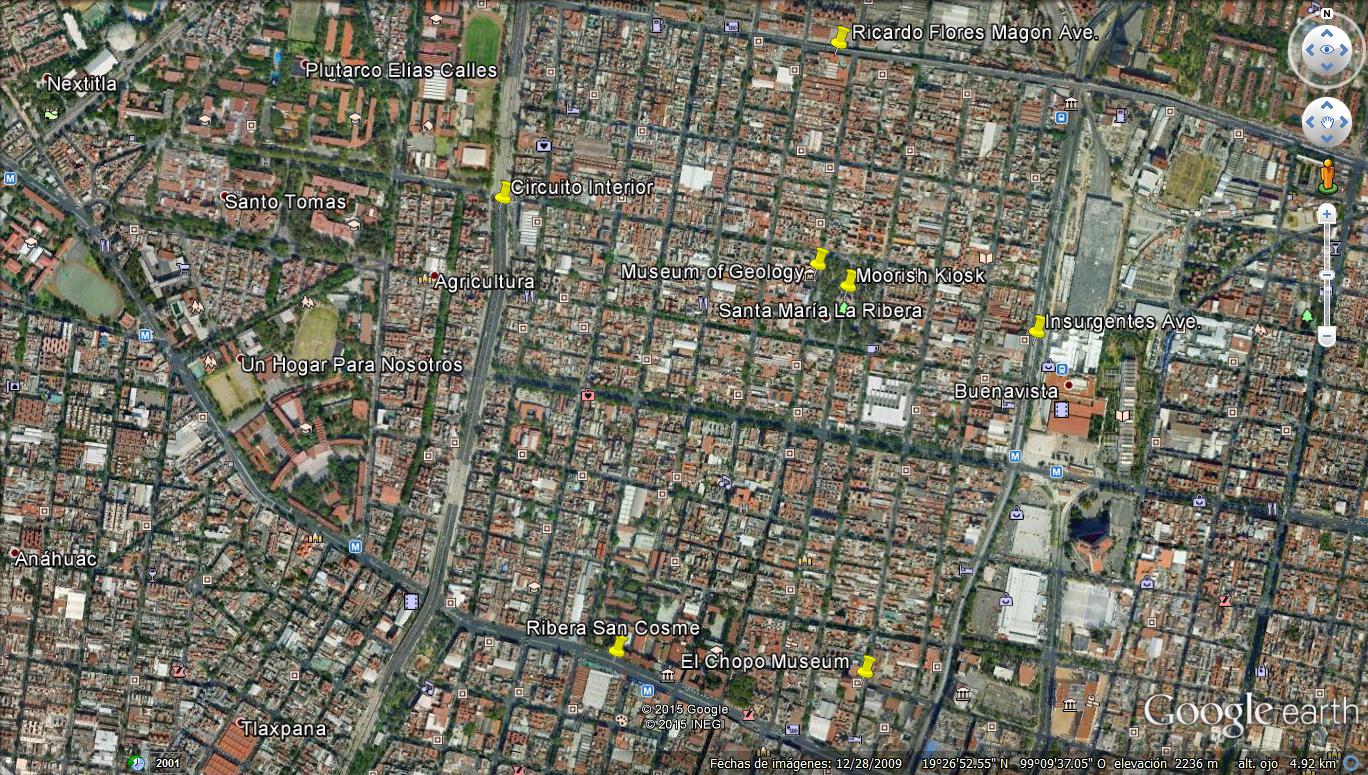
Santa Maria la Ribera is bounded on
the north by Avenue Ricardo Flores Magon,
the east by Insurgentes Ave.,
the south by Ribera San Cosme,
the west by Circuito Interior,


Delegación Cuauhtémoc
The "Porfirian" colonias line the west side of Delegación Cuauhtémoc
From north to south they are:
Santa Maria la Ribera (violet)
San Rafael (medium pink)
Cuauhtémoc, (medium blue triangle)

South of Paseo de la Reforma
Benito Juárez (horizontal triangle of three adjacent pink sections)
Roma Norte (light blue) (Doctores, to the east, is a separate colonia)
Roma Sur (darker blue)

And to the southwest (lower left):
Condesa (medium pink)
Condesa Hípódromo (dark pink)
Hípódromo (pale pink)

Centro, and its five sub-divisions (Historico, north, east, south, west)
 is to the right center (almost white)

Monday, May 18, 2015

The Porfiriato: French Culture Conquers Mexico City

Porfirio Díaz

French Aesthetics Come to Mexico

After the Spanish Colonial period, and until the current era of global-style, post-modern construction, the architectural heritage of the Porfiriato, the thirty-five year period of the dictatorial presidency of Porfiro Díaz, (1877-1911), is the second most important era for shaping the look and ambience of the center of Mexico City.

Díaz undertook to turn the City into one modeled after Paris. He turned Paseo de la Reforma into a French-style boulevard, with monumental statues at major intersections, and he ordered the construction of many major government and civic buildings in the Historic Center. Wealthy Mexican and foreign businessmen built luxurious homes, which mimicked the styles of European royalty and the wealthy bourgeoisie, along Reforma and in new colonias, neighborhoods, to the north and south of it.

Angel of Independence,
Neo-classic momument modeled after Nike, the Greek goddess of Victory,
erected on Refoma by Porfirio Díaz
to commemorate the 100th anniversary of the initiation of
the War of Independence in 1910.

Former mansion on Reforma
 is now a bank branch
Photo: JRB

(left click to enlarge any photo)


Mini-"castle" on Reforma being demolished
for replacement by a skyscraper
Photo: JRB


It is another one of those curious, seemingly paradoxical Mexican stories how European esthetics, and particularly that of the French Second Empire of Napoleon III (1852-1870), came to be recreated in Mexico under Díaz' leadership. He was a mestizo (mixed, Spanish and indigenous) who, like Benito Juárez, came from the southern state of Oaxaca. Even more paradoxically, he had been a leading general in the War of Reform and the war against the French Intervention, instigated by that very Napoleon, a president who had turned himself into an emperor.   

From Humble, Provincial Beginnings

Porfirio Díaz was born Sept. 15, 1830 in Oaxaca City, Oaxaca. His mother, Petrona Mori, was the daughter of a Spanish immigrant and Tecla Cortés, an indigenous woman. Díaz's father, José de la Cruz Díaz was a criollo [pure Spanish, born in New Spain] and a modest innkeeper who died of cholera when his son was three.

Despite the family's difficult circumstances following the death of his father, Díaz was sent to school at age 6. The Díaz family was devoutly religious and, at the age of fifteen, Díaz began training for the priesthood at the Colegio Seminario Conciliar de Oaxaca, but important national events intervened. During the Mexican American War/U.S. Invasion of Mexico (1846-47), seminary students volunteered as soldiers to repel the U.S. invasion. Although he did not see action, Díaz realized that his true vocation was not the priesthood, but the military.

Díaz Joins Liberal Democrats

Also in 1846, Díaz came into contact with Marcos Pérez, a leading Oaxaca liberal, who taught at the secular Institute of Arts and Sciences in Oaxaca. Benito Juárez, who became governor of Oaxaca in 1847, had been a student there. Díaz met Juárez that same year. In 1849, over family objections Díaz abandoned his ecclesiastical career and entered the Institute to study law. 

When Antonio López de Santa Anna returned to power via a coup d'état in 1853, he suspended the 1824 Constitution and persecuted liberals seeking to re-establish the Constitution and democratic government. At this point, Díaz had aligned himself with radical liberals (rojos), such as Juárez, who was forced into exile in New Orleans. Díaz supported the liberal Plan of Ayutla that called for Santa Anna's ouster. Evading arrest, he fled to the mountains of northern Oaxaca, where he joined the rebellion of Juan Álvarez. 

During the War of Reform, the civil war of autocratic conservatives against the liberal, democratic government of Benito Juárez, Díaz became a colonel. In the subsequent War of the French Intervention, he participated in or led several crucial battles and was promoted to general. After the defeat of the French, the execution of Emperor Maximilian I and the return of the Juárez goverment to Mexico City in 1867, Díaz returned to private life in Oaxaca.

Díaz Switches Sides

In 1870, Díaz ran as a presidential candidate against President Juárez and Vice President Sebastián Lerdo de Tejada. He claimed fraud in the elections won by Juárez, and, in typical caudillo, military strongman, style, he announced a rebellion, the Plan de la Noria on November 8,1871, but this rebellion failed. Following the death of Juárez in 1872, Vice President Lerdo became president. Lerdo offered amnesty to rebels, which Díaz accepted and took up residency in Veracruz. In 1874, Díaz served in the federal legislature, representing Veracruz.

In 1875, Díaz left Mexico and went to New Orleans and then to Brownsville, Texas, to plot a rebellion. In 1876, he announced the Plan of Tuxtepec (a town in Oaxaca) as a call to arms against Lerdo, who was running for another presidential term. Lerdo was re-elected in July 1876, but the rebellion forced Lerdo from office. In November 1876, Díaz occupied Mexico City, and Lerdo went into exile in New York City. Díaz did not take formal control of the presidency until the beginning of 1877, placing General Juan Méndez as provisional president, until new presidential elections in 1877 officially gave Díaz the presidency.

The Thirty-Five Year Porfiriato

Diáz got himself "re-elected" president of Mexico over a thirty year period (1877-1911). For the upper-class, it was an era of political stability, industrialization and economic growth. For lower classes, it was a time of exclusion and suppression of protests. Díaz maintained control through "Pan o palo", "bread or a stick", an informal system based on personal loyalty using patronage and repression. His motto was "little politics and plenty of administration." The epoch was to end suddenly with the outbreak of the Mexican Revolution in 1910, when various forces of social, political and economic opposition exploded.

A Francophile City

Our focus is on the architectural identity Díaz and his supporters brought to the center of Mexico City. Perhaps most emblematic of this, Chapultepec Castle, with its Napoleonic ghosts of Emperor Maximilian, was, itself, transformed by Díaz into his summer palace, with the addition of such improvements as ornate Art Nouveau stained glass windows.

Diana, the Huntress
Photo: JRB


Strolling through the colonias built during the Porfiriato you almost feel that you are in some arrondissement of Paris, or, at least, in a tropical replica of the French capital. In subsequent posts, we will visit several of them: Santa Maria Ribera, San Rafael, Roma and Condesa. 

Entrance to mansion in Roma,
now University de Londres


Mansion in Benito Juárez,
now the Wax Museum
Photo: JRB

Houses in Santa Maria de Ribera
Photo: JRB

Window of apartment in San Rafael
Foto: JRB


But first, we will return to the Centro Histórico to explore the Neo-classic, Beaux Arts and Art Nouveau aesthetics of such Porfiriato constructions as the Museo Nacional de Arte (National Museum of Art), the Palacio de Correos (yes, a post office that is a palace), the Alameda Central park, the Palacio de Bellas Artes (yet another palace) and commercial buildings of the epoch.