Showing posts with label Vasco de Quiroga. Show all posts

Saturday, August 24, 2019

Original Villages | San Lorenzo Acopilco, Cuajimalpa: Rural Pueblo in the Forest

We did it! We made it to a fiesta in Delegación/Alcaldía Cuajimalpa, the last of the sixteen delegaciones/alcaldías comprising Mexico City that we have visited!

Delegación/Alcaldía Cuajimalpa lies on the far west side of the City and sits atop a ridge in the Sierra de las Cruces mountain range. Its average altitude is 9,000 ft (2,750 meters) above sea level — that's about 2,000 ft. above the Valley floor. The top of the ridge is at 10,000 ft. (3.050 meters).

Before the Spanish arrived, the Tepaneca of Azcapotzalco (which we just visited, also for the first time) had established villages in the mountains — dedicated mostly to cutting firewood and making charcoal for sale to pueblos in the Valley of Mexico below.

Delegación/Alcaldía Cuajimalpa
is the light magenta area on the west side
of Mexico City.

Getting to Cuajimalpa


The fiesta that we attend on a Sunday in early August is that of San Lorenzo Acopilco. We are extremely fortunate that one of our regular taxi drivers, Sr. Sánchez, who has transported us to many fiestas around the city, is quite willing to undertake the hour-long drive from our base in Coyoacán, in the center of the city, up into the mountains and to seek out San Lorenzo Acopilco. Between my Google map and Sr. Sanchez's knowledge of the route to Cuajimalpa, we arrive in the delegación without difficulty.

However, it is a little more difficult to find San Lorenzo Acopilco. It sits at the southern end of the populated portion of the delegación. Like other delegaciones that rise into the mountains, the southern portion of Delegación/Alcaldía Cuajimalpa is forest preserve. Also, the road signage isn't clear, so Sr. Sánchez stops and asks people by the roadside for directions. At one point, it means learning which road of a Y to take. It is the one to the left, which leads to a larger highway that eventually goes down the mountains to Toluca, the capital of the adjoining State of Mexico.

Soon we enter the tall, dense pine forest and seem to have left civilization behind. Just as we are wondering if we missed the turnoff for San Lorenzo, we see a good-sized sign saying "Acopilco" and pointing to a narrow road running uphill and deeper into the forest. (Afterward, we wish we had taken a photo of this roadway through the evergreens. It was difficult to believe we were still in Mexico City.)

View of the forest from San Lorenzo Acopilco.
The pueblo, at 10,000 ft. (3050 meters) is one of the two highest in Mexico City.
The other is to the south, on the slopes of Mt. Ajusco in Delegación/Alcaldía Tlalpan
.

Not far up the hill, we start to encounter houses. We have entered San Lorenzo, but we still have to find Avenida de las Flores, the street leading to the church. People along the roadside tell us we have just passed it, so we turn around and quickly come to the avenue — actually a narrow street typical of old pueblos and barrios. We head further uphill until we come to an intersection where — as is typical for fiestas — the road ahead is closed.

So we pay Sr. Sanchez, along with a sizeable tip for the quite herculean task he has undertaken to get us here and because he has a long, passengerless trip back to his company's taxi sitio (stand) in Coyoacán. We also thank him profusely for making it possible for us to finally get to Cuajimalpa and the fiesta of San Lorenzo Acopilco.

The Churches of San Lorenzo Acopilco


Walking a short distance uphill, we come to the town plaza. Several rows of folding chairs are lined up in front of a kiosk which is decorated with a floral portada and occupied by statues of the Virgin Mary and Jesus. A statue of San Lorenzo (St. Lawrence) stands to one side. Evidently, this is where the fiesta Mass is to occur.

The lettering on the floral portada says,
"San Lorenzo, thank you for your blessing."

The portada is made with fresh mums.

The Virgin Mary and Jesus as Cristo Rey, Christ the King.

San Lorenzo, St. Lawrence,
was 
martyred by Roman Emperor Valerian in 258 CE
by being roasted on a grill.
As with all martyrs,
he holds the tool of his martyrdom in his hand;
the grill is hidden behind the bouquet of flowers.
 

Behind the kiosk, we can see the top of a church dome, as well as the bell tower of a second church. They are evidently in an atrio (atrium) about a half-story below the town plaza. To the right of the kiosk is a low bandstand where a wind band is enthusiastically playing to entertain the few people in the plaza.


Further to the right, we see a ramp leading down to the churches. A house — evidently the church offices — sits at the bottom of the ramp, next to the second church. We are disappointed to find the entrance to the atrio cordoned off with chicken wire, so it cannot be entered.

At that moment, a woman coming from the office approaches to tell us both churches are closed because they were severely damaged in the major earthquake of September 2017. We express our sorrow for the damage, which we have encountered in other churches, and our regret that we are unable to see inside either one. 

Original chapel, built in 1536,
making it, remarkably, one of the oldest remaining Colonial buildings in Mexico.

Later, in research, we learn (from Spanish Wikipedia) that the first, smaller chapel was built only fifteen years after the Conquest, under the direction of Don Vasco de Quiroga, about whom we know much from our time living in Pátzcuaro, Michoacán. He was a member of the Second Audiencia, a commission sent by King Charles I (Holy Roman Emperor Charles V) in 1530 to govern Nueva España, thus replacing a badly functioning First Audiencia whose leader, Nuño Beltrán de Guzmán, turned into a conquistador and ravaged the western part of Nueva España, including the Purépecha people of Michoacán, searching for gold the inhabitants did not have.  

De Quiroga, a church lawyer, was immediately struck by the abuse the indigenous people were enduring from the conquistadores who, under Hernán Cortés' initiative, were seizing their land as encomiendas, land grants. The native people residing on these lands were forced to work for the encomenderos, the grant-holders. Quiroga left the Audiencia in 1532 to begin to set up "hospital" towns, refuges modeled on St. Thomas More's book Utopia (published in 1516), where the indigenous could live safe from abuse. The first hospital town he established was in the Sierra de las Cruces which he named Santa Fe (Holy Faith). The pueblo still exists not far from San Lorenzo. The chapel here is only four years younger than Quiroga's first in Santa Fe. Unfortunately, the one in Santa Fe has been destroyed, but we still want to visit the pueblo someday.  

Subsequently, Quiroga was made a bishop and sent to Michoacán to try to restore an orderly, autonomous life for the Purépecha people who had been ravaged by de Guzmán. There, he established another Santa Fe del Lago on Lake Pátzcuaro, and several other towns into which the indigenous were gathered. He had the residents of each town assigned a craft with which they could make a livelihood, as their lands had been taken as encomiendas. He is still highly revered by the Purépecha of the pueblos he established. They affectionately call him Tata Vasco, Papa Vasco. Each pueblo still makes the craft he assigned them. We have many of their artesania (criafts) in our apartment, reminding us daily of the Purépecha and Tata Vasco. 

The second, "newer" and larger church was built in 1771, in Neoclassic style.

The Fiesta


Returning to the plaza and passing the church office, we see an announcement posted on its wall listing fiesta activities. We have been looking for this. It tells us that a cuadrilla (cuah-DREE-yah) de arrieros, a team of mule drivers, is to perform in the plaza at 10 AM.

We encountered arrieros for the first time not long ago at three fiestas, two in Tlalpan, also in the mountains, and the other in Coyoacán, where they were visitors from Tlalpan. The cuadrillas of mule drivers were evidently centered in these mountain pueblos, as they were on the trails from Mexico City to other cities in Nueva España and continued to be the means of commercial transportation for four hundred years, until the 20th century, when they were replaced by trucks and highways. 

The announcement also tells us that a procession has begun at 9 AM on the outskirts of the pueblo to welcome other pueblos coming to attend the fiesta Mass. It is now winding its way through the streets for three hours before arriving in the plaza for the noon Mass. We will await its arrival.

The Castillo


While we are waiting for the arrieros to arrive, we watch the construction of the castillo, a "castle" tower on which elaborate fireworks displays will be ignited after dark as the climax of the fiesta.

Construction of the castillo is fascinating. As tall as they may be, they are always built the day of the fiesta and always finished in time. Even more fascinating, they are built from the bottom, using a power winch to lift wooden box frames that are stacked one upon another and simply tied together. As the winch lifts the growing tower of boxes ever higher, a worker slides one frame after another underneath.


Various shaped constructions, loaded with fireworks
are then raised and attached to the frame.
When lighted, they will also spin
.

The castillo nears completion.
A second, smaller castillo rises to the left rear.

Professional companies construct the castillos.
This one says, "Illuminating the heavens with art.
Pyro(technic) Art and Fire."
Note, it honors the Virgin of Guadalupe.
One entire town in the State of Mexico is
dedicated to producing these pyrotechnic displays.
With all the fiestas in the Valley of Mexico, they are kept busy.

Arrieros


Soon, and suddenly, the cuadrilla of arrieros enters the plaza, led by men on horseback. The horses are another reminder that parts of Mexico City are still rural and retain traditions from before our contemporary times. 

Cowboys lead the way.

La cuadrilla de los arrieros enters in double file.

They bring their patron saint, Jesus Christ as Cristo Rey, Heavenly King.

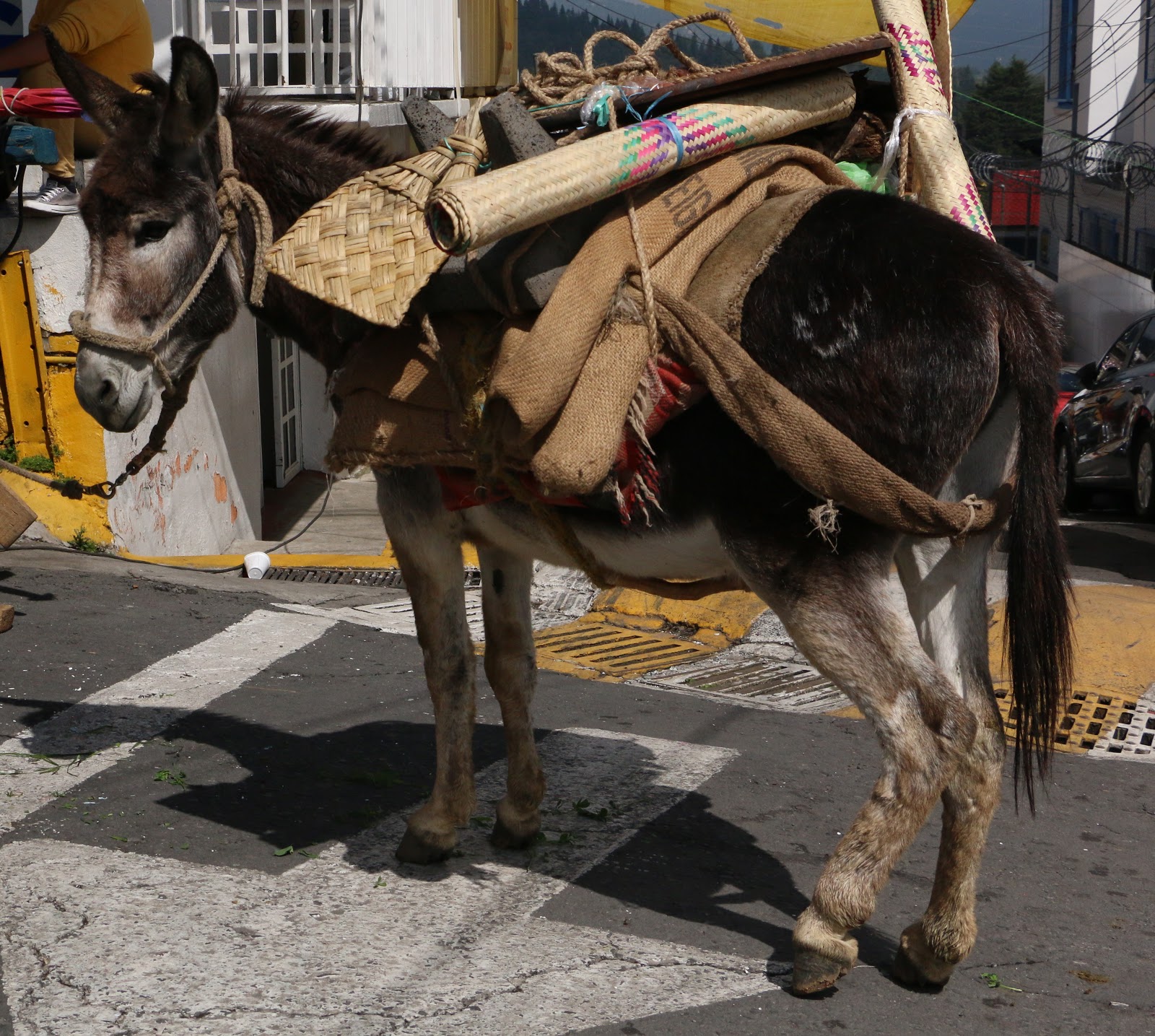
A burro follows, bearing several items,
evidently to be used in the ceremony.
We recognize a large pottery platter for food;
a gray metate, the curved stone used for thousands of years
for grinding corn, as the first step in preparing masa, dough,
for making tortillas, tamales and atole, a corn-based drink,
and some firewood.
We saw the ceremony of 
some previous arriero
 
 dancers end with the preparation
of food to share with the community.

On a stage at the west end of the plaza,
a mariachi band provides music for the arrieros' dance.

The dance begins.
The dancers move in two rotating, narrow ovals
to the front and then to the back.
It is a simple, four-beat rhythm

The leaders.
The leaders' attire 
 a skirt over the traditional pants, all of white manta
 muslin — is different from what we have seen with other arrieros.

The attire is also quite elaborately embroidered.
One leader is dressed in "Western" cowboy attire.

Women, in charro dresses, a more elaborate style of cowgirl attire,
remain dancing at the rear of the men's lines.


Even the youth are really into the dance.

Some of the embroidery,
a traditional Mexican art.

After a considerable time dancing, two of the leaders, dressed in cowboy attire,
then carry on a long, formalized dialogue
which seems to have to do with the need of the cuadrilla to prepare to feed the community.

The burro is brought forward.
The metate hangs upside down on the right.

A fire has been built and a huge metal cauldron placed on top of it.
Atole, a corn-based drink that can be flavored in many different ways, is being prepared
to share with everyone who comes to the fiesta Mass.

Fiesta in the Pueblo's Main Street


As the arrieros engage in preparing the atole and noon is approaching, we decide to walk from the plaza along the pueblo's main street, a typically narrow calleja (cah-YEH-hah), hoping we will run into the procession that is out there somewhere in the labyrinth of similar streets.

Main calleja running along the flat top of the mountain ridge.
Typically, it is lined with temporary puestos, stalls, selling cooked meals for fiesta attendees.
We wonder how the procession will manage to wend its way through,
but we know from past experiences, that they always do.


Flowers are also for sale for people to purchase and take to the Mass to honor San Lorenzo.

Papel picado, cut paper, hangs above the street.
Its colors are those of San Lorenzo.

The Procession


We stop at one of the puestos selling pizza and buy a slice, with pepperoni. As we are eating, we hear from a nearby side street the sound of cohetes, the rocket-style firecrackers used to announce the progress of the procession. So we hurry to the corner just in time to meet the procession as it arrives at the main street. Fortunately, it stops to rest, so we are able to rush ahead in order to get into position for the best photos.


San Lorenzo (upper left) leads the way.
Following are the Virgin of Guadalupe, the Lord of the Garden of Gethsemane
(on the night before Jesus's crucifixion),
and the Virgin of Candelaria
(Feb. 2, Forty Days after Jesus' birth when he was presented at the Temple in Jerusalem).

Standards and statues representing various pueblos, including
Las Cruces, San Jose, San Miguel follow.
The Christ is the Christ of the Sacred Heart

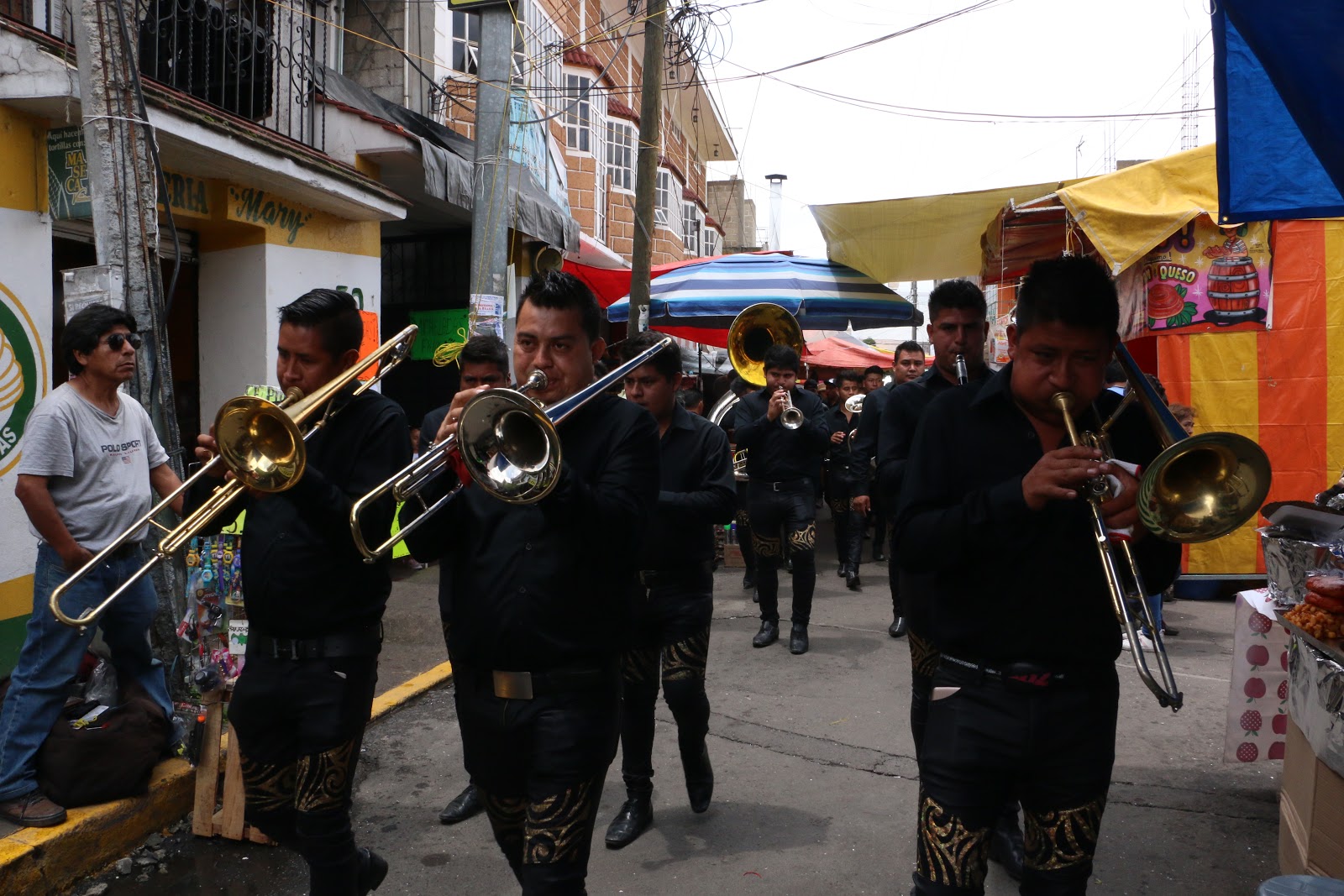
Finally, comes la banda, keeping everyone moving to its rhythm.


The tuba always brings up the rear.
It is actually a Sousaphone,
as the player in one banda informed us,
an invention of John Philip Sousa
making the orchestral tuba portable
for marching bands.

It is our favorite instrument,
as it is the foundation that keeps the beat.

Satisfaction in Coming Full Circle


The procession moves on to the plaza for the celebration of the Mass. By this time, we are tired but very satisfied. We have sought for a long time to make it to Delegación/Alcaldía Cuajimalma, the most distant and difficult to reach from our home in Coyoacán and, therefore, the last of the sixteen delegaciones/alcaldías we have visited. Today, finally, with the help of driver Sr. Sánchez, we have succeeded in arriving. 

San Lorenzo Acopilco, surrounded by evergreen forests, reminds us very much of pueblos in the similarly forested Meseta Purépecha, the Purépecha Highlands, in the state of Michoacán, where we lived for three years before moving to Mexico City. Furthermore, we are awed that here, in San Lorenzo Acopilco, totally unexpectedly, we have also encountered one of the first chapels built by Don Vasco de Quiroga before he moved on to seek to protect the Purépécha people in Michoacán. We feel that, in some way, we have come full circle, both from the beginning of our ambles to the originally indigenous pueblos in the sixteen delegaciones/alcaldías of Mexico City but also back to the realm of Tata Vasco

Now we just need to find a taxi to take us back to Coyoacán. A bit nervous, being so far from home, in an isolated pueblo in the mountains, we ask a couple who are selling food on the street if there is a taxi sitio nearby. They smile and reply, "¡Oh, sí! Todo derecho." | Oh, yes, straight ahead, at the bottom of the hill where the main street ends. So, relieved, we walk down the hill and there, at the intersection of the main street with the road that comes in from the highway, are a number of taxis waiting. We ask the first driver if one of them will take us all the way to Coyoacán, wondering whether they will want to go that far or, perhaps, just take us to the main west-side bus station called Observatorio where we know we can get another taxi. He says, "Sí" and that it will cost us 200 pesos, about $10. Sr. Sánchez's meter had charged us more than 300 pesos, so this is a bargain. He points us to one of the cabs. We greet the driver and tell him where we are going, get in, and we are off for home in the center of the City and the modern world. 

Delegación/Alcaldía Cuajimalpa
Its Pueblos and Colonias.

San Lorenzo Acopílco
is marked by the red/yellow star.
The colonias south of it are modern development
s.

The State of Mexico is immediately to the west. 
Delegación/Alcaldía Álvaro Obregón is to the east. 

Thursday, September 13, 2018

Coyoacán: Indigenous Purépecha Traditions of Michoacán Live On in Colonia Ajusco

Meeting Old Traditions in New Neighborhoods


During our ambles to the original indigenous villages in Mexico City that existed before the Spanish Conquest, we have encountered—and written about—barrios populares, working class neighborhoods, that are virtually indistinguishable in their architecture, daily life and communal religious fiestas from those with indigenous origins. Indistinguishable, that is, with one notable exception: they lack churches dating back to the 16th century. In fact, these neighborhoods are 20th century creations and their church buildings are modern. The story of how they came to be, but maintain traditional identities is fascinating.

We first encountered these neighborhoods in the summer of 2017, at a fiesta in Colonia Pedregal de Santo Domingo and then later that fall at a fiesta in neighboring Colonia Ajuscoboth in Delegación CoyoacánBoth fiestas were large in scope, with all the traditional elements: an abundance of visiting saints on their flower-bedecked andas (platforms), multiple bandas and comparsas (dance groups), and of course, cohetes (rocket-style firecrackers) announcing the fiesta for miles around.

The modern church of  Los Dos Fundadores, The Two Founders
(St. Francis and St. Domingo,
founders of the first two religious orders that came to Nueva España  in the 16th century
to convert the indigenous to Spanish Catholic Christianity.)
Colonia Pedregal Santo Domingo, Coyoacán.

Fiesta de San Francisco (front) and Santo Domingo (rear, to left of Virgin Mary)
Colonia Pedregal de Santo Domingo, Coyocan;
preparing to receive El Señor de la Misericordia, the Lord of Compassion,
from neighboring Colonia Ajusco.
He will be placed under the golden canopy when He is received from Colonia Ajusco.

Fiesta del Señor de los Milagros,
The Lord of Miracles, patron saint of a church of that name in
Colonia Ajusco, Coyocán

We doubted that either Colonias Santo Domingo or Ajusco were original indigenous pueblos. From our research, we learned that both had been created by squatters coming mostly from rural Mexico as a result of population pressures in the 1960s and 70s. Our page, How Mexico City Grew From an Island to a Metropolisdescribes this internal migration more fully.

The short version is that the land was available because it was pedregal, stony ground, lava rock from a volcanic eruption of a small cinder cone volcano called Xitle in the first century CE. Consequently, the area remained barren and unoccupied until the late 20th century, when rural migrants, utterly without resources, established squatter settlements on the pedregal.

Over the years, with Mexican ingenuity, these squatters developed their settlements into working-class neighborhoods that became part of the urban landscape. Eventually, the Federal District/Mexico City government accepted them as de facto neighborhoods needing formalization of property rights and urban services. So, today, as we said, they are virtually indistinguishable from the ancient Pueblos Los Tres Santos Reyes, (Three Holy Kings) and Candelaria immediately north of them.

Rural, Indigenous Mexicans, Moving to the City, Bring Their Traditional Faith With Them


As for the continuity of traditional communal religious customs, a good article on Colonia Ajusco in Wikipedia en español referenced an academic paper specifically on the religious institutions and life of AjuscoEl Pluralismo Religioso en la Colonia Ajusco (México, D.F.) ("Religious Pluralism in Colonia Ajusco, [Coyoacán], Federal District").

Its author is Dr. Hugo José Suárez, a professor of sociology at UNAM, the National Autonomous University of Mexico, whose University City campus, not coincidentally, is located on the Pedregal of Coyoacán, immediately west of Santo Domingo and Ajusco.
The paper has also been published as a freely downloadable book, full of illustrative photos, Ver y Creer: Ensayo de sociología visual en la Colonia Ajusco (Seeing and Believing: Essay of Visual Sociology in Colonia Ajusco). Dr. Suárez uses his own photos to illustrate his observations about Ajusco. Depicting the everyday life of the community, they are worth looking at.
Dr. Suárez documents the origins of Ajusco (and its neighbor, Pedregal de Santo Domingo), beginning with the occupation of some of the barren pedregal by people from the neighboring, originally indigenous Pueblo Candelaria in the 1950s. Then, a second wave took place in the 1960s as a result of the country's population explosion when people flooded in from rural Mexico.

They, of course, brought their traditional religious practices with them, what Dr. Suárez and other students of Latin American Catholicism call religión popular, religion of the people. It is not organized and managed by priests. It is organized and maintained over the years by mayordomía (chief caretakers), a committee of lay persons who, in reality, run the everyday life of the congregation and lead its activities in the community. As a result of our increasing experience and understanding of this religión popular, we have written a group of posts under the heading Mexican Traditional Popular Religion, to look at and share its essential elements and how it is maintained via rituals such as patron saint fiestas.
(For more on Mexican, and Latino, popular (i.e. of the people) Catholicism see the work of Latino Catholic theologians Roberto Goizueta, "The Symbolic Realism of U.S. Latino/a Popular Catholicism" (online PDF) and Orlando Espín, "The Faith of the People: Reflections on Popular Catholicism" available at Amazon.com)

Indigenous Purépecha of Michoacán in Colonia Ajusco, Coyoacán, Mexico City


Dr. Suárez then gave us a complete and wonderful surprise. He tells us that one sizable group that moved into Colonia Ajusco was from the indigenous Purépecha pueblo of Nahuatzen, in the area known as la Meseta Purépecha, the Purépecha Highlands, just west of Lake Pátzcuaro, in the southwestern state of Michoacán.

Michoacán is the magenta colored state on the southwest coast of Mexico, 
just south of Jalisco (yellow).
Lake Pátzcuaro, the Puerpecha Meseta and the state capital of Morelia 
all lie near its north-central border.

Mexico City is the small red area to the east of Michoacán.
The State of Mexico is the light blue area between Michoacán and Mexico City.

Pátzcuaroat the southern end of Lake Pátzcuaro (left center),
was originally a Purépecha village founded in the 1320s.
In 1553, the King of Spain declared it an official Spanish City.

Nahuatzen sits 
to the northwest, among the hills of the Meseta Purépecha. 


Morelia, in the far northeast corner, was established in the 16th century by the Spanish
as the city of Valladolid. After Independence was gained in 1821, its name was changed

 to honor native son and hero of Independence, José María Morelos,
and is the capital of the state of Michoacán. 

To us, Dr. Suárez's revelation was an immeasurable gift.  As we have commented in various posts, before moving to Mexico City in 2011, we lived in Pátzcuaro, Michoacán, for three years. We know and love la Meseta. 

It is a beautiful region of pine-forested mountains and verdant valleys, with cows and horses, sheep and goats grazing in green fields, and small villages. Their churches from the 16th and 17th centuries feature ceilings completely covered with scenes of Heaven. The women dress in incredibly elaborately pleated skirts, embroidered blouses and dark blue rebozos (wool shawls). The men are vaqueros, cowboys. 

A goodly number of times, we visited the pueblos of the Meseta, including Nahuatzen, as well as many around Lake Pátzcuaro, attending many of their fiestas, reading about their history, and seeking to gain as much understanding as we could of this indigenous people. 

The Purépecha are literally a unique ethnic group, as their language is an isolate—that is, it is not related to any other indigenous language in the Americas or in the world, thus indicating that their ancestors arrived in their own, unique migration from Asia. By around 1300 CE, they had developed urban centers such as Pátzcuaro, and begun to expand control over much of what is now southwestern Mexico. Their expansion took place in virtually the same period that the Mexica/Aztec were coming to power in the Valley of Anahuac, now the Valley of Mexico.

La Meseta Purépecha,
Michoacán

Ceiling of Church of Santiago, St. James the Apostle,
in Nuria, Meseta 
Purépecha Highlands,
Michoacán, dating from 1639.
A number of churches on the Meseta have painted ceilings that are treasures of art
and of the history of the Spiritual Conquest.

Purépecha señoras outside Church of Santiago, St. James,
Pueblo Nuria, 
Meseta Purépecha, Michoacán 


We attended many Purépecha fiestas and purchased many pieces of their artesanía (handicrafts), which continue to colorfully enliven our apartment in Mexico City and remind us daily of a dramatically different Mexico.

Fiesta of Santa Cruz, Holy Cross
May 3, Pátzcuaro, Michoacán

Some of these artisans became friends and invited us to their fiestas and into their homes. One of our spouse's Spanish teachers was Purépecha. Through another Spanish teacher, we made friends with two adolescent Purépecha brothers, one in university, the other in high school, who sought help practicing their English, and we then met their father, who was a traditional curandero, healer, and botanist researching the native plants of the region.

They invited us to their home in Pueblo Ucazanastacua, Ucaz for short, on the lake shore, to participate in their annual fiesta. There we met and were served a meal by mother and older sister, a recent teacher's college graduate. As the pueblo's patron saint is el Espírito Santo, the Holy Spirit, the fiesta is held on the weekend of Pentecost Sunday. Coming seven weeks after Easter, it marks the day when the Holy Spirit, symbolized by a dove, descended as flames upon the heads of the disciples of Jesus the Christ, after He had Ascended to Heaven, inciting them to carry on His preaching of the Gospel, the Good News, that the Kingdom of God was present among those who repented their sins and accepted Christ as their Savior from Sin and Death.

Purépecha señora,
during Mass,
Fiesta del Espírito Santo
Pueblo Ucazanastacua, Michoacán

La Mayordormía of the fiesta of Ucazanaztacua
Our friend and host, Jorge Cira, far left, was mayordomo, head of the organizing committee

Dragon alebrije, swallowing three devilish angels,
 molded from clay,
 from Ocumicho, Meseta Purépecha.
in our Mexico City apartment

The Purépecha and the Catholic Spiritual Conquest: the Unique Bishop Don Vasco de Quiroga


The Purépecha remain very traditional Catholics. They were evangelized by Don Vasco de Quiroga, a Spanish church lawyer who was sent to Nueva España by King Charles as a member of the Second Audiencia, governing council.

Sympathetic to the plight of los indios at the murderous hands of the conquistadores, Quiroga specifically became a bishop to implement a plan of establishing 'hospitales', i.e., refuge towns, modeled on the vision in Sir and St. Thomas Moore's Utopia. The first 'hospital' he established was in the mountains west of Mexico City (now Pueblo Santa Fe, Holy Faith, in Delegación Álvaro Obregón).

Quiroga then became the first bishop of Michoacán, which had been ravaged by Nuño Beltrán de Guzmán. Sent to Nueva España by King Charles as head of the first Audiencia to counter the de facto power of conquístador Hernán Cortés with an authority directly appointed by the Crown, Guzmán instead turned himself into another conquístador, attacking indigenous peoples in the west, including the Purépecha, who had actually surrendered to Cortés when they learned he had defeated the Mexica/Azteca (even though the Mexica/Azteca had never been able to conquer them, a fact of which they are still very proud).

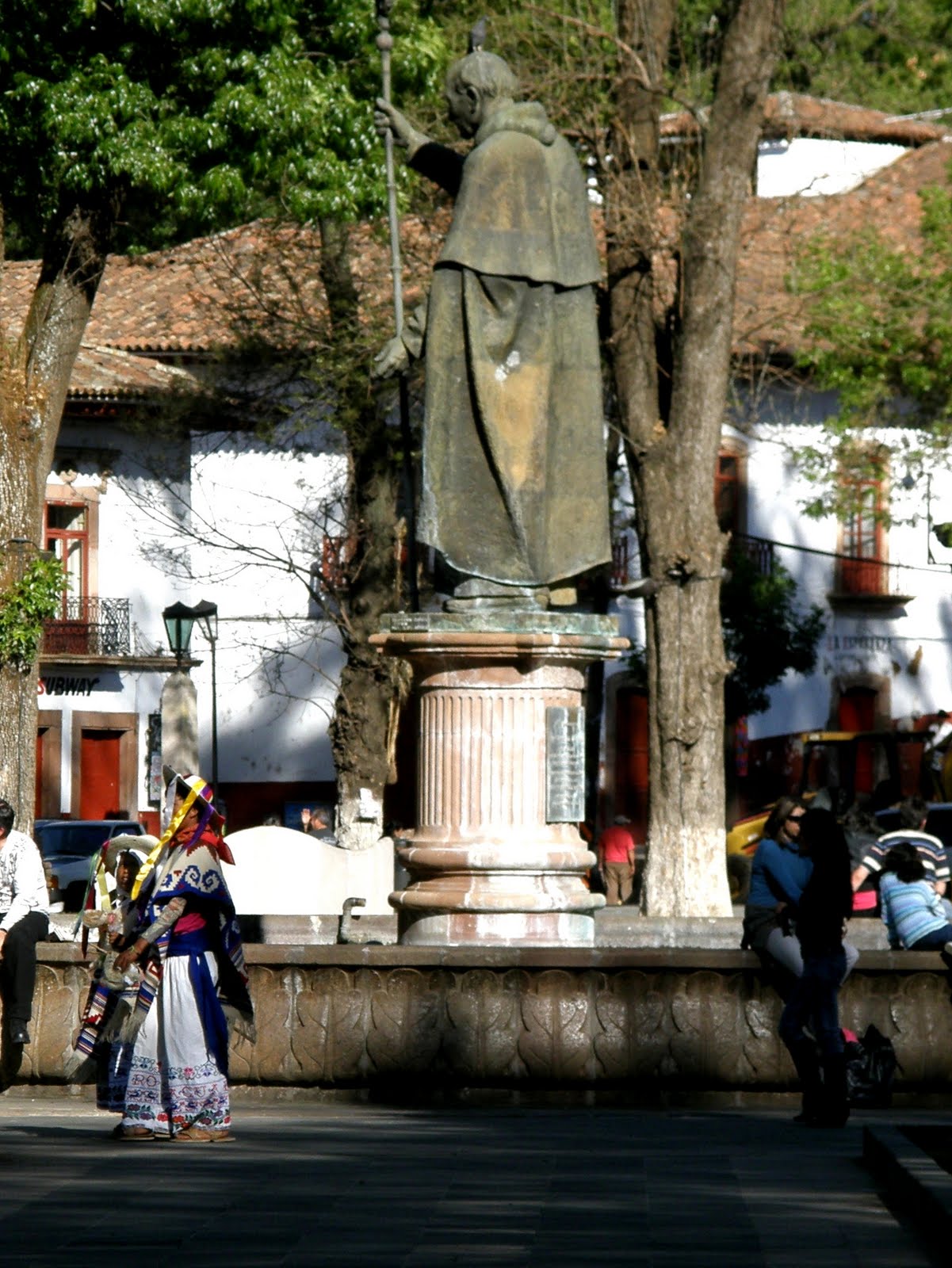
Statue of Bishop Don Vasco de Quiroga,
in the Plaza Grande, Pátzcuaro, Michoacán.

Person in left foreground is a viejito, "little old person" 
a traditional Purépecha dancer.

Bishop Quiroga established hospital pueblos around Lake Pátzcuaro, the first being another Santa Fe, Santa Fe del Lago, Holy Faith of the Lake, where the indigenous were gathered to be protected from the conquistadores, evangelized and taught trades to maintain themselves. To this day, Don Vasco is revered by the Purépecha people, who affectionately, respectfully, call him "Tata Vasco" (Father Vasco). His remains are buried in a crypt in Pátzcuaro's Basilica of Nuestra Señora de la Salud, Our Lady of Health, which he had built.

The Purépecha gave significant support to the Cristeros, fervent Catholics in western Mexico who rebelled against the government in what is known as the Cristero War (1926-29). The Faithful were provoked by President Plutarco Elías Calles when he sought to enforce the anti-Catholic articles of the 1917 Constitution, which had not previously been seriously implemented. Calles had laws passed severely limiting the number of Catholic priests allowed in the country and prohibiting worship (hence fiestas) outside of churches.

We recall being told by a resident of Ucazanaztacua how the pueblo protected the local priest by hiding him in a cave (now a small chapel). Masses were celebrated at night, with worshipers arriving via canoe from other pueblos around the lake.

It is the children of that generation who moved to the pedregal of Ajusco in the 1960s. Over the next two decades, other Purépecha from Nahuatzen migrated to Ajusco  and they brought their intense faith with them.

Purépecha Fiesta from Nahuatzen, Michoacán in Colonia Ajusco, Coyoacán, Mexico City


Serendipitously for us, Dr. Suárez's article informed us that each August, the Purépecha community in Ajusco, now consisting of grandparents, parents and grandchildren, celebrate the fiesta of San Luis Rey, King St. Louis (of France) who is the patron saint of the pueblo of Nahuatzen(The community has a Facebook page, Fiestas y Tradiciones de Nahuatzen, which features photos of San Luis Rey and His fiesta, centered on His feast day, August 25.) The celebration in Ajusco is deliberately held a week ahead of the one in Nahuatzen, so those from either pueblo who desire can attend both.

When we learned of this, we became determined, ¡Ojalá! (the Force be willing), to attend this Purépecha fiesta in August 2018.

We had no further information about the Fiesta beyond Dr. Suárez's statement that it takes place a week ahead of August 25. That meant that in 2018, the fiesta would be held the weekend of August 18 and 19. He also tells us that it is held at the Chapel of the Annunciation, a subsidiary of the Rectory of the Resurrection, a large church in Ajusco organized by Jesuits in the early 1970s.

As the weekend of August 18-19 approaches, having only two pieces of information — the likely date and the location of the Chapel of the Annunciation, which we confirm via Google Maps — we decide to head there by taxi on Saturday morning, the 18th. The most significant events of a patron saint fiesta, usually the procession of the saint through the community, are most often scheduled around midday, sometimes on Saturday, more often on Sunday, followed by a Mass.

We hope that, by arriving a bit before noon on Saturday, we will at least be able to find out the schedule of events, always posted on announcements around the entrance to the church. If the main events are on Saturday, we will be there; if they are to be held on Sunday, we will know when to return. Ajusco is only fifteen minutes from our apartment, so returning would be no problem.

Seeking the Fiesta


We have our taxi driver take us down Avenida Aztecas to Calle Rey Ixtlixóchitl (King Ixtlilxóchitl was lord of the altepetl, city-state, of Texcoco in the early 15th century; interestingly, all street names in modern Colonia Ajusco are of indigneous tribes or rulers). We know the street because we have been to Mercado La Bola, a circular "ball-shaped", indoor market located there. It leads to the Chapel of the Annunciation.

As we turn into the street, we are not surprised — and actually pleased — to see that a couple of blocks ahead, the way is blocked with juegos mecánicos (fair rides) and puestos (street stalls) selling meals. They are a sure sign that a fiesta is underway. It just means that we have to get out and walk the remaining four blocks to the church which is on Calle Otomies (an indigenous people of central Mexico).

Wending our way past rides and puestos, when we arrive at the corner of Otomies, we find a bit of a challenge. The street goes up a small but steep hill; the sidewalk is actually a stairway. Climbing the stairs, we find ourselves out of breath, but nonetheless standing in front of the entrance to the Chapel of the Annunciation. It is now about noon.

A portada of fresh mums announces "King St. Louis, your people venerate you."

So to our great pleasure, we now know that there actually is a fiesta honoring San Luis Rey this weekend, here in Colonia Ajusco, in Coyoacán. But to our consternation, the gates to the church are locked and there is no one in sight. For a moment or two, we are stymied. However, thankfully, there is the inevitable announcement of the fiesta schedule posted on the gate.

The announcement tells us that today, sábado, at noon, there is a Mass,
but it is obviously not at the church; it is being held on Calle Chichimeca.
(Chichimeca was the derogatory, generic name that settled, agrarian, hence "civilized" indigenous residents
 of the Valley of Anahuac used for any nomadic, hunter-gatherer tribe, like the Roman meaning of "barbarians").


At 4:00, a procession will be formed at the church, scheduled to leave at 4:30,
to meet saints and faithful from other churches and return to the church for a Mass.

Sunday will consists only of Masses, community meals and a band concert.
So, obviously, if we want to experience the Purépecha community, today is the day.

We had crossed Chichimeca two blocks back, so we head back down hill and walk there, hoping to find the Mass. We ask various people standing along the street if they know where a Mass is being held. They all shrug their shoulders and say "No, there is no church on this street." Perhaps it is being held in a private home or outside on some empty lot, but we can't find it.

We wonder what to do. From the announcement on the church gate, we know that the next event is scheduled for 4:00 pm, about three-and-a-half hour from now. That's a long time to wait. But we are hungry, so we find a street puesto selling tacos de puerco (roasted, shredded pork wrapped in soft tortillas baked on a portable gas-heated comal, griddle). We order two and sit down on a plastic stool provided for diners. As we eat, we wonder whether we should get a taxi back home, and return at four, or just hang around for three or more hours.  

As fortune would have it, just as we are finishing our tacos, we hear the explosion of cohetes  the rockets that, literally, are a sure-fire announcement that some part of a fiesta is going on somewhere nearby. We look up into the sky and spot the smoke. It´s not far way, back toward the church, but on the opposite side of Calle Rey Ixtlixóchitl from the church, so we head that way. 


A Purépecha Fiesta Underway


As we near the corner of the next street, we hear more cohetes coming from the side street, and then we hear the second sure sign of a fiesta, a banda is playing. Turning the corner, we see a small procession that was not listed on the announcement. Perhaps it is coming from the Mass we couldn't find. Just now, it has stopped in front of a house.

Cohetero igniting a cohete rocket.
His bolsa, bag, says he is part of
The Friends of King Saint Louis
of France.
.
La Banda
We note from the side of the drum that they are from the state of Guanajuato,
just north of Michoacán.

 A floral-covered anda, portable platform, dedicated to San Luis
but without his statue, is accompanied by a large canvas
sign honoring Señor Oscar Rodriguez Montoya,
"a great warrior",
evidently a Purépecha community leader
who died this year, at age 60.
Apparently, this is a stop made in his respect, in front of his house.

      
Our first glimpse of the traditional Purépecha dress,
distinguished by the elaborately pleated skirts and multi-colored ribbons
interwoven in the girls' braids.
Just what we were hoping to see!

The procession then moves on to Calle Otomies and climbs the hill to the church,
with us puffing alongside.

Just past the church, a tarpaulin covers the entire street. (In August, the weather can switch from hot sun to heavy rain at any moment, so tarpaulins are essential, to cover both options.) Underneath, people are being served a comida, meal, a traditional gift given to the community by members of the mayordomía during a fiesta.

While the adults eat, girls help one another put ribbons in their braids.

Las doncellas, the maidens,
girls on the cusp of puberty.

San Luis Rey, King St. Louis,
two of them, are brought from the church and placed on the anda.
The procession is about to get under way.

The Friends of King St. Louis,
the cofradía, brotherhood, that carries out the duties of the fiesta,
including bearing San Luis Rey through the streets of Ajusco.

The procession is going to an intersection in the colonia
where it will greet saints and faithful from other churches
and return with them to the Chapel of Annunciation for a Mass.

La Doña
The older woman is a familiar figure from fiestas we attended in Purépecha pueblos in Michoacán.
She is the caretaker of Purépecha tradition, organizing the youth, teaching them,
thus assuring that the customs that identify them as a distinct people
are passed to the next generation, even here in modern Mexico City.


San Luis Rey

King St. Louis

The procession begins.


The procession heads down hill and turns into Calle Rey Ixtlixóchitl, full of puestos, making the passage of San Luis Rey on His anda a challenge. Hence, the anda is lowered to make its way safely through.

We notice the youth,
fully involved in maintaining the tradition of a pueblo fiesta,
transported from far away Pueblo Nahautzen, Michoacán,
to the center of Mexico City.

The procession stops several times, for the bearers of the anda to rest and, sometimes, we just seem to be waiting, apparently for the arrival of the saints from other churches. It gives us time to take retratos, portraits of some of the women and men participating.

Purépecha  Señoras y Señoritas

The men do not dress traditionally, except a few older ones in cowboy-style sombreros,
like those in Michoacán.
The older ones tells us that, yes, they are oriundos, natives of Nahuatzen

Suddenly, we hear the sound of another banda coming from above the next intersection.
The procession hurries to the corner.

Behind the banda is a fairly large group of people,
several of the women in traditional Purépecha dress.
Behind them is another anda bearing another San Luis Rey, surrounded by white banners.

An anda with a Dove of the Holy Spirit,
and a small Virgin Mary as Our Lady, Queen of Heaven follows.

Then comes San Isídrio, St. Isidor, with His Two Oxen.
He is a saint of farmers, popular in rural pueblos.
We remember seeing an actual ox team used in a procession in Pátzcuaro.
The saint and some men wear cowboy-style sombreros, typical in Michoacán

Real oxen in the Fiesta de Santa Cruz,
Pátzcuaro, Michoacán

Finally, there is a third San Luis Rey!

At this point, the procession is moving very fast, perhaps in order to arrive at the Chapel of the Annunciation for the scheduled Mass. That means another climb up the hill. It is now near 6 PM. We are exhausted and need to call it a day. We do manage to stop one woman in the procession to ask where the other San Luis Reyes come from. We expected only the Chapel of the Annunciation would have this representation of the Purépecha Pueblo Nahuatzen

She replies that these others, with their bearers and followers, are from other parts of Colonia Ajusco. She tells us that there are streets throughout the colonia totally occupied by residents from Nahuatzen. They come from those streets. The Chapel of the Annunciation is simply their shared religious center. 

It reminds me somewhat of ethnic groups in New York City, where we lived for many years. Second and third generation members sometimes have moved to other neighborhoods, even to other boroughs, but they return to the neighborhood of their immigrant forebears to celebrate the traditional fiestas and holidays of their people. 

The meeting of the three San Luis Reyes and other saints has occurred at a major intersection, so we easily hail a taxi and head back home via Avenida Azteca to Colonia Parque San Andrés. As we do, we think of how we came to discover this fiesta, transplanted from our beloved Purépecha Meseta of Michoacán to Colonia Ajusco, fifteeen minutes by cab from our apartment. 

It was via that serendipitous, if not miraculous coincidence, when, one Sunday morning, more than two years ago, we heard the sound and saw the smoke of cohetes from our balcony in San Andrés, and, on the spur of the moment, decided to follow them to their source. They led us to Pueblo Tres Santos Reyes and the Lord of Compassion. Then, following the trail of His visits to the pueblos of Coyoacán across two summers, we came to Colonia Santo Domingo, where the Lord of Compassion was begin delivered from neighboring Colonia Ajusco. That path, and a professor of sociology at nearby UNAM, led us here today and — in our spirit and heart — back to la Meseta Purépecha

Delegación Coyoacán (purple)
sits in the middle of Mexico City.

Pueblos and Colonias of Delegación Coyoacán

Colonia Ajusco is light red area just southwest of center (blue Star).


Two originally indigenous pueblos lie just north of Colonia Ajusco:
 Pueblo Tres Santos Reyes is large green area immediately to the north.
Pueblo Candelaria is yellow area northeast of Ajusco and east of Tres Reyes.

The National Autonomous University of Mexico (UNAM) 
University City campus
is just west of  neighboring Colonia Santo Domingo (large yellow).