Showing posts with label arrieros. Show all posts

Wednesday, October 2, 2019

Original Villages | San Bartolo Ameyalco, Álvaro Obregón: Pueblo of the Mule Drivers

Pueblos in the Mountains


In recent months, we have finally been able to get to pueblos some distance from our home Delegación/Alcaldía of Coyoacán in the middle of Mexico City. Three of those pueblos are to the southwest, in the mountain range of the Sierra de las Cruces, which we wrote about in our post on the volcanoes that surround the city. We have made it to Santa María Magdalena Atlitic in Delegación/Alcaldía Magdalena Contreras and to San Lorenzo Acopilco, in Delegación/Alcaldía Cuajimalpa. Most recently, we made it to San Bartolo Ameyalco, in the Delegación/Alcaldía Álvaro Obregón.

Delegaciónes Magdalena Contreras, Álvaro Obregón and Cuajimalpa
all stretch narrowly from north to south on the west side of Mexico City,

reflecting their mountainous terrain.
The southern half of 
Álvaro Obregón, two-thirds of Magdalena Contreras 
and all of Cuajimalpa lie in the Sierra de las Cruces.

La Sierra de las Cruces,
running northwest from Mt. Ajusco (on the right, which lies in Delegación Tlalpan).
The part that is in Magdalena Contreras lies south of the white building in the foreground.
To the north east are Delegaciónes Álvaro Obergón and Cuajimalpa.

Photo taken from our apartment in northern Coyoacán

The northern end of Delegación Cuajimalpa
which has been developed as a postmodern, international style section of the city
known as New Santa Fe.

We have been to other originally indigenous pueblos in Álvaro Obregón: San Sebastián Axotla, which maintains its indigenous roots, and San Ángel and Chimalistac,which were taken over early in the Colonial Period by wealthy Spanish for haciendas (estates) and country homes. However, they lie near the northeastern end of the delegación, literally on the border with Coyoacán and are now immersed in the modern city. In striking contrast, San Bartolo, like the other pueblos in the Sierra de las Cruces, lies well to the south, high in the mountains, surrounded by evergreen forests. 

San Bartolo Ameyalco


Traveling with our faithful taxista, Sr. Sánchez, on the Sunday morning of the Fiesta de San Bartolomé, we quickly leave our familiar Coyoacán and enter Delegación/Alcaldá Álvaro Obregón. For some distance, we are still on the flat Valley floor and in the midst of the urban, working-class, commercial city. Then we start to climb. As we do, the homes become more upscale, surrounded by walls and with gated entrances. There are entire gated communities and luxury sports clubs. Once again, we are amazed at how quickly one can transition from one world to another in the City, but we also wonder what Pueblo San Bartolo Ameyalco will be like, with all this luxury just below it. 

Finally, after about an hour's ride, as we climb further and begin to enter the ancient forest of the mountainside, we see a sign pointing off the main road to the pueblo. As always, as soon as we enter its narrow streets, lined by modest cinderblock homes and stores, we know we are in a pueblo, not the modern city. Inevitably, because it is fiesta time, we come to the point where the street is closed off and, beyond that point, filled with temporary puestos, stalls, whose owners are preparing them to sell food or other items. And there are the carnival rides, sitting still and empty, awaiting the evening party time. So again, we thank Sr. Sánchez for bringing us so far and so reliably to our destination, pay and tip him well, and bid him "hasta luego", "until the next time".

Walking up the puesto-filled street we soon come to the walled entrance to the church atrio (atrium). So far, all is as it virtually always is for a pueblo's patron saint fiesta. 

Entrance to the atrio of the Church of San Bartolo de Ameyalco.
The portada is not the usual flowers, either fresh or plastic, but a design made with beans.
We have seen such portadas in other pueblos.
"Protect us, San Bartoloméa"
On the far side of the atrio is the original 16th or 17th-century chapel.

The original chapel.
We are sorry that it is closed so that we cannot see its interior.

To the left of the original chapel, and down some stairs, is a larger, modern church.
Its facade is also covered with a fiesta portada made with seeds.

The Pueblo of Arrieros, Mule Drivers


Not seeing any schedule of events posted anywhere, we wander back into the street. There we encounter a traditional group of dancers whom, not long ago. we encountered for the first time in the city, while at a fiesta in Santa Ursula Xitla, in the southern Delegación of Tlalpan. They are a cuadrilla de arrieros, a team of mule drivers. We had encountered them again in Pueblo San Pedro Martir, also in Tlalpan, and most recently in San Lorenzo Acopilco in Cuajimalpa. They seem to be a phenomenon of the mountainous pueblos of the south and west of the city, evidently because, for centuries, the commercial trails leading into and out of the city had to cross these mountains.  

Cuadrill de arrieros de San Bartolo Ameyalco.
Their attire is the traditional white manta (muslin) shirts and pants
dictated for peasant workers by the Spanish after the Conquest.
It is a larger group than we have seen before.

Three small boys lead the procession,
demonstrating the ongoing incorporation
of new generations into the tradition.
Their sign says, "Juvenile Dance of Arrieros".

Soon, they file into the atrio to begin their ritual.
It will turn out to be more elaborate than the ones we have encountered before
.

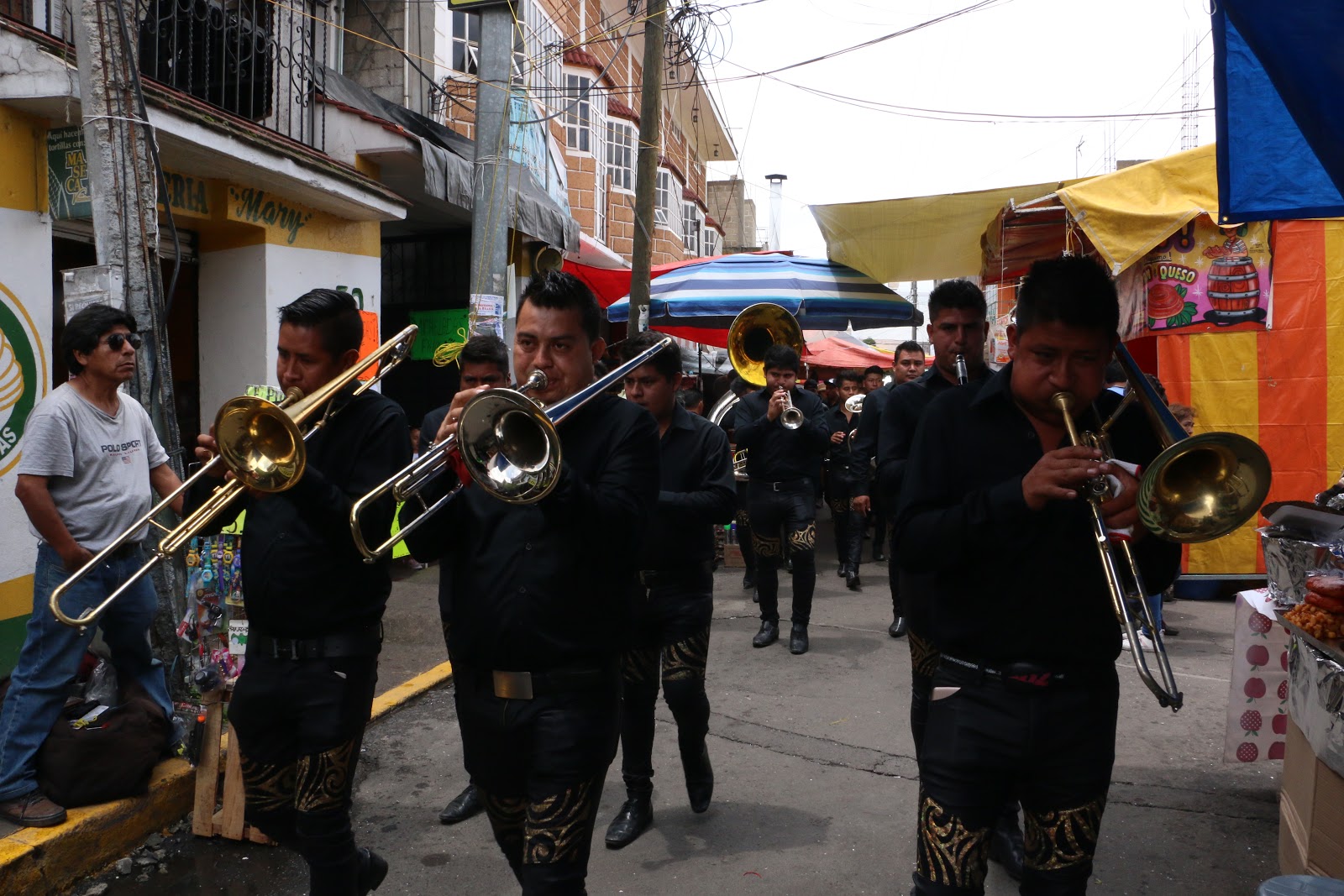
The inevitable and essential banda follows them.

They file down the stairs to the newer church.

Youth form a significant portion of the group.
This is not the nostalgic act of some old men.


The sanctuary is bedecked with bouquets of flowers, typical of a patron saint fiesta.
The banners say, "Glorious apostle St. Bartholomew, pray for us," and
"Strengthen our faith so that we may follow Christ."


San Bartolomé stands to one side.
St. Bartholomew was one of the lesser-known
apostles of Jesus.

The arrieros offer their veneration of San Bartolomé


They then return to the street beside the atrio to begin their ceremonial dance


"Los peques", the little ones, are instructed in the ritual by some adolescent members
given this responsibility of passing on the tradition.

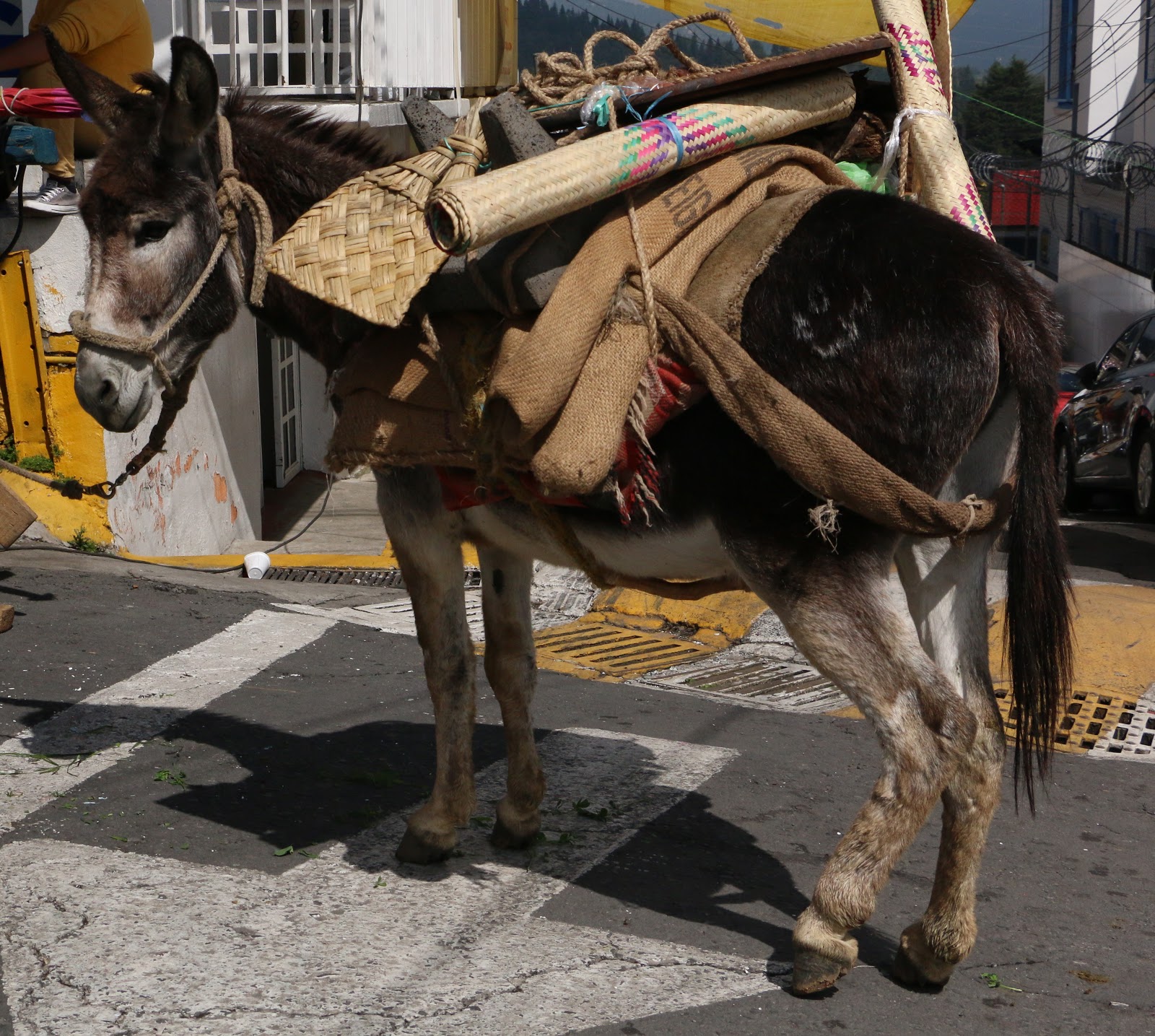
A horse is brought forward with some supplies. 

A mule is unloaded of supplies
for the next part of the ritual.

Older men begin the preparation of food.
It will be shared with the community
at the end of the Mass.

Several wooden fires are built and the cooking begins.
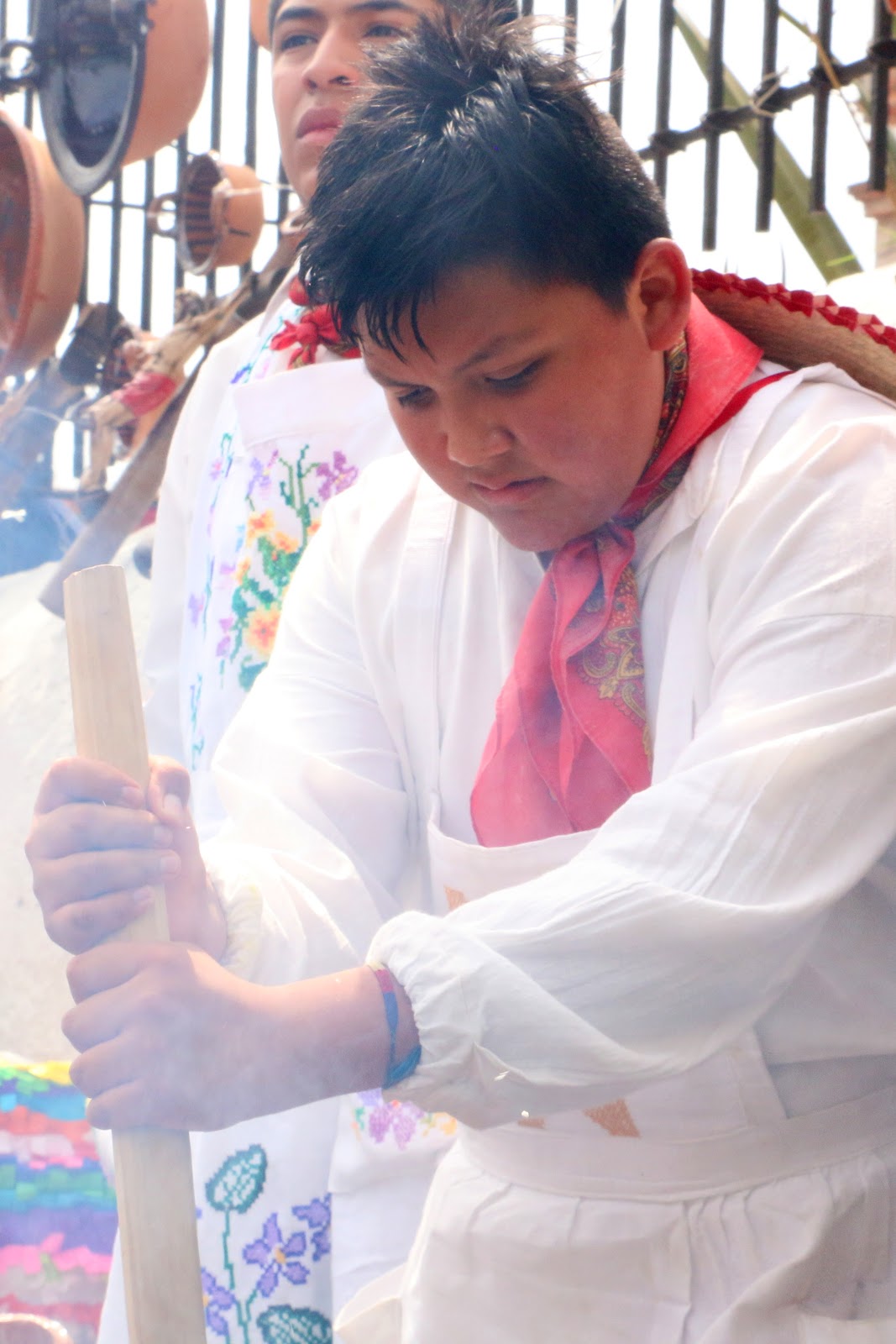
The men's aprons are quite richly embroidered,
indicating their pride in participating in the arrieros ritual.

Traditional clay ollas, pots of various kinds and sizes are being used. 

Adolescents and younger boys are fully brought
 into the work of cooking. 


We think the yellow mass
is corn masa, dough, mixed with fat,
to be melted down to make atole,
a corn-based drink.

We don't know why carrots,
not an indigenous vegetable,
are included in the meal.
 

A large cazuela is being used
to prepare chocolate for drinking.  

Arrieros, young and old.
The apron of the man, second from left, top, says,
"Mule Drivers Dancers of San Bartolo Ameyaco,
Hurry on, hurry on, my little burro."

Comparsa de Caporales


While we are watching the arrerios carry out their elaborate preparations to feed the community, we hear another banda begin to play in the atrio in front of the original chapel, so we hurry over to see what is happening. Fiestas are often "three-ring circuses", with multiple events happening simultaneously.

A comparsa (troupe) of caporales (herdsmen, i.e. cowboys and cowgirls) is performing another colorful traditional Mexican folk dance.


El Pueblo


As always, we are as interested in capturing the faces of the people of the community as in the formal ceremonies. 


The Strength of Tradition


What has impressed us the most about the Fiesta del Pueblo San Bartolo Ameyalco, here in the wooded mountains that surround the modern City, is the strength of their tradition of arrieros. As we noted in introducing them, we have recently encountered them in some pueblos in other southern delegaciones/alcaldías, but not in these numbers, nor with such elaborately embroidered trajes traditionales, traditional dress.

Above all, while we saw the ritual of preparation of some food for the community in San Lorenzo Acopilco in Cuajimalpa, we did not realize how central it is to the arrieros tradition, as evidenced by the extensive preparation of food as we have seen today. It was quite a production of multiple foods, obviously well-organized and carried out with deliberation and pride by the members. The group also included a large number of children and youth, incorporating them fully, thus teaching them all the components of the tradition so that they could maintain it intact into the next generation.

All of these qualities bespeak the community's deep commitment to and pride in reenacting and thereby commemorating the significant role that arrieros played for four hundred years after the Conquest in providing the only means of commercial transport into and out of the capital city. Hence, they were essential both to the life of those living in the city and surrounding villages and, on a global scale, to Spain's international commerce between Asia and the mother country via Nueva España.

Alcaldía Álvaro Obrgón and its colonias and pueblos.

It extends from the valley floor in the northeast 
up into the mountains of la Sierra de las Cruces (Mountains of the Crosses)
in the southwest, which reach altitudes of 12,000 ft.
Pueblo San Bartolo Ameyalco is marked by the green star.

Similar mountainous pueblos are La Magdalena Atitlic in Alcaldáia Magdalena Contreras to the southeast (purple/orange star)
and San Lorenzo Acopilco in Alcaldía Cuajimalpa ( red/yellow star) to the southwest.


Saturday, August 24, 2019

Original Villages | San Lorenzo Acopilco, Cuajimalpa: Rural Pueblo in the Forest

We did it! We made it to a fiesta in Delegación/Alcaldía Cuajimalpa, the last of the sixteen delegaciones/alcaldías comprising Mexico City that we have visited!

Delegación/Alcaldía Cuajimalpa lies on the far west side of the City and sits atop a ridge in the Sierra de las Cruces mountain range. Its average altitude is 9,000 ft (2,750 meters) above sea level — that's about 2,000 ft. above the Valley floor. The top of the ridge is at 10,000 ft. (3.050 meters).

Before the Spanish arrived, the Tepaneca of Azcapotzalco (which we just visited, also for the first time) had established villages in the mountains — dedicated mostly to cutting firewood and making charcoal for sale to pueblos in the Valley of Mexico below.

Delegación/Alcaldía Cuajimalpa
is the light magenta area on the west side
of Mexico City.

Getting to Cuajimalpa


The fiesta that we attend on a Sunday in early August is that of San Lorenzo Acopilco. We are extremely fortunate that one of our regular taxi drivers, Sr. Sánchez, who has transported us to many fiestas around the city, is quite willing to undertake the hour-long drive from our base in Coyoacán, in the center of the city, up into the mountains and to seek out San Lorenzo Acopilco. Between my Google map and Sr. Sanchez's knowledge of the route to Cuajimalpa, we arrive in the delegación without difficulty.

However, it is a little more difficult to find San Lorenzo Acopilco. It sits at the southern end of the populated portion of the delegación. Like other delegaciones that rise into the mountains, the southern portion of Delegación/Alcaldía Cuajimalpa is forest preserve. Also, the road signage isn't clear, so Sr. Sánchez stops and asks people by the roadside for directions. At one point, it means learning which road of a Y to take. It is the one to the left, which leads to a larger highway that eventually goes down the mountains to Toluca, the capital of the adjoining State of Mexico.

Soon we enter the tall, dense pine forest and seem to have left civilization behind. Just as we are wondering if we missed the turnoff for San Lorenzo, we see a good-sized sign saying "Acopilco" and pointing to a narrow road running uphill and deeper into the forest. (Afterward, we wish we had taken a photo of this roadway through the evergreens. It was difficult to believe we were still in Mexico City.)

View of the forest from San Lorenzo Acopilco.
The pueblo, at 10,000 ft. (3050 meters) is one of the two highest in Mexico City.
The other is to the south, on the slopes of Mt. Ajusco in Delegación/Alcaldía Tlalpan
.

Not far up the hill, we start to encounter houses. We have entered San Lorenzo, but we still have to find Avenida de las Flores, the street leading to the church. People along the roadside tell us we have just passed it, so we turn around and quickly come to the avenue — actually a narrow street typical of old pueblos and barrios. We head further uphill until we come to an intersection where — as is typical for fiestas — the road ahead is closed.

So we pay Sr. Sanchez, along with a sizeable tip for the quite herculean task he has undertaken to get us here and because he has a long, passengerless trip back to his company's taxi sitio (stand) in Coyoacán. We also thank him profusely for making it possible for us to finally get to Cuajimalpa and the fiesta of San Lorenzo Acopilco.

The Churches of San Lorenzo Acopilco


Walking a short distance uphill, we come to the town plaza. Several rows of folding chairs are lined up in front of a kiosk which is decorated with a floral portada and occupied by statues of the Virgin Mary and Jesus. A statue of San Lorenzo (St. Lawrence) stands to one side. Evidently, this is where the fiesta Mass is to occur.

The lettering on the floral portada says,
"San Lorenzo, thank you for your blessing."

The portada is made with fresh mums.

The Virgin Mary and Jesus as Cristo Rey, Christ the King.

San Lorenzo, St. Lawrence,
was 
martyred by Roman Emperor Valerian in 258 CE
by being roasted on a grill.
As with all martyrs,
he holds the tool of his martyrdom in his hand;
the grill is hidden behind the bouquet of flowers.
 

Behind the kiosk, we can see the top of a church dome, as well as the bell tower of a second church. They are evidently in an atrio (atrium) about a half-story below the town plaza. To the right of the kiosk is a low bandstand where a wind band is enthusiastically playing to entertain the few people in the plaza.


Further to the right, we see a ramp leading down to the churches. A house — evidently the church offices — sits at the bottom of the ramp, next to the second church. We are disappointed to find the entrance to the atrio cordoned off with chicken wire, so it cannot be entered.

At that moment, a woman coming from the office approaches to tell us both churches are closed because they were severely damaged in the major earthquake of September 2017. We express our sorrow for the damage, which we have encountered in other churches, and our regret that we are unable to see inside either one. 

Original chapel, built in 1536,
making it, remarkably, one of the oldest remaining Colonial buildings in Mexico.

Later, in research, we learn (from Spanish Wikipedia) that the first, smaller chapel was built only fifteen years after the Conquest, under the direction of Don Vasco de Quiroga, about whom we know much from our time living in Pátzcuaro, Michoacán. He was a member of the Second Audiencia, a commission sent by King Charles I (Holy Roman Emperor Charles V) in 1530 to govern Nueva España, thus replacing a badly functioning First Audiencia whose leader, Nuño Beltrán de Guzmán, turned into a conquistador and ravaged the western part of Nueva España, including the Purépecha people of Michoacán, searching for gold the inhabitants did not have.  

De Quiroga, a church lawyer, was immediately struck by the abuse the indigenous people were enduring from the conquistadores who, under Hernán Cortés' initiative, were seizing their land as encomiendas, land grants. The native people residing on these lands were forced to work for the encomenderos, the grant-holders. Quiroga left the Audiencia in 1532 to begin to set up "hospital" towns, refuges modeled on St. Thomas More's book Utopia (published in 1516), where the indigenous could live safe from abuse. The first hospital town he established was in the Sierra de las Cruces which he named Santa Fe (Holy Faith). The pueblo still exists not far from San Lorenzo. The chapel here is only four years younger than Quiroga's first in Santa Fe. Unfortunately, the one in Santa Fe has been destroyed, but we still want to visit the pueblo someday.  

Subsequently, Quiroga was made a bishop and sent to Michoacán to try to restore an orderly, autonomous life for the Purépecha people who had been ravaged by de Guzmán. There, he established another Santa Fe del Lago on Lake Pátzcuaro, and several other towns into which the indigenous were gathered. He had the residents of each town assigned a craft with which they could make a livelihood, as their lands had been taken as encomiendas. He is still highly revered by the Purépecha of the pueblos he established. They affectionately call him Tata Vasco, Papa Vasco. Each pueblo still makes the craft he assigned them. We have many of their artesania (criafts) in our apartment, reminding us daily of the Purépecha and Tata Vasco. 

The second, "newer" and larger church was built in 1771, in Neoclassic style.

The Fiesta


Returning to the plaza and passing the church office, we see an announcement posted on its wall listing fiesta activities. We have been looking for this. It tells us that a cuadrilla (cuah-DREE-yah) de arrieros, a team of mule drivers, is to perform in the plaza at 10 AM.

We encountered arrieros for the first time not long ago at three fiestas, two in Tlalpan, also in the mountains, and the other in Coyoacán, where they were visitors from Tlalpan. The cuadrillas of mule drivers were evidently centered in these mountain pueblos, as they were on the trails from Mexico City to other cities in Nueva España and continued to be the means of commercial transportation for four hundred years, until the 20th century, when they were replaced by trucks and highways. 

The announcement also tells us that a procession has begun at 9 AM on the outskirts of the pueblo to welcome other pueblos coming to attend the fiesta Mass. It is now winding its way through the streets for three hours before arriving in the plaza for the noon Mass. We will await its arrival.

The Castillo


While we are waiting for the arrieros to arrive, we watch the construction of the castillo, a "castle" tower on which elaborate fireworks displays will be ignited after dark as the climax of the fiesta.

Construction of the castillo is fascinating. As tall as they may be, they are always built the day of the fiesta and always finished in time. Even more fascinating, they are built from the bottom, using a power winch to lift wooden box frames that are stacked one upon another and simply tied together. As the winch lifts the growing tower of boxes ever higher, a worker slides one frame after another underneath.


Various shaped constructions, loaded with fireworks
are then raised and attached to the frame.
When lighted, they will also spin
.

The castillo nears completion.
A second, smaller castillo rises to the left rear.

Professional companies construct the castillos.
This one says, "Illuminating the heavens with art.
Pyro(technic) Art and Fire."
Note, it honors the Virgin of Guadalupe.
One entire town in the State of Mexico is
dedicated to producing these pyrotechnic displays.
With all the fiestas in the Valley of Mexico, they are kept busy.

Arrieros


Soon, and suddenly, the cuadrilla of arrieros enters the plaza, led by men on horseback. The horses are another reminder that parts of Mexico City are still rural and retain traditions from before our contemporary times. 

Cowboys lead the way.

La cuadrilla de los arrieros enters in double file.

They bring their patron saint, Jesus Christ as Cristo Rey, Heavenly King.

A burro follows, bearing several items,
evidently to be used in the ceremony.
We recognize a large pottery platter for food;
a gray metate, the curved stone used for thousands of years
for grinding corn, as the first step in preparing masa, dough,
for making tortillas, tamales and atole, a corn-based drink,
and some firewood.
We saw the ceremony of 
some previous arriero
 
 dancers end with the preparation
of food to share with the community.

On a stage at the west end of the plaza,
a mariachi band provides music for the arrieros' dance.

The dance begins.
The dancers move in two rotating, narrow ovals
to the front and then to the back.
It is a simple, four-beat rhythm

The leaders.
The leaders' attire 
 a skirt over the traditional pants, all of white manta
 muslin — is different from what we have seen with other arrieros.

The attire is also quite elaborately embroidered.
One leader is dressed in "Western" cowboy attire.

Women, in charro dresses, a more elaborate style of cowgirl attire,
remain dancing at the rear of the men's lines.


Even the youth are really into the dance.

Some of the embroidery,
a traditional Mexican art.

After a considerable time dancing, two of the leaders, dressed in cowboy attire,
then carry on a long, formalized dialogue
which seems to have to do with the need of the cuadrilla to prepare to feed the community.

The burro is brought forward.
The metate hangs upside down on the right.

A fire has been built and a huge metal cauldron placed on top of it.
Atole, a corn-based drink that can be flavored in many different ways, is being prepared
to share with everyone who comes to the fiesta Mass.

Fiesta in the Pueblo's Main Street


As the arrieros engage in preparing the atole and noon is approaching, we decide to walk from the plaza along the pueblo's main street, a typically narrow calleja (cah-YEH-hah), hoping we will run into the procession that is out there somewhere in the labyrinth of similar streets.

Main calleja running along the flat top of the mountain ridge.
Typically, it is lined with temporary puestos, stalls, selling cooked meals for fiesta attendees.
We wonder how the procession will manage to wend its way through,
but we know from past experiences, that they always do.


Flowers are also for sale for people to purchase and take to the Mass to honor San Lorenzo.

Papel picado, cut paper, hangs above the street.
Its colors are those of San Lorenzo.

The Procession


We stop at one of the puestos selling pizza and buy a slice, with pepperoni. As we are eating, we hear from a nearby side street the sound of cohetes, the rocket-style firecrackers used to announce the progress of the procession. So we hurry to the corner just in time to meet the procession as it arrives at the main street. Fortunately, it stops to rest, so we are able to rush ahead in order to get into position for the best photos.


San Lorenzo (upper left) leads the way.
Following are the Virgin of Guadalupe, the Lord of the Garden of Gethsemane
(on the night before Jesus's crucifixion),
and the Virgin of Candelaria
(Feb. 2, Forty Days after Jesus' birth when he was presented at the Temple in Jerusalem).

Standards and statues representing various pueblos, including
Las Cruces, San Jose, San Miguel follow.
The Christ is the Christ of the Sacred Heart

Finally, comes la banda, keeping everyone moving to its rhythm.


The tuba always brings up the rear.
It is actually a Sousaphone,
as the player in one banda informed us,
an invention of John Philip Sousa
making the orchestral tuba portable
for marching bands.

It is our favorite instrument,
as it is the foundation that keeps the beat.

Satisfaction in Coming Full Circle


The procession moves on to the plaza for the celebration of the Mass. By this time, we are tired but very satisfied. We have sought for a long time to make it to Delegación/Alcaldía Cuajimalma, the most distant and difficult to reach from our home in Coyoacán and, therefore, the last of the sixteen delegaciones/alcaldías we have visited. Today, finally, with the help of driver Sr. Sánchez, we have succeeded in arriving. 

San Lorenzo Acopilco, surrounded by evergreen forests, reminds us very much of pueblos in the similarly forested Meseta Purépecha, the Purépecha Highlands, in the state of Michoacán, where we lived for three years before moving to Mexico City. Furthermore, we are awed that here, in San Lorenzo Acopilco, totally unexpectedly, we have also encountered one of the first chapels built by Don Vasco de Quiroga before he moved on to seek to protect the Purépécha people in Michoacán. We feel that, in some way, we have come full circle, both from the beginning of our ambles to the originally indigenous pueblos in the sixteen delegaciones/alcaldías of Mexico City but also back to the realm of Tata Vasco

Now we just need to find a taxi to take us back to Coyoacán. A bit nervous, being so far from home, in an isolated pueblo in the mountains, we ask a couple who are selling food on the street if there is a taxi sitio nearby. They smile and reply, "¡Oh, sí! Todo derecho." | Oh, yes, straight ahead, at the bottom of the hill where the main street ends. So, relieved, we walk down the hill and there, at the intersection of the main street with the road that comes in from the highway, are a number of taxis waiting. We ask the first driver if one of them will take us all the way to Coyoacán, wondering whether they will want to go that far or, perhaps, just take us to the main west-side bus station called Observatorio where we know we can get another taxi. He says, "Sí" and that it will cost us 200 pesos, about $10. Sr. Sánchez's meter had charged us more than 300 pesos, so this is a bargain. He points us to one of the cabs. We greet the driver and tell him where we are going, get in, and we are off for home in the center of the City and the modern world. 
Delegación/Alcaldía Cuajimalpa
Its Pueblos and Colonias.

San Lorenzo Acopílco
is marked by the red/yellow star.
The colonias south of it are modern development
s.

The State of Mexico is immediately to the west. 
Delegación/Alcaldía Álvaro Obregón is to the east.