Showing posts with label Academy of San Carlos. Show all posts

Monday, February 15, 2016

Small Gems in the Archbishop's Palace: Antonio Ruiz's Paintings of Post-Revolutionary Everyday Life

We have been following the trail of the grand art of the Mexican Muralists around Mexico City. Our hunt began at San Carlos Academy, where almost every Mexican artist received his training. It stands at the corner of Academy Street and Moneda, Coin Street, so named because the mint of New Spain was located there, just behind the National Palace, off the Zócalo in Centro Histórico.

Aztec Temple to Bishop's Palace to Treasury to Art Museum
On Moneda Street, halfway between the Zócalo and San Carlos. across from the Mint (now the National Museum of Cultures), stands another of those grand Spanish colonial palaces, the former Palace of the Archbishop. Its construction was begun in the 16th century, on top of the ruins of the Aztec temple to the god, Tezcatlipoca, a god of night, the underworld and warriors. The Palace reached its present form in the Baroque period of the 18th century.

In the 1860s it was expropriated by the Reform government of Benito Juárez and made into offices for the Secretariat of Hacienda, the Treasury. In the 1950s it was converted into the Museum of the Secretariat of Hacienda. The Treasury obtained its collection via in-kind payments for taxes owed. Over the latter half of the last century, it became a Mexican tradition for artists to donate works instead of paying cash.


Former Palace of the Archbishop,
now Museum of the Secretariat of Hacienda, the Treasury.
Towers of the Cathedral in the background

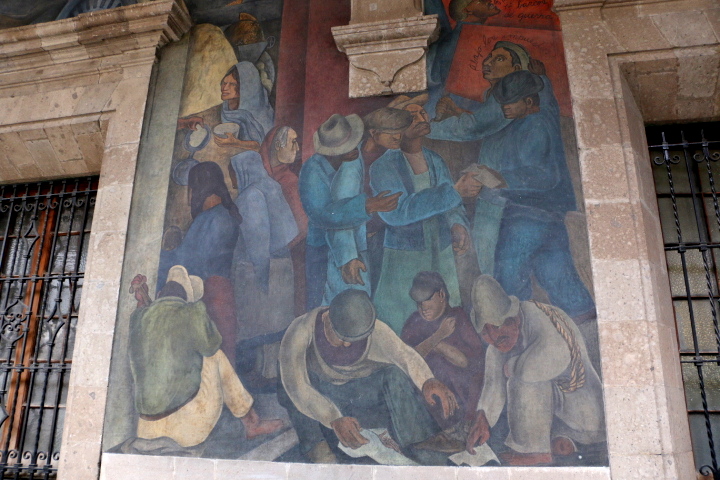
We originally visited the Musuem to see the mural, Song to the Heroes, by José Gordillo, one of what we call the Reverberations of the Mexican Revolution, art inspired by the Revolution that is scattered around the city.

The Un-Muralist
While there, we explored the exhibits and were surprised and delighted to come across another of the city's hidden gems. They aren't murals, but small paintings by an artist we had never heard of, Antonio Ruiz. No more than 18" by 24", in their own manner and voice, they tell us of the post-Revolutionary era of the second quarter of the 20th century in Mexico City. While the Big Three, Diego Rivera, José Clemente Orozco and David Alfaro Siqueiros, tended to disdain easel painting as art for the rich, Ruiz explicitly chose to work in small, very focused oil paintings.

Born in 1892 in Texcoco, State of México, adjacent to Mexico City, in 1914 Ruiz entered the Academy of San Carlos in the midst of the Revolution (1910-1920). But unlike his fellow student, Siqueiros, he did not become a revolutionary. After his art training, he worked in the Secretariat of Communications and Transportation and as a primary school art teacher. He spent two years, 1925 to 27, in Hollywood, working as a set designer, which was a skill he continued to use throughout his life in Mexico, designing stage sets for Mexican plays and ballets. Early on, he adopted the very Mexican apodo, nickname, “Cocito”, "Little Corzo", because he looked like a Spanish toreador, “El Corzo”.

Ruiz taught at the Institute of Bellas Artes and the Academy of San Carlos. In 1942 he became director of the Escuela Nacional de Pintura, Escultura y Grabado aka "La Esmeralda", the National School of Painting, Sculpture and Engraving, known as "La Esmeralda" from the street on which it was located. He died in 1964 of a cerebral hemorrhage. 

Ordinary People in a Time of Change

Through a focus on ordinary people and their daily lives in Mexico City, Ruiz communicates the post-Revolutionary transition from, and conflicts between, a more internally focused, traditional Mexican culture to one seeking to join the modernity of the larger world. Working slowly, seeking to communicate through details, he did not produce many works. The Flemish masters were his models.

About a dozen of his works are in the Museum of the Hacienda, in their own small gallery on the second floor. They are portraits, not just of individuals, but of an epoch. To us, they say as much about that time as the murals of the Big Three, but in a softer voice.


The Miners
(Compare with Rivera's Entrance to the Mine)


School Independence Day Parade
Father Miguel Hidalgo is portrayed on the banner.
Parades like this are still held every September 16,
all across Mexico


The Milkman's Girl Friend
Milkmen no longer go door to door in the city,
but plenty of other vendors still do,
often with bicycles and baskets.

Romance, of course, is eternal.


The Serenade
Nowadays, one would hire a Mariachi Band.


Opening of the Pulquería,
Pulque bar.
Beer has pretty much replaced pulque,
a beer made from juice of the agave,
now used to distill mezcal and tequila.


The Shoppers
Polanco, Fifth Avenue or your local mall.


Summer
This is our favorite. Make the bathing suits skimpier and it could be today.
Peasant couples still appear occasionally on the streets of Mexico City.
The number 8 is pure Art Deco.


The Paranoids
We would love to know what Ruiz had in mind.
These characters could be from New York


Self-portrait
The "turkey" envisions himself as a peacock
or an even more fantastic bird.
Such a sense of self-deprecating humor!
We think Orozco would get it;
Rivera and Siqueiros, probably not.

To us, Ruiz's art has the same focus as that expressed by another observer of the details of la cotidianidad, everyday life, in Mexico City some 350 years earlier, Bernardo de Balbuena, who painted what he saw with words in his poem, La grandeza mexicana, that is, the grandeza of ordinary people:

Of various looks and various movements
various figures, faces and demeanors,
various men with various thoughts... 

Saturday, January 9, 2016

Mexican Revolution and Mexican Muralists - Part XI: The Abelardo Rodríguez Market

Hidden Historical and Artistic Treasure

On Venezuela Street, in the Centro Histórico—a few blocks north of the former College of San Ildefonso (National Preparatory [High] School) and the Secretariat of Public Education with their murals by Diego Rivera and José Clemente Orozco—is the Abelardo Rodríguez Market. The venue is very different from the official government buildings of the Secretariat or the former High School. But here, virtually hidden in plain view, sit historical and artistic treasures from the era that emerged out of the Mexican Revolution and that fell, increasingly, under the shadow of an impending World War.

Motivated by the populist values of the Mexican Revolution, the Market was built in 1934, during the interim presidency of Abelardo Rodríguez (1932-34), as a prototype integrating a modern, indoor marketplace—replacing street stalls—with community social and cultural services, including a day care center and a theater.

The grand colonial entrance was originally part of one of the outside corridors of the old Colegio Máximo de San Pedro y San Pablo de la Compañía de Jesús (The Supreme School of St. Peter and St.Paul of the Company of Jesus,i.e. Jesuits),


Steel and glass-roofed market


Community theater
Proscenium decorated with folkart-style flowers and birds

by Antonio Pujol

Joint Mexican-American Project

However, the Market's most distinctive feature is the approximately 1,400 square metres (15,000 sq. ft.) of wall and ceiling space covered in murals painted by a group of ten artists: six Mexicans and four from the United States, all under Diego Rivera's supervision.

The Mexicans included Ángel BrachoLeopoldo Méndez, Antonio Pujol, Miguel Tzab, Pablo Rendón and Ramón Alva Guadarrama. Most had studied at the National School of Plastic Arts, the post-Revolutionary name for the Academy of San Carlos, where Rivera, José Clemente Orozco and David Siqueiros had studied. All would have careers as painters through the middle of the 20th century, contributing to and broadening the Mexico Mural Movement.

The four artists from the U.S. were Paul "Pablo" O'Higgins, who had emigrated to Mexico in 1924, sisters Grace and Marion Greenwood from New York City, and Japanese-American Isamu Noguchi.

1930s: Between Revolution and World War

In the foyer of the community center section, we get our first taste of political art — it takes us back to Rivera's own militant Ballad of the Revolution in the Secretariat of Education.


"Strike Against the Imperialist War". 
Hitler was on the rise in Germany, and Spain was in the turmoil that led up to the Spanish Civil War in 1936. 
World War II was to break out soon after.


Warmongering imperialist capitalists.

Several of the Mexican painters were members of the Mexican League Against War and Fascism, an affiliate of the World Committee Against War and Facism, a communist and pacifist organization founded in Europe in 1932 in the face of Hitler's rise in Germany and Japan's invasion of Manchuria.

They were also members of the Liga de Escritores y Artistas Revolucionarios, the League of Revolutionary Writers and Artists, founded in 1933 by Mendéz, O'Higgins and Luis Arenal as a successor to the Union of Engravers, Painters and Sculptors founded in 1923 by Siqueiros, Rivera and Orozco. The League was the Mexican member of the International Union of Revolutionary Writers, founded by the Third Communist International in the Soviet Union in 1930. In 1937, the League was to be replaced by the Taller de Gráfica Popular, People's Graffic Workshop, also founded by Mendéz, O'Higgins and Arenal with the goal of using art to advance revolutionary social causes. It existed until the end of the 20th century.

Mexican Worker

Moving to the inner patio, we encounter more subdued paintings, more like Rivera's murals of Mexican workers in the Patio of Labor in the Secretariat of Education.


Mexican street people,
by Pablo O´Higgins (Paul Higgins Stevenson)


Mexican Madonna

Counterpoint of Revolution and Everyday Life

The Market is entered from the street by a series of passageways lined with murals—some explicitly revolutionary like those in the entrance foyer.


"Workers and Farmers United against Imperialism"
Note: Top, center, "The Capitalist", protected by his army, reads his ticker tape, below giant, ominous hands.
Bottom right, the outcast poor.
Possibly by Leopoldo Méndez


"We demand bread and work. We struggle against Imperialism."
While workers make gold coins for the Capitalists, upper left, the unemployed suffer below. At center right, a worker collects his few coins in pay from the Paymaster, who, behind the barred window, hoards bags of them.

Others portray workers and la cotidianidad, daily life.


A totally different style and theme:
Workers cut wood to produce charcoal.
By Ramón Alva Guadarrama


Mercado, traditional street market
with deliveries of sugar cane, watermelons, root vegetables, grain

Yet another style, one I particularly like. I've been uable to find any information on the artist, Pablo Rendón.


Mural by Pablo Rendón


Last, my favorite of all:

Traditional Street Market, or Tianguis.
Note the curving, dance-like movement in the arms of the women 

versus the very angular movements of the men.
It could be a Martha Graham dance.

See more of our series on the Mexican Revolution and Mexican Muralists:

Wednesday, December 30, 2015

Mexican Revolution and Mexican Muralists - Part IX: David Siqueiros, Painter and Revolutionary

David Alfaro Siqueiros (1896-1974), who was to become the third member of the "Big Three Mexican Muralists", along with Diego Rivera and José Clemente Orozco, came to Mexico City from Guanajuato with his father and siblings after the deaths of his mother and grandmother, when he was in primary school. In 1911, at age fifteen, he began his art training in the Academy of San Carlos, where Rivera had trained before going to Europe in 1907 and where Orozco, thirteen years his elder, was a student.

In the early 1920s, after the Mexican Revolution, Siqueiros took part with Rivera and Orozco in creating the first works of the Mexican Mural Movement in the National Preparatory School (former College of San Ildefonso). However, because of changes in the political environment, he did not finish the mural he began there and was not to leave his own visible artistic mark on the city until some twenty years later in the 1940's. (Note: some time after writing this post, we were able to see Siqueiros's first, partial work, See: David Siqueiros. Part III)


David Alfaro Siqueiros

Beginning with his art school studies in the mid-1910s and continuting through three-plus turbulent decades of Revolutions (Mexican and Russian), the Great Depression and two World Wars, until the end of his life in the 1970s, Siqueiros immersed himself in a personal political, cultural and geographic quest to discover and create for the modern world what he envisoned to be an art that was truly contemporary not only in its aesthetic, but also in its materials and techniques—an art, moreover, that communicated on grand scales in public spaces the core political issues of the epoch.

To tell the convoluted tale of his spiritual, political and artistic journey, we have written the page David Siqueiros: Twentieth Century Odysseus. In this post, we explore the art that he created in public spaces in Mexico City.

Palacio de Bellas Artes

In 1944, after passing through the Mexican Revolution, Paris, Italy, Guadalajara, Los Angeles, Uruguay, Argentina, Moscow, New York, the Spanish Civil War, an assassination attempt against Leon Trotsky and several stays in Mexico City's Lecumberri Prison, Siqueiros was back in Mexico City, out of prison and painting. The National Institute of Fine Arts commissioned him to create murals for Bellas Artes. Creating their own murals in the 1930s, Rivera and Orozco had preceded Siqueiros there by ten years.

Siqueiros' murals in Bellas Artes are direct, forceful examples of the sculptural, almost three- dimensional style he had developed over the years in smaller works. By foreshortening the subjects, the muralist makes them thrust forward, so they appear almost to attack the viewer. Their theme isn't the Mexican Revolution. It is World War II and the battle against Fascism which was at its height.


Victim of Fascism
Bellas Artes, 1944

The near-naked figure could as well be a slave from Roman times.

The New Democracy
Emerging from the volcano's fire, Liberty breaks her bonds.
She wears the red French Liberty Cap,
a symbol also used by Orozco.


"New Democracy" possibly refers to Mao Zedong's concept
that Chinese Communism would emerge directly 
from the working, peasant, small business and large capitalists,
skipping the Marxist stage of imperial capitalism and colonialism.

Six years late, in 1950, Siqueiros was invited back to place murals on the opposite side of the second balcony. Instead of a contemporary story of oppression, here he portrayed an historical, Mexican one: the Spanish Conquest of the Aztecs.


Cuauhtémoc, the last Aztec ruler, who briefly replaced Moctezuma II after he was killed, is tortured by the Spanish
to reveal any hidden gold. Moctezuma had already given most of his treasury to Cortés.
Cuauhtémoc is heroic in refusing to speak, while his companion pleads for mercy.

To execute these murals, Siqueiros used pryoxilin, a modern synthetic paint that enables surfaces to be built up, hence creating a sculpted effect. Rivera and Orozoco worked in the ancient technique of fresco, paint on wet plaster. Siqueiros criticized them for being old-fashioned.

University City

In 1952, the Mexican government, feeling more prosperous and stable after the War, decided to relocate the National Autonomous University of Mexico (UNAM) from its hodgepodge collection of Spanish colonial buildings in the Centro Histórico to a new campus, la Ciudad Universitaria, University City, to be built on a barren lava bed in the southern borough of Coyoacán.

The campus was to be a major embodiment of Mexico's drive to become a modern nation and, by the same token, a physical, visible expression of national pride and identity. Siqueiros and other Mexican artists were invited to create outdoor murals on the buildings to communicate those messages. He was assigned the Rectory, the main administration building at the center of the huge campus.


The People to the University, The University to the People
From the rear, el Pueblo, the People, offer the tools of learning to students, 
who, in turn, offer the results of their education to the People.

The mural is entitled The People to the University, The University to the People: For a National Neohumanist Culture of Universal Depth. Here Siqueiros carried the three-dimensional appearance of his earlier work into true, sculptural three dimensions. This technique was to be carried to its fullest expression in his final masterwork, the Siqueiros Cultural Polyforum. The universal humanistic theme of education—in place of a specifically revolutionary theme—also foreshadows that later work.

National Museum of History, Chapúltepec Castle

In 1957, Siqueiros was commissioned by the government to create a mural for the National Museum of History in Chapúltepec Castle. Titled From the Dictatorship of Porfirio Díaz to the RevolutionDel porfirismo a la Revolución, this was his biggest mural yet, and the only one directly portraying the Revolution.

 
Del porfirismo a la Revolución, from the Porfiriato to the Revolution.
Díaz is surrounded by his scientificos, technocratic bureaucrats, 
and female tiples (sopranos), singer-entertainers of the day. 
His left foot rests atop the Constitution of 1857.


During the Cananea Consolidated Copper Company strike in Sonora, in 1906, rural police and hired Arizona rangers prepare to repress miners and strike leaders. Rafael Izabal, governor of Sonora, accompanied by the president of the U.S.-owned company, William C. Green, tries to seize the Mexican flag from Esteban Baca Calderón. Workers carry a victim of the repression. Other leaders of the Revolution appear, including Francisco Ibarra and Manuel M. Diéguez (moustache), under whom Siqueiros served during the Revolution.

The People in Arms include (second and third rows, from left) Francisco I. Madero (bald), Venustiano Carranza (full beard), Eufemio and Emiliano Zapata (red sombrero), Álvaro Obregón (moustache, cowboy hat) and Plutarco Calles (moustache, large sombrero). The country in flames is symbolized by the woman (red dress) on the right.

The Revolutionary, abruptly reining in his horse, symbolizes the end of the armed struggle.
One feels the horse's momentum is going to carry it beyond the mural's frame.

Row of Corpses symbolizes Revolution's cost in terms of human lives lost.
The first figure is Leopoldo Arenal, father of Siqueiros' third wife, Angélica, 
who was killed in 1913.

While this sequential mural starts out with a clear, revolutionary political position, it ends with a brutal realism that reminds us of Orozco's images in San Ildefonso.

Obra Interrupted

Siqueiros's work on the mural was interrupted by his political activities. In 1960 he was again arrested for openly criticizing Adolfo López Mateos, then President of Mexico, and for leading protests against the arrests of striking workers and teachers. He was imprisoned, yet another time, in Palacio de Lecumberri. While there, he continued to paint. 


Siqueiros painted this panel for a theater performance put on by prisoners in Palacio de Lecumberri Prison.
On display in Palacio de Lecumberri, now the National Archives.

During that imprisonment, he also made numerous sketches for a proposed mural project in the Hotel Casino de la Selva in Cuernavaca, Morelos. In the spring of 1964, Siqueiros was finally released and immediately resumed work on his suspended murals in Chapultepec Castle, which he completed in 1966.

Climactic Chapter of Revolutionary Art

Next we move to an aging David Siqueiros—militant Communist, who had fought in the Mexican Revolution and the Spanish Civil War, who had attempted to assassinate Leon Trotsky—to explore his final, grand project of the late 1960s.

Slated for a luxury resort hotel in Cuernavaca being built by a wealthy entrepreneur (quintessential capitalist who likely would have been quite comfortable in the pre-Revolutionary Porfiriato), the project was to end up being something even grander, more complex, and also quite challenging for the viewer to comprehend, very much like the artist himself. And it was to end up being realized in Mexico City as the Siqueiros Cultural Polyforum, which is subject of our next post.

See our other posts on the Mexican Revolution and Mexican Muralists:
Part I: Bellas Artes 
Part II: The Academy of San Carlos and Dr. Atl 
Part III: Secretariat of Education, José Vasconcelos and Diego Rivera 
Part IV: Secretariat of Education and Diego Rivera's Vision of Mexican Traditions 
Part V:  Secretariat of Education and Diego Rivera's Ballad of the Revolution 
Part VI: Diego Rivera at the College of San Ildefonso 
Part VII: José Clemente Orozco Comes to San Ildefonso 
Part VIII: College of San Ildefonso and José Clemente Orozco - Continued 
Part X: David Siqueiros Cultural Polyforum
Part XI: The Abelardo Rodríguez Market 
See also our short biography: David Siqueiros: Twentieth Century Odysseus

For the story of the Mexican Revolution, see: Mexican Revolution: Its Protagonists and Antagonists 

Sunday, October 18, 2015

Mexican Revolution and Mexican Muralists - Part II | The Genesis of the Mexican Mural Movement: The San Carlos Academy of Art and Dr. Atl

National Academy of San Carlos

Intertwined with the Mexican Revolution was a revolution in Mexican Art, which began within the walls of another colonial building in the heart of the Centro Histórico. It was here that a teacher of painting and some students came together and provided the fuel and fire for what was to become the Mexican Mural Movement when the military Revolution finally came to an end.

Royal Spanish Foundation and Neoclassic Aesthetic

The Academy of San Carlos was initially founded in 1781 under the name of the School of Engraving. Renamed many times in the intervening years, it remains known as the Academy of San Carlos. The School of Engraving started out in a building that had been the mint, and would later become the modern-day National Museum of Cultures. Ten years later, it was moved to the former Amor de Dios (Love of God) Hospital, where it remains to this day. The original hospital building was remodeled in Neoclasssic style. The street on which it is located was renamed from Amor de Dios Street to Academia Street in its honor.

The Academy was originally sponsored by the Spanish Crown and a number of private patrons. It was the first major art institution in the Americas. The new school promoted Neoclassicism, focusing on Greek and Roman art and architecture and advocating European-style training of its artists. To this end, plaster casts of classic Greek and Roman statues were brought to Mexico from Europe for students to study.

Interior patio

In the early 19th century, the Academy was closed for a short time due to the Mexican War of Independence. When it reopened, it was renamed the National Academy of San Carlos and enjoyed the new government's preference for Neoclassicism, as it considered the Baroque style reminiscent of colonialism. The academy continued to advocate classic, European-style training of its artists up until the Mexican Revolution. (Wikipedia)

New Aesthetic Arrives with the Twentieth Century

As the 19th century was nearing its end, new currents began to enter the school. In 1897, Gerardo Murillo Cornado (October 3, 1875 – August 15, 1964), a twenty-two year old student at the Academy, was granted a scholarship by President Porfirio Díaz to travel to Europe to study painting. He had broad, humanistic interests and obtained a doctorate in philosophy at the University of Rome. He traveled to Paris to study art. He also became involved in the anarcho-syndicalist (union) movement and the Italian Socialist Party. He apparently met both Lenin and Mussolini. In 1902, he took the name "Dr. Atl"—"water" in the Nahuatl language of the Aztecs.

Gerardo Murillo Cornado, Dr. Atl.
Photo in the Diego Rivera House Museum
Colonia San Ángel.
Returning to Mexico in 1904, Atl became a teacher at San Carlos. Shortly afterwards, he issued a manifesto calling for the development of a monumental public art movement sponsored by the government and linked to the lives and interests of the Mexican people. He advocated painting from real life and nature and using paints made from native materials, rather than following the classical training of San Carlos, which involved copying European classic paintings and sculpture.

José Clemente Orozco, an evening student in his early twenties, and other students began to experiment, breaking with the strict classical training of the Academy. In his autobiography, Orozco recalls:
"In these night classes of apprentice painters, the first signs of revolution appeared in Mexican Art. The Mexican had been a poor colonial servant, incapable of creating or thinking for himself. Everything had to be imported ready made from European centers, for we were an inferior and degenerate race. ...It was inconceivable that a Mexican should dream of vying with the world abroad... 
"In the night classes in the Academy, as we listened to the fervent voice of that agitator, Dr. Atl, we began to suspect that the whole colonial situation was nothing but a swindle foisted upon us... We, too, had a character that was quite the equal of any other. We could learn what the ancients and the foreigners had to teach us, but we could do as much as they, or more. It was not pride but self-confidence that moved us to this belief, a sense of our own being and our destiny.  
"I set out to explore the most wretched of the city's barrios. On every canvas there began to appear, bit by bit, like a dawn, the Mexican landscape and familiar forms and colors. It was only a first and still timid step toward liberation from foreign tyranny, but behind it there was throrough preparation and rigorous training." (Autobiography of Orozco)
Diego Rivera, in his late teens, was also a student at the time. In 1907, at age twenty-one, he left for Europe with a scholarship to study art. He was to remain there until 1922.

As Mexican Revolution Erupts, Academy Undergoes Its Own Revolution

The year 1910 was the 100th Anniversary of the start of the Mexican War of Independence. As part of the celebrations planned by President Porfirio Díaz, an Exposition of Contemporary Spanish Painting was organized, to be shown in a special pavillion erected on the Alameda.

The students of the Academy protested that, since it was a celebration of Mexican independence from Spain, Mexican art should be represented. Dr. Atl negotiated with the government and they were given a small grant to put on an exhibit in the Academy. Orozco was one of some fifty artists to exhibit their work. It was a huge popular success.
Dr. Atl proposed that the young artists form their own organization, the Artistic Center, which would seek to gain access to government buildings where they could paint murals on the walls. They were given permission to start in the National Preparatory School. They erected scaffolding, but did not get the chance to begin. In November the Mexican Revolution began.

By May 1911, Porfirio Díaz was overthrown and Francisco Madero became president. Students at San Carlos saw this as an opening to get the traditional curriculum. along with the current director, thrown out and have one in line with Dr. Atl's manifesto instituted. They went on strike, which lasted more than a year. That same year, David Siqueiros, age fifteen, enrolled in evening classes at the Academy.

The strike, and life in Mexico City, was interrupted by the overthrow of President Madero by his general Victoriano Huerta during the Ten Tragic Days of February 9-19, 1913. The forces that had overthrown Díaz immediately rose up against Huerta. Dr. Atl had allied himself with Venustiano Carranza, governor of Sonora and self-declared Primer Jefe, First Boss, of the Constitutional Army created from various northern states. Atl left for Europe to gain support for Carranza.

Meanwhile, the Academy continued to function and a new director was appointed, Alfredo Ramos Martínez, who had just returned from Europe where he had studied Impressionist painting. He advocated painting from nature and focusing on the beauty of the Mexican countryside. One of his first acts as director was to rent a house in the then rural village of Santa Anita Ixtapalapa (now part of the Mexico City borough of that name), where he had students paint from nature in plein air, open air.

While Ramos Martínez extolled French Impressionism, even naming the school El Barbizón after the French village beloved by the Impressionists, the students rejected the continuing European focus and began painting local scenes and people of "el pueblo", the working class and poor, who were predominately indigenous. They became enamored with the popular and folk paintings of the barrios and the murals in cantinas (bars) and pulquerías (pulque is beer made from the sap of the agave succulent). They declared that European art, especially in its Classic Greco-Roman forms, was ugly and that the Mexican "Indian" and his art was the most beautiful.

Later in life, Siqueiros wrote:
"This was the beginning of a new aesthetic. Although childlike, we launched a permanent break with the archaic and academic pedagogy of the official art academy. It was at Santa Anita that we began to discover our own country." (Siqueiros, Biography of a Revolutionary Artist, D. Anthony White)
In the context of the revolt against Huerta that was going on (1913-14), these encounters with popular, lower class, indigenous poor also politically radicalized the students, who were mostly from rich upper-class familes. They began to participate in demonstrations against Huerta. The school was closed by the government. Some students left Mexico City to join the various factions allied, for the time being, in the rebellion: Venustiano Carranza, Emiliano Zapata and Francisco "Pancho" Villa.

When Huerta was defeated in July of 1914, and Carranza entered Mexico City, the Academy was reopened and Dr. Atl, who had returned from his mission to Europe on Carranza's behalf, was appointed its director. He spoke to the students about starting their own workshops for the "popular classes", i.e., the working class and poor. He also talked about the creation of murals in public spaces.

But this was but a brief respite in the civil war. After the attempt between Pancho Villa and Emiliano Zapata and Carranza to agree on a government failed at the Convention of Aguascalientes, in October of 1914, Villa and Zapata mobilized their armies against Carranza. In November, Carranza retreated to the state of Veracruz. Dr. Atl convinced many of the students at the Academy to join him and Carranza there.

Students Dispersed by War

Both Orozco and Siqueiros went with Atl to Veracruz. Orozco helped run a printing operation producing propaganda for Carranza. Siqueiros joined a group of adolescents who formed a batallion that went to the western part of Mexico to fight against Pancho Villa. Because of their age, they became known as the Batallón Mamá. When they arrived in Jalisco, Siqueiros was assigned to the staff of General Diéguez because he could read and write. He also participated in direct combat. 

After Carranza had defeated Villa and Zapata and forced them to retreat, Villa to the north, Zapata to the mountains of Moreles to the south, he returned to Mexico City, became provisional president, and after the approval of the Constitution of 1917, Mexico's elected president.

Orozco, disenchanted with war, went to the United States to try his success as a painter. Siqueiros was sent to Paris by Carranza to be a military attaché at the embassy, but actually giving him an opportunity to study European art. There, he met and became friends with Diego Rivera. 

José Vasconcelos and the Beginning of the Mexican Mural Movement

In 1921, Álvaro Obergón, Carranza's lead general, overthrew Carranza, who was killed on his way to Veracruz after fleeing Mexico City. As president, Obregón appointed José Vasconcelos, a lawyer and philosopher who had supported the Revolution, to be head of the new Secretariat of Public Education.

Vasconcelos saw as part of his mission fulfilling Dr. Atl´s call to create public murals for displaying the Mexican people, their history, the stuggles and achievements of the Revolution and a vision of their future as a new, modern nation. To implement this, he summoned three students from the Academy of San Carlos back to Mexico, Rivera and Siqueiros from Europe and Orozco from the United States.

As Orozco was to write later in his Autobiography, "the table was set for mural painting." The Mexican Mural Movement started at full steam. Dr. Atl's vision first began to be realized in real paint on real walls of public buildings in Mexico City, and then beyond. Atl, himself, continued to paint and advocate for popular folk art and murals until his death in 1964.

For more on Mexican Revolution and Mexican Muralists, see:
For background on the Mexican Revolution, see: Mexican Revolution: Its Protagonists and Antagonists