Showing posts with label San Ildefonso. Show all posts

Sunday, May 14, 2017

Mexican Muralists | David Siqueiros, Part III - His First, Unfinished Mural Forshadows His Later Work

David Alfaro Siqueiros
1896-1974

Siqueiros | Twentieth Century Odysseus


In our first post on David Siqueiros, we wrote that in the early 1920s, after the Mexican Revolution, he took part with Diego Rivera and José Clemente Orozco in creating the first works of the Mexican Mural Movement in the National Preparatory School (formerly the Jesuit College of San Ildefonso), but that he did not finish the mural he began there.

In 1925, after the election of Plutarco Calles as President, replacing Álvaro Obregón, José Vasconcelos—the Secretary of Education who had sponsored the artists' work and who had wanted to become president—was replaced in his post. The painters were dismissed. Siqueiros went to Guadalajara, where he could find work because he knew people from his participation there in the war.

His artistic and political passions then led him, over the intervening years, to Russia, South America, the United States and active duty in the Spanish Civil War. Whenever he returned to Mexico City, he would become active in the Communist Party and get jailed for various acts of protest. As a result, he was not to leave his own visible artistic mark on the city until the 1940's. (See our page: David Siqueiros: Twentieth Century Odysseus)

Returning to a Beginning


At the time we wrote the post, we had read that Siqueiros' first work, in San Ildefonso, was not accessible to the public, as it was in a "back stairwell" in an unoccupied part of the building. Subsequently, while visiting San Ildefonso to show its murals to friends, we learned that that part of the building was now the Museum of Light, under the direction of the National Autonomous University of Mexico (UNAM), as is the main San Ildefonso Museum. But at that point, we had moved on to other topics in our Ambles, so we did not pursue visiting the Museum of Light.

Recently, we were able to redress that omission. While visiting Centro to explore another episode in the Mexican Mural Movement previously unknown to us (and which we will be writing about), we realized that we were very close to San Ildefonso, so after completing our new investigation, we went to the Musuem of Light, not knowing whether it would lead us to the Siqueiros mural that lay somewhere within. 

Third, east, patio of San Ildefonso,
now the Museum of Light

In the entry passageway, we ask the ticket taker if the Siqueiros mural is accessible. She replies, "Yes, if you buy a ticket. It's in the stairwell." We happily and excitedly pay the few pesos charged for admission and head into the patio to find the stairwell.

As soon as we start up stairs, we are confronted by the first sign of Siqueiros' presence hanging above our heads.


The bold color and forceful figure speak at once of the artist's eye and hand. Continuing upward, we then meet Siqueiros' artistic and ideological vision in full force.

Painted on the stairwell ceiling

A very human, very muscular winged goddess, traditionally of Victory, foreshadows Siqueiros' post-World War II mural entitled 'Democracy', in Bellas Artes. We have read that the artist referred to it as The Elements. To us it is a direct expression of his life-long focus on liberation of the suppressed underclasses.

Democracy breaks the chains of Fascism
Bellas Artes

We turn the corner of the stairwell and look up.


Mural at the top of the stairwell

We are definitely puzzled by the composition above us but not surprised, given that we have seen Siqueiros' final work, the Cultural Polyforum, completed nearly fifty years later, in 1971. Here in San Ildefonso, he first undertook the challenge of using a three-dimensional space to surround his viewer with his vision. His March of Humanity, in the Polyforum, is the culmination that effort.

Section of March of Humanity Toward the Democratic, Bourgeois Revolution,
Siqueiros Cultural Polyforum

So we try to decipher the various components. Fortunately, a small plaque on the wall helps us.

David Alfaro Siqueiros
The Call to Liberty
The Myths
The Burial of the Sacrificed Worker

Two themes are certainly central to the artist's lifetime work: Liberty and the oppression of Workers. We will try to figure out what the "Myths" might be.

The Call to Liberty


The Call to Liberty

In the right-hand corner of the stairwell's left wall, the figures in the Call to Liberty are hard to make out due to the low light and the viewing angle. However, the forceful nude male figure, with his large, strong arms and legs, holding a child in one hand and a pole in the other, although flatter and more static, is certainly the forefather of later males created by the artist.

Victim of Fascism
Bellas Artes, 1944

Two unfinished portraits stand to the side of the male figure. What their relationship is to the Call to Liberty isn't evident, but they are nonetheless interesting portraits.


The two portraits are markedly different in style: one is a face of fine lines, narrow width, wide eyes and relatively light skin; the other of thick lines, round-faced, somewhat veiled eyes and darker skin. Whether Siqueiros intended a reference to racial and social differences in Mexico (our hunch), or was just experimenting with styles remains a mystery.

The Burial of the Sacrificed Worker


The right wall of the composition also presents a puzzle, at least on initial viewing.


Three men hold an iridescent blue object. The image is far above the viewer and in low light, so we can´t make out the nature of the object. The title should have been clue enough, but it takes our later blowing up and lightening up of our photo to see: it is a coffin. On the top, barely visible, are a hammer and sickle, symbols of laborers and farmers, and their alliance via Communism. Siqueiros makes no secret of his political beliefs and revolutionary passions. 

We are also struck by the artist's use of cerulean blue. It was used extensively by José Clemente Orozco (San Ildefonso, third floor) in his paintings of ordinary Mexicans in the midst of revolutionary chaos, evidently to express a still-existing hope. But we haven't seen it used by Siqueiros in any of his other works, which are dominated by aggressive red and black. 


In the right-hand corner stand a woman and man painted in Siqueiros' favorite red. The woman holds one hand erect, in an apparent gesture of defiance. In the other, she holds broken chains, the symbol of liberation from oppression. 


In the middle of the wall is a single portrait, powerful in its directness and simplicity. The portrait is of a man—by his features clearly an indigenous Mexican campesino, traditional peasant farmer. We wonder what Siqueiros might have had in mind for the rest of this empty middle section.

The Myths


We now turn to try to decipher The Myths section of the mural on the center wall. 


Two large human figures and one small one seem to float at the top. At the bottom, two other figures lie on their backs, mouths agape. In between the two windows is Siqueiros' clear profession of faith, the Hammer and Sickle, symbols of the uniting of laborers and farmers via the Communist vision (myth?) of liberation from capitalist domination. 


The left-hand figure is clearly a king, now deposed, lying helpless on his back. The right-hand figure is another puzzle. From the heavy, dark features he would appear to be indigenous, but why is he then overthrown like the king? The covering on his head may be a hint. Its tan color reminds us of the battle attire of the jaguar warriors of Aztec/Mexica fame who, together with eagle warriors, were the elite soldiers protecting the empire and those who ruled it—the tlatoanis like Moctezuma the Younger and Cuhuatémoc, who were defeated by Cortés. 

If our interpretation is correct, the artist is depicting the overthrow of two empires, the indigenous and, later, the Spanish. 


Floating above are three figures. On the right is a morena, dark-skinned, woman, clothed in cerulean blue. Her arms are folded as if she were holding an infant; on closer inspection, she is evidently wearing a halo. Is she Siqueiros' image of the Virgin of Guadalupe—that synthesis of Spanish Catholicism and indigenous identity that is literally the vision (or myth for non-believers) that unites Mexicans from both sides of the Conquest?  

The image may also refect the Virgin's counterpart in Mexican "mythology"—one who elicits great ambivalence from Mexicans, Malinche. She was the indigenous woman who served as Cortés' translator, thereby betraying her indigenous world by opening its door to its conquistadores. In counterpoint, by bearing Cortés' child, she began the "mestization", the mixing of indigenous and Spanish blood that resulted in the Mexican people. If the woman is seen as Malinche, then we know the meaning of the child floating between the woman and the naked, face-down indigenous man on the left side. As such, he is not a vision (or myth) of hope.

We are reminded of José Clemente Orozoco's much more direct and, therefore, more powerful representation of this conflict between and mergers of races, of peoples from the opposite side of an ocean. It lives in another stairwell in San Ildefonso.

Cortés and Malinche
By José Clemente Orozco
San Ildefonso

We are also reminded that Siqueiros took up this primal Mexican theme (myth) at the end of his artistic life, at the Polyforum.

The Mestizaje,
The Interbreeding
Here the Spaniard is naked, exposed,
like the Cortés of Orozco.
One of the huge outdoor murals
at the Siqueiros Cultural Polyforum.

As for the row of steel bits filling the ceiling, that is another puzzle for us. Given the Communist frame of reference, perhaps Siqueiros was alluding to the industrial, capitalist economy and the related concentration of power that exploited and suppressed workers.

Fragmentary Hints of Siqueiros' Later Art


So, in another, previously inaccessible part of the ex-Colegio San Ildefonso—what in the 1920s was Mexico's first government-run high school—we gain a fragmentary glimpse of the artistic and revolutionary vision and the graphic style and palette of David Alfaro Siqueiros. All the aspects of his later works are foreshadowed here: bold, molded muscular figures projecting towards the viewer; predominant colors of red and black; themes of liberation of the common folk from oppression by those in power; and the attempt to master a three-dimensional space in order to surround his audience with this vision. 

We leave very satisfied that we have finally been able to see this first work of the master. We have a feeling that we have come full circle in our encounters with Siqueiros' tumultous life and dramatic works, connecting the later flowering with the first sprouts. And we are grateful to UNAM (National Autonomous University of Mexico) for the opening of the Museum of Light in this previously neglected but grand space, making possible this encounter and fulfillment.

More about how the Museum of Light came to be in San Ildefonso will be shared in a subsequent post, which will also focus on an obscured beginning of the Mexican Mural Movement.

Monday, December 14, 2015

Mexican Revolution and Mexican Muralists - Part VIII: José Clemente Orozco at the College of San Ildefonso - Continued

Continuing our encounter with the murals painted by José Clemente Orozco for the National Preparatory (High) School in the Antiguo Colegio de San Ildefonso, we climb to el primer piso, the first upper floor. After our confrontation in the stairway with the primal conflict of the Spanish Conquista of the indigenous, we are abruptly brought back across four hundred years to the pre-Revolutionary days of the early 20th century.

Those Above Versus Those Below

Here the theme of conquerors versus conquered is transformed into a more modern version, that of los de arriba vs. los de abajo, those above vs. those below.


Los aristócratas

The Aristocrats is in the same style of caricature as Orozco's Banquet of the Rich on the ground floor. His brush, it might be said, is even mightier than the pen. The postures and the faces say it all.


Note the blue and red hats.
We will see more of these colors

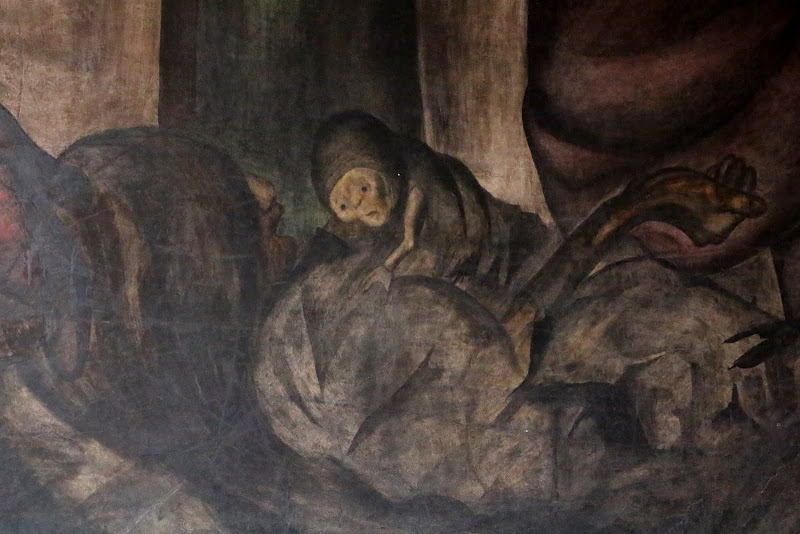
Beneath the feet of "these of the above", in a corner, almost invisible in the darkness, lies the object of their scorn, an apparent pile of grey rags.


The almost shapeless form is a woman lying on her back, one hand upturned in classic begging posture, the other holding a skeletal, desperate baby.

The Law, Justice, God and Liberty

From this scathing portrayal, we move on to meet other murals in the same caricature style, but more symbolic in their content.

La ley y la justicia
The Law and Justice

A drunken Law and Justice dance. The scales that should impart fairness seem about to fall from Justice's hand. Her skirt is stained by a bloody hand print, possibly raised in a failed protest.


El juicio final
The Final Judgment

And next to terrestial Law and Justice, the Final Judgment. A cross-eyed Father God, looking annoyed and/or otherwise out of sorts, his World slipping from his hand, sits above the adoring bourgeoisie, with halos over their stovepipe hats and bonnets. 


And to God's left, devils pursue and hound the poor, who flee from the Lord's presence.


La libertad
Liberty

And just beyond, Liberty, wearing her Red Cap, hangs from the fly space of a theater, like a Deus ex machina meant to come to the rescue and break the bonds of servitude, but she is inept, toothless and semi-conscious at best. It is a sad comedy, a burlesque of the Revolution.


El acecho
The Stalker

Orozco's last charicature is an even more sardonic take on the Revolutionary rhetoric of Liberty and Justice for All. A rotund member of the bourgeois, identified by the watch fob over his vest and his fine shoes, disguises himself as a poor man, even a Christ figure with his crown of thorns. He holds out the promise of the Red Cap of Liberty to the poor worker, who, himself has an almost simian face. Behind the distracted worker, el acecho, the stalker is poised to stab the laborer to death.

One recalls Orozco's words about the Revolution,
"Buffoons and dwarfs, trailing along after the gentleman with the noose and dagger, in conference with smiling procuresses."


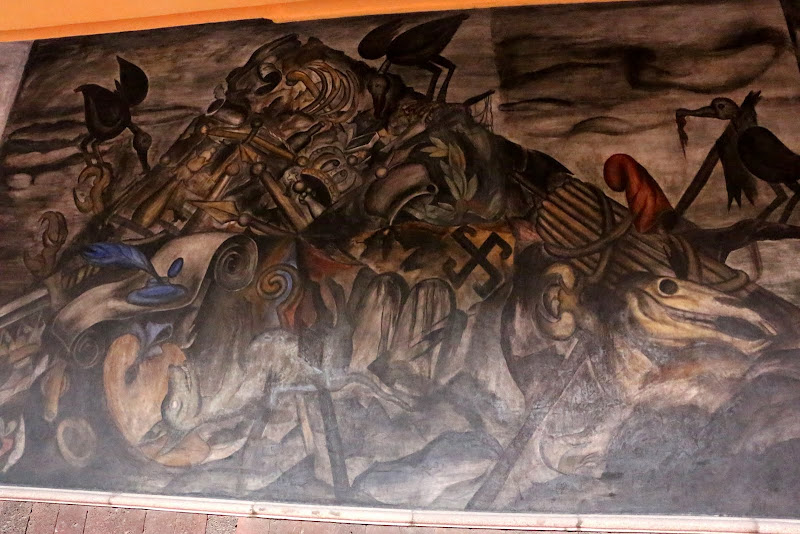
Basura social
Social Garbage
Note: Liberty cap

Then Orozco hits us with a symbolic ton of bricks, his words in images:
"The world was torn apart around us. Troop convoys passed through on their way to slaughter. Trains were blown up. Wretched Zapatista peasants who had fallen prisoner were summarily shot down. People grew used to killing, to the most pitiless egotism, to the glutting of sensibilities, to naked bestiality." 
Painted in 1926, Orozco presciently places the Nazi swastika near the center. The National Socialist Party had been founded in Germany in 1920.

Included in the pile are other symbols of power: the Sacred Heart of Jesus, a bishop's crosier, a king's crown, the Mosaic tablets, an olive wreath, an Aztec eagle warrior, the Roman fasces, bundle of sticks, which became the symbol of Italian Facism after World War I, the skull of a horse.

In this dismal landscape only two points of color survive, the blue feather pen of the written law and the ubiquitous Red Cap of Liberty. Three crows feed on the refuse: the one on the left perched on the claw of a dead eagle, the symbol of Mexico, buried under it all.

We wonder how Orozco could have gotten away with painting such a devastating, damning portrait of the Revolution, together with his sardonic burlesquing caricatures, in the government's own National Preparatory School, where the future leaders of the post-Revolutionary regime were to be formed. With that question, and wondering what more Orozco could have in store, we climb to the topmost floor.

Of Revolution and Humanity, Earth and Sky


La familia
The Family

Here we meet a quieter, more realistic, but subtly moving set of images of the Revolution. The Mexican family—all in Orozco's favoite "colorless" greys and tans—sits close together, subdued, stoic. One woman cares for an ill or exhausted but substantial man, while a second cradles a newborn, everyday embodiments of the iconic Virgin of Guadalupe and the Virgin Mary. A couple, faces invisible to the viewer, hence anonymous yet universal, embrace and look toward an unfinished pyramid-like edifice. Beyond is a stunning, impossibly intense, cobalt blue sky.

We have seen this blue before, here in San Ildefonso. First, in the firmament of Diego Rivera's Creation, then, in Orozco's disturbing Revolutionary Trinity, on the ground floor, and in a less saturated mode, as the backdrop for his burlesque theater version of Heaven on the floor just below us. In the series of murals here on the top floor, this blue becomes the counterpoint to the earthly, subdued, human, painful realities of the Revolution.


La despedida
The Farewell

Son bids farewell to mother, husband to wife, as they depart for the war. Here the blue, painted on a wall, is only a pale echo of the sky.


La bendición
The Blessing

Another son receives the blessing of his old mother. The plows that are his work and that he is also leaving behind, sit inactive. The sky conveys a pure, infinite force of nature.


Trabajadores
Workers

Laborers begin to leave their tools, and their women. Behind a red wall, the azure sky.


Los revolucionarios
The Revolutionaries

Here we meet another Revolutionary trinity, but a realistic one—weighed down by their arms, the loss of what they are leaving behind and their possible future. Two women—one with a baby in her rebozo, the other carrying some load—accompany them. Here there is no blue sky.


Las mujeres
The women

The women left behind, one with a baby, one crying. The plows sit, unemployed. But there is that impossibly blue sky.


El sepulturero
The gravedigger

What simpler image could there be of the inevitable outcome of war, of violence, than a gravedigger. His preparatory work evidently done, he sleeps while awaiting the culminating act of burial. But the sky is blue.


La familia
The Family


Feeling sobered, as subdued as the paintings, we return to gaze again at The Family. Stoic, solid, bonded, comforting one another in the midst of life's challenges, losses and hopes. And the sky is so blue.

Once again in our tour of San Ildefonso, we feel how far we are—how far Orozco has brought us—from Rivera's idealized Ballad of the Revolution, painted at virtually the same time on a similar top floor, around a similar patio of a similar former colonial building just two blocks away. Two visions of a Revolution, but worlds apart.

See more on the Mexican Revolution and Mexican Muralists
Part I: Bellas Artes 
Part II: The Academy of San Carlos and Dr. Atl 
Part III: Secretariat of Education, José Vasconcelos and Diego Rivera 
Part IV: Secretariat of Education and Diego Rivera's Vision of Mexican Traditions 
Part V:  Secretariat of Education and Diego Rivera's Ballad of the Revolution 
Part VI: Diego Rivera at the College of San Ildefonso 
Part VII: José Clemente Orozco Comes to San Ildefonso 
Part VIII: College of San Ildefonso and José Clemente Orozco - Continued 
Part IX: David Siqueiros, Painter and Revolutionary 
Part X: David Siqueiros Cultural Polyforum 
Part XI: The Abelardo Rodríguez Market 
For the story of the Mexican Revoluion, see: Mexican Revolution: Its Protagonists and Antagonists 

Mexican Revolution and Mexican Muralists - Part VII: José Clemente Orozco Comes to San Ildefonso

José Clemente Orozco,
by David Siqueiros,
Siqueiros Cultural Polyforum,
Delegación Benito Juárez,
Mexico City

Secretary of Public Education José Vasconcelos had put Rivera to work creating murals in the Secretariat of Education, so he hired artist José Clemente Orozco (1883-1949) to add more murals in the Preparatory School. Orozco was forty years old.


Born in the western state of Jalisco, his family had moved to Mexico City in 1890, when he was seven. He was enrolled in the elementary school of the Teachers College in the Centro Histórico. On his way to school, Orozco recounts in his Autobiography, he would pass the printing shop where José Guadalupe Posada (February 2, 1852 – January 20, 1913) worked as an engraver, illustrating books and newspaper stories.


José Guadalupe Posada,
by David Siqueiros,
Siqueiros Cultural Polyforum,
Delegación Benito Juárez,
Mexico City

Orozco was fascinated. He felt
"impelled to cover paper with my earliest figures; this was my awakening to the art of painting."
At some point while still attending elementary school, he enrolled in evening classes at the San Carlos Academy of Fine Arts. Diego Rivera, who was three years younger, also started studying at the Academy in 1896, at age 10.

In 1897, at age fourteen, Orozco's father sent him to the San Jacinto School of Agriculture, just outside the city. Completing the three-year course, in 1900 Orozco enrolled in the National Preparatory School, planning to study architecture. But his passion for painting overtook him and he left to enroll in San Carlos. His father had died, so he supported himself working as a draftsman for architects and newpapers.

In 1911, when Francisco Madero and others had overthrown Porfirio Díaz, Orozco, now twenty-eight, got work through a journalist friend as a cartoonist with an opposition newpaper. As for taking sides in the Revolution, Orozco wrote later in his Autobiography:
"I might equally well have gone to work for a government paper instead of the opposition. No artist has, or ever has had, political convictions of any sort. Those who profess to have them are not artists."
He joined the student strike at the Academy, seeking to throw out the director and the Neoclassic curriculum. When Alfredo Ramos Martínez became director of the re-opened Academy and led students to paint plein air, in the open air, at a house he rented in the then rural village of Santa Anita Ixtapalapa (now part of the Mexico City borough of that name), Orozco initially went along. But he soon found the focus on French Impressionism too precious for his taste. Instead of their
"pretty landscapes with the requisite violets and Nile greens, I preferred black and the colors exiled from Impressionist palettes. I painted the pestilent shadows of closed rooms, and instead of the Indian male, drunken ladies and gentlemen."
He left and rented his own studio in thc City Center.

By his own account, he took no part in the various phases of the Revolution, despite U.S. newspaper accounts to the contrary. He felt Madero's presidency was "a half revolution, sheer confusion and senseless." Huerta was
"no doubt a monster, but no different from others who fill the pages of history."
After Huerta's defeat in October of 1914, the forces of Villa and Zapata on one side and Carranza on the other failed to agree on a new government at the Convention of Aguascalientes. Pancho Villa and Emiliano Zapata then directed their armies at Carranza's. In November, Carranza retreated to the state of Veracruz. Dr. Atl, the students' mentor at the Academy, convinced many of them to join him and Carranza. Orozco went with him to the city of Orizaba, helped set up printing presses and drew political cartoons against Villa and Zapata. And witnessed the horrors of war:
"The world was torn apart around us. Troop convoys passed through on their way to slaughter. Trains were blown up. Wretched Zapatista peasants who had fallen prisoner were summarily shot down. People grew used to killing, to the most pitiless egotism, to the glutting of sensibilities, to naked bestiality.
"In the world of politics, it was the same, war without quarter, struggle for power and wealth. Factions and subfactions were past counting; the thirst for vengeance insatiable. And underneath it all, subterranean intrigues went on between the friends of today and the enemies of tomorrow, resolved, when the time came, upon mutual extermination. Farce, drama, barbarity. Buffoons and dwarfs, trailing along after the gentleman of the noose and dagger, in conference with smiling procuresses."
In 1917, after Carranza had defeated Villa and Zapata and become president, and some stability returned to Mexico, Orozco, now thirty-four, seeing no future for himself in Mexico, left for the United States. Carrying some of his rolled-up paintings with him, he was inspected by U.S. Customs Officials at the border in Laredo, Texas. They destroyed sixty of his paintings because they were seen as "immoral," even though, Orozco comments, "there were no nudes."

Orozco went on to San Francisco, where acquaintances took him in and he survived with small painting and printing jobs. He later moved on to New York City, where he loved Harlem and Coney Island.

In 1922, seeing that "the table was set for mural painting," Orozco returned to Mexico. In 1923, he was hired by José Vasconcelos to paint murals in the National Preparatory School, the former Jesuit Colegio de San Ildefonso.


Inner patio of San Ildefonso
Some of Orozco's murals
can be glimpsed in the passageway on the right
Photo: Rebecca Brundage Clarkin

Orozco's first painting seems to be a continuation of both the classic imagery and idealized, hopeful theme of Rivera's Creation.


Maternidad
Maternity

Maternidad is an ethereal, semi-modern reworking of a Renaissance or even Baroque-style portrayal of a Madona and her child, now blond and naked, surrounded by hovering angelic figures. Striking both in its idealization and boldness, it is at the same time strange, as if from the Art Nouveau end of the 19th century rather than the third decade of the 20th. This and other murals Orozco painted in the Preparatory School at the time were strongly criticized, including by Catholics who saw them as blasphemous. Orozco responded by destroying all but this mural and quitting the job.

An Artistic Revolution in Style and Vision

At the end of 1924, Plutarco Elías Calles became president and announced several populist projects to fulfill the Revolutionary desires of peasant farmers for land and urban laborers for the workers' rights that had been incorporated into the Constitution of 1917. Orozco decided to return to San Ildefonso in 1926 and began painting again, restoring some of his destroyed murals, but now he worked in a starkly modern style, presenting a startling perspective on the events that, a decade before, had devastated the country.

Next to Maternidad he painted a series of murals on the Mexican Revolution very different from the optimistic, idealized ones Rivera was realizing nearby in the Secretariat of Education. In them, Orozco gave visual life to his autobiographical observations on the brutality and senselessness of the Revolution.


La Trinchera
The Trench

The vital, velvet rich reds and warm golds of Maternidad are replaced with somber greys, tans and black and a touch of blood red in the background, the colors that he has told us he loved. We are confronted with three revolutionary soldiers falling in battle. Two topple, arms extended as if crucified, against hard, harsh rock. The third doubles over on his knees, covering his eyes from the scene.  The contrast with Rivera's heroic Trinchera, in his Ballad of the Revolution, could not be more striking.


Diego Rivera's En la Trinchera
Secretariat of Public Education

Further along the colonnade of the planta baja, the ground floor, we encounter a more symbolic but almost as disturbing image of the Revolution.

La trinidad revolucionaria
The Revolutionary Trinity

This very non-Christian Trinity is composed of a central figure holding a rifle but blinded by the Red Cap of Liberty that had been the symbol of the French Revolution. The left-hand figure covers his eyes, similar to the third figure in La Trinchera. The right-hand figure has had his hands cut off. Behind him is a small, paradoxical slice of the azure Mexican sky.

Alongside this critical, to say the least, even sardonic and despondent view of the Revolution, Orozco places his view of the bourgeois upper-class.


El banquete de los ricos
Banquet of the Rich

Here Orozco is much more in synch with Rivera's view of wealthy capitalists.


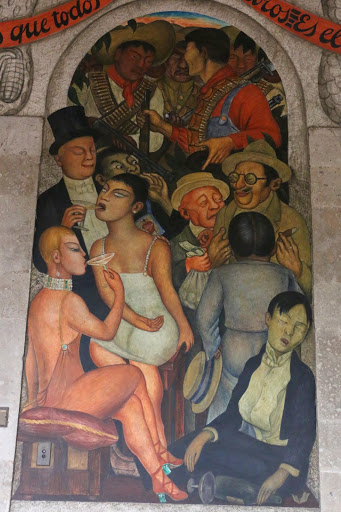
La Orgia-La Noche de los Ricos
The Orgy-The Night of the Rich
Diego Rivera
Secretariat of Education

However, the style of Rivera's "Orgy" and the figures within it seem tame, aloof, stilted compared to Orozco's over-the-top painting style and his corpulent, drunken, contemptuous diners.

With this stark introduction to both sides of the early 20th century's economic and political divides, we start up the stairs to the two upper floors, wondering what more Orozco has in store for us.

Up the Stairs and Backward in Time

Reaching the landing halfway up to el primer piso, the first upper floor, we turn to continue ascending, but become aware of a powerful presence looming over our head.


Cortés y Malinche

Hernán Cortés, the Conquistador, and Malinche, the indigenous Nahua woman given to him by her Maya master as a peace offering and who became his translator, sit naked and rigidly upright above us. Cortés stares into the distance, as if his mind is on other things, other places. Malinche drops her gaze. While they hold right hands, Cortés uses his left to block Malinche from moving forward. Below them, outside this photo (it was too dark to capture), lies the small, naked body of an indigenous man or youth, face down. Cortés´ right foot rests on the person's legs. His left foot is held poised in the air, as if about to stomp on the prostrate figure.

Artistically and emotionally, it is the simplest, most unadorned and powerful representation we have seen of the contrasts, clash, devastation and synthesis that was the Spanish Conquest of what is today called Mexico.

On the side walls leading up the stairs, Orozco continues with this potent, truly shocking theme.


Los Franciscanos
The Franciscans

It was Cortés himself who, after his defeat of the Aztecs and demolition of their capital, Tenochtitlán, petitioned the young King Charles I, who was also Holy Roman Emperor Charles V, to send friars, members of religious orders, monks, not priests of the regular "secular" church, i.e. the church in the everyday world, to evangelize the indigenous peoples of the lands he was now subduing. Charles sent Franciscans. (See our post: The Spiritual Conquest: The Franciscans - Where It All Began.)

They arrived barefoot and dressed in near rags, manifesting their vows of humility and poverty. While they strove to convert the "heathen", saving them from their violent "pagan" gods, they also became known for seeking to defend them from the worst depredations of the conquistadores and peninsulares, members of the Spanish ruling class who came to manage the new realm and extract its natural wealth using indigenous labor.   


Sobered by this confrontation with Mexico's roots exposed, we continue up the stairs, wondering even more how Orozco will unsettle us with the range and power both of his themes and his technique.


See more on the Mexican Revolution and Mexican Muralists
Part I: Bellas Artes 
Part II: The Academy of San Carlos and Dr. Atl 
Part III: Secretariat of Education, José Vasconcelos and Diego Rivera 
Part IV: Secretariat of Education and Diego Rivera's Vision of Mexican Traditions 
Part V:  Secretariat of Education and Diego Rivera's Ballad of the Revolution 
Part VI: Diego Rivera at the College of San Ildefonso 
Part VIII: College of San Ildefonso and José Clemente Orozco - Continued 
Part IX: David Siqueiros, Painter and Revolutionary 
Part X: David Siqueiros Cultural Polyforum
Part XI: The Abelardo Rodríguez Market 
For the background of the Mexican Revoluion, see: Mexican Revolution: Its Protagonists and Antagonists