Saturday, April 18, 2020

Mexico City's Flowers

In our ambles through the colonias, pueblos and barrios of Mexico City, we have been focused on the important buildings, primarily the original 16th-century churches built by the Franciscans or other orders of monks, and most of all on the people and their celebrations of their traditional fiestas.

However, also being a gardener, we have taken photos of the many kinds of flowering plants, vines, shrubs and trees that lend the beauty of nature to the city's neighborhoods, particularly their plazas and the atriums of their churches. There are also many parks. So, in this time of confinement, when we cannot take ambles, we thought we would present our collection of flower photos.

Hibiscus

Southern Mexico does not really experience distinct seasons, except the "dry season" of winter to mid-spring and the "wet" season from May through September. The somewhat cooler temperatures of "winter" (daytime highs of high 60s to low 70s) are an indistinguishable blend of what, in the northern U.S. is early fall with late spring. Deciduous trees don't all lose their leaves at the same time in October. Each one has a "fall" of its leaves in a sequence between October and February, and its "spring" of new leaves within a month of the "fall". Therefore, we call this "season" "Fling", a merger of fall and spring.

Canna lily

As a result, there is no clear season for flowers, except for some that like the dry time for blooming while others like the rainy season. Thus, there is no clear order in which they bloom. Roses bloom in the midst of winter and poinsettias bloom from November through April. Hence, our presentation has no chronological order that a northern gardener would be able to display.

In any case, we hope you enjoy the flowers of Mexico City. Interestingly, many come from other tropical climates: South America, Southern Africa and Southern Asia. So the tour is also a botanical tour of these other continents!

Jacaranda  (hah-kah-RAHN-da) tree

I have placed the flowers in a Google Photo Album, Flowers of Mexico City. Clicking on the link will take you there. Then click on the first photo to enlarge it. In the upper right-hand corner is an icon consisting of the letter 'i' in a circle; clicking on it will open a sidebar of information about each flower. I have done my best to identify each one, but there are several I haven't been able to. Enjoy!

Rose

San Francisco Tlaltenco, Tláhuac | Carnaval of Disguises and Faces

San Francisco Tlaltenco is one of seven originally indigenous pueblos in the Delegación/Alcaldía of Tláuac, in southeastern Mexico City. Until the latter part of the 20th century, it was still rural, with residents raising crops on chinampas, man-made island gardens in the former Lakes Xochimilco and Chalco. San Francisco Tlaltenco was originally on the south side of the Iztapapalpa Peninsula, on the north shore of Lake Xochimilco. Some chinampas and remnants of Lake Chalco still exist in eastern Tláhuac. (See our post: Tláhuac: Crossroads Between Two Lakes and Two Cultures.)

Each spring, during the Catholic season of Lent, between Ash Wednesday and Holy Week, many of the pueblos in Tláhuac and its neighbor, Delegación/Alcaldía Iztapalapa, hold Carnavales. They can be extended over several weeks, with various comparsas (troupes of parade dancers) marching through the streets each weekend, accompanied, of course, by the music of brass bandas.

Carnaval in San Francisco Tlaltenco


We have been to four of the other pueblos of Tláhuac, usually for their patron saint fiesta or some other fiesta. We haven't been to one of their Carnavales, so we are doubly eager to get to the one in San Francisco Tlaltenco. It turns out that this weekend is devoted to a parade of comparsas de disfraces, of disguises.

Arriving via taxi from the nearby Tláhuac Metro Station to a corner where the Carnaval's Facebook page says it will pass, we find it is in front of a small chapel where mass is being held. In the blocked-off street, people are standing or milling about, some are wearing disguises of all types: princesses, Aztec death warriors, chinelos (Moorish-style costumes), space creatures, cartoon characters. It´s quite a conglomeration. We wait un rato, a while, before anything happens.

Then, suddenly, a banda appears and begins to play. Apparently, the parade is about to begin.

Lower Left is the shirt of a committee member of the Comparsa (parade troupe)
called los Cupamaros (cupar is to suck, a maro is the seed of a lavender plant
considered medicinal).
Second from bottom right is a chinelo, a frequently seen style of parade comparsa
in Mexico City and in the State of Morelos, where they are said to have originated to spoof the Spanish.

Egyptian Princess

Anubis, Egyptian Dog God of Death and the Underworld
A large float appears, decorated with peacocks, a favorite symbol of royalty. A beautiful young woman with flowing blond hair, dressed in a sequin-covered evening gown and crown is assisted in mounting a tall podium from which she will preside over the parade. 


Princess Dayan (Dah-yahn)
Dayan tosses candies to the crowd.

The Parade Gets Underway


A  golden angel leads the way.

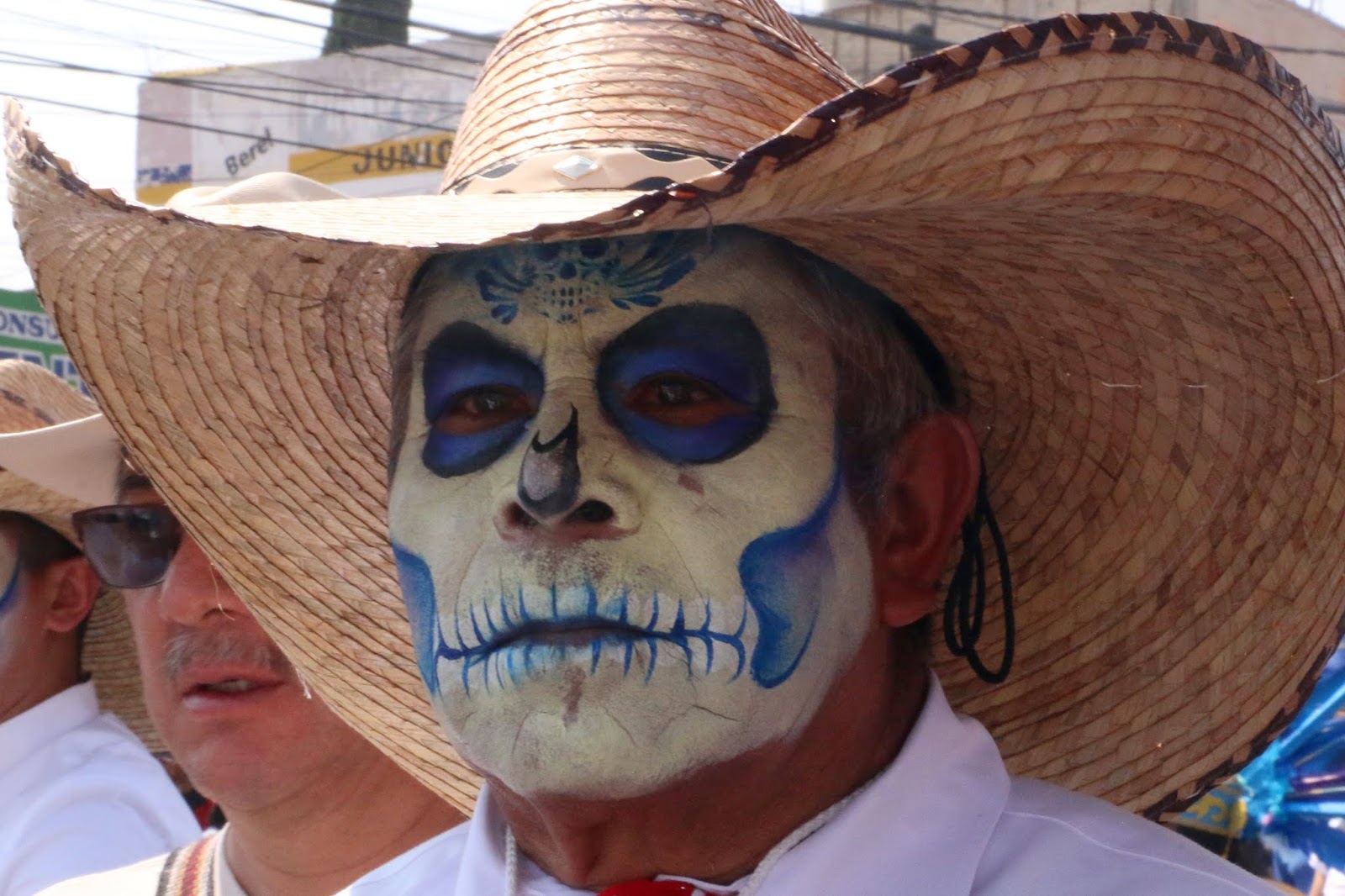
Followed by esqueletos, skeletons.
The vivid contrast of eternal life and death is a central theme in Mexican culture
.

One esqueleto is holding a michelada, a beer with chile added and salt on the rim.
The salt actually cuts the picoso or piquante hotness of the chili.

A large float appears, decorated with peacocks, a favorite symbol of royalty. A beautiful young woman with flowing blond hair, dressed in a sequin-covered evening gown and crown is assisted in mounting a tall podium from which she will preside over the parade. 

There is a Greco-Roman god, Neptune, and an indigenous one.
The jaguar is a traditional indigenous symbol of the sun god at night,
on his journey through the Underworld.

comparsa with more explicit and elaborate Mardi Gras-style Carnaval disfraces is next. 


Then some more ominous figures, including the appearance of two angels of death.


They are followed by some comic relief.


Then there are the inevitable vaqueros, cowboys.


This is a charro (fancy-dressed cowboy) of death.
We have seen many fiestas
with large comparsas of such charros.

More death, but in more ordinary vaquero dress.

Then another dramatic change of theme:

Two Hydras.


Followed by some sci-fi figures.


Finally, just sheer beauty!


We feel like we have been at a Halloween parade, with the wide variety of disguises presented. But this is springtime Carnaval, when Mexicans can discard their ordinary identity and disguise themselves as anything they wish to represent, be it angels of light or darkness, monsters or Greek gods, cowboys of death, cartoon figures, sci-fi heroes, or princesses. Their imagination and inventiveness is remarkable. 

When the parade is over, happy that we have come to San Francisco Tlaltenco for this holiday from daily routine, we hail a cab to take us back to the Tláhuac Metro station and la cotidianidad, daily life. 

Delegaciones or Alcaldías of Mexico City
Tláhuac is the dark brown one
in the southeast. 

Seven Original Pueblos of Delegación Tláhuac
(Each pueblo is divided into various barrios)

San Francisco Tlaltenco (red/yellow star) is in the northeast corner.

Gray-green areas marked by rectangles are chinampa fields.
Other gray green areas to the north and south are volcanic mountains.
A remnant of Lake Chalco remains to the east.

Tuesday, November 12, 2019

Mexico City's "Walking Fish", Axolotls

BBC: Megan Frye

For some, axolotls are considered adorable, with the appearance of a perpetual smile (Credit: Credit: Minden Pictures/Alamy)
Photo: BBC
Axolotls (ah-show-LOW-tls) are curious amphibians that offer hope for healing the human body, but face near extinction in the wild. They have remarkable regeneration abilities, being able to regrow lost body parts, including even eyes. Though gaining traction as a symbol of Mexico City, and specifically of the southern borough of Xochimilco, a Unesco World Heritage site, they are nearly extinct in the wild due to increases in invasive fish species and water pollution in the city’s troubled canals.  
MCA Note: We don't usually publish links to otherwised published articles about Mexico City, but this one is both delightful and of serious interest beyond the intriguing nature of the animal. 
There are seventeen species of axolotls, found primarily in the states of Mexico, Puebla and Michoacán, many critically endangered. Some species transform themselves into earth-walking salamanders by losing their tadpole-like tails and gills from their heads. However, this too depends on the environment. Where their waters are devoid of predators, they remain eternal teenagers. Never transforming into salamanders, such axolotls will keep the external gills they developed as a larva and live their entire life underwater. Read full article

Wednesday, October 2, 2019

Original Villages | San Bartolo Ameyalco, Álvaro Obregón: Pueblo of the Mule Drivers

Pueblos in the Mountains


In recent months, we have finally been able to get to pueblos some distance from our home Delegación/Alcaldía of Coyoacán in the middle of Mexico City. Three of those pueblos are to the southwest, in the mountain range of the Sierra de las Cruces, which we wrote about in our post on the volcanoes that surround the city. We have made it to Santa María Magdalena Atlitic in Delegación/Alcaldía Magdalena Contreras and to San Lorenzo Acopilco, in Delegación/Alcaldía Cuajimalpa. Most recently, we made it to San Bartolo Ameyalco, in the Delegación/Alcaldía Álvaro Obregón.

Delegaciónes Magdalena Contreras, Álvaro Obregón and Cuajimalpa
all stretch narrowly from north to south on the west side of Mexico City,

reflecting their mountainous terrain.
The southern half of 
Álvaro Obregón, two-thirds of Magdalena Contreras 
and all of Cuajimalpa lie in the Sierra de las Cruces.

La Sierra de las Cruces,
running northwest from Mt. Ajusco (on the right, which lies in Delegación Tlalpan).
The part that is in Magdalena Contreras lies south of the white building in the foreground.
To the north east are Delegaciónes Álvaro Obergón and Cuajimalpa.

Photo taken from our apartment in northern Coyoacán

The northern end of Delegación Cuajimalpa
which has been developed as a postmodern, international style section of the city
known as New Santa Fe.

We have been to other originally indigenous pueblos in Álvaro Obregón: San Sebastián Axotla, which maintains its indigenous roots, and San Ángel and Chimalistac,which were taken over early in the Colonial Period by wealthy Spanish for haciendas (estates) and country homes. However, they lie near the northeastern end of the delegación, literally on the border with Coyoacán and are now immersed in the modern city. In striking contrast, San Bartolo, like the other pueblos in the Sierra de las Cruces, lies well to the south, high in the mountains, surrounded by evergreen forests. 

San Bartolo Ameyalco


Traveling with our faithful taxista, Sr. Sánchez, on the Sunday morning of the Fiesta de San Bartolomé, we quickly leave our familiar Coyoacán and enter Delegación/Alcaldá Álvaro Obregón. For some distance, we are still on the flat Valley floor and in the midst of the urban, working-class, commercial city. Then we start to climb. As we do, the homes become more upscale, surrounded by walls and with gated entrances. There are entire gated communities and luxury sports clubs. Once again, we are amazed at how quickly one can transition from one world to another in the City, but we also wonder what Pueblo San Bartolo Ameyalco will be like, with all this luxury just below it. 

Finally, after about an hour's ride, as we climb further and begin to enter the ancient forest of the mountainside, we see a sign pointing off the main road to the pueblo. As always, as soon as we enter its narrow streets, lined by modest cinderblock homes and stores, we know we are in a pueblo, not the modern city. Inevitably, because it is fiesta time, we come to the point where the street is closed off and, beyond that point, filled with temporary puestos, stalls, whose owners are preparing them to sell food or other items. And there are the carnival rides, sitting still and empty, awaiting the evening party time. So again, we thank Sr. Sánchez for bringing us so far and so reliably to our destination, pay and tip him well, and bid him "hasta luego", "until the next time".

Walking up the puesto-filled street we soon come to the walled entrance to the church atrio (atrium). So far, all is as it virtually always is for a pueblo's patron saint fiesta. 

Entrance to the atrio of the Church of San Bartolo de Ameyalco.
The portada is not the usual flowers, either fresh or plastic, but a design made with beans.
We have seen such portadas in other pueblos.
"Protect us, San Bartoloméa"
On the far side of the atrio is the original 16th or 17th-century chapel.

The original chapel.
We are sorry that it is closed so that we cannot see its interior.

To the left of the original chapel, and down some stairs, is a larger, modern church.
Its facade is also covered with a fiesta portada made with seeds.

The Pueblo of Arrieros, Mule Drivers


Not seeing any schedule of events posted anywhere, we wander back into the street. There we encounter a traditional group of dancers whom, not long ago. we encountered for the first time in the city, while at a fiesta in Santa Ursula Xitla, in the southern Delegación of Tlalpan. They are a cuadrilla de arrieros, a team of mule drivers. We had encountered them again in Pueblo San Pedro Martir, also in Tlalpan, and most recently in San Lorenzo Acopilco in Cuajimalpa. They seem to be a phenomenon of the mountainous pueblos of the south and west of the city, evidently because, for centuries, the commercial trails leading into and out of the city had to cross these mountains.  

Cuadrill de arrieros de San Bartolo Ameyalco.
Their attire is the traditional white manta (muslin) shirts and pants
dictated for peasant workers by the Spanish after the Conquest.
It is a larger group than we have seen before.

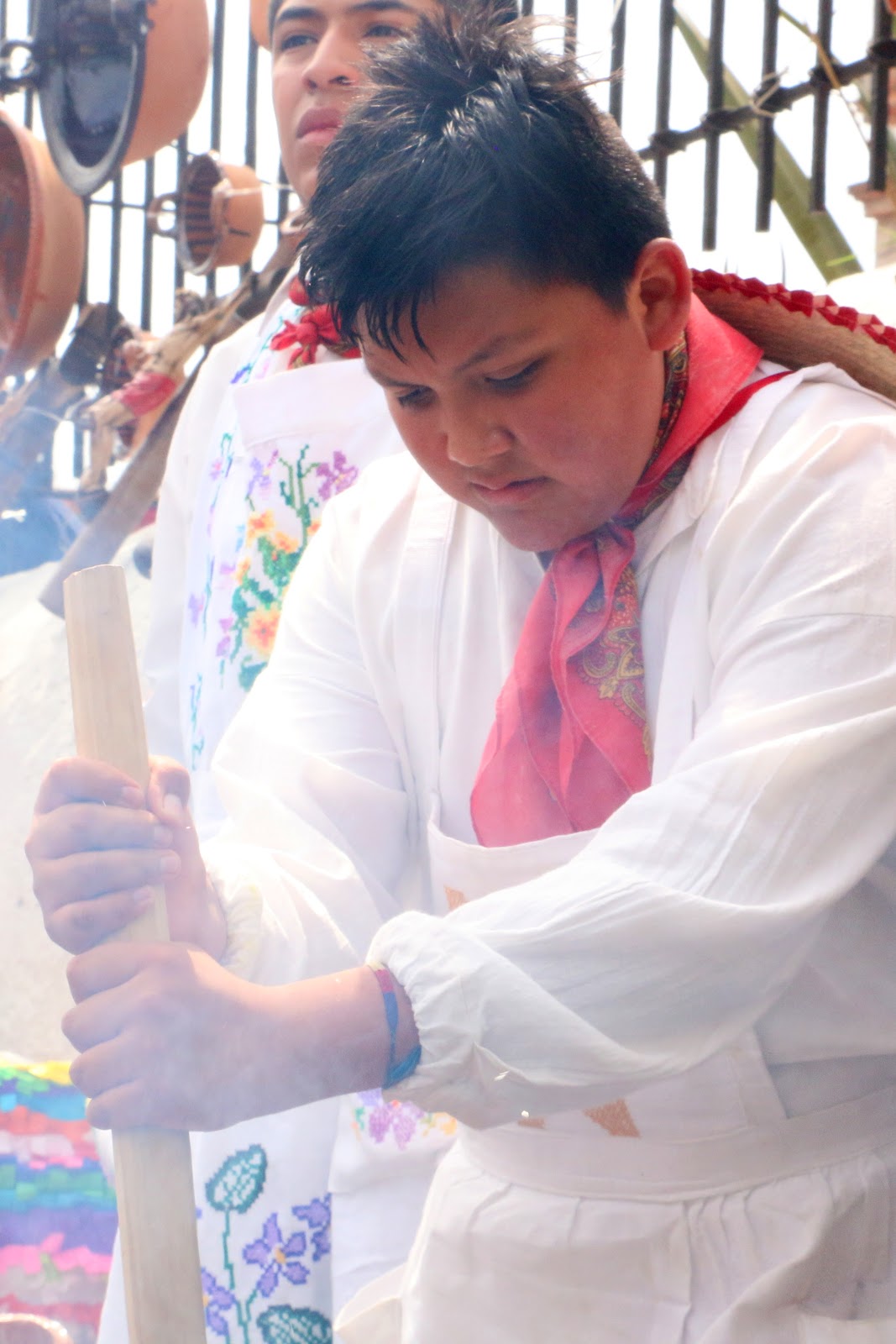
Three small boys lead the procession,
demonstrating the ongoing incorporation
of new generations into the tradition.
Their sign says, "Juvenile Dance of Arrieros".

Soon, they file into the atrio to begin their ritual.
It will turn out to be more elaborate than the ones we have encountered before
.

The inevitable and essential banda follows them.

They file down the stairs to the newer church.

Youth form a significant portion of the group.
This is not the nostalgic act of some old men.


The sanctuary is bedecked with bouquets of flowers, typical of a patron saint fiesta.
The banners say, "Glorious apostle St. Bartholomew, pray for us," and
"Strengthen our faith so that we may follow Christ."


San Bartolomé stands to one side.
St. Bartholomew was one of the lesser-known
apostles of Jesus.

The arrieros offer their veneration of San Bartolomé


They then return to the street beside the atrio to begin their ceremonial dance


"Los peques", the little ones, are instructed in the ritual by some adolescent members
given this responsibility of passing on the tradition.

A horse is brought forward with some supplies. 

A mule is unloaded of supplies
for the next part of the ritual.

Older men begin the preparation of food.
It will be shared with the community
at the end of the Mass.

Several wooden fires are built and the cooking begins.
The men's aprons are quite richly embroidered,
indicating their pride in participating in the arrieros ritual.

Traditional clay ollas, pots of various kinds and sizes are being used. 

Adolescents and younger boys are fully brought
 into the work of cooking. 


We think the yellow mass
is corn masa, dough, mixed with fat,
to be melted down to make atole,
a corn-based drink.

We don't know why carrots,
not an indigenous vegetable,
are included in the meal.
 

A large cazuela is being used
to prepare chocolate for drinking.  

Arrieros, young and old.
The apron of the man, second from left, top, says,
"Mule Drivers Dancers of San Bartolo Ameyaco,
Hurry on, hurry on, my little burro."

Comparsa de Caporales


While we are watching the arrerios carry out their elaborate preparations to feed the community, we hear another banda begin to play in the atrio in front of the original chapel, so we hurry over to see what is happening. Fiestas are often "three-ring circuses", with multiple events happening simultaneously.

A comparsa (troupe) of caporales (herdsmen, i.e. cowboys and cowgirls) is performing another colorful traditional Mexican folk dance.


El Pueblo


As always, we are as interested in capturing the faces of the people of the community as in the formal ceremonies. 


The Strength of Tradition


What has impressed us the most about the Fiesta del Pueblo San Bartolo Ameyalco, here in the wooded mountains that surround the modern City, is the strength of their tradition of arrieros. As we noted in introducing them, we have recently encountered them in some pueblos in other southern delegaciones/alcaldías, but not in these numbers, nor with such elaborately embroidered trajes traditionales, traditional dress.

Above all, while we saw the ritual of preparation of some food for the community in San Lorenzo Acopilco in Cuajimalpa, we did not realize how central it is to the arrieros tradition, as evidenced by the extensive preparation of food as we have seen today. It was quite a production of multiple foods, obviously well-organized and carried out with deliberation and pride by the members. The group also included a large number of children and youth, incorporating them fully, thus teaching them all the components of the tradition so that they could maintain it intact into the next generation.

All of these qualities bespeak the community's deep commitment to and pride in reenacting and thereby commemorating the significant role that arrieros played for four hundred years after the Conquest in providing the only means of commercial transport into and out of the capital city. Hence, they were essential both to the life of those living in the city and surrounding villages and, on a global scale, to Spain's international commerce between Asia and the mother country via Nueva España.

Alcaldía Álvaro Obrgón and its colonias and pueblos.

It extends from the valley floor in the northeast 
up into the mountains of la Sierra de las Cruces (Mountains of the Crosses)
in the southwest, which reach altitudes of 12,000 ft.
Pueblo San Bartolo Ameyalco is marked by the green star.

Similar mountainous pueblos are La Magdalena Atitlic in Alcaldáia Magdalena Contreras to the southeast (purple/orange star)
and San Lorenzo Acopilco in Alcaldía Cuajimalpa ( red/yellow star) to the southwest.