Showing posts with label traditional music and dance. Show all posts

Wednesday, October 2, 2019

Original Villages | San Bartolo Ameyalco, Álvaro Obregón: Pueblo of the Mule Drivers

Pueblos in the Mountains


In recent months, we have finally been able to get to pueblos some distance from our home Delegación/Alcaldía of Coyoacán in the middle of Mexico City. Three of those pueblos are to the southwest, in the mountain range of the Sierra de las Cruces, which we wrote about in our post on the volcanoes that surround the city. We have made it to Santa María Magdalena Atlitic in Delegación/Alcaldía Magdalena Contreras and to San Lorenzo Acopilco, in Delegación/Alcaldía Cuajimalpa. Most recently, we made it to San Bartolo Ameyalco, in the Delegación/Alcaldía Álvaro Obregón.

Delegaciónes Magdalena Contreras, Álvaro Obregón and Cuajimalpa
all stretch narrowly from north to south on the west side of Mexico City,

reflecting their mountainous terrain.
The southern half of 
Álvaro Obregón, two-thirds of Magdalena Contreras 
and all of Cuajimalpa lie in the Sierra de las Cruces.

La Sierra de las Cruces,
running northwest from Mt. Ajusco (on the right, which lies in Delegación Tlalpan).
The part that is in Magdalena Contreras lies south of the white building in the foreground.
To the north east are Delegaciónes Álvaro Obergón and Cuajimalpa.

Photo taken from our apartment in northern Coyoacán

The northern end of Delegación Cuajimalpa
which has been developed as a postmodern, international style section of the city
known as New Santa Fe.

We have been to other originally indigenous pueblos in Álvaro Obregón: San Sebastián Axotla, which maintains its indigenous roots, and San Ángel and Chimalistac,which were taken over early in the Colonial Period by wealthy Spanish for haciendas (estates) and country homes. However, they lie near the northeastern end of the delegación, literally on the border with Coyoacán and are now immersed in the modern city. In striking contrast, San Bartolo, like the other pueblos in the Sierra de las Cruces, lies well to the south, high in the mountains, surrounded by evergreen forests. 

San Bartolo Ameyalco


Traveling with our faithful taxista, Sr. Sánchez, on the Sunday morning of the Fiesta de San Bartolomé, we quickly leave our familiar Coyoacán and enter Delegación/Alcaldá Álvaro Obregón. For some distance, we are still on the flat Valley floor and in the midst of the urban, working-class, commercial city. Then we start to climb. As we do, the homes become more upscale, surrounded by walls and with gated entrances. There are entire gated communities and luxury sports clubs. Once again, we are amazed at how quickly one can transition from one world to another in the City, but we also wonder what Pueblo San Bartolo Ameyalco will be like, with all this luxury just below it. 

Finally, after about an hour's ride, as we climb further and begin to enter the ancient forest of the mountainside, we see a sign pointing off the main road to the pueblo. As always, as soon as we enter its narrow streets, lined by modest cinderblock homes and stores, we know we are in a pueblo, not the modern city. Inevitably, because it is fiesta time, we come to the point where the street is closed off and, beyond that point, filled with temporary puestos, stalls, whose owners are preparing them to sell food or other items. And there are the carnival rides, sitting still and empty, awaiting the evening party time. So again, we thank Sr. Sánchez for bringing us so far and so reliably to our destination, pay and tip him well, and bid him "hasta luego", "until the next time".

Walking up the puesto-filled street we soon come to the walled entrance to the church atrio (atrium). So far, all is as it virtually always is for a pueblo's patron saint fiesta. 

Entrance to the atrio of the Church of San Bartolo de Ameyalco.
The portada is not the usual flowers, either fresh or plastic, but a design made with beans.
We have seen such portadas in other pueblos.
"Protect us, San Bartoloméa"
On the far side of the atrio is the original 16th or 17th-century chapel.

The original chapel.
We are sorry that it is closed so that we cannot see its interior.

To the left of the original chapel, and down some stairs, is a larger, modern church.
Its facade is also covered with a fiesta portada made with seeds.

The Pueblo of Arrieros, Mule Drivers


Not seeing any schedule of events posted anywhere, we wander back into the street. There we encounter a traditional group of dancers whom, not long ago. we encountered for the first time in the city, while at a fiesta in Santa Ursula Xitla, in the southern Delegación of Tlalpan. They are a cuadrilla de arrieros, a team of mule drivers. We had encountered them again in Pueblo San Pedro Martir, also in Tlalpan, and most recently in San Lorenzo Acopilco in Cuajimalpa. They seem to be a phenomenon of the mountainous pueblos of the south and west of the city, evidently because, for centuries, the commercial trails leading into and out of the city had to cross these mountains.  

Cuadrill de arrieros de San Bartolo Ameyalco.
Their attire is the traditional white manta (muslin) shirts and pants
dictated for peasant workers by the Spanish after the Conquest.
It is a larger group than we have seen before.

Three small boys lead the procession,
demonstrating the ongoing incorporation
of new generations into the tradition.
Their sign says, "Juvenile Dance of Arrieros".

Soon, they file into the atrio to begin their ritual.
It will turn out to be more elaborate than the ones we have encountered before
.

The inevitable and essential banda follows them.

They file down the stairs to the newer church.

Youth form a significant portion of the group.
This is not the nostalgic act of some old men.


The sanctuary is bedecked with bouquets of flowers, typical of a patron saint fiesta.
The banners say, "Glorious apostle St. Bartholomew, pray for us," and
"Strengthen our faith so that we may follow Christ."


San Bartolomé stands to one side.
St. Bartholomew was one of the lesser-known
apostles of Jesus.

The arrieros offer their veneration of San Bartolomé


They then return to the street beside the atrio to begin their ceremonial dance


"Los peques", the little ones, are instructed in the ritual by some adolescent members
given this responsibility of passing on the tradition.

A horse is brought forward with some supplies. 

A mule is unloaded of supplies
for the next part of the ritual.

Older men begin the preparation of food.
It will be shared with the community
at the end of the Mass.

Several wooden fires are built and the cooking begins.
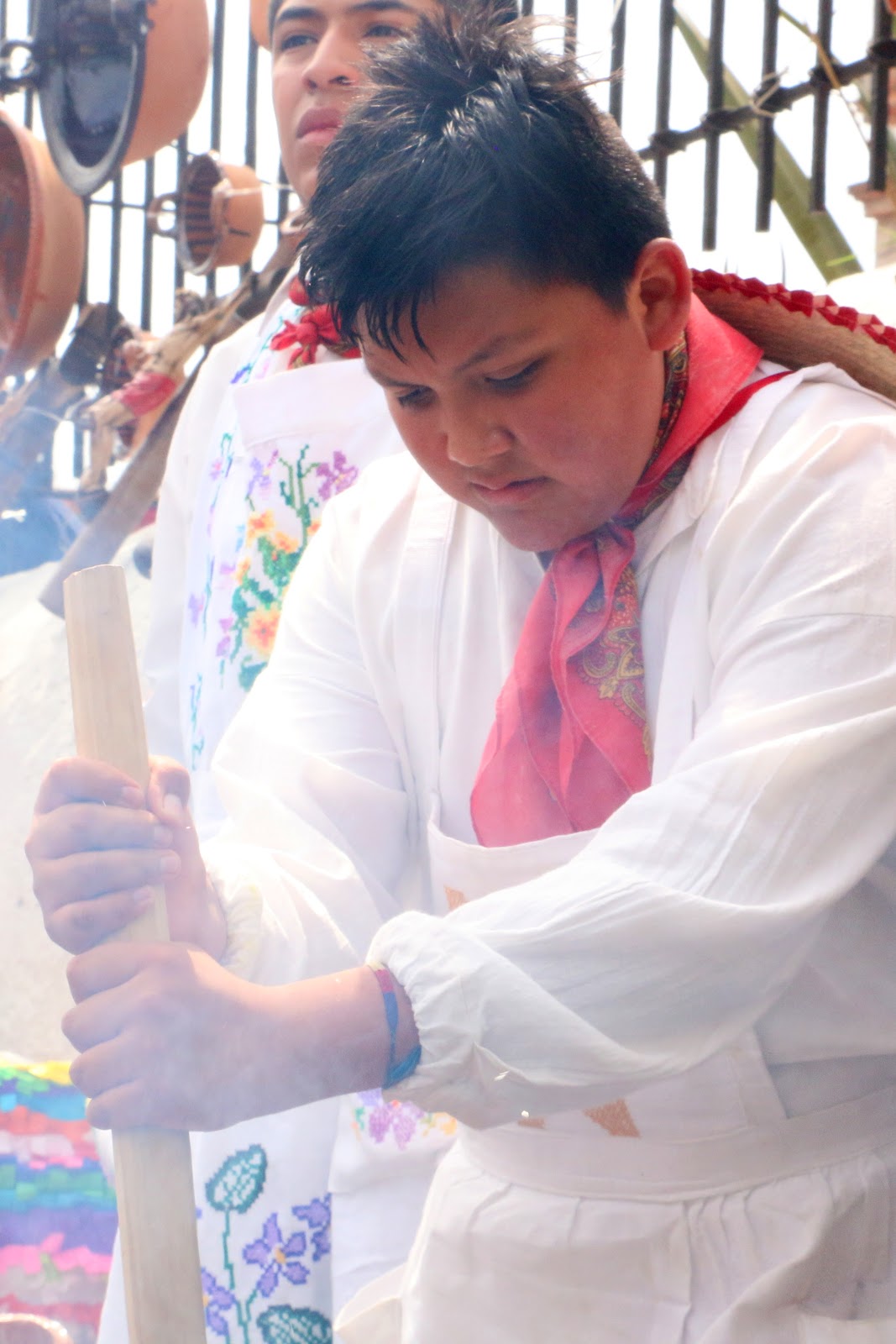
The men's aprons are quite richly embroidered,
indicating their pride in participating in the arrieros ritual.

Traditional clay ollas, pots of various kinds and sizes are being used. 

Adolescents and younger boys are fully brought
 into the work of cooking. 


We think the yellow mass
is corn masa, dough, mixed with fat,
to be melted down to make atole,
a corn-based drink.

We don't know why carrots,
not an indigenous vegetable,
are included in the meal.
 

A large cazuela is being used
to prepare chocolate for drinking.  

Arrieros, young and old.
The apron of the man, second from left, top, says,
"Mule Drivers Dancers of San Bartolo Ameyaco,
Hurry on, hurry on, my little burro."

Comparsa de Caporales


While we are watching the arrerios carry out their elaborate preparations to feed the community, we hear another banda begin to play in the atrio in front of the original chapel, so we hurry over to see what is happening. Fiestas are often "three-ring circuses", with multiple events happening simultaneously.

A comparsa (troupe) of caporales (herdsmen, i.e. cowboys and cowgirls) is performing another colorful traditional Mexican folk dance.


El Pueblo


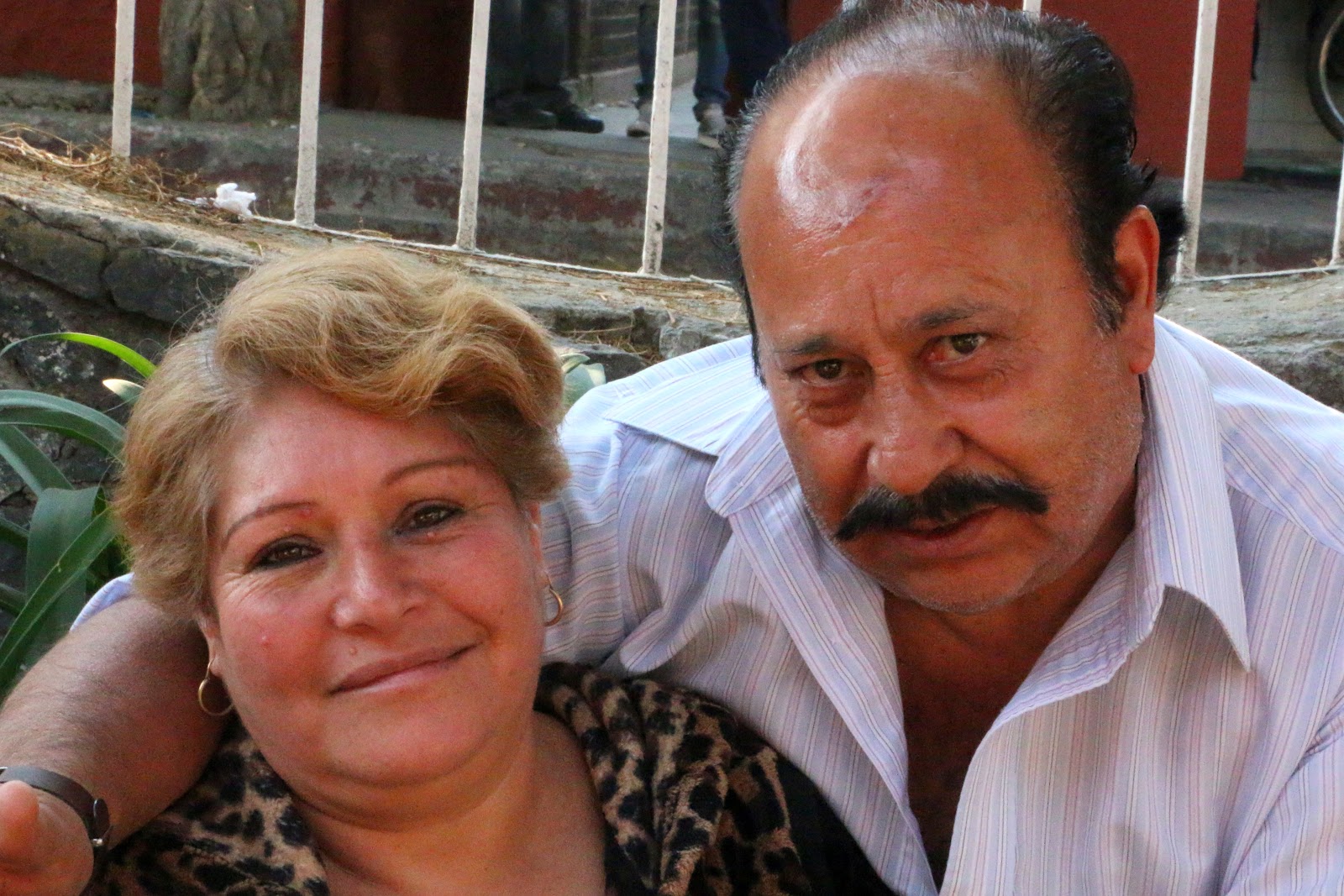
As always, we are as interested in capturing the faces of the people of the community as in the formal ceremonies. 


The Strength of Tradition


What has impressed us the most about the Fiesta del Pueblo San Bartolo Ameyalco, here in the wooded mountains that surround the modern City, is the strength of their tradition of arrieros. As we noted in introducing them, we have recently encountered them in some pueblos in other southern delegaciones/alcaldías, but not in these numbers, nor with such elaborately embroidered trajes traditionales, traditional dress.

Above all, while we saw the ritual of preparation of some food for the community in San Lorenzo Acopilco in Cuajimalpa, we did not realize how central it is to the arrieros tradition, as evidenced by the extensive preparation of food as we have seen today. It was quite a production of multiple foods, obviously well-organized and carried out with deliberation and pride by the members. The group also included a large number of children and youth, incorporating them fully, thus teaching them all the components of the tradition so that they could maintain it intact into the next generation.

All of these qualities bespeak the community's deep commitment to and pride in reenacting and thereby commemorating the significant role that arrieros played for four hundred years after the Conquest in providing the only means of commercial transport into and out of the capital city. Hence, they were essential both to the life of those living in the city and surrounding villages and, on a global scale, to Spain's international commerce between Asia and the mother country via Nueva España.

Alcaldía Álvaro Obrgón and its colonias and pueblos.

It extends from the valley floor in the northeast 
up into the mountains of la Sierra de las Cruces (Mountains of the Crosses)
in the southwest, which reach altitudes of 12,000 ft.
Pueblo San Bartolo Ameyalco is marked by the green star.

Similar mountainous pueblos are La Magdalena Atitlic in Alcaldáia Magdalena Contreras to the southeast (purple/orange star)
and San Lorenzo Acopilco in Alcaldía Cuajimalpa ( red/yellow star) to the southwest.


Tuesday, April 30, 2019

Original Villages | Mule Drivers of Santa Ursula Xitle and Tlapan

Encountering a New Form of Fiesta Dancers


Virtually every amble we have made to an original indigenous village in Mexico City has brought us surprises: some new experiences, something new learned about Mexican popular (the people's) culture, the culture of el pueblo mexicano.

When we saw an announcement of a fiesta in the Pueblo Santa Úrsula Xitle we were intrigued by two things. First, fulfilling one of our primary criteria, it was a pueblo we had not previously visited and, additionally, it was in Delegación/Alcaldía Tlalpan, the city's largest but one where we had explored only a few of its original pueblos.

Second, the announcement said cuadrillas (qua-DREE-yahs) of arrieros would be performing. In all of our many experiences of fiesta performers, we have seen many types of comparsas (dance troupes) representing various parts of Mexican identity, but never cuadrillas de arrieros. We had seen:
  • Chinelosdancers "disguised", as their name means in Nahuatl, usually wearing masks with blue eyes, pink skin and long, pointed beards, caricatures of colonial Spaniards! However, they are dressed in elaborately decorated, spacious velvet gowns and tall headdresses, and they dance a jumping, spinning, Sufi Muslim dervish-like dance, with their gowns ballooning around them. So, they strike us not just as a caricature of Spaniards, but more as an imaginative, orientalist representation of the Moors, i.e., the North African Muslims who occupied portions of the Iberian peninsula for seven hundred years. They were viewed by the Christian Spaniards as "pagans", and were slowly driven out in the centuries-long "Reconquista", which was completed only in the year 1492. The Spanish Conquista of Mexico and the subsequent "Spiritual Conquest" of its "pagans" began just thirty years later.
  • Charros, dressed as Spanish hacendados (ah-cen-DAH-dos), wealthy hacienda (ah-cee-EN-dah, rural estate) owners. Like the chinelos, they are usually masked with Spanish faces that have long beards and dressed in fancy Spanish cowboy attire, elaborately embroidered in gold thread with a wide range of symbols on the fronts and backs of their jackets and pants;
  • Caporales (herdsmen) or vaqueros (cowboys), in much simpler, working cowboy attire (think your old "Western" movie, with everyone dressed up for a square dance).
But we had never encountered a cuadrilla de arrieros. A quick consultation of our Spanish-English dictionary told us a cuadrilla was a work-crew or team and arrieros were mule drivers. Hence, a team of mule drivers. 

Thus, like charros, cuadrillas de arrieros--as participants in fiestas--are an incorporation of Spanish culture into Mexican popular culture, but they aren't like the elegant charros in their gold-embroidered jackets, tight pants and huge sombreros. They are something more like caporales, an organized group of working-class indigenous and mestizo (mixed indigenous and Spanish) people created to meet the needs of the Spanish ruling class in the Colonial period.

Arrieros: Key Links in a Global Trade Route


Before the Spanish Conquest, the indigenous had no beast of burden. Men, called tamemes in Nahuatl, carried everything, including members of the upper class, on their backs. After the Spanish took over, they introduced mules and horses — eliminating the need for human carriers. Mules became the "trucks" of cross-country commerce and those who gained the skills to manage mule trains during what could be long trips, called los arrieros, achieved a certain level of increased status.

During Colonial times, the Spanish, after they conquered what is now central Mexico, conquered the Philippines on the opposite side of the Pacific Ocean. In 1513, the Spanish explorer, Vasco Núñez Balboa discovered the Pacific from Panama and declared that it and all lands adjoining it were possessions of the Spanish crown. The Portuguese explorer Ferdinand Magellan arrived in the Philippines in 1521, where he was killed in battle with the resident people. The Spanish explorer, Ruy López de Villalobos, landed there in 1543, and in 1565, the Spaniard Miguel López de Legazpi, sailing from Mexico, conquered the islands. Like Mexico, they became part of the globe-spanning Spanish Empire that endured for some 300 years.

Thereafter, each year, the Spanish sailed what they called the Manila Galleons across the Pacific, bringing goods from China and Japan to the port of Acapulco on the southwest coast of Mexico. From Acapulco, these luxury goods were then carried by mule trains, led by arrieros, 10,000 feet (3,000 meters) up to the pass in the Chichinautzin mountains that form the southern boundary of the Valley of Mexico, and down 3,000 ft. (915 meters) to Mexico City. (See our post Encountering Mexico City´s Many Volcanoes: Giants on All Sides.) From the city, other mule trains carried the goods on to Veracruz on the Gulf of Mexico, where they were shipped to Spain.

Santa Úrsula Xitle, like its neighbor, Chimalcoyotl, and others along the trails leading up the Chichinautzin mountains provided the mules and drivers needed for this arduous trip. Mule drivers worked for Spanish businessmen. So, we wonder why this manifestation of Spanish colonialism is, like charros and caporales, actively maintained and celebrated by the descendants of those who did the actual hard work, essentially as peons on haciendas or low-paid employees of the owners of mule trains.

Why maintain memories of a life of full of hard labor, repressive relationships and poverty? The answer, we surmise, lies in the fact of their awareness that they were an essential link in Spain's global trading network. Without them, that chain from the Philippines to Spain via Mexico would have been broken. So we were most curious to meet these arrieros in the fiesta at Santa Úrsula Xitle.


Fiesta at Santa Úrsula Xitle


The fiesta at Santa Úrsula Xitle was likely to be a modest one. It was not the pueblo's patron saint fiesta, which is held in October. It was a fiesta sponsored by a cofradía, a brotherhood of parishioners of the church dedicated to venerating la Virgen de San Juan de los Lagos. We had previously encountered this advocación of the Virgin Mary, that is, a manifestation of the Virgin, appearing at a particular time and place and serving as an advocate for the forgiveness of her followers, supplicating for them before her Son, the Christ, and his Father in Heaven. That had been last autumn at the Fiesta de San Francisco in the Quadrante de San Francisco in Delegación Coyoacán, where a conchero comparsa was dedicated to her.

Despite the fiesta's likely modest size, we set off on a Sunday morning in early February to the Pueblo de Santa Úrsula Xitle in Tlalpan, eager to become acquainted with a new pueblo and a new form of fiesta dancer. (The pueblo is the center of a group of colonias that identify themselves as part of the original indigenous village of Xitle. It was named after a nearby, small volcano whose eruption, about the year 100 A.D., destroyed nearby Cuicuilco, the first urban center in the Valley of Mexico.) 

Although the pueblo is some distance southwest of our base in Delegación Coyoacán, it isn´t difficult for our taxi driver to find. Santa Úrsula lies just south of Tlalpan Centro (the original capital of the altepetl (city-state) of Tlalpan and north of Pueblo Chimalcoyotl, whose fiesta of the Immaculate Conception we attended in December 2017. 

Its eastern border is the major Avenida Insurgentes, which crosses much of the city from north to south on its western side. Just south of Santa Úrsula, the avenue merges with the Calzada de Tlalpan to form the Expressway 95D. It follows the ancient trail that climbs over the mountains, and then descends 5,000 feet (1,524 meters) to the state of Morelos and its capital Cuernavaca, and then, more gradually, another 5,000 ft. (1,524 meters) to Acapulco, on the Pacific Ocean in the state of Guerrero. .

Reaching Avenida Insurgentes, we turn south and soon find Calle Santa Úrsula. Traveling into the pueblo some blocks, we come to where the road divides, one half turning left, the other to the right. There is no sign of a church. Facing us is a tall wall we cannot see over. Not sure which way to turn, we ask our driver to wait and we get out to ask some people on the street where the church is. They smile and point to the street going to the right and then left, around a corner. We thank them and then our driver, pay him and walk around the corner to the right. Immediately we see people gathered at an entrance in the wall. It is the wall of the church atrio (atrium).

The original, well-preserved 16th-century Franciscan chapel
sits at the far end of the spacious, 
tree-filled, tranquil, park-like atrio.

The blue and white papel picado, cut paper,
tell us this is a festival dedicated to the Virgin Mary
.

The decoration of the small chapel also announces this is a fiesta for the Virgin.
Two small representations (called "demanditas", little petitions) of the Virgen de San Juan de los Lagos sit on the altar.
Santa Úrsula stands above and behind them.

Banner
of the Virgen de San Juan de los Lagos
of the cofradía (brotherhood) of the Colonia Pedegral de Santa Úrsula, Tlalpan.

Las Cuadrillas de Arrieros


Outside the chapel, we notice two gentlemen wearing cowboy-style sombreros. They appear to be in charge of the proceedings. They introduce themselves as the leaders of two cuadrillas de arrieros, one from Santa Úrsula, the other from Pueblo San Andrés Toltótepec, a short distance south of Pueblo Santa Úrsula and Pueblo Chimalcoyotl, where the climb up the mountains begins to be seriously steep.

Heads of the Arrieros of San Andrés Totóltepec (left) and Santa Úrsula (right).
They hold a standard representing Santa Úrsula.
The leader from San Andrés invites us to their patron saint fiesta in November.
Ojalá, hopefully, we will be able to attend.

We tell them that our purpose in being here is to get know the pueblo and to take photos to share their fiesta, including the dance of the cuadrillas de arrieros, on the internet via our blog, Mexico City Ambles. We tell them we consider it an honor to be able to witness and record the fiesta and their dance. They invite us to join in the meal being served to participants by a group of women at a table just inside the atrio entrance. We courteously and gratefully accept. It is a simple comida of beef boiled in a broth, accompanied by the indispensable corn tortillas.

When the meal is over, the men of the two cuadrillas line up for their dance. The majority are dressed in the white muslin shirts and pants, some with embroidery, and straw sombreros that were the standard dress for campesinos (rural Mexicans workers) beginning after the Spanish Conquest until the 20th century, that is, for over 400 years. U.S. style "Western cowboy" dress was not adopted until the latter half of the past century. 

La cuadrilla de arrieros de Santa Úrsula

La cuadrilla de arrieros de San Andrés Totóltepec.
Note: This cuadrilla includes one young woman.
Also, unlike those in traditional campesino dress,
the leader is attired as a gentleman cowboy, in a suit, dress shirt and tie, with a felt sombrero,
definitely a "step up" from the campesino class.

The dance, like those of most comparsas of charros and caporales, is a simple line dance to a basic four-beat rhythm. 

The Arrieros Closeup


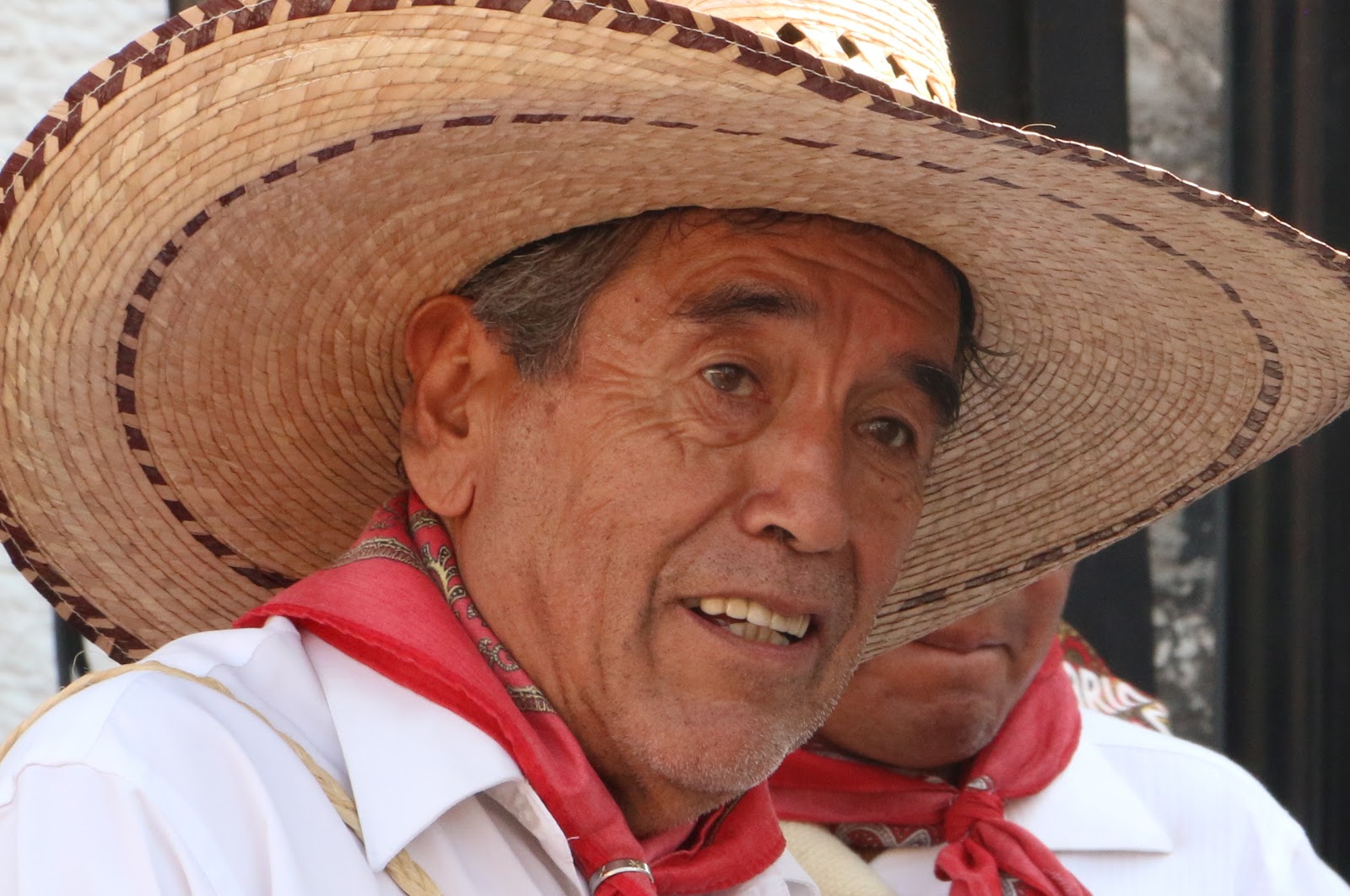
At every fiesta, one of our passions is taking retratos, portraits, of the individuals who are participants and the people who make up the audience. Here are some of the arrieros and those attending the fiesta close up.


The embroidery says "Cuadrilla de Arrieros Águilas del Sur"
Mule Drivers Team Eagles of the South.

At the end of the dance, the leader of the Santa Úrsula Xitle arreiros introduces us to the mayordomo (chief caretaker) responsible for organizing the fiesta for la Cofradía de la Virgen de San Juan de los Lagos. He introduces himself simply as Fausto, with his wife, Tere. 

Tere and Fausto

We thank them profusely for the opportunity and privilege they have provided of being able to attend today's fiesta and photograph it. We tell them we will share our photos via the internet and give them the link to our Facebook page. 

As almost always in our ambles to pueblos and their fiestas, our desire to get to know Santa Úrsala Xitle and to meet and learn about a new group of fiesta dancers, las cuadrillas de los arrieros, has led to an experience full of Mexican ánimo (spirit) and alegría (joy).

And it has led to our learning about a key link, centered here in the pueblos of Tlalpan, in the global trade network that maintained the Spanish Empire for 300 years. The role of los arrieros in that network still gives their descendants mucho orgullo (much pride). It is the same pride we see daily that Mexicans take in mi trabajo, my work, no matter how humble in the economic system it may seem.

Post Script:


By pure chance, we encountered the Arrieros de San Andrés Totóltepec the very next day at the Fiesta of Candelaria in the pueblo of that name in Delegación/Alcaldía Coyoacán. After the main procession and Mass, they sang songs called mañanitas (morning songs, commonly sung on a patron saint's day or an individual's birthday), accompanied by a group of mariachis, to the Virgen de Candelaria in her church. Then they performed their dance outside the church.

Cuadrilla de arrieros from San Andrés Totóltepec
sing mañanitas in the Chruch of Candelaria, Coyoacán


Arrieros de San Andrés Totótepec (left) and
Arrieros of another pueblo we didn't manage to identify.


Clearly, we have only scraped the proverbial surface of cuadrillas de arrieros in Mexico City. We wonder where and when we will encounter them again.


Delegación Tlalpan (mustard yellow)
is at the southwest corner of Mexico City.
It is just south of Coyoacán (purple), our home,
and west of Xochimilco (pink),
and Milpa Alta (light yellow).

Pueblos of north-central Delegación/Alcaldia Tlalpan

Santa Úrsula Xitle is dark blue area marked by green/yellow star.
Tlalpan Centro is the green area to its northeast.
Chimalcoyotl is green area to its southeast.
San Andres Totoltepec is large yellow area to the south.