Showing posts with label chinampas. Show all posts

Tuesday, July 7, 2020

In Mexico City, the Coronavirus Is Bringing Back Thousand-Year-Old Indigenous ‘Floating Gardens’

Atlas Obscura, June 25, 2020 | By Amanda Gokee*

Business is booming for farmers who plant on man-made islands


A man uses a "trajinera" — a traditional flat-bottomed river boat — as transport in the Xochimilco natural reserve in Mexico City. Credit: Ronaldo Schemidt / AFP via Getty Images
In the south of Mexico City, about 100 miles of murky canals wind their way through the Xochimilco alcaldía (borough).
Here, the urban sprawl of one of the world’s densest cities yields to a lake region where indigenous farmers have been cultivating a unique system of floating gardens for over one thousand yearsCalled chinampas, these floating gardens were built by the Xochimilcas to feed a growing population
MCA Note: Around 900 CE, the Xochimilca people, considered one of earliest of the seven Nahuatl-speaking tribes to migrate into the Valley of Mexico, settled on the south shore of the lake that would come to bear their name. It was the southernmost lake, along with Lake Chalco, of the five lakes nearly filling the valley. Their first chief was Acatonallo, who is credited with inventing the chinampa system, which greatly increased crop productivity. These chinampas eventually became the main producer of crops of corn, beans, tomatoes, chili peppers and squash in the Valley of Anáhuac.
The altepetl, city state, of Xochimilco was founded in 919 CE. Over time, the city came to dominate other areas on the south side of the lake and across the mountains to the south, in what is now the State of Morelos. In 1352, the tlatoani, "speaker", Caxtoltzin moved the city from the mainland to the island of Tlilan.
In 1376, the Mexica (aka "Aztecs") who had established their city of Tenochtitlán in 1325 on a group of islands in Lake Texcoco, attacked Xochimilco, forcing the city to appeal for help from Azcapotzalco, the Tepaneca power on the west side of Lake Texcoco. The attack was unsuccessful, but Xochimilco then became a tributary of Azcapotzalco.
The Mexica finally conquered Azcapotzalco in 1428 and conquered Xochimilco in 1430. Shortly thereafter, the Mexica huey tlatoani, "chief speaker", Itzcoatl built a causeway south across the lake to Coyoacán on the southwest bank and Culhuacán on the Iztapalapa Peninsula which separated Lake Texcoco from Lake Xochimilco. This also create a land route from the island of Tenochtitlán to Xochimilco via Coyoacán. At that time, Xochimilco became a major supplier of produce to Tenochtitlán. 
When Hernán Cortés led his Spanish soldiers and indigenous allies into the Valley in 1521, after being driven out in June 1520, the Mexica rulers of Xochimilco resisted. So, Cortés decided to attack the city before his final assault on Tenochtitlan. Using indigenous allies, he attacked on April 16, 1521. Although Cuautémoc, the last Mexica tlatoani, sent ten thousand warriors by land and two thousand by canoe to defend the city, the Mexicas and Xochimilcoans were defeated.
Subsequently, Mexico City was built on top of the ruins of Tenochtitlán. The Spanish then undertook a massive project of draining Lake Texcoco to prevent flooding of their island city, but to keep a route for continued water transport of produce from Xochimilco to Mexico City, they created a canal, called the Royal Canal. After Mexican independence in 1521, it became the National Canal. It remained in use until trucks replaced canoes in the 1920s. Wikipedia
Xochimilco became one of the city’s main sources of food, but rapid urbanization in the 1900s meant less land available for farming.
In 1985, when an earthquake struck Mexico City, many chinampas were abandoned as people who had lost their homes built shanty towns on themToday, only an estimated 20 percent of the approximately 5,000 acres of chinampas are in use, and only 3 percent are used for farming.
But since the COVID-19 pandemic hit Mexico, interrupting the industrial food supply in important ways, small farmers have increased production and rehabilitated abandoned chinampas to fill the demand for fresh, local food.

Raúl Mondragón (left) and Pedro Capultitla (right) covering a chinampa in dried grass for mulch. Courtesy of Colectivo Ahuejote (Ahuejote is the tree Salix bonplandiana (Bonpland willow) native to southern and southwest Mexico and planted around the edge of chinampas to hold their soil in place.)
Raúl Mondragón says on a Zoom call from his home in Mexico City:
“We’re talking about something that’s 1,000 years old. We have to preserve this.” 
Mondragón has been recuperating chinampas since 2016, when he founded Colectivo Ahuejote. Now the virus is revealing the strength of this model in the midst of a crisis.
The revival of chinampa farming is due, in part, to pandemic-related problems at Mexico City’s main market, La Central de Abastos, the largest of its kind in Latin America.
Some warehouses have closed, truck traffic has been limited, and people have been getting sick with the virus. The supply chain of producers from around the country has also had to contend with road closures that limited deliveries to the capital and raised prices.
Mondragón and Capultitla taking in a harvest of kale (left) and a chinampero farmer holding a colorful array of carrots (right).Courtesy of Colectivo Ahuejote

While the market is an enclosed and often crowded environment, small farmers can deliver their crops to the consumer directly, using a model similar to Community Supported Agriculture [CSA].
At a time when people are worried about the risk of shopping at a crowded market or grocery store, buying directly from a chinampero, parked with his truck at an outdoor pickup point in their neighborhood, is one way of limiting exposure.
Quarantine has also given many Mexicans more time to cook, Mondragón points out, and they are taking a greater interest in where their food comes from.
He cites a friend who now not only knows what a leek is but also how to cook it. His “very capitalistic” sister has started compulsively composting.
At a Colectivo Ahuejote workshop, farmers use a kassine tool to till the soil. Courtesy of Colectivo Ahuejoten

Mondragón grew up in Xochimilco, eating produce from the chinampas that his family bought at a local market
.
Now he works on the 16,000-square-foot chinampa that Colectivo Ahuejote uses for growing crops, teaching, and experimenting with new techniques. 
The collective operates as an NGO to develop cooperation among farmers, and they’ve also started a for-profit business to sell produce. 
Their goal is to rehabilitate abandoned chinampas to promote sustainable agriculture and the country’s agricultural heritage.
The pandemic halted the collective’s workshops and training activities, but the commercial side of the business has been flourishing.
Between February and May, small farmers who are part of the collective have increased sales by 100 to 120 percent, according to Mondragón. Networks that have been years in the making are now becoming a bigger part of the city’s food supply.
Fennel, broccoli, and quelites (native greens to Mexico that often grow wild) growing in a chinampa
Courtesy of Colectivo Ahuejote

This is a welcome change for farmers who have other jobs to support themselves.
Chinampero Pedro Capultitla used to have two or three extra jobs, but he was able to quit one recently to spend more time farming.
The word chinampa comes from the Nahuatl chinámitl, meaning a hedge or fence made out of reeds.
Mud from the bottom of the canal as well as lake vegetation are piled into this fencing until they reach the surface, creating a fertile and well-irrigated place for crops to grow. These favorable conditions make the chinampas one of the most productive types of agriculture in the world, enabling as many as seven harvests per year.  
A variety of produce flourishes here:
greens, herbs, flowers, fruits, and milpa — a combination of corn, beans, and squash also grown by Native American farmers in the United States, who call this collection the three sisters.
Chinampero Pedro Méndez Rosas has been farming his whole life, and in that time, he’s seen generations of farmers leave to find work in the city.
“They go in search of more money, or a more elegant life,” he says on a phone call after a day spent mostly harvesting squash. 
“But I’ve always preferred to be in the field.”
Pedro Capultitla’s son, Axel, navigates a trajinera on a canal in Xochimilco. Axel is a 6th-generation chinampero
Courtesy of Colectivo Ahuejote

Méndez Rosas farms the same chinampas as his father and grandfather, and he eats the food he grows there, only buying products like grains and meat
.
He started helping out when he was 5 or 6, and “really working” when he was 13. This October, he’ll turn 50.
Since COVID-19, Méndez Rosas has seen the demand for leafy greens go up.
As the orders he normally fills from restaurants and chefs have been put on hold, he is now primarily selling products to individuals and families. The quick changes to business can be challenging, but Méndez Rosas has never been in it for the money.

“Being a chinampero is a vocation,” Méndez Rosas says. 
“For me, it’s a way of life. It’s a way of hanging onto our traditions and our culture.”
These floating gardens have been feeding the city for a millennium, in times of sickness and in times of health, and this pandemic has made it clear that they are poised to keep sustaining the city in the future.
Traditions continue quietly; a seed buried in fertile ground, small certainties against the future. For his part, Pedro Méndez Rosas prepares, again, to plant.
+   +   +

*Amanda Gokee is a Jewish/Ojibwe writer interested in food systems, food sovereignty, and the connection between plants, people, and places.

Tuesday, November 12, 2019

Mexico City's "Walking Fish", Axolotls

BBC: Megan Frye

For some, axolotls are considered adorable, with the appearance of a perpetual smile (Credit: Credit: Minden Pictures/Alamy)
Photo: BBC
Axolotls (ah-show-LOW-tls) are curious amphibians that offer hope for healing the human body, but face near extinction in the wild. They have remarkable regeneration abilities, being able to regrow lost body parts, including even eyes. Though gaining traction as a symbol of Mexico City, and specifically of the southern borough of Xochimilco, a Unesco World Heritage site, they are nearly extinct in the wild due to increases in invasive fish species and water pollution in the city’s troubled canals.  
MCA Note: We don't usually publish links to otherwised published articles about Mexico City, but this one is both delightful and of serious interest beyond the intriguing nature of the animal. 
There are seventeen species of axolotls, found primarily in the states of Mexico, Puebla and Michoacán, many critically endangered. Some species transform themselves into earth-walking salamanders by losing their tadpole-like tails and gills from their heads. However, this too depends on the environment. Where their waters are devoid of predators, they remain eternal teenagers. Never transforming into salamanders, such axolotls will keep the external gills they developed as a larva and live their entire life underwater. Read full article

Tuesday, November 7, 2017

Original Villages | Tláhuac: San Andrés Mixquic - Preparing for Day of the Dead in a Rural Pueblo

The Delegacion (Borough) de Tláhuac, in the southeast of Mexico City has lain at the outer limits of our range of Ambles. Finally, in June of this year, we made it to one of its seven original pueblos, San Pedro Tláhuac, for its annual patron saint fiesta honoring St. Peter. The new Line 12 of the Metro ends there, so although it is a rather long trip, it is quite doable. The taxi driver who took us back from the church to the Metro station at the end of our visit told us it was no problema to drive to the other pueblos, further south and east of San Pedro, although it would take some time because of traffic on the narrow, two-lane roads.

Delegaciones of Mexico City
Delegación Tláhuac is the chocolate brown area in the southeast.

Coyoacán, our base, is the purple in the middle.


Seeking a Traditional Day of the Dead


Our next opportunity to visit Tláhuac was presented at the end of October, with the approach of  Día de Muertos, Day of the Dead, celebrated on November 1 and 2, All Saints Day and All Souls Day on the Catholic calendar. We had read multiple times that the Pueblo San Andrés Mixquic (Meesh-Keek), at the far southeast corner of the delegación, bordering the State of Mexico, held the most traditionally authentic celebration of Día de Muertos, so we very much wanted to get to Mixquic to experience its interpretation of this day. We did not know whether we had the energy to be up to the challenge of the distance and time involved in traveling there, as well as mastering the "unknown-ness" of this "outer borough", to which many chilangos, residents of Mexico City, particularly those of the central boroughs, won't go.

Pueblos and Barrios of Delegación Tláhuac

San Andrés Mixquic lies in the southeastern corner,
surrounded on three sides by the State of Mexico.
It is marked by blue/red star.

In Coyoacán, where we live, and other delegaciones more toward Centro, in the north of the City, Día de Muertos is more one of artistic displays on the theme of Death and the party atmosphere of a U.S. Halloween. Now there is even a gigantic parade in Centro, actually initiated in 2015 by the James Bond movie, Spectre, which features such a parade that had never really been held before. Now it has become an annual event, drawing millions of onlookers. It is a clear mixture of Mexican Day of the Dead imagery with U.S. Halloween and the gigantic figures and floats of the Macy´s Thanksgiving Day Parade.

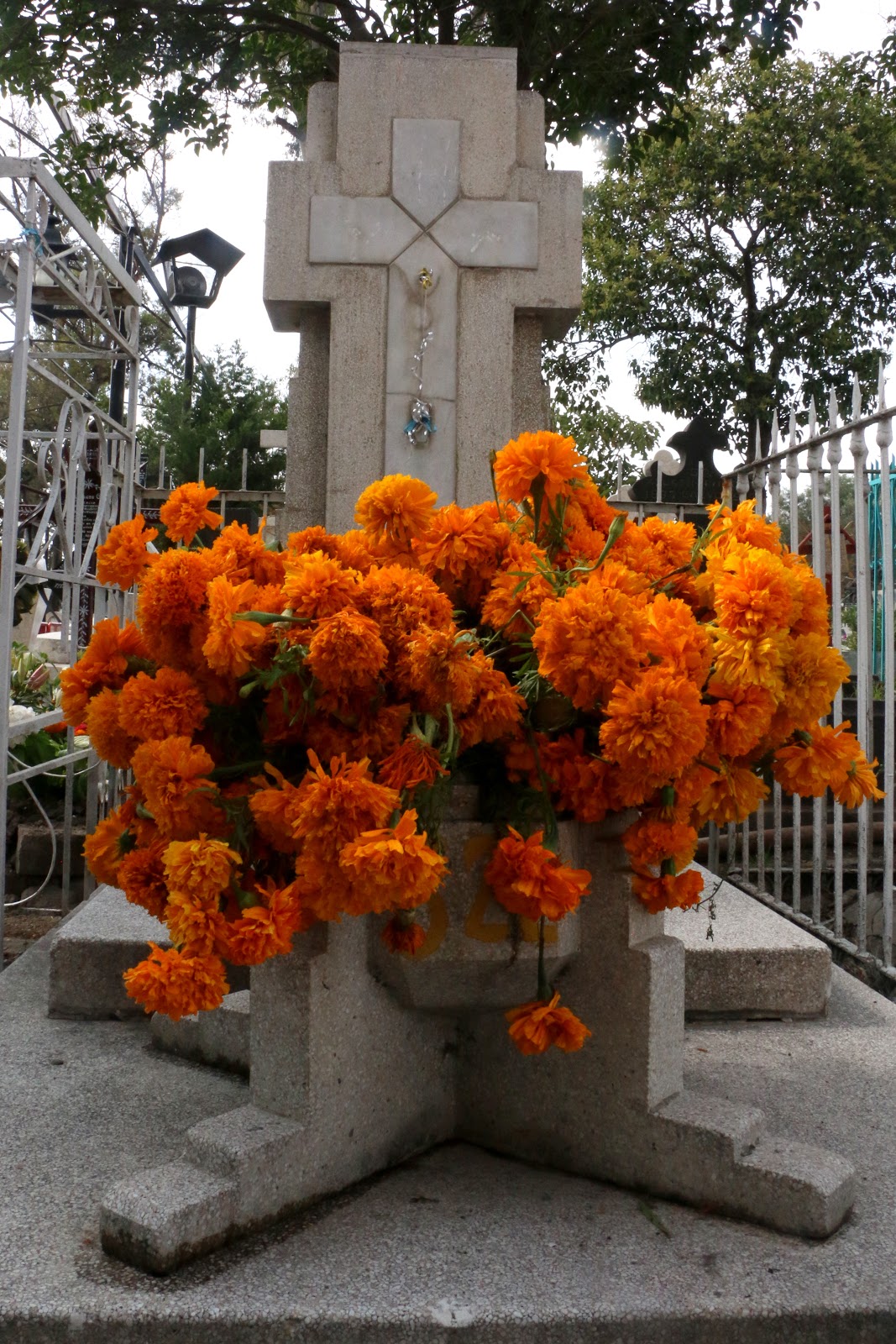
Having lived in Pátzcuaro, Michoacán, and experienced Day of the Dead in the indigenous Purépecha pueblos around Lake Pátzcuaro, with their quiet seriousness and simple but mystical beauty of the candle lit, cempasuchil (marigold) covered tombs in the panteones (cemeteries), these celebrations in Mexico City, while visually interesting, are not our idea of authentic tradition.

So the end of this October, having made it into the middle of Tláhuac in June, we decided to undertake the trip to Mixquic for Day of the Dead. However, because it was beyond the limits of our previous Ambles and its reputation for "strangeness" from the point of view of the rest of the City, our attendant anxiety led us to decide to visit on October 31, one day before Day of the Dead. We thought it would be a good idea to check out how much of a challenge it would be to get to Mixquic and to familiarize ourself with the layout of the pueblo. We would then return on November 1 or 2 to witness the festival.

The Way to Mixquic


The taxi ride from Coyoacán to Culhuacán, in Iztapalapa, is relatively short and now very familiar from our several visits there—the latest for a parade that took place just a few weeks earlier. From there the Metro trip to Tláhuac is twenty minutes or so. Exiting at the Tláhuac station, we walk down the stairs from the elevated platform to a taxi stand. Somewhat nervously, we tell the young lady dispatching the taxis that we want to go to Mixquic. Matter-of-factly, she informs us that they offer a choice: either a metered ride via the road through the other pueblos, or the more round about but faster trip via "Las Lagunas" for a flat rate of 120 pesos, about US$6.00. The taxi driver we met in June had also told us that this back way to Mixquic was faster, so we choose it.

Entering the Ancient World of Lakes and Chinampas


Getting into the front taxi in line, the driver takes us through the streets of tiny San Pedro and soon we are in a different, rural world of fields. These are the ancient chinampas of Lake Chalco, man-made fields created in the lake, like those in neighboring Xochimilco. Then, suddenly, we are on a narrow road lined only by a row of trees. Beyond them, on both sides, we can glimps a lake. I realize it is what remains of Lake Chalco, the only surviving lake of the five that originally filled the center of what the indigenous peoples called the Valley of Anahuac! We are on the Tláhuac-Chalco Causeway. (See map of the delegación above. The causeway is the gray, east-west line across the lake.)

These are Las Lagunas spoken of by the taxi dispatcher. Stunned, we ask the driver if he could stop so we could take a photo. Reluctantly, he agrees. Since there is no berm to pull over onto, stopping blocks the road. We jump out, take the photo and climb back into the cab as the driver of the jitney bus behind us is already blowing its horn. These ubiquitous, local route, gray and green jitney buses stop for no one except for passengers getting on or off.

The Tláhuac-Chalco Causeway.
A jitney bus can be seen ahead of us.
  
Lake Chalco, looking north

As we travel along, we take photos out of the side windows, and even through the front windshield—not exactly the best of photographic conditions, but the only one possible, given our restrictions traveling through this amazing landscape. The experience is much more one of being in the original indigenous lacustrine world of the Valley of Anahuac than when we are on the canals of Xochimilco, with their tourist-filled trajineras (flat-bottomed boats), as fun and enchanting as that can be.

At some point on the causeway, we cross the invisible political line between the City of Mexico and the State of Mexico, but there is no change in the world around us. Soon we reach the end of the causeway. Turning south, we travel along a narrow dirt road through more chinampas, which now are large fields, full of vegetable crops and criss-crossed with irrigation canals fed by the lake. The driver tells us that because of the lake waters, crops can be grown year-round. In much of Mexico, even though the climate is mild, only one crop can be grown each year, since the crop relies on water that falls during the rainy season from May through September. 

Dirt road from Lake Chalco to Mixquic,
taking us from the State of Mexico, back into Mexico City.

Field of cabbage and other crops.

Canals feed the fields with water.

Volcano in the distance is Teuhtli (Teh-OOT-lee),
which lies at the intersection of the Delegaciones of
Xochimilco, Tláhuac and Milpa Alta.
(See lower left quadrant of delegación map above;
Teuhtli is marked by a green icon.
)

As we pass a small pond, another remnant of Lake Chalco,
the driver tells us we are entering Mixquic.

Mixquic


Entering Pueblo Mixquicwe find it hard to believe we are in Mexico City. We feel like we are back in one of the indigenous Purépecha pueblos of Michoacán. It is a simple, rural village of small, one and two story, cinder-block buildings. 

The driver soon stops at the intersection of two narrow streets and tells us this is the farthest he can take us towards the Church and panteón of San Andrés, since the street to our left is closed for the fiesta. To the right, he points down a short block and says that the center of town is at the other end, where we can find a taxi-stand to get a ride back to the Metro. That relieves one of our anxieties: how will we get back home from this place that is so enchanting but so culturally distant from our familiar world in modern Mexico City?

Preparing for Day of the Dead


Walking up the street towards where the driver says we will find the church, we soon reach an open-air tianguis (street market). It is clear that preparations for Day of the Dead are underway.

Calle Independencia,
street leading to the Church of San Andrés,
is closed to traffic for the fiesta,
announced by colorful papel picado,
designs cut from papel china, tissue paper.
(See our post:
Fiestas as Creative Acts of Cultural Transformation and Continuity
for a description of the many standard components
of traditional fiestas, such as papel picado.)

Campesinas, women farmers, with wheelbarrows full of cempasuchil,
the native marigolds essential to Day of the Dead.
We feel like we are back in Tzurumútaro, the Purépecha pueblo near our house,
on the outskirts of Pátzcuaro, Michoacán.

There can never be too much cempasuchil for Day of the Dead.
We remember in Tzurumútaro seeing trucks full of its blossoms
.

While we are adjusting our camera setting in order to try to photograph a campesina selling cempasuchil from under a tarp that shades her from the sun, we hear a voice behind us laughingly say, "Nunca sonríen." "They never smile." Turning around, we see three women, leaning on a railing at the top of a few steps leading into a building. They are laughing in an amable (amiable, kind) manner at our photographic effort. We acknowledge the truth of what they have said, "¡Sí, nunca sonríen!"). 

With this exchange, they ask us the usual questions about why we are here, taking photos. We tell them about Paseos por la Ciudad de México, Mexico City Ambles, and give each of them our card, which presents our activity as a more professional one than mere tourism and shows the seriousness with which we take our endeavor to get to know and share with our audience Mexico City's original pueblos.

Duly impressed, they invite us into the building, which turns out to be the Library and Museum of Mixquic. We had read about this local museum, which displays pre-hispanic artifacts found in the pueblo. Since it was on our list of places to see, we climb the few steps, thank them profusely and enter. 

Mixquic´s Past Unearthed


In the entrance is an
Estrella por los difuntos,
a star to light the way
for the spirits of the dead
to find their way back to Mixquic.
It is a unique Mixquic tradition.

The Library is on the first floor of the modest, modern building. At the rear, a person is giving a slide show about the Day of the Dead to a small audience. A sign points upstairs to the Museum, where we head. At the rear end of the space is an array of several large, glass display cases containing stone sculptures from the pre-conquest indigenous civilization, all found here in Mixquic.

Chalchiuhtlicue (Chal-chee-ut-LEE-quay)
"Lady of the Precious Green Jade Skirt."
Goddess of running water and springs, rivers and lakes,
who brings fertility to crops.
Wife of Tlaloc, God of All Waters.

The first piece in the display,
she speaks to the centrality of the waters
of Lake Chalco (jade green), to the people of Mixquic.

Tlaloc, God of All Waters,
One of the primary gods of indigenous peoples
of the Valley of Mexico,
identifiable by his large, circular eyes.

Serpent,
often related to themes of water.
Signs indicate that all the objects are from the period
between 1200 and 1500 CE. 

The tiny museo del sitio, musem displaying objects from the immediate area, piques our interest in the history of the original settlement of Mixquic. It was most likely founded around the 11th century by people who migrated here from Xochimilco, like those who settled the island of Cuitláhuac (San Pedro Tláhuac). At the time, Mixquic was also a small island in Lake Chalco, around which the inhabitants created chinampas. (Wikipedia)

Old Belltower and a Patio Full of Indigenous History


Leaving the museum, we continue on up the street and quickly encounter an aged stone church steeple, standing all by itself, but embedded in an equally old wall. 

Bell tower of the original Church of San Andrés.
The church was built by Augustian Friars
Jorge de Avila and Geronimo de San Esteban,
between 1536 and 1563.
For some reason, the original church was destroyed
and a new one, which still stands, was constructed in 1600.
(Wikipedia)

The wall encloses the patio of the original convent or monastery. Entering, we find we are in a courtyard nicely landscaped in traditional Spanish/Moorish (Islamic) style, with a central fountain and boxwood hedges. But different from most convent patios, it prominently displays several obviously ancient stone sculptures. Like those in the museum, all were found at this site, the teocalli, house of the god of the pre-Conquest people of Mixquic. The Augustians replaced the indigenous temple with their church and convent, another act of the Spiritual Conquest, whose trail we have been following for the past year and a half.


Mictlāntēcutli, Lord of Mictlan,
the Underworld of the Dead,
We think it noteworthy that he occupies the center of the courtyard,
while a Christian cross stands to one side.

Figure now called a Chac-mool (Mayan),
related to human sacrifice.

Stone scoring ring from a sacred ball court,
The piece of sloping wall behind it reminds us of the sloped walls of such courts,
designed to ricochet the ball.

The ball game, ubiquitous throughout Mesoamerica,
was not played for fun (although bets were evidently laid),
but rather was a symbolic battle between
the forces of life and death.
The losers were likely sacrificed. 

We leave the courtyard sobered by the dominant theme of Death that reinforces the fact that we are visiting during preparations for Day of the Dead, an indigenous tradition married to the Catholic All Saints and All Souls Days. Here in Mixquic, the indigenous origins certainly predominate!

Church and Panteón of San Andrés Mixquic


A few steps beyond the courtyard and the original bell tower, we come to the entrance to the atrio (atrium) of the Church of San Andrés.

The large atrio serves as the panteón, cemetery, for the parish.
This was the traditonal use of atrios until the period of the Reform (1855-72),
when the liberal government of Benito Juárez
declared that all cemeteries should be secular and placed outside the city for health reasons.
The panteón of San Andrés was one of the few that survived this revolution in cultural practice.

Parish Church of San Andrés Mixquic

We guess that the red temporary fencing
is placed to guide visitors in and out of the atrio
during the Day (and night) of the Dead

Inside, we are awed by the ornate gold-guilt Baroque altar and ceiling.
evidently from a restoration done in the 18th century.
We have not seen this style of elaborate ceiling before.
A statue of San Andrés, the Apostle St. Andrew,
stands in the center of the retablo (reredos).

The priest is giving a talk to a few parishioners. 

A side altar. dedicated to the Virgin of Guadalupe,
is almost as ornate as the main altar.
And this is the church of a small, rural pueblo!

In the Panteón, Decoration of the Tombs Has Begun


Life and Death in Mixquic


After walking alongside the tombs, tired, we go to sit down on the low wall enclosing the panteón, near the door to the church. A señor, older man, is also sitting on the wall, looking rather somber. Not knowing whether he will want to talk with us, we give the usual greeting, "Buenas tardes." "Good afternoon." He immediately responds in kind, as all Mexicans do, following la courtesia, the standard, expected show of courtesy.

Mixquic caballero, gentleman

We should not have been surprised, given Mexican amabilidad, amiability, consideration, but he immediately engages us in conversation, with the usual questions as to why we are here in Mixquic and where we are from. We reply and share our card. He then tells us he is a life-long resident of Mixquic, which he says, is still a farming community, with over 60% of its people involved in farming. The continued existence of Lake Chalco makes this possible. 

He also clarifies a matter about which we were unsure regarding Day of the Dead in Mixquic. The main decoration of the tombs takes place on November 2, and the alumbrada, lighting of candles, in the panteón happens that night at 8:00PM. In Pátzcuaro, candles are lit on November 1 to assure the safe arrival of the spirits of the deceased. In Mixquic the candles are lit at the end of All Souls Day, the night of November 2 when the spirits depart once again for Mictlan. Pátzcuaro's ceremony thus marks the arrival of the spirits, and Mixquic´s ceremony marks their departure.

Standing up, the gentleman excuses himself by explaining that a friend has recently died, and the funeral procession is approaching. We are a bit taken aback by this rather abrupt but totally normal entrance of Death into our day.

Funeral procession, accompanied by a mariachi band, arrives at the church door.
The mariachis sing a most appropriate, melancholy song of departure.

Un abrazo fuerte,
A strong embrace.
"Te doy pésame."
"I give you my condolences."
El luto,
Mourning


Every Day is Day of the Dead


A priest, dressed in the purple robes of mourning, comes to the church door, blesses the coffin and the people attending it, and the funeral entourage enters the church. We do not follow, but remain sitting on the panteón wall, in the company of the tombs. We wonder whether we will have the energy to return to Mixquic in two days. It has been a long trip for un viejo, an old man, one who knows that death is the ever closer final event in his own life. Today is day of the dead for the person just carried into the church and for his family and friends.

Two days later, November 2nd, we find ourselves still tired out from our trip to Mixquic. We regret that we will not get to see the decorating of the tombs. We know that we would not be able to stay until 8PM for the alumbrada; it would be too late for us to make the trip back to our bed in Coyoacán. We would have to have found a hotel or posada (inn) where we could stay the night.

So, ojalá que sí, God willing that it may be possible, we may return next year. One thing is certain: Day of the Dead will continue to be honored in Mixquic.
Here is a link to a video of the flower-covered tombs on November 2, posted on the Facebook page of San Andrés Mixquic

Sunday, November 20, 2016

Mexico City's Original Villages | Xochimilco: Field of Flowers Still Blooms

"Floating Islands" and Flat Boats


Xochimilco—“field of flowers” in Nahuatl—is now a delegación, or borough, in southeastern Mexico City. A UN-designated "World Heritage Site" world-famous for its canals and chinampas, these so-called "floating gardens" are actually man-made islands used for growing flowers and vegetables for sale in city markets.

Chinampa in current cultivation.
From: The Chinampas of Mexico,
by Jason Turner, Ph.D.

These chinampas have a history that goes back more than a thousand years. But their current fame centers around the canals and the trajineras, flat boats, that traverse them. Poled by local men, trajineras carry tourists though parts of the labyrinth. On weekends, especially, they constitute a kind of floating fiesta or party, with supporting trajineras providing fresh-cooked meals, beer and singing mariachis for the visitors.

"Sporty Independence"?


Mariachi offers his song, for 100 pesos
(now about US$5.00)
Cold beer
(note pilings and trees to rear,
 holding in chinampa)
View 30 second film taken in 1912,
of an indigenous celebration on the canals

But behind this very Mexican-style show for tourists, Mexican as well as foreign, there is a long history and a very different side to Xochimilco.

Thousand-Year-Old Field of Flowers


Xochimilco was originally settled on an island near the southwest shore
of Lake Xochimilco

Around 900 CE, the Xochimilca people, considered one of earliest of the seven Nahuatl-speaking tribes to migrate into the Valley of Mexico, settled on the south shore of the lake that would come to bear their name. Their first chief was Acatonallo, who is credited with inventing the chinampa system, which greatly increased crop productivity. These chinampas eventually became the main producer of crops of corn, beans, tomatoes, chili peppers and squash in the Valley of Anáhuac.
The altepetl, city state, of Xochimilco was founded in 919 CE, about three hundred years after the Toltecs had established Culhuacán on the peninsula on the north side of the lake. Over time, the city came to dominate other areas on the south side of the lake and across the mountains to the south, in what is now the State of Morelos. 
In 1352, the tlatoani, "speaker", Caxtoltzin moved the city from the mainland to the island of Tlilan. Possibly, this was done to make it more defensible, like the island city of the Mexicas, Tenochtitlán, which was coming to be a rival. The island was connected to the mainland by three causeways. One of these still exists in the form of Avenida Guadalupe I. Ramírez, one of the borough's main streets. 

Mexicas of Tenochtitlán Take Control

In 1376, Tenochtitlán attacked Xochimilco, forcing the city to appeal for help from Azcapotzalco, the Tepaneca power on the west side of Lake Texcoco. The attack was unsuccessful, but Xochimilco then became a tributary of Azcapotzalco. Tenochtitlán finally conquered Azcapotzalco in 1428 and conquered Xochimilco in 1430. Shortly thereafter, the Mexica huey tlatoani, "chief speaker" Itzcoatl built the causeway or calzada to Coyoacán and Culhuacán that would also create a land route to Xochimilco.
During the reign of Moctezuma Ilhuicamina (the Elder, the First, 1440-1469), the Xochimilcas participated in the further conquests of the Mexica/Aztec Empire. For their service, they were granted autonomy in their lands. 

Spanish Conquest

When the Spanish arrived, Moctezuma Xocoyotzin (the Younger, the Second) imposed a new governor, Omácatl, on Xochimilco to take tighter control. With the chaos that followed the imprisonment and death of Moctezuma, other Mexica nobles took control of Xochimilco.
Because of Xochimilco's resistance, Cortés decided to attack the city before his final assault on Tenochtitlan. Using indigenous allies, he attacked on April 16, 1521. Although Cuautémoc, the last Mexica tlatoani, sent ten thousand warriors by land and two thousand by canoe to defend the city, the Mexicas and Xochimilcoans were defeated. After the defeat of Tenochtitlan in August 1521, the land around Xochimilco was granted, as an encomienda, to Pedro de Alvarado, one of Cortés' lieutenants. Wikipedia

Spiritual Conquest of Xochimilco
As they did in Tenochtitlan and in all the altepetls and villages around the lakes, the Spanish destroyed the ceremonial center of Xochimilco, called the Quilaztli. In 1522, Apochquiyauhtzin, the last tlatoani of Xochimilco, was baptized with the name of Luís Cortés Cerón de Alvarado and allowed to continue governing under the Spanish. .
Franciscan monks then came to the city. Construction of their first church, San Bernardino de Siena, and their convent or monastery was begun around 1535 on the site of the Quilaztli, in what is now the historic center of the Delegación Xochimilco. Like other churches of the Franciscans and other religious orders, it was converted into a parochial church in the mid-18th century.

San Bernardino de Siena Church
after Sunday Mass

It sits at the end of a large atrio,
at the east end of the main plaza

Portion of atrio, atrium

Reredos is Neo-classic in style,
(probably late 18th century)
with Greek-style columns
and triangular pediments

Dome
A vision of Heaven
God the Father (in blue)
and Christ (in red) are below center;
Virgin Mary is below them.
Opposite them, above, is St. Michael the Archangel,
patron saint of Mexico.

Inner patio of Convent,
with traditional Moorish-style fountain

Vestiges of the Spiritual Conquest: Many original barrios and pueblos

Today, like most of the Valley of Mexico, the original Xochimilco is almost swallowed up by the indiscriminate spread of the megalopolis that now covers most of the former lake beds and surrounding land. However, at its heart Xochimilco still retains living vestiges of an earlier world. In part, this is because its remaining canals and chinampas have been declared a World Heritage Site and Patrimony of the Nation of Mexico—making for tourist income. But even more so, these living vestiges remain because their extensive roots in the ancient indigenous world are still nurtured in original barrios and pueblos.

At the center of the old city are those landmarks that we have found at the core of the Spanish transformation of indigenous Mexico: a plaza, church (San Bernadino), ayuntamiento (town hall) and mercado. In Xochimilco, unlike in other colonial neighborhoods in the City, they all remain in place, alive and well.

Xochimilco plaza
Large and tree-filled

"Honey Fair"
takes up large space at one end of the plaza.
Various fairs, actually temporary markets, frequently 
take place.

Street musician
Vaquero, cowboy dress is not uncommon
Aztec danzante group performs dances
and cleansing rituals.

Cuates, buddies, pass the time.

Generations

Large, indoor mercado
is on south side of the plaza

Walking around this core, the heart of Xochimilco, we feel like we have entered a world apart from most of the rest of Mexico City. It feels like a city located in what chilangos, Mexico City residents, refer to as las provincias, Mexico's other states, with their more traditional, rural ambiance.
Circling this core are some sixteen barrios that made up the original indigenous altepetl on the island of Tlilan. Beyond them are another fourteen or so pueblos that were on the original mainland to the south. The contemporary delegación or borough also includes newer colonias.
It is to these barrios and pueblos originales that we will direct a series of Ambles. As there are so many, we expect to return to Xochimilco many times.


Delegación Xochimilco
is large pink area in southeast Mexico City

Barrios, Pueblos and Colonias of Delegación Xochimilco
Barrios of original altepetl of Xochimilco marked by yellow star.
Ecological Park of chinampas and canals is gray-green area in northeast
Southern side of delegación is mostly mountainous forest preserve.

See also: