Sunday, May 8, 2016

The Spiritual Conquest: The Franciscans - Where It All Began

Es fácil traducir esta página en español: vaya a la columna a la derecha. En la parte más alta hay una ventana etiquetada "Translate". Desplace la flecha abajo hasta encuentra "Spanish". Click en ese y inmediatamente todo el texto estará traducido en español por Google. Con certeza, habrá errores, pero creemos qué el sentido se quede bastante claro.
The objective of our current series of Ambles is to locate the vestiges of the original indigenous villages that still exist within Mexico City. We realized that the most obvious landmarks of these original communities are the churches established in these villages by various orders of Catholic monks to effect the evangelización and conversion of los indios, also called los naturales, the indigenous, into Spanish Catholics, the so-called Spiritual Conquest.

We then realized that, in addition to the many altepetls, city-states, around the lakes of the Valley of Anahuac, now the Valley of Mexico, and on a number of its islands, there were also the original indigenous residential quarters of the main city of Mexico-Tenochtitlan, now El Centro. These quarters were not eliminated by the Spanish; instead, they adapted them to organize and govern the indigenous residents of the city through a system of limited self-rule they called Indian Republics. The four campan (quarters) of Tenochtitlan became the Republic of San Juan Tenochtitlan. Catholic monks went into each quarter to build churches and convert the residents.

As we began exploring these four indigenous quarters, seeking out the churches that remain from this process, we became aware that we needed to trace the path of their construction from the Spanish side as well; that is, the path of the Franciscan monks who were the vanguard of the Spiritual Conquest.

How the Franciscans Came to Nueva España

In 1522, Hernán Cortes asked the young Holy Roman Emperor Charles V (Charles I of Spain, born 1500, died 1558) to send monks to Nueva España to evangelize and convert the natives. In his fourth letter to the king, Cortés pleaded for friars rather than diocesan or secular priests because those clerics were in his view a serious danger to the Indians' conversion.
"If these people [Indians] were now to see the affairs of the Church and the service of God in the hands of canons or other dignitaries, and saw them indulge in the vices and profanities now common in Spain, knowing that such men were the ministers of God, it would bring our Faith into much harm that I believe any further preaching would be of no avail." (Wikipedia)

As it happened, the Emperor, whose father was an Austrian Habsburg and mother the daughter of Queen Isabella and King Ferdinand of the emerging nation of Spain, was born in 1500, in Ghent, Flanders, part of the Habsburg Netherlands, and had grown up there.

The Protagonists: Conquistador, Emperor and Pope
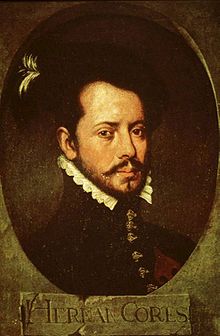

Hernán Cortés, Museo de América.jpg
Hernán Cortés
Charles I of Spain,
Holy Roman Emperor Charles V
age 19
by Bernard van Orley

From 1505 to 1515, Charles's teacher, was one Adrian Florisz Boeyens, a Dutch professor of theology. He had been selected for this responsiblity by Charles' paternal grandfather, the Habsburg Archduke of Austria and Holy Roman Emperor, Maximillian I.

When, after the death of his maternal grandfather, Ferdinand in 1516, Charles inherited the throne of Spain, he saw that Boeyens was made a bishop in Spain. In 1519, upon the death of Maximilian, Charles became Holy Roman Emperor. In February 1522, Charles saw to it that Boeyens was elected Pope. He took the name Adrian VI and was the last non-Italian pope until John Paul II.
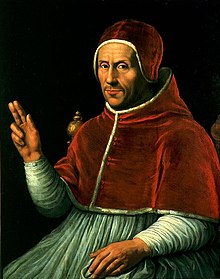
Hadrian VI.jpg
Pope Adrian VI

In response to Cortés's request, Charles consulted his old mentor, now the Pope, who selected/recommended the Franciscan order, founded in 1209 by Francis of Assisi as the Order of Minor Friars, to undertake the mission. The two then chose Charles's recently appointed Confessor, Jean Glapion, a French Franciscan stationed in Flanders, to lead a group to the New World. He, in turn, selected three Flemish brothers of the order to go with him: Pieter van der Moere, who became, in Spanish, Fray Pedro de Gante, (Friar/Brother Peter of Ghent); Johann Dekkers, who became Juan de Tecto, and Johan van der Auwera, who became Juan de Ayora.

In the summer of 1522, the four traveled to Spain. However, Glapion died there in September, at the age of sixty-two. The other three left for Nueva España on May 31, 1523, and arrived in Veracruz on August 13. Pope Adrian VI died of the plague in September of that same year.

Brother Pieter van der Moere,
aka Fray Pedro de Gante
Brother Peter of Ghent

Brother Pieter, Fray Pedro, born in 1479 or 80, is thought to have been a bastard son of Emperor Maximilian I, Charles's grandfather and, thus, a quasi uncle of Charles.

Arriving in Veracruz in August 1523, the three Franciscans were sent by Cortés to Texcoco, on the east side of the Lake, because there was a plague in Mexico City (brought by Spanish soldiers). There they began to study Nahuatl in order to preach to the indigenous and to learn native culture. They came to Mexico City the following year. That same year, Cortés decided on an expedition to what is now Honduras. He took Juan de Tecto and Juan de Ayora with him. Both died, likely of starvation, on the ill-fated adventure.

Meanwhile, in May of 1524, another group of Franciscans arrived in Nueva España, the famous "Twelve Apostles of Nueva España." They were led by Fray Martín de Valenciaf; all were Spanish. Together with Fray Pedro, they undertook the conversion of los indios. Some went out to other parts of Nueva España. Fray Pedro remained in Mexico City and began building churches in the indigenous quarters of San Juan Tenochtitlan.
 

Franciscans Establish the Foundations for the Spiritual Conquest


The Franciscans built a church and headquarters for themselves within the Traza español, the Spanish district, in the heart of the city, west of what is now the Zócalo, on the site where Moctezuma II’s zoo once stood. They named it San José de los Naturales (St. Joseph of the Natives). Next to it, they built a school for indigenous children, especially the sons of the noble class. It was an interno, a residential school, as the friars wanted to completely separate their students from their previous, "pagan" culture.

Critical to their goal of evangelization, the conversion of the indigenous, the Franciscans, and other religious orders that followed them in coming to Nueva España, rather than trying to completely suppress old beliefs and practices, deliberately adopted a strategy of seeking out elements in indigenous religious practice that had similarities to Catholic Christianity and building on them in order to create "bridges" between the indigenous beliefs and Catholicism, so that the new faith would be seen by the people as an evolution from their old faith rather than its elimination. The indigenous were seen as children who needed to be "brought up" to the religious maturity of the friars' version of Catholicism.

In the view of the friars, the European Roman Catholic Church had been corrupted by its hierarchy and wealth. The true church was that which was founded by Jesus' apostles, one characterized by simplicity of organization and style, poverty and humility. It was to be what Jesus had preached, the Kingdom of God on Earth. The Franciscans saw the indigenous as providing a unique and wonderful opportunity to re-establish the Church on that original model. It was to be an Indian Church, still obedient to the Pope, but otherwise distinct from the European one.

They accomplished their strategy via three main tactics:
  • They learned the native languages (Nahuatl being the first) not only so they could preach the Christian message but also so they could dialogue with the priests and sages of the people to learn about their religious beliefs and practices. Thus, they could find in those beliefs and practices ones that could be interpreted in Christian forms and incorporated into Catholic religious belief and practice. 
  • They used Christian fiestas as concrete, paticipatory vehicles to incorporate acceptable indigenous religious practices, such as dancing and singing, and to instruct in the faith using Christian songs translated into the indigenous language and set to indigenous musical form.
  • They created schools for educating the young, both from the upper class and the lower class, in Christian beliefs and rituals, and in Latin, the language of the Catholic Bible and Church writings so that these could subsequently be translated into the native tongue.
  • They developed a catechism of basic beliefs, written first in Nahuatl. In it, they explicitly used indigenous terminology for the Divine, particularly as the creator and lord of all things and as close by. So, when they spoke of their Christian God and His Son, Jesus the Incarnated Christ, these deeply rooted religious meanings would make them sound familiar to the people. Thus, their Christian God and especially Jesus the Christ could be understood as the ultimate embodiment of these very familiar characteristics of divinity. 
They minimized the concept of the Trinitarian God, likely to avoid polytheistic interpretations, and emphasized the closeness of God to humanity via the incarnate Jesus the Christ. He had shared the very flesh of common people. He had come among them and been one of them. God could be no closer than that. This human, but at the same time divine, Jesus had performed the ultimate sacrifice of himself to redeem mankind from their sins which had separated them from God. Hence, human sacrifice was no longer necessary. This sacrificed, human Jesus and his mother, the Virgin Mary, were the primary focus of the teaching.
Note: A much more detailed explanation of how the Franciscans undertook this "evolution" of the indigenous from their faith to Catholic Christianity is presented in the essay, The Native Encounter With Christianity: Franciscans And Nahuas In Sixteenth-Century Mexico, by Friar Francisco Morales, OFM, Historian of the Order of the Minor Friars, i.e., Franciscans, in Mexico. Click here to read our abridged version of the article.
(As it happened, the Protestant Reformation had only just begun in Germany (1517), led by Martin Luther, an Augustinian monk. The Counter-Reformation began with the convening of the Council of Trent, with its first session in 1545. Emperor Charles sat with the Pope in the early sessions. The Spanish Habsburg monarchy, and their 18th-century successors, the French Bourbons, using the Spanish Inquisition, never allowed Reformation thinking to gain a foothold in Spain or Nueva España)
Temple of San Francisco,
Baroque facade built in 1766
Entrance on Madero Street

Two hundred years later, at its peak in the 18th century, the church, monastery, school and a hospital for los indios covered the blocks now bordered by Bolivar, Madero, Eje Central (Central Axis) and Venustiano Carranza Streets—a total area of 8 acres.

Convent (monastery) and Temple of San Francisco at its height in 18th century.
Current Madero Street is upper left
Still existing church is to left of center,
Immediately to its right is the cloister, with fountain, now a Methodist church.
Lower, right corner, with small dome, is 
Calvario and San Antonio chapel, now a book store
Photo is of a tapestry currently hanging in the church entrance.

What Remains of San Francisco

After the Reform War (1857-61), the monastery of San Francisco, like many others, was disbanded and most of the property seized by the government. Much of the old monastery was demolished for the construction of new streets.

Temple of San Francisco


The church standing today is the third to be built on the site. The first two sank into the soft soil underneath Mexico City and were torn down. The current church was built between 1710 and 1716. Although the entire building is known as the San Francisco Church, the entrance on Madero Street is actually the entrance to the Balvanera Chapel. The church’s main facade, dating from 1710, is walled in and not visible.

The facade of the chapel was constructed in 1766. It is not certain who designed it, but most think it was the work of Lorenzo Rodríguez, best known for his Churrigueresque Baroque facade on the Metropolitan Tabernacle, adjacent to the Metropolitan Cathedral (Wikipedia).

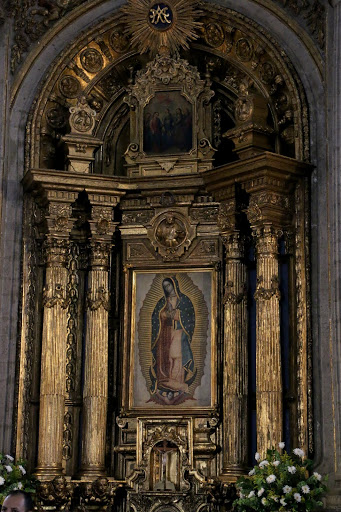
Inside, the Balvanera Chapel is dominated by an 18th-century Baroque altarpiece dedicated to the Virgin of Guadalupe.

Baroque reredos of Balvanera Chapel,
with image of Virgin of Guadalupe

In the main sanctuary, the large, gilded altar is a reconstruction of the original Baroque one.

Main altar

All that remains of Franciscan simplicity is a statue at one side of the sanctuary.

St. Francis

Hidden Treasures


A couple of other components of the 18th century complex remain, but we have to go looking for them by leaving the church, returning to Madero Street and going around the corner onto Pedro de Gante Street, named after the founding friar.


Street sign at the corner of Madero and
Fray Pedro de Gante Streets


Fray Pedro de Gante Plaza

Part way down the block, now a tree-shaded pedestrian plaza lined with sidewalk cafes and restaurants, we come to the rather non-descript, neo-gothic facade of a Methodist church. A sign says it was founded in the 1873. Luckily, the front door is open, so we enter. A way inside, a glass and wooden wall closes off the space. Further inside, we can see the columns of what appears to be an interior patio. 

At the side of the door is a bell, so we ring it. Within a minute, a middle-aged workman comes from the patio area and opens the door a crack. We tell him our mission of exploring the original churches of the city and our desire to see another part of San Francisco. He nods assent and lets us in.

Thanking him profusely that we didn't need the usual Mexican "permission in advance", we walk the rest of the hallway ... and enter another piece of history.


The cloister is now the sanctuary of a Methodist church established in the 1930s

The church sanctuary is the original Franciscan two-story cloister or residence, surrounding an inner patio that is a quintessential example of such Spanish colonial spaces: rows of arches whose even rhythm creates a space of complete balance and, thus, total tranquility. The Methodists were lucky to get it and wise not to modify it.

Thanking our lucky stars, and the workman who let us in, we return to Pedro de Gante Street. Walking two short blocks to Venustiano Carranza, we turn right towards the Eje Central (Main Axis, aka Lázaro Cárdenas). At the corner, we come to another remnant of Franciscan glory days.


Calvario and San Antonio chapels, now a bookstore

It is a modest looking edifice. We wonder what Baroque elegance it might once have contained. Looking up, we get a glimpse of past glory.


Glimpse of former glory, the tiled dome.

Most pleased with the success of our exploration, we return to the shade of Ghante Street to rest from our exertion in the Mexican sun. Sitting in the welcome shadow, we see two images that sum up the history of the monastery of San Francisco, and of Mexico City: modernity face to face with memory.

Modernity

Memorial
to Fray Pedro de Gante


Plaque reads:
Friar Peter of Ghent
(1480 - 1572)
First of the Great Educators of America,
The plaza and monument were inaugurated
January 16, 1976.
Constructed by the Federal District


Donated by the Eastern Province of Flanders
to Mexico City
in testimony to Belgium's friendship
toward Mexico.

What might he think of all that has transpired
from what he began?

Sunday, May 1, 2016

Mexico City's Original Villages: Centro's Four Indigenous Quarters | Introduction

As we began our explorations of the original indigenous villages of Mexico City, we realized that we needed to return to where our ambles began more than a year ago, to El Centro, for that is not only where the Spanish Mexico City began, but also where the Mexica [me-SHE-kah] had developed their island city of Mexico-Tenochtitlan. 

Thus, what is now El Centro was where the two cultures most dramatically confronted each other, and where, after the Spanish defeat of the Mexica, the winners—few in numbers as they were—had to figure out how they were going to live among and maintain control over the people they had defeated. The indigenous survivors, for their part, had to come to terms with how they would live with their new rulers and their foreign culture.  

What to do with los indios?

Initially, Cortés removed all the city's indigenous inhabitants and razed it in order to build a Spanish city on the island. But then he was faced with a question that has echoed ever since throughout Mexican history, "What do we do with los indios, the Indians?" If the Spanish were going to thrive, let alone survive, they needed not only the submission of los indios, but their help—most of all, first their labor in building the city, then supplying its many needs.

Cortés's answer was, perhaps, an obvious one. He took the Mexica organization of the city and adapted it to Spanish purposes. In traditional Mesoamerican manner, the Mexica had organized their city by dividing it into four campan, quadrants or quarters, associated with the four cardinal directions. Each campan was originally divided into five calpultin (singular: calpulli), or "big houses", for a total of twenty—one for each of the recognized calpulli, kin group or clans of the Mexica. By the time of the Conquest, the city had grown considerably and there were eighty calpultin, barrios in Spanish.

Outline of Mexico-Tenochtitlan
Drawn by Alonso García Bravo, 1521-22

The small square at right-center is the Templo Mayor complex.
Below it is the area of palaces of Mexica rulers,
surrounding what is now the Zócalo.

The four campan are, clockwise from upper left/northwest:
Cuepopan
Atzacoalco
Teopan Zoquipan
Moyotla

Three main streets, cuepotli, lead to causeways:
North to Tlatelolco and Tepeyac
(now Republic of Argentina St., which becomes Calzada de Guadalupe)
West to Tacuba (now Tacuba St. and then other names)
South to Iztapalapa and Coyoacán, (now Pino Suárez and Calzada de Tlalpan).

Reproduced in "Cosmopolitan Indians and Mesoamerican Barrios in Bourbon Mexico City"
Doctoral dissertation by Luis Fernando Granados
Gerogetown University, 2008.


Statue of Alonso García Bravo carrying out his survey of the island of  Tenochtitlan,
He rides in a canoe propelled by Mexicas.

Statue located in the Plaza of Merced,
East Centro

Separate Quarters for "the Indians"

Cortés had a city plan, traza (literally, outline), drawn up. The Spanish conquistadores, of course, took the Center for themselves. There they built the government palace, churches and residences of Nueva Españareplacing those of the Mexica. Indigenous, los indios, also called naturales, were excluded from this Traza española.

The island's remaining land was divided into two areas for the Indians. The surviving Mexica, under the leadership of the their last huey tlatoani, chief speaker, Cuauhtémoc, were restricted to Tlatelolco to the north. Once a separate atepetl, Tlatelolco was a city-state that the Mexicas had subjugated in the fifteenth century and annexed to Tenochtitlan. The Spanish named it Santiago Tlatelolco.

In the four original Mexica campan around the Traza española, Cortés settled the indigenous tribes who had been his allies in defeating the Mexica. Adapting the Mexica name for the city, this entire area was named San Juan Tenochtitlan. Each of the four original campan, called parcialidades in Spanish (sections, sectors) was likewise assigned a Catholic saint's name appended to its Nahuatl name.

They were:
  • Santa María Cuepopan (northwest);
  • San Sebastian Atzacoalco (northeast);
  • San Pablo Teopan Zoquipan (southeast);
  • San Juan Moyotla (southwest).
In 1530 King Charles I (Holy Roman Emperor Charles V) directed the Audiencia of Mexico (governing council of Spanish nobles appointed by the king) to organize the Indians into governments similar to the Spanish, with a governor and a constable, as in Spain.

 A tlatoani ("speaker") became governor in each of the two areas. Caciques, lower chiefs, became alcaldes, "mayors," in each of the four quarters. They could govern the internal affairs of their area according to their traditional uses and customs, so long as their people worshipped within the Roman Catholic faith and obeyed Spanish laws, including those that restricted their rights in comparison to Spanish residents of Nueva España.

Republics of the Indians

In 1549, by decree of King Charles I, these separate indigenous areas in Nueva España were declared Republics of the Indians. Santiago Tlatelolco and San Juan Tenochtitlan were two such Republics. By that time, several others had been created in the atepetls, city-states, around the lakes. Among these were Iztapalapa, Tlalpan and Coyoacán to the south, Azcapotzalco to the west and Texcoco to the east.

The Indian Republics were divided into parishes, each with a central church managed by one of the orders of Spanish Catholic friars. Each parish was divided into barrios.

The Ayuntamiento, the Council of the City of Mexico, had veto powers over the indigenous governors of Santiago Tlatelolco and San Juan Tenochtitlan. The Spanish Viceroy had final say over all the Republics.

Mexico City, 1550

This map shows the basic four-part division,
but here the Traza español is not clearly defined.
It is evidently represented by the large buildings around the north-south eje, axis.
Smaller structures on the periphery indicate the Indian quarters, 

the Republic of San Juan Tenochtitlan. 

Two hundred years later, in the 1760s, the French Bourbons, who had replaced the Austrian Habsburg dynasty in ruling Spain, implemented reforms in Spanish government structure that left the indigenous republics with no real powers—merely formal appendages of the central government.

Bourbon Reforms: Coming Up Against Customs


In 1765, the royal visitor, Jose de Gálvez, arrived in New Spain, with the intention of implementing the economic and tax reforms of the new French Bourbon kings of Spain. One of them was a reform of the finances of Spanish and indigenous cities and towns. For both sets of towns or cities, a reduction of expenditures and an increase of income was demanded, as well as the sending of financial surpluses to the royal treasury.

The most important regulation reduced the spending for fiestas, as well as the number of them. Among other things, it was forbidden to use money from community treasuries for flowers, cohetes (rocket-style fire crackers) and kermeses, communal meals, all key elements of fiestas. In the long run, even after similar restrictions were imposed by the post Mexican Revolution government in the 1920s, the indigenous culture won out. As we constantly see, and hear, in the fiestas we are visiting in these original villages, "Echamos la casa por the ventana", "We throw the house out the window", i.e. spend without limit, for patron saint and other religious fiestas.

"Liberal Reforms"


Some fifty years later, in 1820, the last Spanish Viceroy implemented the Spanish Constitution of Cádiz of 1812, which officially abolished the legal distinction between Spaniards and naturales. The Republics and their councils were eliminated. Santiago Tlateloloco and San Juan Tenochtitlan were integrated into the Ayuntamiento of Mexico City, ending their nearly three hundred-year long history. (Based on material translated from Wikipedia en español)

Vestiges of the Republic of San Juan Tenochtitlan and Its Four Quarters

In Mexico, history may fade into the background, but it doesn't go away. Vestiges of the four original campan of Tenochtitlan, the parishes of the Indian Republic of San Juan Tenochtitlan, still exist, some more obvious than others.

Roughly speaking, the contemporary Colonia Centro, with its five subdivisions: Centro Histórico and Centro North, East, South and West (shades of yellow in the map below), continue the five-part Mexica and Spanish city layout, with a religious and governmental Center surrounded by four quadrants or quarters. The lower half of the current colonia of Guerrero (red, to northwest) was also within the original Mexica campan and, later, Spanish parcialidades and parishes.

Colonia Centro, with its five zones (shades of yellow):
Histórico (Zócalo and Cathedral in its upper right corner),
North, East, South (narrow strip) and West.
The lower half of Colonia Guerrero (red, to northwest)
was part of the original four Mexica campan and parishes 

of the Indian Republic of San Juan Tenochtitlan.
Tlatelolco is the blue to the north of Guerrero.

With this awareness of the seven-hundred-year-old history of the indigenous quarters within Mexico City's Centro, we will visit each one seeking their still-existing physical remnants. As we described in our introductory post to this series on Mexico City's Original Villages—Landmarks of the Spiritual Conquest—the key will be finding the churches built by the Catholic friars, brothers, to begin the religious conversion and "hispanización," the cultural transfomation of los indios, los naturales, into faithful, obedient Spanish Catholics.

Series on Mexico City's Original Indigenous Villages:

Monday, April 25, 2016

Mexico City's Original Villages: Tepeyac and the Virgin of Guadalupe

Here we begin a series of posts devoted to our ambles through the pueblos originarios, the original, indigenous neighborhoods and villages of Mexico City. Today they are simply islands surrounded by the modern urban sea, most of them more or less hidden from the view of outsiders.

To understand the dynamics of the confrontation between and subsequent synthesis of indigenous, Mesoamerican, and Spanish worlds, we don't start our tour with the now-hidden indigenous neighborhoods of Tenochtitlan or the first villages around the lake which the Spanish Catholic friars entered to implement the cultural transformation known as the Spiritual Conquest.

We begin, instead, with the most potent, quintessential embodiment of this process of Mexican reincarnation:

Tepeyac and Its Temple to Tonantzín, the Earth Mother


Tepeyac (circled) lies on the shore of Lake Texcoco,
just north of Tenochtitlan and Tlatelolco,
to which it was connected by a short causeway.

Before the Spanish arrived in the Valley of Anahuac, one of the multitude of temples around the lakes was located on a hill in the capulli, village of Tepayac. Located on the shore of Lake Texcoco, north of and across a narrow channel in the lake from Tenochtitlan, Tepayac was linked to Tenochtitlan by a causeway that passed through Tlatelolco. The temple was dedicated to the goddess Tonantzín.  

Tonantzín is a manifestation of the Earth Mother, who was also known as Coatlicue, the mother of all living things. Conceived by immaculate and miraculous means, Tonantzín, or Little Mother, was the patronness of childbirth. In Mesoamerican culture, the earth was both mother and tomb, the giver of life and the receiver of human remains as they decomposed to rejoin the Life Force. Hence, the goddess was also the one to decide the length of life given to a person. As a primary force in human life, she had a devout following.

A Vision Transforms a People and Their Culture

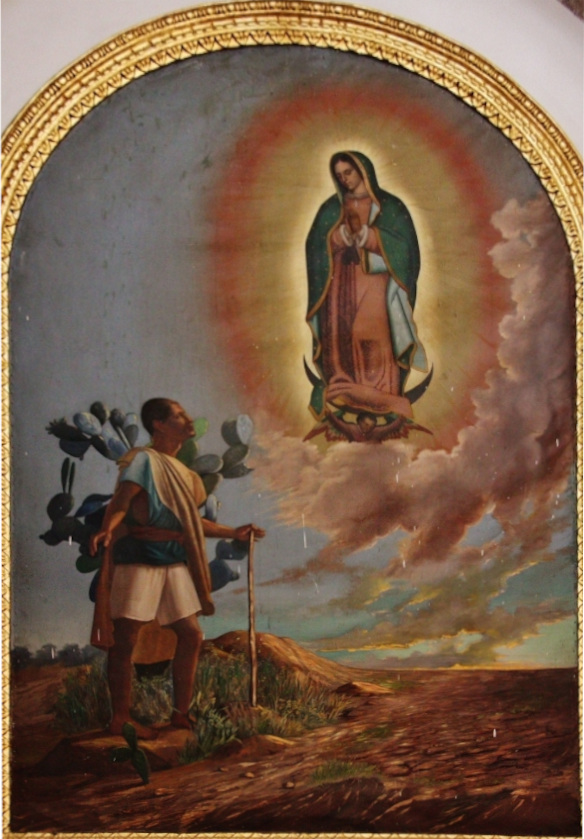
According to tradition, on a Saturday, December 9, 1531, ten years after the fall of Tenochtitlán, Juan Diego, a Náhuatl peasant who had been baptized as a Roman Catholic Christian, was passing by the hill of Tepeyac headed toward the causeway to get to the Franciscan mission at Tlatelolco for religious instruction and to perform various religious duties. He was stopped by the appearance of a young, morena, brown-skinned, woman who addressed him in Nahuatl, his native language. She was clearly one of his own, indigeous people.


Our Lady of Guadalupe Shrine, Irapuato, Guanajuato State, Mexico 07.jpg
From Shrine of Our Lady of Guadalupe, Guanajuato,
Photo by By Enrique López-Tamayo Biosca, Wikimedia 

She identified herself as Mary, the ever-virgin Mother of God, and instructed him to request that the bishop erect a chapel in her honor at that spot, so she might relieve the distress of all those who call on her in their need.

Juan Diego went into the Center of Mexico City, and reported his vision to the bishop, Fray Juan Zumárraga, who told him to come back another day, after he had had time to reflect on what he had been told.

Returning to Tepeyac, Juan Diego encountered the Virgin for a second time and announced the failure of his mission. Feeling himself to be merely "a backside, a tail, a wing, a man of no importance," Juan Diego suggested that she would do better to recruit someone of greater standing. But she insisted that it was he whom she wanted for the task. Juan Diego agreed to return to the bishop to repeat his request.

On the morning of Sunday, December 10, he returned to the bishop, who asked for a sign to prove that the apparition was truly one from heaven. Juan Diego returned immediately to Tepeyac. Encountering the Virgin, he reported the bishop's request for a sign; she agreed to provide one the following day.

However, during that night, Juan Diego's uncle, Juan Bernardino, fell seriously ill and Juan Diego was obliged to attend to him. In the very early hours of Tuesday, December 12, Juan Bernardino's condition having deteriorated overnight, Juan Diego set out for Tlatelolco to summon a priest to hear Juan Bernardino's confession and administer the Last Rites to him. In order to avoid being delayed by the Virgin and embarrassed at having failed to meet her on Monday as agreed, Juan Diego chose to go around the opposite side of the hill.


Our Lady of Guadalupe Shrine, Irapuato, Guanajuato State, Mexico 08.jpg
From Shrine of Our Lady of Guadalupe, Guanajuato,
Photo by By Enrique López-Tamayo Biosca, Wikimedia 

But once again the Virgin intercepted him and asked where he was going. Juan Diego explained what had happened. The Virgin gently chided him for not having turned to her for help. In the words which have become the most famous phrase of the Guadalupe event—now inscribed over the main entrance to the Basilica of Guadalupe—she asked: "¿No estoy yo aquí que soy tu madre?" (Am I not here, I who am your mother?).

She assured him that Juan Bernardino had now recovered, and she instructed him to climb the hill and collect flowers growing there. 


Our Lady of Guadalupe Shrine, Irapuato, Guanajuato State, Mexico 09.jpg
From Shrine of Our Lady of Guadalupe, Guanajuato,
Photo by By Enrique López-Tamayo Biosca, Wikimedia 

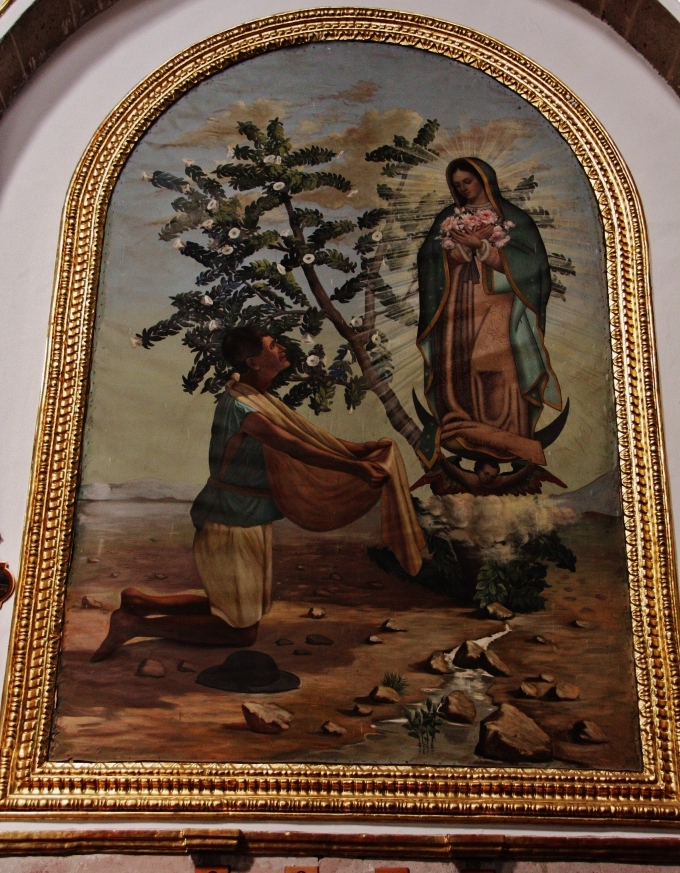
Obeying her, Juan Diego found an abundance of flowers unseasonably in bloom on the rocky outcrop where only cactus and scrub normally grew. Using his open mantle as a sack (with the ends still tied around his neck), he returned to the Virgin; she re-arranged the flowers and told him to take them to the bishop. 


Our Lady of Guadalupe Shrine, Irapuato, Guanajuato State, Mexico 10.jpg
From Shrine of Our Lady of Guadalupe, Guanajuato,
Photo by By Enrique López-Tamayo Biosca, Wikimedia 

On gaining admission to the bishop in Mexico City later that day, Juan Diego opened his mantle, the flowers poured to the floor, and the bishop saw they had left on the mantle an imprint of the Virgin's image, which he immediately venerated.

The next day, December 13, Juan Diego found his uncle fully recovered, as the Virgin had assured him, and Juan Bernardino recounted that he, too, had seen her at his bedside; that she had instructed him to inform the bishop of this apparition and of his miraculous cure; and that she had told him she desired to be known under the title of Guadalupe. The bishop kept Juan Diego's mantle first in his private chapel, then in the cathedral on public display where it attracted great attention. 

On December 26, 1531, a procession took the miraculous image back to Tepeyac, where it was installed in a small, hastily erected chapel.

This image of the Virgin of Guadalupe, on display in the
Basilica of Our Lady of Guadalupe.
The Virgin stands on the half-moon, which represents female energy.
 The cherub below the moon is interpreted to be Saint Michael the Archangel, 

patron saint of Mexico.

Virgin of Guadalupe, Mother of All Mexicans

The reported appearance of the Virgin of Guadalupe to the recently-baptized Náhuatl peasant Juan Diego—and its combined acceptance by indigenous converts and the Catholic clergy—became the single most powerful unifying factor between the two peoples and their cultures. The conquered indigenous people identified the dark-skinned  Virgin who spoke in Náhuatl with the mother goddess Tonantzín and celebrated her with indigenous-tinged rites within the framework of the Catholic Church's veneration of the Mother of the Son of God.

The Virgin of Guadalupe was also embraced by the Spanish criollos, pure-blooded Spanish born in Nueva España, rather than in Spain. The Virgin´s personal appearance on Mexican soil was seen as establishing a sacred relationship between their actual homeland and their cultural homeland, Spain. Mestizos, those with mixed indigenous and Spanish blood, who were essentially outcasts from both cultures, found in the Virgin not just the recognition, but the very embodiment and, thus, sanctification and reconciliation of their conflicted heritage.

The Basílica's official web site posts the following, remarkable statement: 
"The people present the Virgin to their children as the mother of the Creator and Protector of the entire universe, who comes to the people because she wants to embrace them all—Indian and Spanish—with the same mother's love. The miraculous image imprinted on the sisal—a plant whose strong fibers were used by indigenous weavers to make tilmas (cloaks)—signaled the dawn of a new world, which was the Sixth Sun awaited by the Mexicas (Aztecs)."
The Virgin had adopted the Mexican people, el pueblo, as her own; in turn, el puebloindigena, mestizo, criollo—adopted her as the Mother of Mexico. All of Mexico, el pueblo mexicano, still respects her. Many still adore her.

Six Churches of the Basilica Complex

Tradition says that in response to the request of the Virgin to build her a chapel at the foot of Tepeyac Hill, in 1536, Bishop Fray Juan Zumárraga replaced an original temporary shrine with a church, This was replaced in 1622 by a larger church, which, in turn was replaced by a third at the beginning of the 18th century which still stands and is known as the Old Basilica.

Meanwhile, four other churches and chapels were erected around the base and atop the small hill. Most recently, in the 1970s, as the Old Basilica was both badly damaged by sinking into poor subsoil and earthquakes and too small to accommodate the faithful for the December 12 Fiesta of the Virgin of Guadalupe, a new Basilica was built.

Here we amble around the five churches:

Starting at bottom center, with the Antigua Basilica (yellow dome),
going counter-clockwise, the churches are:
Parroquia Capuchinas, Parroquia de los Indios, Capilla del Pocito, and Capilla del Cerrito
The new Basilica is bottom, left.
                                     

Old Basilica,
seen from entrance to Basilica grounds

Antigua Basilica:
The Old Basilica stands on the site of the first church, built around 1536. According to tradition, its construction was ordered by Bishop Fray Juan Zumárraga to comply with the Virgin's command. In 1622 the original church was replaced by a second structure that was, in turn, replaced between 1695 and 1709 with this Baroque-style structure, which remained in use until 1974. But this building lies, in part, over the old lake bed; consequently, there was considerable structural damage as the old lake bed continued to settle. The damage was such that a new Basilica had to be built. The old one then subsequently underwent extensive repair.


Dome of the Antigua Basílica, 
with image of the Virgin of Guadalupe, surrounded by angels


Parochial Church of the Capuchins, a Franciscan offshoot. Built in 1797 and intended to serve parish residents. The interior is very simple.


Church of the Indians
(It now has a modern interior
and roof)
Chapel of the Little Well
site of a spring,
believed to be miraculous.

Parroquia de Indios: Parish Church of the Indians, where the indigenous could worship. According to tradition, it is built atop the foundation for the ancient Mexicas-Aztec Temple of Tonantzín.

Capilla del Pocito. Chapel of the Little Well, considered to be the exact place where the Virgin of Guadalupe appeared for the first time and spoke with Juan Diego.


With its circular shape
and mudejar (Moorish) dome,
this one's my favorite
Chapel was built in 1777


Interior of Chapel of the Little Well


Baroque Vision of Heaven, full of Joyous Cherubs

From the Chapel of the Little Well, a stairway leads upward, through a beautifully landscaped garden, to the top of Tepeyac Hill.


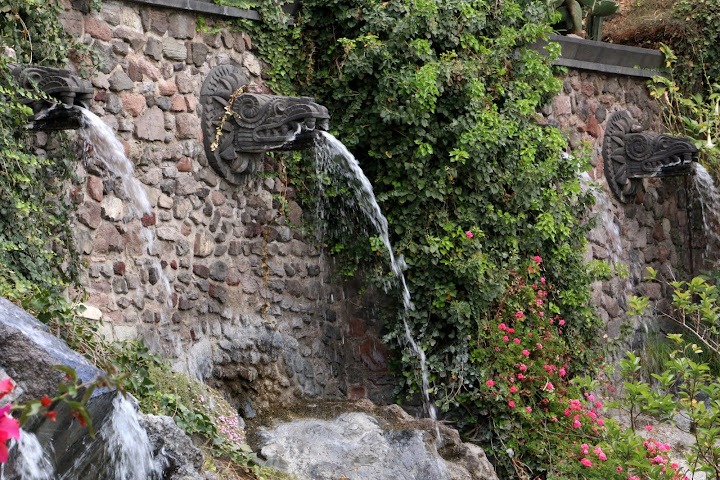
Along the way, you pass a reminder of the indigenous foundations of Mexico:


Feathered Serpents, Quetzalcóatl,
copied from the Temple of the Feathered Serpent,
Teotihuacan, some miles north


Chapel of the Little Hill,
In 1660, a small chapel was built here
to commemorate the place where Juan Diego gathered the roses.
This chapel was built at the beginning of the 18th century.


Inside, a wonderful mosaic of angels

On the way down,
a view of the modern City.
The wide boulevard follows the path of
the original causeway across Lake Texcoco.

Modern Basilica, built in the 1970s,
an amphitheater seating 10,000 people
and housing the original image of the Virgin


"Thanks, Dear Little Virgin, for one more year."

Sunday, April 17, 2016

Mexico City's Original Villages: Introduction | Landmarks of the Spiritual Conquest

As we wrote in The Buried Heart of Mexico, Mexico City's Centro Histórico was previously the center of the Mexíca-Azteca city founded in 1325: México-Tenochtitlán.

In 1521, when Cortés defeated the Mexica in the name of the Christian god and the Spanish king, he had the surviving native Mexica expelled to Tlatelolco, just to the north, their city razed and the beginnings of a new Mexico City built above the old urban center. So the Spanish city and its contemporary Colonia Centro rest upon the buried indigenous capital.

The Palace and the Cathedral—framing the Zócalo and embodying in their grandeur the power of the Spanish State and the Catholic Church—were built over their respective political and religious predecessors, the "New Houses", the palaces of Moctezuma II, and the teocalli, house of god, Temple or Pyramid of the Sun. But that was only part of the task of attempting to replace one political entity, belief system and civilization with another.

Indigenous Context of the Spanish Conquest

As we wrote in our description of the geographic patchwork quilt that is contemporary Mexico City, it is an amalgam, not only of the colonial Centro Historico and its expansion beginning in the late 19th and across the 20th century, but also of ancient indigenous pueblos, villages, and altepetls, city-states that, beginning some two thousand years ago, were established on the shores of the five lakes at the center of the Valley of Anahuac and on some of their other islands as well.

Map of altepetls, city-states, and some villages 
at the time of the arrival of the Spanish in 1519.
Tenochtitlan is on the island
in the southwest corner of Lake Texcoco,
connected by causeways to other significant altepetls on the lakeshore.

Bernal Díaz del Castillo, one of Cortés's lieutenants, describes this complex lacustrine civilization:
"Gazing on such wonderful sights, we did not know what to say, or whether what appeared before us was real, for on one side, on the land, there were many great cities, and in the lake ever so many more, and the lake itself was crowded with canoes, and in the Causeway were many bridges at intervals, and in front of us stood the great City of Mexico." (The Discovery and Conquest of Mexico, by Bernal Díaz del Castillo, translated by A. P. Maudslay, De Capo Press, 1996)
Southwest Bay of Lake Texcoco
shows many more villages and small cities. 

These are what Díaz del Castillo, Cortés
and the other Spanish soldiers
would have seen as they progressed up the causeway
from Mexicaltzinco (lower right) to Tenochtitlan.


Cortés's Challenge: Spiritual Conquest

So Cortés not only had to transform the center of power, he also had to transform a geographically extensive civilization and culture. This meant implementing a program of radical reconstruction of the culture, of the peoples' customary ways of being and their organizing beliefs.

It required the "conversion" of el pueblo, the people residing in hundreds of villages in the Valley and thousands across the territory of Nuevo España, which soon extended south to South America and north to the nomadic tribes in the deserts of Sonora and Chihuahua and, eventually, beyond to what is now the Southwest United States. This project was the "Spiritual Conquest", which followed the military one.

As with most all of Mexican history, this Conquest is not something confined to "history", to the past. Remarkably, to this day the landmarks of this process remain standing. They are the ubiquitous churches and chapels established by various groups of Spanish Catholic friars—Franciscans, Dominicans, Augustinians, and many others—in the multitudinous colonial-period cities, towns and pueblos all across Mexico.

These landmarks of the Spiritual Conquest embody the political and cultural entrance of the Spanish into the indigenous communities. This entrance was carried out literally and symbolically by the "vertical" imposition of the Catholic God with the attendant belief system and priestly institutions, over the indigenous ones. Sites where Catholic churches were erected were not random. At the geographic center of the ancient villages, they were often erected atop the ruins of the temples of their indigenous predecessors, torn down by the Spanish friars.

This act of destruction of one culture and the attempt to create another had a paradoxical result. In the effort to replace the old gods and the religious practices honoring them, the Spanish established a physical, cultural and spiritual continuity with those very predecessors. It is noteworthy that the Franciscans, and other religious orders that followed them in coming to Nueva España, while they had indigenous temples torn down and statues of their gods destroyed, they deliberately adopted a strategy of seeking out elements in indigenous religious practice that had similarities to Catholic Christianity and building on them to teach the new faith as an evolution from the old, rather than trying to completely suppress old beliefs and practices. The indigenous were seen as children who needed to be "brought up" to the religious and cultural maturity of Spanish Catholicism.

Landmarks of the Spiritual Conquest in Mexico City

The existence and centrality of colonial churches is taken for granted in Mexico's colonial-era cities and towns, as well as in the Centro Histórico of Mexico City, with its Metropolitan Cathedral and many Baroque churches. What is surprising, at least to the foreigner, is that an almost countless number of such churches and chapels still stand in all the sixteen delagaciones, boroughs of the capital, and in hundreds of their colonias, neighborhoods, and throughout the surrounding urban sea that has replaced the original lakes and now fills the Valley of Mexico with 21 million people, the world's fourth-largest metropolis.

Mexica temples of Tlatelolco (15th century) stand in front of Church of Santiago, St. James.
The church was erected by Franciscans in 1545 and became a major center of 
evangelization. It was enlarged in 1609.

Tlatelolco was an altepetl, city-state, on an island just north of Tenochtitlán,
built by a group of Mexica who split off from those in the other city.
In the early 15th century, Tenochtitlán, now the dominant power in the Valley,

defeated the warriors of Tlatelolco and incorporated it into their city.
(See: Portraying Mexico City's Azteca/Mexica Origins)

Original Villages: Ancient Living Islands in the Urban Sea

What is even more remarkable is that around some of these churches there still survive vital pueblos originarios, original villages, whose contemporary residents trace their roots back to before the Spanish Conquest. They are living historical islands in the urban sea.

The Mexico City government officially recognizes 150 such original villages and has programs to support their continued life. There are more sites where the original churches still stand as landmarks of the Spiritual Conquest, but the people have been displaced by chilangos, outsiders who have moved in as part of the expansion of the modern city.

Original Pueblos of Mexico City
Ethnographic Atlas,
National Institute of Anthropology and History, 2007

The churches—physically marking the location of these original villages—remain the centers of barrio life. Each has its patron saint, assigned by the original friars and whose name is often combined with the original indigenous name of the settlement (e.g., San Matéo Churubusco, San Marcos Ixquitlán, San Pedro Cuajimalpa, Santa María Aztahuacán).

As one pueblo stated on its Facebook page:
The church ... plays an important role in the life of the people, since it is through the patron saint that the people of the community acquire a strong sense of belonging to their community. (The patron saint) constitutes the basis of social organization (embodied in the mayordomo, the head of the fiestas' mayordomía [commitee]) and symbolic consensus, since the patron saint is considered not only as the protector and the defender of the pueblo, but as the center where all social relations converge, the vital principle of the community and a key element of its identity.
Every year, each pueblo celebrates its patron saint's day, often along with other fiestas on the Catholic religious calendar such as Navidad (Christmas), Three Kings Day (Januaary 6), Candelaria (February 2), Semana Santa (Holy Week), Trinity Sunday (at the end of the Easter Season), Corpus Cristi (The Body of Christ, May or June,), the Assumption of the Virgin Mary into Heaven (August 15) and Día de los Muertos, Day of the Dead (November 1-2).

These fiestas are organized by committees of residents, often composed of key families of long-standing status, who by their faithful work earn the privilege of increasing responsibilities. The ultimate responsibility is to serve as mayordomo (head caretaker).

Patron Saint Festival of San Mateo (St. Matthew) Churubusco,
Delegación of Coyoacán.
"Glory to you, Lord"

Carnaval Festival,
Pueblo Santa María Magdelena Petlacalco,
Delegación of Tlalpan


Dancer is a "chinelo",
derived from the Nahuatl word “zineloquie”,
which means “disguised.”

Pueblos maintain connections with one another by means of "visits" of their saints to one another on their respective saint days. The visiting saints participate in the procession, a central event in the fiesta, and the celebrating parish hosts its guests with free, communally prepared meals. Some saints even spend part of the year on visitas, visits to various neighboring pueblos. Hosting these visits is a great honor.

Niño-pa de Xochimilco, Child God of Xochimilco,
visits Barrio Xoco (HO-ko) in Delegación Benito Juárez.
The two communities are about 9 miles apart. 

Next Mexico City Ambles

So, with this understanding, we head out on the next series of Mexico City Ambles, our own recorridos of a number of these original villages and their churches—living landmarks of the Spiritual Conquest begun by the Catholic friars, summoned from Spain by Cortés, nearly 500 years ago.

Series on Mexico City's Original Indigenous Villages: