Monday, January 28, 2019

Original Villages: Coyoacán's Chapel of the Immaculate Conception, Part II: "La Conchita" Celebrates Its Rebirth

Es fácil traducir esta página en español: vaya a la columna a la derecha. En la parte más alta hay una ventana etiquetada "Translate". Desplace la flecha abajo hasta encuentra "Spanish". Click en ese y inmediatamente todo el texto estará traducido en español por Google. Con certeza, habrá errores, pero creemos qué el sentido se quede bastante claro.
On December 8, we go to Coyoacán's Chapel of the Immaculate Conception, popularly called "La Conchita", "the Little Shell", hopeful to experience the Fiesta of its patron saint, the Virgin Mary and its restoration to its original beauty. (See our initial post on this unique chapel: Coyoacán's Chapel of the Immaculate Conception of Our Lady, the Virgin Mary, Part I: Small Church with a Big History.)

Happily, when we arrive, although there are few people in the atrio (atrium) and adjacent plaza, the chapel is open and we get our first look inside the church that, when we moved to Coyocán in 2011, had been in such disrepair and had been closed for four years for restoration by the National Insititute of Anthropology and History.

However, arriving after 10 AM on Saturday morning and witnessing a baptism in the small but now pristine sanctuary, we then discover an announcement showing that two fiesta events, dances of the Moors and of indigenous-style concheros, dance troupes that frequently perform at fiestas, were scheduled to occur an hour earlier and the next event would not be until 1 PM, a Mass.

We are disappointed and wonder if it would be worth returning at 2 for a "quema de castillo en movimiento" (castillos are towers of fireworks that are usually burned in the dark of night, so we wonder what this one of "movement" will be in the mid-afternoon). There will also be a "brinco de chinelos", a "jumping" of Moorish-style dancers at 5. Following this, there will be a procession of the patron saint through the streets of the barrio beginning at 6. Such processions are usually good opportunities for taking photos, not only of the participants but also of bystanders watching. However, by 6 PM on this pre-winter day, the sun will be setting, making any photography challenging, at best. 

Schedule of fiesta events

But as we are debating what to do, we are surprised to see a small procession coming up one of the sidewalks crossing the tree-filled plaza. The procession of a patron saint through the streets of her or his pueblo is a central act of all saints´ fiestas, but this one was not on the schedule. In any case, it appears that there is more to this fiesta than what is listed on the announcement, so we decide to stay and see what may happen. Our decision leads to a day of remarkable experiences.

Fiesta Procession


The procession is led, of course, by a statue of the Virgin Mary in her advocación, her particular state or manifestation representing her own God-determined immaculate conception, i.e. that she, herself, unlike all other human beings, was born free of sin in order to later be able to immaculately conceive Jesus, the Christ, the Anointed Son of God, incarnated as a human being. In that sense, the statue presents an image of Mary that God the Father envisaged in Heaven before her earthly birth (celebrated in September).

Procession of
Our Lady of the Immaculate Conception

Behind her come some parishioners and two comparsas, dance troupes that perform at fiestas.

Concheros del Santo Niño de Atocha


The first group in the procession, behind the Virgin, are concheros, indigenous-style dancers such as we have seen at many fiestas. (See our post: Traditional Indigenous Dancers: Concheros and Danzates Aztecas)

Concheros del Santo Niño de Atocha.
We have not previously encountered this particular advocación (representation) 

of the Child Jesus.
We will have to do some research later, at home.

Concheros del Santo Niño de Atocha.
Especially notable is the mask (top center) of the major indigenous god Quetzalcoatl, 

the Plumed Serpent

Later. via Wikipedia en español, we learn that el Santo Niño de Atocha is a figure of the Child Jesus at about age 12, credited with having saved Christian captives of the Muslim Moors in the Barrio Atocha of Madrid in the 13th century. A copy of the sculpture of el Santo Niño, dressed as a pilgrim going to Santiago (St. James) Compostela, the largest pilgrimage site in Spain, was brought in the mid-16th century to what is now the State of Zacatecas, Mexico. There, he has been credited with many miracles, making himself the destination of numberless pilgrimages to el Santuario de los Plateros (silversmiths) near the city of Fresnillo, Zacatecas.

Dance of the Moors of San Bartolomé Atlatlauca


The next group in the procession is something quite different from any comparsa we have ever seen before. They are the Dancers of the Moors of San Bartolomé Atlatlauca. 


Banner announces the
Dance of the Moors 
of San Bartolomé Atlatlauca.

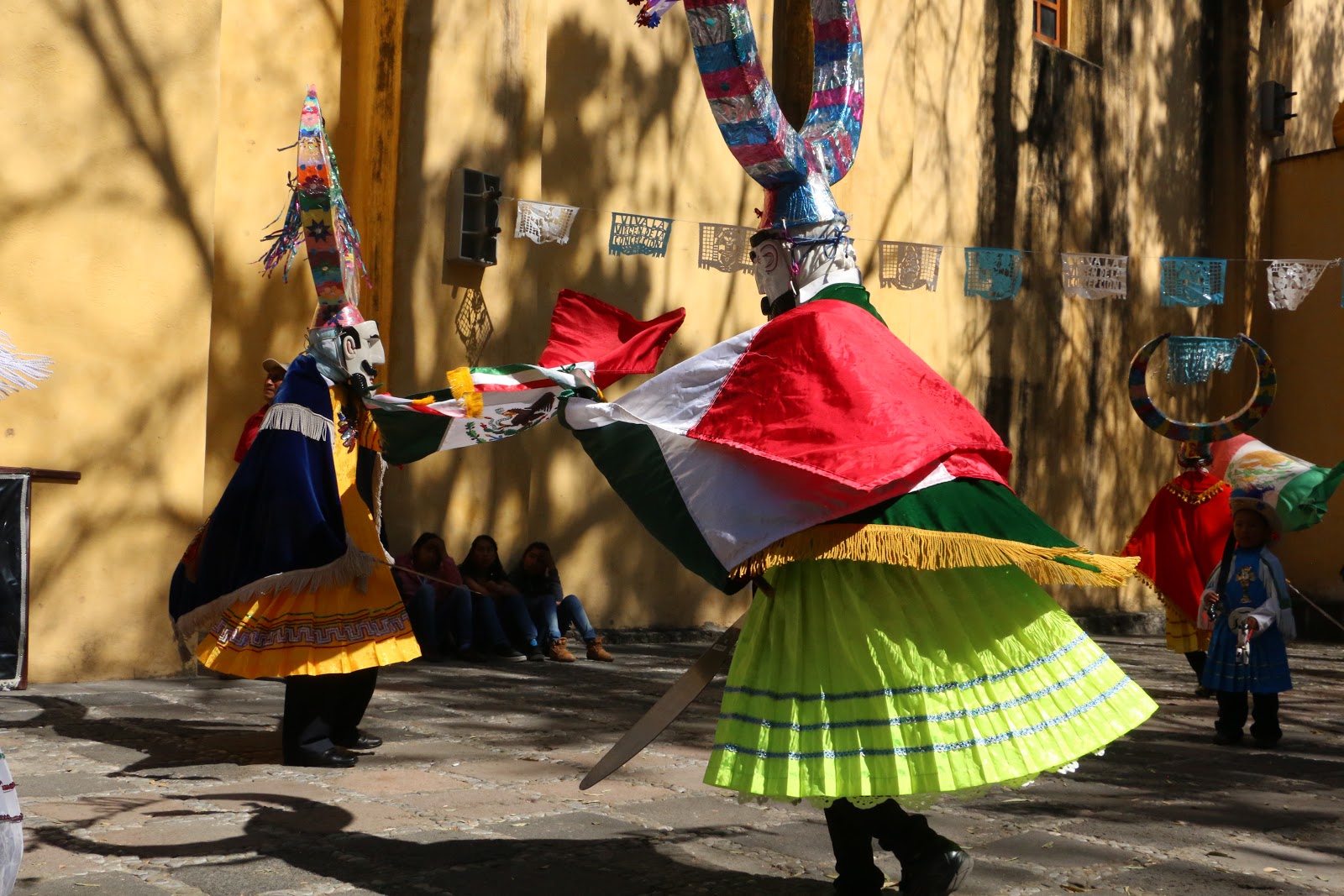
We have seen dances of the Moors and Christians, both in the State of Michoacán and here, in Mexico City. The basic dance was brought by friars to Nueva España to dramatize the message that Christianity was superior to any other "pagan" religion. Each region that reenacts the dance-drama does so in widely varying costumes and choreography. But, we have never seen such fantastic tocados (headdresses) as those worn by these "Moors" (Muslims). They are completely original in style. They appear to be huge half-moons. Their masks are also different from any we have seen, starkly white and black. We are enchanted and overjoyed that we had not left precipitously.


We note that, although these are "pagan" Muslims, incorporated in their attire are Christian symbols: the Virgin Mary as Queen of Heaven on the shirt of one, San Bartolomé, the pueblo's patron saint, on the tocado of one and the shirt of another. The Virgin of Guadalupe appears on the shirt of a fourth. The Spiritual Conquest of Christianity over indigenous "paganism" has already happened. This is just a dramatization of that transformation.

The Spanish Christian warriors' attire is less dramatic, but also colorful and unusual: satin skirts over pants and a type of decorated "cowboy" hat.

  
San Bartolomé, the patron saint of the comparsa's pueblo, is portrayed on one warrior's shirt.


There are also some strange and even comic members of the troupe. We have no idea of their roles, as they do not engage in the battle that ensues between the Moors and the Christians.


This character would seem to be some form of the devil.

We have never heard of the Pueblo San Bartolomé Atlatlauca, so, later, speaking with one of the dancers, we learn that their pueblo is south of the city of Toluca, capital of the State of Mexico, and a couple of hours drive west of Mexico City. They have traveled a fair distance to participate in the fiesta.

The Rituals Begin

Concheros of El Santo Niño de Atocha enter the sanctuary to venerate
Our Lady of the Immaculate Conception

The Christians of the Danzantes de Moros de San Bartolomé Atlatlauca
also enter the sanctuary to make their veneration to the Virgin.

So, too, do the Moors enter the sanctuary.
The image on the chest of one is the Virgin Mary as Queen of Heaven.

The Christians prepare for their battle with the Moors.
They all ride delightful miniature horses.

The simple musical accompaniment
is a flute and drum.

The Moors "warm up" for the battle.

The battle between the two religions and their respective cultures begins.
(Note that the Christian warrior wears a shawl depicting Mexico's
Virgin of Guadalupe, while the Moor curiously wears the flag of Mexico!)

Here, the Moor's cape is embroidered with the image of the Virgin of Guadalupe,
the great unifying figure between the indigenous peoples and the Spanish.
The Christian wears an image of Our Lady the Queen of Heaven.

As is typical in danzas,
children play an active role.

Here, the Moor wears an image of
his legendary adversary,
Santiago Matamoros,
St. James, the Moor-killer.

              
Finally, inevitably, the Moors are defeated by the Christians.


Party Time


After the Christians have defeated the Moors, a brass banda appears and begins to play.


Cohetes, rocket-style firecrackers essential to every fiesta, are shot off.

Quema de Castillo and a Palo Cebo


The "quema de castillo en movimiento" is set off.
Fireworks power a papier-maché figure so that it climbs a pole.
This is an enactment of another common fiesta ritual,
the actual climbing by young men of a palo cebo (baited pole),
a greased pole, to obtain prizes at the top.

Climbing a palo cebo, a greased pole
at the Fiesta of San Mateo Churubusco.
Here a cooperative effort is permitted.

The top prize here is a bicycle!
The competition has its origins in fiestas in medieval Europe.

The quema ends
with the unfurling of a banner
displaying Our Lady
of the Immaculate Conception
.

Dance of the Mojigangas, Títeres Gigantes


Next, two títeres gigantes, giant puppets, 
also known as mojigangas (possibly of Moorish/Arabic origin)
from European medieval festivals, dance to the music of the band.

Their dance ends with a kiss.
The puppets are also a medieval European tradition.

Chinelos


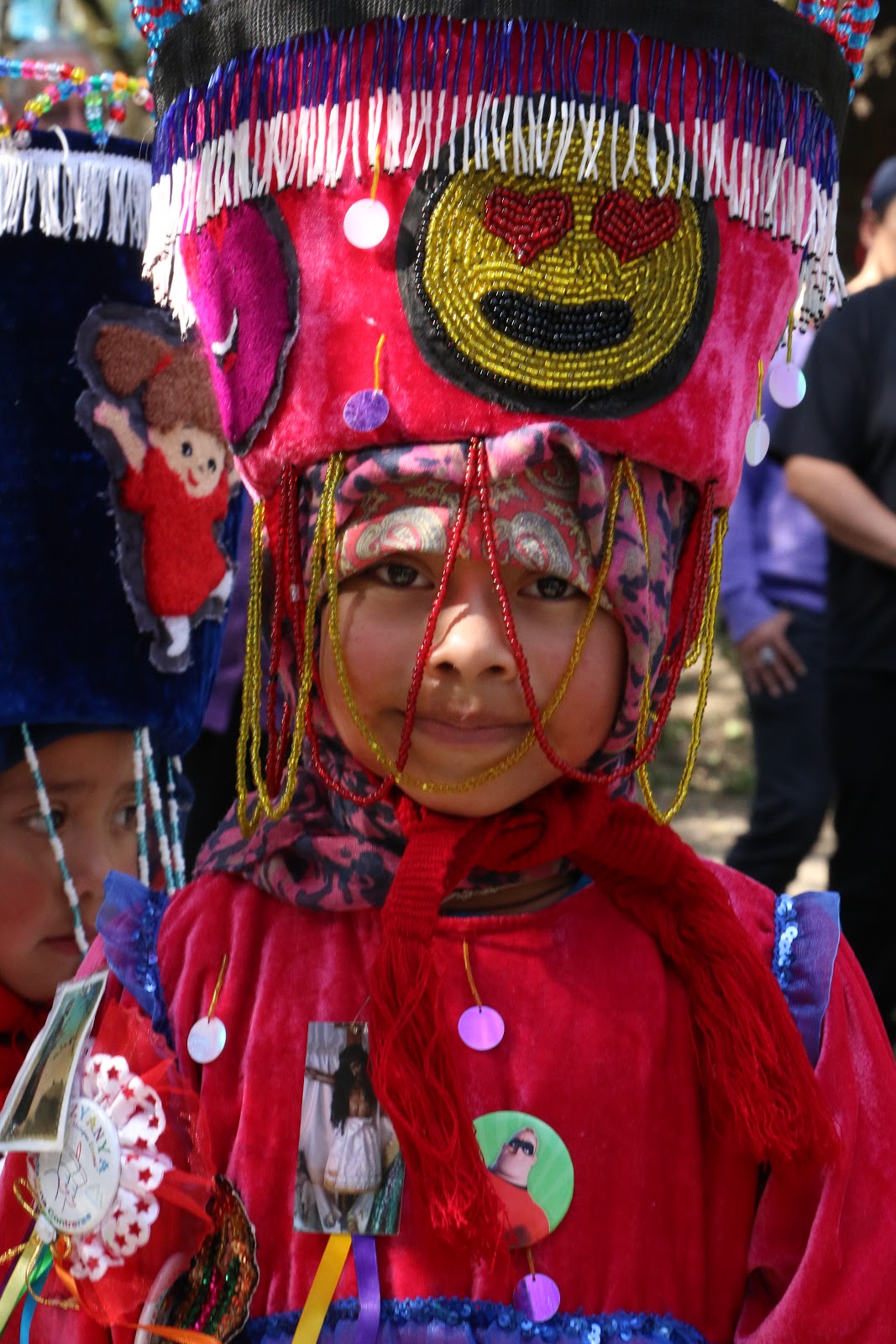
Finally, it is the time for the chinelos, the "disguised ones" to "brincar" and "girar", do their jumping and spinning dance.

This comparsa of chinelos is from the Pueblo San Bartolomé,
in the Delegación/Alcaldía Magdalena Contreras
on the far west side of the city.

Quite a number of children are participants.
The tradition, like all other comparsas, is handed down through families.


Brincar, jumping

Girar, spinning

Just People


Los mayordomos,
the "overseers" or chairmen in charge of organizing the fiesta.


Well done!
La Capilla de Nuestra Señora de la Concepción
is alive and full of ánimo (life force).

Wednesday, January 9, 2019

Original Villages | San Andrés Tetepilco, Iztapalapa: Once an Island Village, Still a Pueblo Celebrating Its Identity

Tetepilco: Another "Lost Island"


We have been exploring the original indigenous villages that existed in what is now the Valley of Mexico when the Spanish arrived five hundred years ago and which continue to exist today as pueblos, within the City of Mexico. One of many themes that has emerged is that, as the Valley was filled with a chain of five lakes, a number of these still-existing pueblos were, like the Mexica capital of Tenochtitlan itself, originally located on islands. (See our page: City of Lost Islands.)

Most of these villages were on a chain of islands that ran from north to south in a large bay that formed the southwest corner of Lake Texcoco, the central and largest of the lakes. We have already visited a number of these "lost island" villages. In this post, we visit another, San Andrés Tetepilco.

The Valley of Mexico (then called Anahuac by its Nahua residents)
about 1519,
at the Time of the Arrival of the Spanish.


Tenochtitlán, the Mexica/Azteca capital, 
lay in the middle of a chain of islands 
in the southwest bay of Lake Texcoco.
(Click on any photo to enlarge.)

The island of Teteopilco
(now Pueblo Tetepilco)
lay near the south end of the bay of Lake Texcoco,
just off-shore from the Peninsula of Iztapalapa

Like all the other island villages and all those that were on the mainland, Tetepilco now lies immersed in the urban sea of the city, indistinguishable from any of hundreds of working-class and lower-middle-class neighborhoods. It is now just one of 199 colonias and pueblos in the very large Delegación (now Alcaldía) Iztapalapa, which contains nearly two million people.

Feast of San Andrés: Celebrating Tetepilco


But Tetepilco, assigned the patron saint, San Andrés — St. Andrew, one of the twelve apostles of Jesus — by Franciscan monks in the 16th century, still tenaciously holds onto its ancient identity as a village, and a community, and it does so, as do the other original villages in the city, via the church founded by those monks and the celebration of its patron saint fiesta, along with other fiestas of the Catholic liturgical year. 

San Andrés' feast day is November 30. So on the Sunday of the closest weekend, the biggest day of such fiestas, which this year is December 2, we head off to San Andrés Tetepilco. As it is located in the northwest corner of Iztapalapa, it is not far from our base in Delegación Coyoacán, just up the Calzada de Tlalpan highway, originally the Mexica causeway south across the lake, and a short distance east of it. Via our usual taxi chauffeur, we arrive easily, spotting the food puestos (stalls) and juegos mechanicos (fair rides) that inevitably accompany fiestas, filling the avenue in front of the church.

We find our way through the puestos to the entrance to the church atrio (atrium), enclosed, as usual, by a wall, setting the interior space apart from the everyday world around it. The atrio is a tree-filled space, making it a park-like island of tranquility amidst the urban bullicio (hubbub).

Fiesta of Many Parts


However, as the fiesta is in full swing, the atrio is today, by no means, a tranquil space. A center walkway leads to the church. Two other walks, near the sides, further divide the space. Entering, we find each of the three walks filled with a comparsa, a dance group that performs at fiestas, which gives the atrio more of the feeling of a three-ring circus than a quiet park.

In one aisle is a comparsa, a troop of chinelos, the "disguised ones,"
in their Moorish-style robes and headdresses.

Comparsas of Conchero Azteca Danzantes occupy two other walkways.
We have presented the long and fascinating history of these dance groups in our post:
Traditional Indigenous Dancers: Concheros and Danzantes Aztecas


Santiagüeros, Warriors of St. James

Meanwhile, a fourth drama is being enacted in the open space directly in front of the church. It is los Santiagüeros, the Warriors of St. James. The apostle of Jesus, James, is believed to have come to the Iberian Peninsula in the mid-first century CE, from Jewish Judea at the other end of the Mediterranean, both part of the Roman Empire, to preach the Christian faith. Returning to Judea, he was martyred. Some eight hundred years later, he is believed to have appeared on a white horse in the midst of a battle between Iberian Christians and Islamic Moors and helped the Christians win. He became known as Santiago Matamoros, St. James, the Moor Slayer, and is the patron saint of Spain. 


Los Santiagüeros
Warriors of Santiago, St. James.
The conflict ends, of course, with the submission of the Moors to the Christian God.

Catholic monks brought the story to Nueva España and had it enacted by the indigenous as a means of demonstrating the victory of Christianity over what they considered pagan religions. Los Santiagüeros maintain the tradition of this re-enactment. We have seen them at other fiestas and wrote about the complete drama they performed at a fiesta we previously attended in Delegación Xochimilco: Santa María Tepepan: Drama of the Christians vs. the Pagans.


Preparing to Honor San Andrés


In the center walkway, the components of the procession begin to take form.
The anda, platform, will carry San Andrés through the streets of his pueblo.
The banners represent the various comparsas of danzantes participating.

The first is from Pueblo Santa Cruz Ayotuxco, in the State of Mexico
in the Sierra de las Cruces, just west of the city. 

Church of San Andrés Tetepilco
with its fiesta portada
An image of San Andrés stands at the top.
The sign says, "Good fortune, San Andrés¨
This salutation is meant as much for the Pueblo as for its patron saint.

The Conchero Azteca Danzantes enter the church to pay homage to San Andrés
and the Sacred Power.

The winged saint, upper left, is the Archangel San Miguel, St. Michael.
We saw this same comparsa at the Fiesta of San Francisco
in Delegacion Coyoacán
in early October.

Chancel of the Sanctuary
San Andrés has been removed from behind the altar
to be placed on his anda for the procession.

Leaving the sanctuary, the two conchero groups then raise two large crosses at the sides of the atrio, joining a third, already in place. This is a briefer version of the ritual of The Veneration of the Three Crosses which we witnessed at the Fiesta of San Francisco.


Exceptional Danzantes


All this time, we have heard drumming coming from the street alongside the church — obviously originating from yet another comparsa of Azteca danzantes. So we go out a side entrance into the street. 


This is one of the largest, and most elaborately dressed Azteca dance groups
 we have seen at a fiesta in Mexico City.

From the mother of one of the children dancing, 
we learn they are la Danza Azteca Coyolxauhqui, from the Pueblo of San Andrés. 
They are under the direction of the Martínez brothers.

Also, they are dancing around, obviously in honor of, 
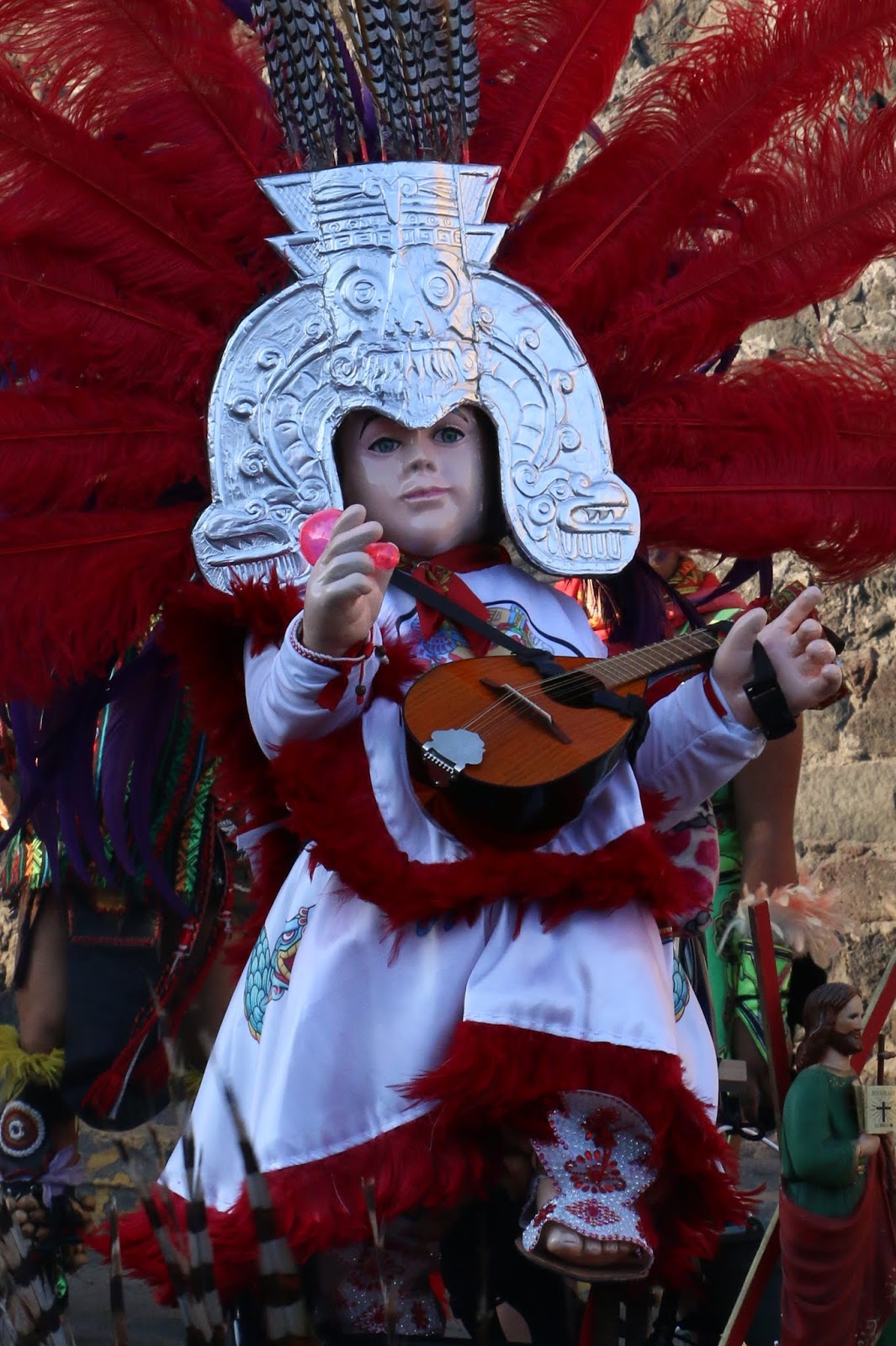
an image we have not seen before.
El Niño Jesús, the Infant Jesus,
attired as an Azteca conchero (lute-playing dancer),

in what was the original conchero white tunic.

Yet none of these dancers are playing conchos.
They are dancing only to the indigenous beat of drums and rattles.
This is, to us, 
another, mysterious variation on such danzantes.

Multiple drummers provide a deafening beat.

Drummer,
the only one in traditional Azteca dress.

Many of the headdresses are exceptional works of art.
Artwork of feathers is an ancient indigenous tradition.


The tradition is passed on
 and girls are an equal part!


The Procession Begins


Suddenly, around the corner, from the front of the atrio, comes the procession.

San Andrés, St. Andrew
leads the way.

Two of the crosses follow


Then the comparsas of Azteca danzantes

Lastly, a gigantic Toro, Bull
Toritos, "little bulls", wire frames with a bull's head and horns, carried by one person, 

are common in Mexican fiestas,
but we have never seen one anywhere near this size or this realistic.
Fireworks are attached to the frame around his sides and will be set off later,
at the evening's pyrotechnic display, which will include a "castillo" castle tower,
the sine qua non climax of every fiesta.

Taking a break and looking on

Just folks

So the patron saint fiesta of San Andrés Tetepilco has more than plenty of the requisite fiesta components: chinelos and three comparsas of Azteca dancers (including one with the most elaborate and beautiful feather headdresses we have ever seen), Santiagüeros, a procession through the pueblo's streets. It has its Mass and will have the pyrotechnic quema de castillo after dark. Thus, it shows the commitment of the many original pueblos within Mexico City to their history and traditions, a history and traditions that go back to the time when Tetepilco was an island in a lake, Texcoco, that unlike the pueblo, didn't survive the onslaught of Mexico City. 

Delegación/Alcaldía Iztapalapa 
is large, light green area on the mid-east side of Mexico City.

Delegcion/Alcaldía Iztapalapa's Pueblos and Colonias.
Pueblo San Andrés Tetepilco is in the northwest corner
(yellow area to left of blue/purple star).

Current locations of
island pueblos north of former Iztapalapa Peninsula.

 The thick black line marks the Canal de la Viga ,
created when Lake Texcoco was drained, in order
to enable trade from Lakes Xochimilco and Chalco to Centro.

Pueblo San Andrés Tetepilco 
is the yellow area marked by the blue/purple star, center-left.

 East of Tetepilco are former island pueblos of
Nextipac (green/yellow star),
Atlazolpa (purple/orange star) and

West of Tetepilco are the former islands pueblos of
Tepetlatzinco (now Niños Heroes) (yellow/blue star)
Ticumac (yellow/black star), and 
Huitzliopocho (now Churubusco) yellow/purple star)

North of Tepetilco are the former island pueblos of:
Iztacalco (yellow/red star),
 Zacatlamanco (purple/green star)
Mixhuca (green/green star) and
Tultengo (red/yellow star), 
which formed the southern end of Tenochtitlan 

To the south of Tetepilco are the main pueblos 
that were on the west end of the Iztapalapa Peninsula:

Mexicaltzingo (mustard/yellow star), 
was at Peninsula's western point, 
or possibly, an island just offshore.

Iztapalapa (red/orange star), east of Mexicaltzingo, was
another altepetl, built by the Mexica at the south end of the
dike they constructed in the 1430s.

Culhuacán (blue star, red area at bottom of the map)
is the oldest altepetl on the west end of the Peninsula.