Es fácil traducir esta página en español: vaya a la columna a la derecha. En la parte más alta hay una ventana etiquetada "Translate". Desplace la flecha abajo hasta encuentra "Spanish". Click en ese y inmediatamente todo el texto estará traducido en español por Google. Con certeza, habrá errores, pero creemos qué el sentido se quede bastante claro.On December 8, we go to Coyoacán's Chapel of the Immaculate Conception, popularly called "La Conchita", "the Little Shell", hopeful to experience the Fiesta of its patron saint, the Virgin Mary and its restoration to its original beauty. (See our initial post on this unique chapel: Coyoacán's Chapel of the Immaculate Conception of Our Lady, the Virgin Mary, Part I: Small Church with a Big History.)
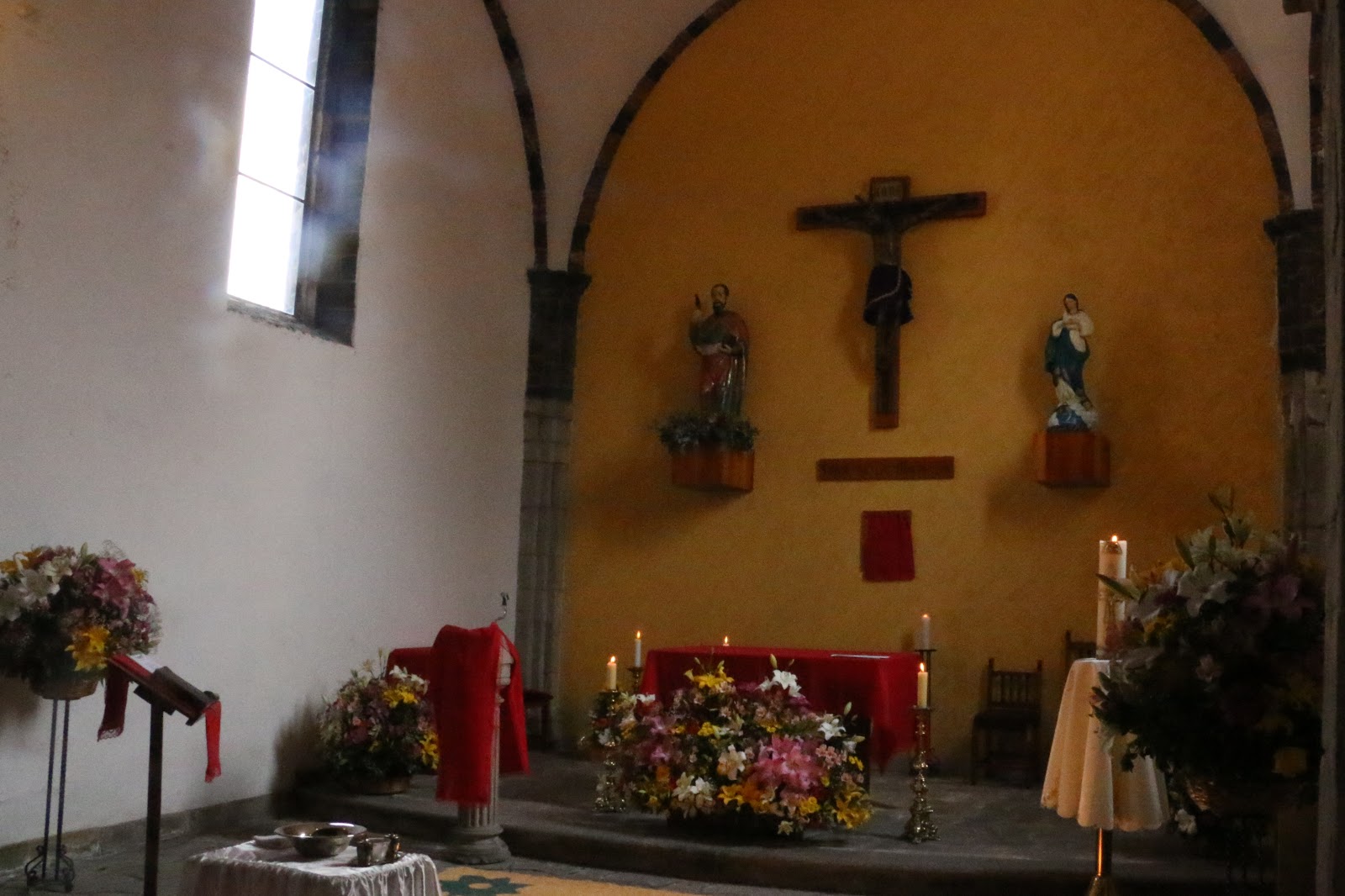
Happily, when we arrive, although there are few people in the atrio (atrium) and adjacent plaza, the chapel is open and we get our first look inside the church that, when we moved to Coyocán in 2011, had been in such disrepair and had been closed for four years for restoration by the National Insititute of Anthropology and History.
However, arriving after 10 AM on Saturday morning and witnessing a baptism in the small but now pristine sanctuary, we then discover an announcement showing that two fiesta events, dances of the Moors and of indigenous-style concheros, dance troupes that frequently perform at fiestas, were scheduled to occur an hour earlier and the next event would not be until 1 PM, a Mass.
We are disappointed and wonder if it would be worth returning at 2 for a "quema de castillo en movimiento" (castillos are towers of fireworks that are usually burned in the dark of night, so we wonder what this one of "movement" will be in the mid-afternoon). There will also be a "brinco de chinelos", a "jumping" of Moorish-style dancers at 5. Following this, there will be a procession of the patron saint through the streets of the barrio beginning at 6. Such processions are usually good opportunities for taking photos, not only of the participants but also of bystanders watching. However, by 6 PM on this pre-winter day, the sun will be setting, making any photography challenging, at best.
 |
| Schedule of fiesta events |
But as we are debating what to do, we are surprised to see a small procession coming up one of the sidewalks crossing the tree-filled plaza. The procession of a patron saint through the streets of her or his pueblo is a central act of all saints´ fiestas, but this one was not on the schedule. In any case, it appears that there is more to this fiesta than what is listed on the announcement, so we decide to stay and see what may happen. Our decision leads to a day of remarkable experiences.
Fiesta Procession
The procession is led, of course, by a statue of the Virgin Mary in her advocación, her particular state or manifestation representing her own God-determined immaculate conception, i.e. that she, herself, unlike all other human beings, was born free of sin in order to later be able to immaculately conceive Jesus, the Christ, the Anointed Son of God, incarnated as a human being. In that sense, the statue presents an image of Mary that God the Father envisaged in Heaven before her earthly birth (celebrated in September).
 |
| Procession of Our Lady of the Immaculate Conception |
Behind her come some parishioners and two comparsas, dance troupes that perform at fiestas.
Concheros del Santo Niño de Atocha
The first group in the procession, behind the Virgin, are concheros, indigenous-style dancers such as we have seen at many fiestas. (See our post: Traditional Indigenous Dancers: Concheros and Danzates Aztecas)
 |
| Concheros del Santo Niño de Atocha. We have not previously encountered this particular advocación (representation) of the Child Jesus. We will have to do some research later, at home. |
 |
| Concheros del Santo Niño de Atocha. Especially notable is the mask (top center) of the major indigenous god Quetzalcoatl, the Plumed Serpent |
Later. via Wikipedia en español, we learn that el Santo Niño de Atocha is a figure of the Child Jesus at about age 12, credited with having saved Christian captives of the Muslim Moors in the Barrio Atocha of Madrid in the 13th century. A copy of the sculpture of el Santo Niño, dressed as a pilgrim going to Santiago (St. James) Compostela, the largest pilgrimage site in Spain, was brought in the mid-16th century to what is now the State of Zacatecas, Mexico. There, he has been credited with many miracles, making himself the destination of numberless pilgrimages to el Santuario de los Plateros (silversmiths) near the city of Fresnillo, Zacatecas.
Dance of the Moors of San Bartolomé Atlatlauca
The next group in the procession is something quite different from any comparsa we have ever seen before. They are the Dancers of the Moors of San Bartolomé Atlatlauca.
 |
| Banner announces the Dance of the Moors of San Bartolomé Atlatlauca. |
We have seen dances of the Moors and Christians, both in the State of Michoacán and here, in Mexico City. The basic dance was brought by friars to Nueva España to dramatize the message that Christianity was superior to any other "pagan" religion. Each region that reenacts the dance-drama does so in widely varying costumes and choreography. But, we have never seen such fantastic tocados (headdresses) as those worn by these "Moors" (Muslims). They are completely original in style. They appear to be huge half-moons. Their masks are also different from any we have seen, starkly white and black. We are enchanted and overjoyed that we had not left precipitously.


We note that, although these are "pagan" Muslims, incorporated in their attire are Christian symbols: the Virgin Mary as Queen of Heaven on the shirt of one, San Bartolomé, the pueblo's patron saint, on the tocado of one and the shirt of another. The Virgin of Guadalupe appears on the shirt of a fourth. The Spiritual Conquest of Christianity over indigenous "paganism" has already happened. This is just a dramatization of that transformation.
The Spanish Christian warriors' attire is less dramatic, but also colorful and unusual: satin skirts over pants and a type of decorated "cowboy" hat.
  |
| San Bartolomé, the patron saint of the comparsa's pueblo, is portrayed on one warrior's shirt. |


There are also some strange and even comic members of the troupe. We have no idea of their roles, as they do not engage in the battle that ensues between the Moors and the Christians.


 |
| This character would seem to be some form of the devil. |
We have never heard of the Pueblo San Bartolomé Atlatlauca, so, later, speaking with one of the dancers, we learn that their pueblo is south of the city of Toluca, capital of the State of Mexico, and a couple of hours drive west of Mexico City. They have traveled a fair distance to participate in the fiesta.
The Rituals Begin
 |
| Concheros of El Santo Niño de Atocha enter the sanctuary to venerate Our Lady of the Immaculate Conception |
 |
| The Christians of the Danzantes de Moros de San Bartolomé Atlatlauca also enter the sanctuary to make their veneration to the Virgin. |
 |
| So, too, do the Moors enter the sanctuary. The image on the chest of one is the Virgin Mary as Queen of Heaven. |
 |
| The Christians prepare for their battle with the Moors. They all ride delightful miniature horses. |
 |
| The simple musical accompaniment is a flute and drum. |
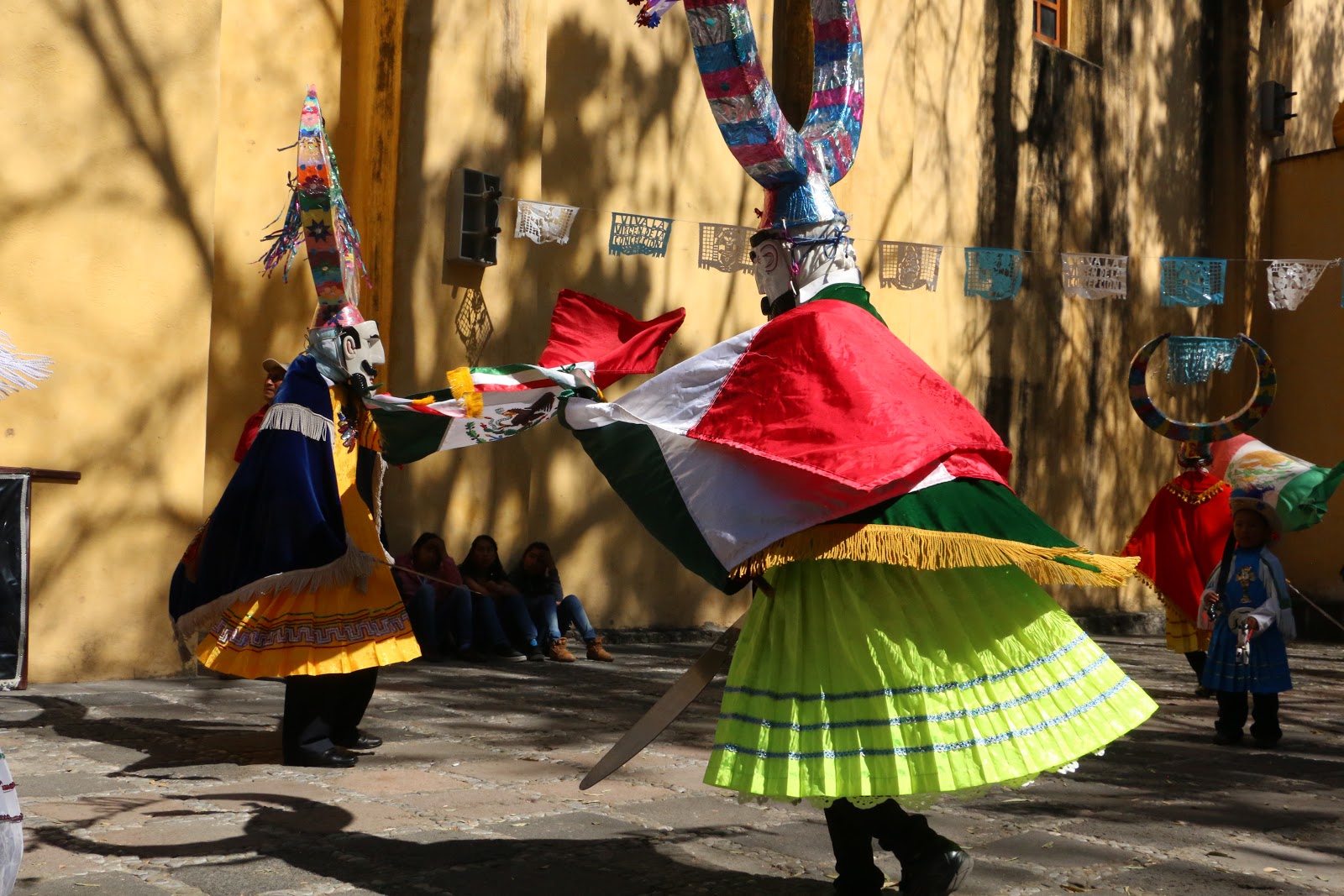 |
| The Moors "warm up" for the battle. |
 |
| The battle between the two religions and their respective cultures begins. (Note that the Christian warrior wears a shawl depicting Mexico's Virgin of Guadalupe, while the Moor curiously wears the flag of Mexico!) |
 |
| Here, the Moor's cape is embroidered with the image of the Virgin of Guadalupe, the great unifying figure between the indigenous peoples and the Spanish. The Christian wears an image of Our Lady the Queen of Heaven. |
 |
| As is typical in danzas, children play an active role. Here, the Moor wears an image of his legendary adversary, Santiago Matamoros, St. James, the Moor-killer. |
 |
 |
| Finally, inevitably, the Moors are defeated by the Christians. |
Party Time
After the Christians have defeated the Moors, a brass banda appears and begins to play.

Cohetes, rocket-style firecrackers essential to every fiesta, are shot off.
Quema de Castillo and a Palo Cebo
 |
| The "quema de castillo en movimiento" is set off. Fireworks power a papier-maché figure so that it climbs a pole. This is an enactment of another common fiesta ritual, the actual climbing by young men of a palo cebo (baited pole), a greased pole, to obtain prizes at the top. |
 |
| Climbing a palo cebo, a greased pole at the Fiesta of San Mateo Churubusco. Here a cooperative effort is permitted. The top prize here is a bicycle! The competition has its origins in fiestas in medieval Europe. |
 |
| The quema ends with the unfurling of a banner displaying Our Lady of the Immaculate Conception. |
Dance of the Mojigangas, Títeres Gigantes
 |
| Next, two títeres gigantes, giant puppets, also known as mojigangas (possibly of Moorish/Arabic origin) from European medieval festivals, dance to the music of the band. |
 |
| Their dance ends with a kiss. The puppets are also a medieval European tradition. |
Chinelos
Finally, it is the time for the chinelos, the "disguised ones" to "brincar" and "girar", do their jumping and spinning dance.
 |
| This comparsa of chinelos is from the Pueblo San Bartolomé, in the Delegación/Alcaldía Magdalena Contreras on the far west side of the city. |
 |
| Quite a number of children are participants. The tradition, like all other comparsas, is handed down through families. |

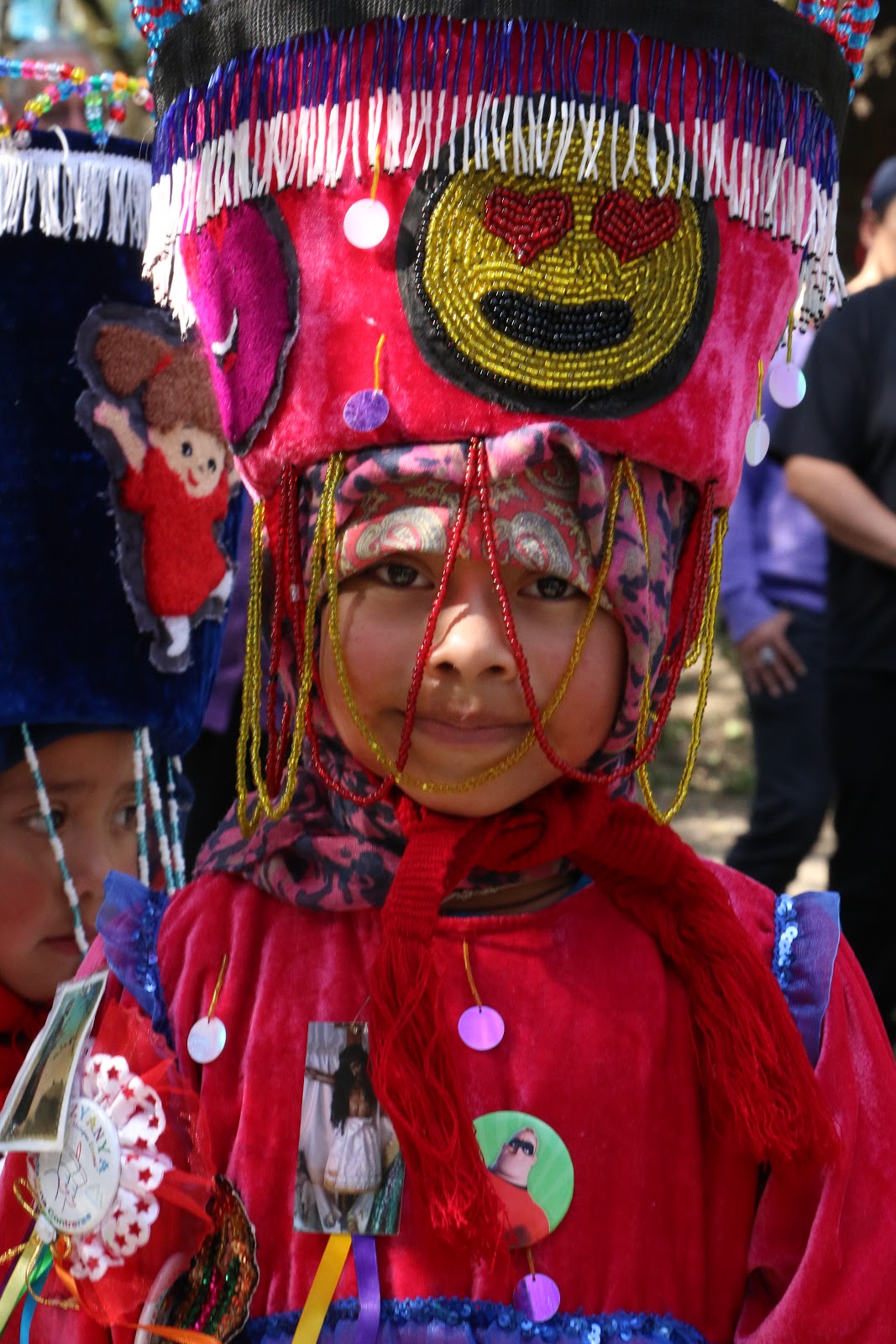
 |
| Brincar, jumping |
 |
| Girar, spinning |
Just People

 |
| Los mayordomos, the "overseers" or chairmen in charge of organizing the fiesta. Well done! La Capilla de Nuestra Señora de la Concepción is alive and full of ánimo (life force). |