It is a Mexican credo, expressing the belief that the Revolution was not completed in 1917 or even in the years afterward, but remains to be fulfilled.

This declaration is more than a proposition. It is a statement of faith made in a post-Revolutionary effort to reconcile the anarchy of the series of civil wars fought from 1910 to 1917 and the violent power struggles that followed it through the 1920s, with the ongoing incompleteness of the fulfillment of the popular hopes raised for liberty, equality and justice for all embodied in the Constitution of 1917. Thus, the phrase postulates that the fulfillment of those promises requires struggle in the present that will need to go on into the indeterminant future. The refrain of the faithful that literally reverberates to this day through the streets of the capital is "¡La lucha sigue!"—"The struggle continues".
Two Mexican historians sum it up in a recent book on the Revolution and its meaning in Mexican culture:
"...the Revolution was not only used by the State to legitimize itself, popular organizations (working class and poor) have had it as the referent and symbol guiding their struggles. The predominant way of doing politics throughout the twentieth century was the politics of the masses established by the Revolution, that of mobilization and struggle (lucha) in the streets, organized in the workplace, in the ejidos (indigenous communal lands) and schools, by collective actors ...
"The Mexican Revolution was the source of that kind of politics by the popular sectors and their organizations. ... In many of these mobilizations and struggles the meaning that the Revolution had for the popular sectors was present. Thus, the Revolution remains a benchmark of the political culture and for the mobilization and struggle of Mexican popular sectors." (Felipe Avila and Pedro Salmeron, Historia breve de la Revolución Mexicana, Brief History of the Mexican Revolution, Mexico, Siglo XXI, 2015)
 |
| March up Reforma from Angel of Independence, September 26, 2015, commemorating one year since disappearance of 43 Ayotzinapa Normal School students. Note far right: Banner portraying Emiliano Zapata In the distance, behind the Angel, is Chapúltepec Castle. Photo: Cuartoscuro |
This Revolutionary faith is manifested in frequent protest manifestaciones, demonstrations, that go on in Mexico City. They are usually organized along streets that form a slanted cross defined by three symbolic architectural points:
- Zócalo: Symbolic heart of Mexico, its people and its government and the location of the National Palace;
- Angel of Independence: Quintessential symbol of Mexican liberty on Paseo de la Reforma, southwest of the Zócalo; and
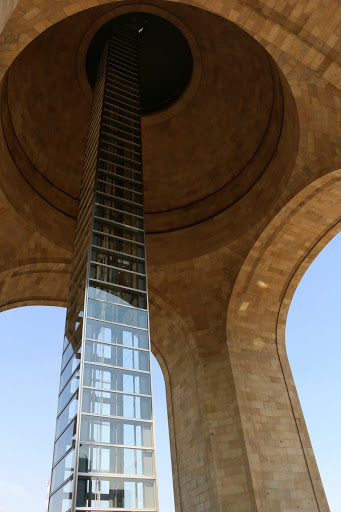
- Monument to the Revolution: directly west of the Zócalo, across Reforma.
 |
| Click to enlarge. |
However, this blog is not about the politics of these struggles (for those, see our Mexico Voices blog). Here, we are interested in discovering the symbolic representations of the Revolution and its ongoing proclamations in the cityscape and public art of Mexico City. Of course, there are the names of streets (20th of November, Madero, Revolution, Carranza, Zapata, División del Norte [name of Villa's army]), colonias (Francisco Madero, Alianza Popular Revolucionaria) and delegaciones, boroughs, (Venustiano Carranza, Gustavo Madero, Álvaro Obregón) and, of course, the statues.
 |
| President Francisco Madero in front of Bellas Artes near where he dismounted on his last ride from Chapultepec Castle to the National Palace during the uprising against him, the Ten Tragic Days, February 1913. |
 |
| Bust of President Francisco Madero, outside Lecumberri Prison, where he was assassinated, February 22, 1913, ending the Ten Tragic Days. |
 |
| General Francisco "Pancho" Villa Entrance to park in his name, along División del Norte, the name of his army, Delegación Benito Juárez. |
 |
| Emiliano Zapata entered Mexico City in the fall of 1914, coming from the state of Moreleos, to the south, Statue is in Huipulco, Tlalpan, at intersection of the Calzada de Tlalpan and roads into Tlalpan and Xochimilco |
But in the most unexpected places, we come across representations of the Revolution:
 |
| Secular, socialist education (note Communist red star and sickle at right) overcomes Catholic education (bishop) and Fascism (Hitler) Central Primary School, built 1934 across Balderas Avenue from the Ciudadela. |
 |
| Catholic "Cristeros", opposed to Post-Revolutionary secular education, drag a government teacher from her classroom during their uprising in the 1920's, Central Primary School, built 1934. |
 |
| The Revolution Mosaic mural in the Jesús Romero Flores Culture Center Colonia Hipódromo Condesa. |
 |
| Venustiano Carranza and the Constitution of 1917 Jesús Romero Flores Culture Center Colonia Hipódromo Condesa |
In a rather peculiar setting, but one quite Mexican in its peculiarity, we come across a rather strange mural. The setting is the Museum of the Secretariat of the Treasury, housed in the former Palace of the Archbishop, on Moneda (Mint) Street in Centro Histórico. The Treasury took over the building during the Reforms of the 1860s, when church property was expropriated by the government of Benito Juárez. The Treasury has a very nice art collection built from works given it in lieu of payment of taxes.
The mural, Song to the Heroes, by José Gordillo, a student of Dr. Atl, David Alfaro Siqueiros and Diego Rivera, is in the stairway. Created in 1952, it has two parts, which seem unrelated in both style and mood.
The Revolution, or at least memories of it, live on in another, unexpected space. The Metro is the most visited public space in the city (average of 4.4 million travelers per day), so the city government has made it a space to present public art. Many of its stations serve as galleries for displaying murals portraying more or less explicit lessons in Mexican history or messages with an implicit social and/or cultural intent.
As such, these Metro station murals are direct descendents of the revolutionary mission of the founding fathers of Mexican Muralism; namely, to place politically meaningful art in public spaces. Metro stations become the extensions of the Secretariat of Public Education and San Ildefonso, variations of the marriage of everyday space with art with a message which was first embodied in the Abelardo Rodríguez Market.
In the Insurgentes Station on Line 1, we find a virtually explicit acknowledgement of the transmission of that revolutionary heritage that had its beginnings one hundred years ago with Dr. Atl in the Academy of San Carlos.
The Revolution, or at least its particular heros and villains, is explicitly presented in a passageway in Hidalgo Station, where Lines 2 and 3 intersect.
Revolution in Education
As manifested in the Central Primary School murals, the establishment of secular education was one of the major achievements of the Revolution. The National Preparatory (High) School was established during the Reform period of Benito Juárez in the mid-19th century, but there was little further development of public education during the rule of Porfiro Díaz in the second half of that century.
In 1910, just before the Revolution broke out, the National University was established by Justo Sierra, who was Secretary of Education under Porfiro Díaz. However, with the war, it didn't get underway until José Vasconceles was appointed in 1920 as rector for a short period before being named Secretary of Public Education. The University occupied the buildings of the former Royal and Pontifical University of Mexico in Centro Histórico, which had been founded in 1551 by decree of Holy Roman Emperor Charles V and closed in 1867 during the Era of Reform.
In the 1950's the Mexican government decided to move the University to an entirely new campus in the Coyoacán Delegación, borough, in the south of the city. We will visit the Ciudad Universitaria, University City, next. For now, we make a stop in the University Metro Station at the southern end of Line 3, where there is a mural portraying the history of education in Mexico and its modern, secular transformation as a result of the Revolution.
Revolution Redux
However, it is in the Xola ('Shola') station, on Line 2, just a few stops north of our home-base station, General Anaya, that we find ourself confronted by a mural that takes us back—not just in Revolutionary themes and imagery, but in dramatic artistic style as well—to the works of Orozco and Siqueiros that we first encountered in Bellas Artes.
The creator of the mural is Ariosto Otero Reyes, born in 1949, who, like his famous "Great Three" predecessors, attended the Academy of San Carlos, named the Superior School of Plastic Arts in the 1920s after it became part of UNAM. Otero Reyes has created murals at other sites in Mexico City and elsewhere in the country.
 |
| The much larger top portion portrays a bare-chested worker wearing a miner's hat and manipulating a complex set of machinery. The piece for which he is reaching is marked, "Made in the United States of America." In his left hand is, apparently, a crumpled Mexican flag. The tube extending into the lower left corner seems to be vacuuming up whatever is below it. |
 |
In a narrow strip across the bottom, some of Mexico's heroes stolidly stand.
Independence: Miguel Hidalgo, Vicente Guerrero, José María Morelos.
Reform Period: Benito Juárez, Melchor Ocampo. Revolution: Ricardo Flores Magón (radical author), Felipe Ángeles (general), Emiliano Zapata, Francisco Villa.
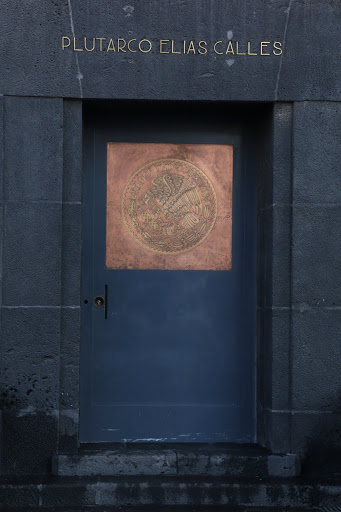
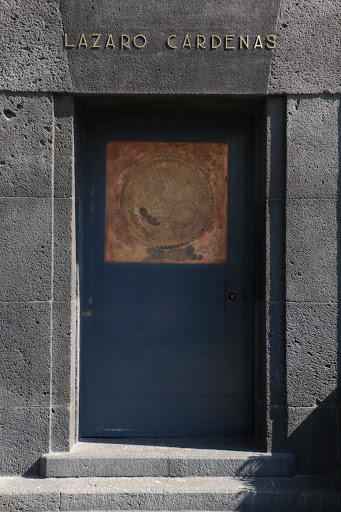
The mural is also curious for who is left out of the pantheon: Francisco Madero, Venustiano Carranza, Álvaro Obregón and Plutarco Calles, all buried together in the Monument to the Revolution.
|
 |
| "The Streets of My General" Ad on a wall along Calzada de Tlalpan Coyoacán |
The Metro: Where Revolution and Mural Art Meet
The Revolution, or at least memories of it, live on in another, unexpected space. The Metro is the most visited public space in the city (average of 4.4 million travelers per day), so the city government has made it a space to present public art. Many of its stations serve as galleries for displaying murals portraying more or less explicit lessons in Mexican history or messages with an implicit social and/or cultural intent.
As such, these Metro station murals are direct descendents of the revolutionary mission of the founding fathers of Mexican Muralism; namely, to place politically meaningful art in public spaces. Metro stations become the extensions of the Secretariat of Public Education and San Ildefonso, variations of the marriage of everyday space with art with a message which was first embodied in the Abelardo Rodríguez Market.
In the Insurgentes Station on Line 1, we find a virtually explicit acknowledgement of the transmission of that revolutionary heritage that had its beginnings one hundred years ago with Dr. Atl in the Academy of San Carlos.
 |
| David Siqueiros, José Clemente Orozco, Frida Kahlo and Diego Rivera Mural in Insurgentes Station, Metro Line 1 |
The Revolution, or at least its particular heros and villains, is explicitly presented in a passageway in Hidalgo Station, where Lines 2 and 3 intersect.
 |
| Counter-clockwise, from upper right: Porfirio Díaz, Emiliano Zapata, Pancho Villa, Francisco Madero enters Mexico City, Madero and Lazaro Cárdenas, "Adelitas" (woman soldiers) and, bottom right, railroad trains used by Revolutionary Armies. |
Revolution in Education
As manifested in the Central Primary School murals, the establishment of secular education was one of the major achievements of the Revolution. The National Preparatory (High) School was established during the Reform period of Benito Juárez in the mid-19th century, but there was little further development of public education during the rule of Porfiro Díaz in the second half of that century.
In 1910, just before the Revolution broke out, the National University was established by Justo Sierra, who was Secretary of Education under Porfiro Díaz. However, with the war, it didn't get underway until José Vasconceles was appointed in 1920 as rector for a short period before being named Secretary of Public Education. The University occupied the buildings of the former Royal and Pontifical University of Mexico in Centro Histórico, which had been founded in 1551 by decree of Holy Roman Emperor Charles V and closed in 1867 during the Era of Reform.
In the 1950's the Mexican government decided to move the University to an entirely new campus in the Coyoacán Delegación, borough, in the south of the city. We will visit the Ciudad Universitaria, University City, next. For now, we make a stop in the University Metro Station at the southern end of Line 3, where there is a mural portraying the history of education in Mexico and its modern, secular transformation as a result of the Revolution.
 |
| Left: Aztec noble youth are educated in the calmecac. Center, above: 17th century nun, Sor Juana, who wrote poetry and plays. Center, right, with beard: Justo Sierra Below: Frida Kahlo, Right, below: Diego Rivera Artist: Arturo García Bustos 1989 |
 |
| The Revolution and afterward
The merged raptors, the Andean condor and the Mexican golden eagle,
represent the envisioned bond of Mexico and South America.
is the basis of the crest for the National University, designed by Jóse Vasconcelos (at right, arms raised). On the white ribbon the University motto: "The spirit will speak for my race." The outstretched arms of the nude female are reminiscent of Diego Rivera's two "new" men in Bellas Artes and San Ildelfonso Right: Behind professors in traditional robes, students protest for University autonomy, freedom from government control, granted in 1929. Hence, National Autonomous University of Mexico, UNAM. |
Revolution Redux
However, it is in the Xola ('Shola') station, on Line 2, just a few stops north of our home-base station, General Anaya, that we find ourself confronted by a mural that takes us back—not just in Revolutionary themes and imagery, but in dramatic artistic style as well—to the works of Orozco and Siqueiros that we first encountered in Bellas Artes.
 |
| The peoples don't protect (their) memory. Ariosto Otero Reyes 1997 |
 |
| Education and Work "Education will be democratic, democracy understood not only as a legal structure and political regime, but as a system of life founded on constant economic and cultural improvement of the people." Constitution, Article 3. |
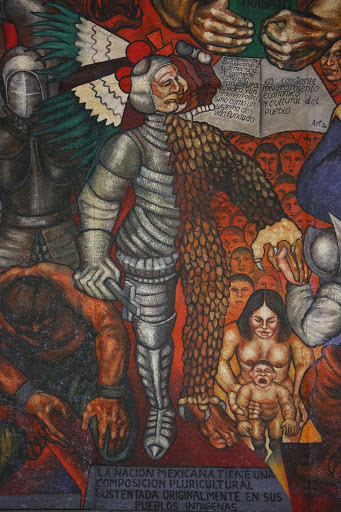 |
| A hybrid figure, half-Spanish conquistador Hernán Cortés, half-Aztec Eagle warrior, uniting enemies of the Conquest, has his hand kissed by Spanish soldier. (at right, in full mural, Catholic priest blesses this union and Spaniard's submission) An indigenous woman gives birth to a mestizo, mixed-race, child. This recalls Orozco's "Cortés and Malinche" in San Ildefonso and Rufino Tamayo's "Birth of Nationality" mural in Bellas Artes. Inscription: "The Mexican Nation has a pluricultural composition based originally in its indigenous peoples." |
But to the left, right and behind this vision of cultural, spiritual and political resolution, all is not well.
 |
| Justice is a robotic prostitute, backed by robotic, skinhead soldiers. We are reminded of Orozco's drunken justice in San Ildelfonso. Men in cowboy hats and sunglasses are, apparently, the new oil-rich. "Atoleoducto" combines "atole", traditional corn-based drink, with oil duct, representing what, in the late 1970s, was supposed to bring new wealth and well-being to Mexicans. Upper left: A street clown entertains to receive a few coins. We are reminded of the clowns and masked figures in Diego Rivera's "Carnaval de la vida mexicana" in Bellas Artes. Lower right: peasant farmer, in traditional white, and worker in blue pants, seem to struggle with each other. |
 |
| Bartolomé de las Casas was a Spaniard who first joined in the seizing of land and oppression of indigenous people in the first Spanish settlements in Hispaniola and Cuba in the early 16th century. An ordained priest, he was subsequently influenced by Dominicans who preached against such abuses. De las Casas had a change of heart. In 1515 he began to advocate for the abolition of encomiendas, Spanish land grants, the end to enslaving indigenous people; instead, gathering them into independent towns. He became a Dominican friar and wrote A Short Account of the Destruction of the Indies to try to influence Emperor Charles V to change Spanish treatment of indigenous people. He later became the first resident Bishop of Chiapas, and the first officially appointed "Protector of the Indians." Here, De las Casas reappears in modern time to try to intervene to protect the poor from the new "conquistadores," the World Bank (Banco Mundial) and its "enslavement by debt." |
 |
| Four Horsemen of the Apocalypse of the "New World Order" (global capitalism) attack the people. Curiously, Batmen are among other masked characters in the crowd that follows Aztec jaguar warriors trying to fight them off. |
 |
| A woman trys to protect a fallen worker, who is clawed and stabbed by a blind figure. The blindness of the act reminds us of the blind revolutionary in Orozco's "Revolutionary Trinity" in San Ildelfonso. Mexico, represented by a small girl in tennis shoes, weeps. The forward-thrusting perspective of the man echoes the figures of Orozco and Siqueiros in Bellas Artes. |
In the background of this epic struggle, representatives of the people of today express their protests.
 |
| In the center, a group raises its hands as if voting, while, behind, others protest. To the left, the contemporary "muralist"—graffiti or street artist with his spray paints—makes his visual statement. (We will see some of their work in a later post.) To the right: A youth appears to be blowing gasoline onto a hot object. Men at street intesections do this today to elicit a few pesos from those driving by. |
This mural was orginally placed in the new Merced Commercial Center in East Centro in 1997, during the city administration of Cuauhtémoc Cárdenas, son of President Lázaro Cárdenas (1934-40), who is viewed as having most fully implemented the aims of the Revolution. However, in that location, it was poorly cared for, so, in 2008, at the insistence of Otero Reyes, it was removed, restored and placed under the care of the Metro system in Xola station.
Another Mexican mystery. "¡La búsqueda sigue!" The search continues.
The Metro's website lists another Otero Reyes mural, also created for Merced, called "Monstruos de fin de mileno," "Monsters of the End of the Millenium," portraying what the muralist saw as the now universal struggle of the poor and powerless against the rich and powerful. The Metro´s website says it is in La Raza (The Race) station where Lines 3 and 5 cross, north of Centro. So recently, we went to seek it out. We could not find it in any of the station's corridors. When a Metro employee was shown a copy of the webpage containing a photo and description of the mural, he replied that he had never seen it and that it was not in the station.
Another Mexican mystery. "¡La búsqueda sigue!" The search continues.