Monday, December 14, 2015

Mexican Revolution and Mexican Muralists - Part VIII: José Clemente Orozco at the College of San Ildefonso - Continued

Continuing our encounter with the murals painted by José Clemente Orozco for the National Preparatory (High) School in the Antiguo Colegio de San Ildefonso, we climb to el primer piso, the first upper floor. After our confrontation in the stairway with the primal conflict of the Spanish Conquista of the indigenous, we are abruptly brought back across four hundred years to the pre-Revolutionary days of the early 20th century.

Those Above Versus Those Below

Here the theme of conquerors versus conquered is transformed into a more modern version, that of los de arriba vs. los de abajo, those above vs. those below.


Los aristócratas

The Aristocrats is in the same style of caricature as Orozco's Banquet of the Rich on the ground floor. His brush, it might be said, is even mightier than the pen. The postures and the faces say it all.


Note the blue and red hats.
We will see more of these colors

Beneath the feet of "these of the above", in a corner, almost invisible in the darkness, lies the object of their scorn, an apparent pile of grey rags.
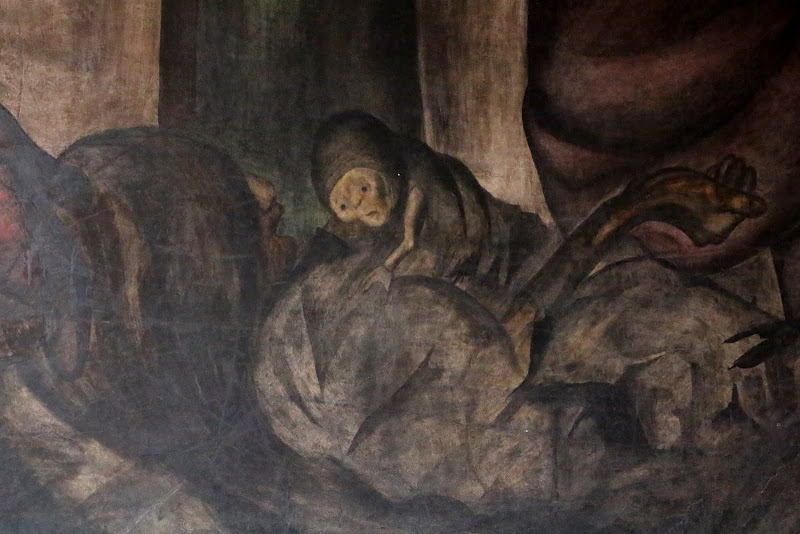


The almost shapeless form is a woman lying on her back, one hand upturned in classic begging posture, the other holding a skeletal, desperate baby.

The Law, Justice, God and Liberty

From this scathing portrayal, we move on to meet other murals in the same caricature style, but more symbolic in their content.

La ley y la justicia
The Law and Justice

A drunken Law and Justice dance. The scales that should impart fairness seem about to fall from Justice's hand. Her skirt is stained by a bloody hand print, possibly raised in a failed protest.


El juicio final
The Final Judgment

And next to terrestial Law and Justice, the Final Judgment. A cross-eyed Father God, looking annoyed and/or otherwise out of sorts, his World slipping from his hand, sits above the adoring bourgeoisie, with halos over their stovepipe hats and bonnets. 


And to God's left, devils pursue and hound the poor, who flee from the Lord's presence.


La libertad
Liberty

And just beyond, Liberty, wearing her Red Cap, hangs from the fly space of a theater, like a Deus ex machina meant to come to the rescue and break the bonds of servitude, but she is inept, toothless and semi-conscious at best. It is a sad comedy, a burlesque of the Revolution.


El acecho
The Stalker

Orozco's last charicature is an even more sardonic take on the Revolutionary rhetoric of Liberty and Justice for All. A rotund member of the bourgeois, identified by the watch fob over his vest and his fine shoes, disguises himself as a poor man, even a Christ figure with his crown of thorns. He holds out the promise of the Red Cap of Liberty to the poor worker, who, himself has an almost simian face. Behind the distracted worker, el acecho, the stalker is poised to stab the laborer to death.

One recalls Orozco's words about the Revolution,
"Buffoons and dwarfs, trailing along after the gentleman with the noose and dagger, in conference with smiling procuresses."
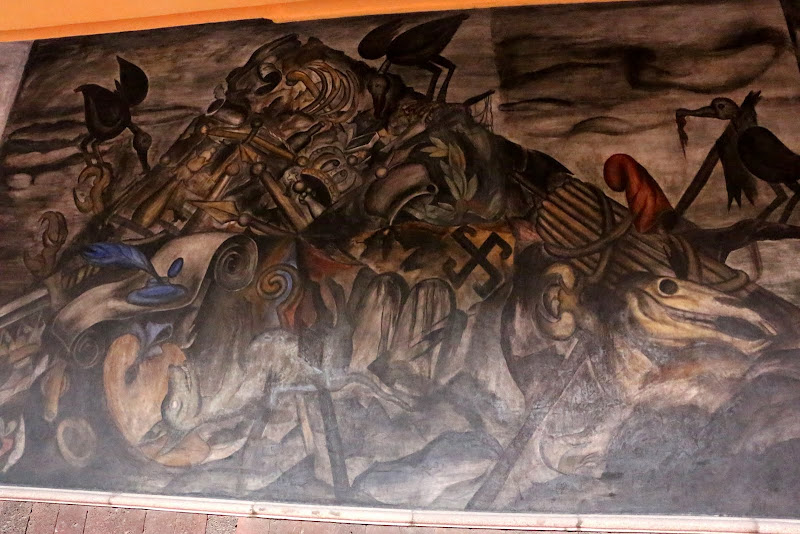

Basura social
Social Garbage
Note: Liberty cap

Then Orozco hits us with a symbolic ton of bricks, his words in images:
"The world was torn apart around us. Troop convoys passed through on their way to slaughter. Trains were blown up. Wretched Zapatista peasants who had fallen prisoner were summarily shot down. People grew used to killing, to the most pitiless egotism, to the glutting of sensibilities, to naked bestiality." 
Painted in 1926, Orozco presciently places the Nazi swastika near the center. The National Socialist Party had been founded in Germany in 1920.

Included in the pile are other symbols of power: the Sacred Heart of Jesus, a bishop's crosier, a king's crown, the Mosaic tablets, an olive wreath, an Aztec eagle warrior, the Roman fasces, bundle of sticks, which became the symbol of Italian Facism after World War I, the skull of a horse.

In this dismal landscape only two points of color survive, the blue feather pen of the written law and the ubiquitous Red Cap of Liberty. Three crows feed on the refuse: the one on the left perched on the claw of a dead eagle, the symbol of Mexico, buried under it all.

We wonder how Orozco could have gotten away with painting such a devastating, damning portrait of the Revolution, together with his sardonic burlesquing caricatures, in the government's own National Preparatory School, where the future leaders of the post-Revolutionary regime were to be formed. With that question, and wondering what more Orozco could have in store, we climb to the topmost floor.

Of Revolution and Humanity, Earth and Sky


La familia
The Family

Here we meet a quieter, more realistic, but subtly moving set of images of the Revolution. The Mexican family—all in Orozco's favoite "colorless" greys and tans—sits close together, subdued, stoic. One woman cares for an ill or exhausted but substantial man, while a second cradles a newborn, everyday embodiments of the iconic Virgin of Guadalupe and the Virgin Mary. A couple, faces invisible to the viewer, hence anonymous yet universal, embrace and look toward an unfinished pyramid-like edifice. Beyond is a stunning, impossibly intense, cobalt blue sky.

We have seen this blue before, here in San Ildefonso. First, in the firmament of Diego Rivera's Creation, then, in Orozco's disturbing Revolutionary Trinity, on the ground floor, and in a less saturated mode, as the backdrop for his burlesque theater version of Heaven on the floor just below us. In the series of murals here on the top floor, this blue becomes the counterpoint to the earthly, subdued, human, painful realities of the Revolution.


La despedida
The Farewell

Son bids farewell to mother, husband to wife, as they depart for the war. Here the blue, painted on a wall, is only a pale echo of the sky.


La bendición
The Blessing

Another son receives the blessing of his old mother. The plows that are his work and that he is also leaving behind, sit inactive. The sky conveys a pure, infinite force of nature.


Trabajadores
Workers

Laborers begin to leave their tools, and their women. Behind a red wall, the azure sky.


Los revolucionarios
The Revolutionaries

Here we meet another Revolutionary trinity, but a realistic one—weighed down by their arms, the loss of what they are leaving behind and their possible future. Two women—one with a baby in her rebozo, the other carrying some load—accompany them. Here there is no blue sky.


Las mujeres
The women

The women left behind, one with a baby, one crying. The plows sit, unemployed. But there is that impossibly blue sky.


El sepulturero
The gravedigger

What simpler image could there be of the inevitable outcome of war, of violence, than a gravedigger. His preparatory work evidently done, he sleeps while awaiting the culminating act of burial. But the sky is blue.


La familia
The Family


Feeling sobered, as subdued as the paintings, we return to gaze again at The Family. Stoic, solid, bonded, comforting one another in the midst of life's challenges, losses and hopes. And the sky is so blue.

Once again in our tour of San Ildefonso, we feel how far we are—how far Orozco has brought us—from Rivera's idealized Ballad of the Revolution, painted at virtually the same time on a similar top floor, around a similar patio of a similar former colonial building just two blocks away. Two visions of a Revolution, but worlds apart.

See more on the Mexican Revolution and Mexican Muralists
Part I: Bellas Artes 
Part II: The Academy of San Carlos and Dr. Atl 
Part III: Secretariat of Education, José Vasconcelos and Diego Rivera 
Part IV: Secretariat of Education and Diego Rivera's Vision of Mexican Traditions 
Part V:  Secretariat of Education and Diego Rivera's Ballad of the Revolution 
Part VI: Diego Rivera at the College of San Ildefonso 
Part VII: José Clemente Orozco Comes to San Ildefonso 
Part VIII: College of San Ildefonso and José Clemente Orozco - Continued 
Part IX: David Siqueiros, Painter and Revolutionary 
Part X: David Siqueiros Cultural Polyforum 
Part XI: The Abelardo Rodríguez Market 
For the story of the Mexican Revoluion, see: Mexican Revolution: Its Protagonists and Antagonists 

Mexican Revolution and Mexican Muralists - Part VII: José Clemente Orozco Comes to San Ildefonso

José Clemente Orozco,
by David Siqueiros,
Siqueiros Cultural Polyforum,
Delegación Benito Juárez,
Mexico City

Secretary of Public Education José Vasconcelos had put Rivera to work creating murals in the Secretariat of Education, so he hired artist José Clemente Orozco (1883-1949) to add more murals in the Preparatory School. Orozco was forty years old.


Born in the western state of Jalisco, his family had moved to Mexico City in 1890, when he was seven. He was enrolled in the elementary school of the Teachers College in the Centro Histórico. On his way to school, Orozco recounts in his Autobiography, he would pass the printing shop where José Guadalupe Posada (February 2, 1852 – January 20, 1913) worked as an engraver, illustrating books and newspaper stories.


José Guadalupe Posada,
by David Siqueiros,
Siqueiros Cultural Polyforum,
Delegación Benito Juárez,
Mexico City

Orozco was fascinated. He felt
"impelled to cover paper with my earliest figures; this was my awakening to the art of painting."
At some point while still attending elementary school, he enrolled in evening classes at the San Carlos Academy of Fine Arts. Diego Rivera, who was three years younger, also started studying at the Academy in 1896, at age 10.

In 1897, at age fourteen, Orozco's father sent him to the San Jacinto School of Agriculture, just outside the city. Completing the three-year course, in 1900 Orozco enrolled in the National Preparatory School, planning to study architecture. But his passion for painting overtook him and he left to enroll in San Carlos. His father had died, so he supported himself working as a draftsman for architects and newpapers.

In 1911, when Francisco Madero and others had overthrown Porfirio Díaz, Orozco, now twenty-eight, got work through a journalist friend as a cartoonist with an opposition newpaper. As for taking sides in the Revolution, Orozco wrote later in his Autobiography:
"I might equally well have gone to work for a government paper instead of the opposition. No artist has, or ever has had, political convictions of any sort. Those who profess to have them are not artists."
He joined the student strike at the Academy, seeking to throw out the director and the Neoclassic curriculum. When Alfredo Ramos Martínez became director of the re-opened Academy and led students to paint plein air, in the open air, at a house he rented in the then rural village of Santa Anita Ixtapalapa (now part of the Mexico City borough of that name), Orozco initially went along. But he soon found the focus on French Impressionism too precious for his taste. Instead of their
"pretty landscapes with the requisite violets and Nile greens, I preferred black and the colors exiled from Impressionist palettes. I painted the pestilent shadows of closed rooms, and instead of the Indian male, drunken ladies and gentlemen."
He left and rented his own studio in thc City Center.

By his own account, he took no part in the various phases of the Revolution, despite U.S. newspaper accounts to the contrary. He felt Madero's presidency was "a half revolution, sheer confusion and senseless." Huerta was
"no doubt a monster, but no different from others who fill the pages of history."
After Huerta's defeat in October of 1914, the forces of Villa and Zapata on one side and Carranza on the other failed to agree on a new government at the Convention of Aguascalientes. Pancho Villa and Emiliano Zapata then directed their armies at Carranza's. In November, Carranza retreated to the state of Veracruz. Dr. Atl, the students' mentor at the Academy, convinced many of them to join him and Carranza. Orozco went with him to the city of Orizaba, helped set up printing presses and drew political cartoons against Villa and Zapata. And witnessed the horrors of war:
"The world was torn apart around us. Troop convoys passed through on their way to slaughter. Trains were blown up. Wretched Zapatista peasants who had fallen prisoner were summarily shot down. People grew used to killing, to the most pitiless egotism, to the glutting of sensibilities, to naked bestiality.
"In the world of politics, it was the same, war without quarter, struggle for power and wealth. Factions and subfactions were past counting; the thirst for vengeance insatiable. And underneath it all, subterranean intrigues went on between the friends of today and the enemies of tomorrow, resolved, when the time came, upon mutual extermination. Farce, drama, barbarity. Buffoons and dwarfs, trailing along after the gentleman of the noose and dagger, in conference with smiling procuresses."
In 1917, after Carranza had defeated Villa and Zapata and become president, and some stability returned to Mexico, Orozco, now thirty-four, seeing no future for himself in Mexico, left for the United States. Carrying some of his rolled-up paintings with him, he was inspected by U.S. Customs Officials at the border in Laredo, Texas. They destroyed sixty of his paintings because they were seen as "immoral," even though, Orozco comments, "there were no nudes."

Orozco went on to San Francisco, where acquaintances took him in and he survived with small painting and printing jobs. He later moved on to New York City, where he loved Harlem and Coney Island.

In 1922, seeing that "the table was set for mural painting," Orozco returned to Mexico. In 1923, he was hired by José Vasconcelos to paint murals in the National Preparatory School, the former Jesuit Colegio de San Ildefonso.


Inner patio of San Ildefonso
Some of Orozco's murals
can be glimpsed in the passageway on the right
Photo: Rebecca Brundage Clarkin

Orozco's first painting seems to be a continuation of both the classic imagery and idealized, hopeful theme of Rivera's Creation.


Maternidad
Maternity

Maternidad is an ethereal, semi-modern reworking of a Renaissance or even Baroque-style portrayal of a Madona and her child, now blond and naked, surrounded by hovering angelic figures. Striking both in its idealization and boldness, it is at the same time strange, as if from the Art Nouveau end of the 19th century rather than the third decade of the 20th. This and other murals Orozco painted in the Preparatory School at the time were strongly criticized, including by Catholics who saw them as blasphemous. Orozco responded by destroying all but this mural and quitting the job.

An Artistic Revolution in Style and Vision

At the end of 1924, Plutarco Elías Calles became president and announced several populist projects to fulfill the Revolutionary desires of peasant farmers for land and urban laborers for the workers' rights that had been incorporated into the Constitution of 1917. Orozco decided to return to San Ildefonso in 1926 and began painting again, restoring some of his destroyed murals, but now he worked in a starkly modern style, presenting a startling perspective on the events that, a decade before, had devastated the country.

Next to Maternidad he painted a series of murals on the Mexican Revolution very different from the optimistic, idealized ones Rivera was realizing nearby in the Secretariat of Education. In them, Orozco gave visual life to his autobiographical observations on the brutality and senselessness of the Revolution.


La Trinchera
The Trench

The vital, velvet rich reds and warm golds of Maternidad are replaced with somber greys, tans and black and a touch of blood red in the background, the colors that he has told us he loved. We are confronted with three revolutionary soldiers falling in battle. Two topple, arms extended as if crucified, against hard, harsh rock. The third doubles over on his knees, covering his eyes from the scene.  The contrast with Rivera's heroic Trinchera, in his Ballad of the Revolution, could not be more striking.


Diego Rivera's En la Trinchera
Secretariat of Public Education

Further along the colonnade of the planta baja, the ground floor, we encounter a more symbolic but almost as disturbing image of the Revolution.

La trinidad revolucionaria
The Revolutionary Trinity

This very non-Christian Trinity is composed of a central figure holding a rifle but blinded by the Red Cap of Liberty that had been the symbol of the French Revolution. The left-hand figure covers his eyes, similar to the third figure in La Trinchera. The right-hand figure has had his hands cut off. Behind him is a small, paradoxical slice of the azure Mexican sky.

Alongside this critical, to say the least, even sardonic and despondent view of the Revolution, Orozco places his view of the bourgeois upper-class.


El banquete de los ricos
Banquet of the Rich

Here Orozco is much more in synch with Rivera's view of wealthy capitalists.


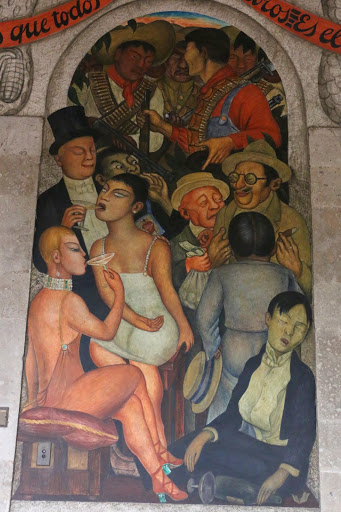
La Orgia-La Noche de los Ricos
The Orgy-The Night of the Rich
Diego Rivera
Secretariat of Education

However, the style of Rivera's "Orgy" and the figures within it seem tame, aloof, stilted compared to Orozco's over-the-top painting style and his corpulent, drunken, contemptuous diners.

With this stark introduction to both sides of the early 20th century's economic and political divides, we start up the stairs to the two upper floors, wondering what more Orozco has in store for us.

Up the Stairs and Backward in Time

Reaching the landing halfway up to el primer piso, the first upper floor, we turn to continue ascending, but become aware of a powerful presence looming over our head.


Cortés y Malinche

Hernán Cortés, the Conquistador, and Malinche, the indigenous Nahua woman given to him by her Maya master as a peace offering and who became his translator, sit naked and rigidly upright above us. Cortés stares into the distance, as if his mind is on other things, other places. Malinche drops her gaze. While they hold right hands, Cortés uses his left to block Malinche from moving forward. Below them, outside this photo (it was too dark to capture), lies the small, naked body of an indigenous man or youth, face down. Cortés´ right foot rests on the person's legs. His left foot is held poised in the air, as if about to stomp on the prostrate figure.

Artistically and emotionally, it is the simplest, most unadorned and powerful representation we have seen of the contrasts, clash, devastation and synthesis that was the Spanish Conquest of what is today called Mexico.

On the side walls leading up the stairs, Orozco continues with this potent, truly shocking theme.


Los Franciscanos
The Franciscans

It was Cortés himself who, after his defeat of the Aztecs and demolition of their capital, Tenochtitlán, petitioned the young King Charles I, who was also Holy Roman Emperor Charles V, to send friars, members of religious orders, monks, not priests of the regular "secular" church, i.e. the church in the everyday world, to evangelize the indigenous peoples of the lands he was now subduing. Charles sent Franciscans. (See our post: The Spiritual Conquest: The Franciscans - Where It All Began.)

They arrived barefoot and dressed in near rags, manifesting their vows of humility and poverty. While they strove to convert the "heathen", saving them from their violent "pagan" gods, they also became known for seeking to defend them from the worst depredations of the conquistadores and peninsulares, members of the Spanish ruling class who came to manage the new realm and extract its natural wealth using indigenous labor.   


Sobered by this confrontation with Mexico's roots exposed, we continue up the stairs, wondering even more how Orozco will unsettle us with the range and power both of his themes and his technique.


See more on the Mexican Revolution and Mexican Muralists
Part I: Bellas Artes 
Part II: The Academy of San Carlos and Dr. Atl 
Part III: Secretariat of Education, José Vasconcelos and Diego Rivera 
Part IV: Secretariat of Education and Diego Rivera's Vision of Mexican Traditions 
Part V:  Secretariat of Education and Diego Rivera's Ballad of the Revolution 
Part VI: Diego Rivera at the College of San Ildefonso 
Part VIII: College of San Ildefonso and José Clemente Orozco - Continued 
Part IX: David Siqueiros, Painter and Revolutionary 
Part X: David Siqueiros Cultural Polyforum
Part XI: The Abelardo Rodríguez Market 
For the background of the Mexican Revoluion, see: Mexican Revolution: Its Protagonists and Antagonists 

Saturday, November 14, 2015

Mexican Revolution and Mexican Muralists - Part VI: Diego Rivera at the College of San Ildefonso

Jesuit College of San Ildefonso

Just around the corner and down the street from the Secretariat of Public Education is another building central to the history of both education and art in Mexico. The Jesuit College (School) of San Ildefonso was founded in 1583 by combining three other Catholic colleges or schools.

During the early decades of the eighteenth century the building was renovated, resulting in the edifice that stands today as one of the most outstanding examples of Spanish Baroque architecture in Mexico City.


Antiguo Colegio de San Ildefonso
on Calle Justo Sierra
Centro Historico

After the Jesuits were expelled by decree of King Carlos III in 1767, the building was "repurposed", as we moderns would say, as headquarters of a battalion of the Regiment of Flanders, a school administered by the colonial government, temporary headquarters for the School of Jurisprudence and some departments of the School of Medicine.

In 1847, at the end of the Mexican American War, the building served as the headquarters for the occupying U.S. Army and, from 1863 to 1867, it fulfilled the same purpose for French troops during the French Intervention.


Central Patio
Murals by Jose Clemente Orozco visible in right hand portal
Photo: Rebecca Brundage Clarkin

Benito Juárez Reforms Establish National Preparatory School

In 1867, the government of Benito Juárez launched an education reform replacing the schools controlled by the Catholic Church with secular, public education. As part of the Organic Law of Education, the National Preparatory (High) School was created and lodged in the former College of San Ildefonso. In 1910, just before the outbreak of the Mexican Revolution, the School became part of the National University (UNAM) founded by Justo Sierra. The School continued to occupy the building until it was moved to new quarters in 1978.

The building remained closed until 1992, when it was restored to house the exhibition 'Mexico, Splendors of 30 Centuries' to mark the 500th anniversary of the arrival of Columbus. Since then, the Antiguo Colegio de San Ildefonso has functioned as a museum managed by a team from the National Autonomous University of Mexico, the National Council for Culture and Arts and Mexico City. It hosts temporary exhibits, often of international art. An exhibit of Islamic Art was the most recent.

The Mexican Revolution, José Vasconcelos, Diego Rivera and José Clemente Orozco

After the Mexican Revolution, in 1920, José Vasconcelos was appointed head of the National University, which included overseeing the National Preparatory School. A year later, President Álvaro Obregón appointed him head of the new Secretariat of Public Education, which was intended to fulfill Benito Juárez's vision of secular education for all.

As part of his project to create representations of a post-Revolutionary Mexican identity, Vasconcelos decided to have murals painted in the National Preparatory School, as well as in the new Secretariat of Education, two blocks away. The first mural in the Preparatory School was created in 1922 by Diego Rivera, who had just returned from Europe at Vasconcelos's request to undertake his mural project.

La Creación
The Creation

The Creation is Rivera's tour de force attempt to realize Vasconcelos' vision: the synthesis of Classical European and indigenous Mexican cultures. His materials and techniques reflect his intent—creating his paints, for example, by using copal, a native Mexican pine resin, and beeswax mixed with local pigments. The esthetic style is reminiscent of European medieval paintings, with its static figures, including groups with halos in the background, and angel-like figures suspended on wing-like clouds. 
A nude couple, the Adam and Eve of the new mestizaje, mixed race, culture envisioned by Vasconcelos, sit, observing at each side. At the right, the new Adam gazes at female figures representing indigenous culture: legends, practical knowledge, poetry, tradition and, curiously, tragedy, represented by a person holding a classic Greek theater mask. Behind and above are representations of the Classic virtues of Prudence, Justice, Strength and Self-restraint.

At the left are the Performing Arts: music, represented by a Greek Panpipe, song, dance and comedy. Behind are the Biblical virtues of Charity (Love), Hope and Faith. The angels represent wisdom and science. All of the figures are portraits of contemporary Mexican women, many performing artists or favorite painters' models.

Within the central arch rises the New Man, offspring of this New Creation. We have already seen a later version of this same figure in Rivera's 1934 mural El Hombre En El Cruce de Caminos (Man at the Crossroads) in Bellas Artes.

Above all these ancient and new-born creatures shines a medieval-style representation of the blue firmament of the heavens, divided into the four cardinal directions that are archetypical in all primary cultures. We will see this intense azure sky again here in San Ildefonso.

Recalling the murals in Porfirio Díaz's Palace of Communications, we think the old promoter of Order and Progress might be quite pleased with the Classic foundation and optimistic content of Rivera's work, if not with its revolutionary message. He might even have been pleased with its Art Nouveau style.


Progress Bestows Her Blessings,
Ceiling mural in the Reception Hall
Palace of Communications
now National Museum of Art

In fact, there is a Porfirian context for this continuity right here in the Preparatory School:


"Order and Progress"
Porfirian motto from the late 19th century over a doorway at the Preparatory School


Bienvenida (Latin: Salve)
Welcome
1899
Stained glass window at top of stairs

José Clemente Orozco Comes to San Ildefonso

Vasconcelos then put Rivera to work creating murals in the Secretariat of Education, so he hired the artist José Clemente Orozco (1883-1949) to add more murals at the Preparatory School. Orozco was forty years old. He was to bring a very different style of painting and a very different view of the Mexican Revolution to the walls of the School.

Monday, November 2, 2015

Mexican Revolution and Mexican Muralists - Part V: Diego Rivera's Ballad of the Revolution in the Secretariat of Education

Ascending from the planta baja, the ground floor of the Secretariat of Public Education, we leave behind Diego Rivera's reverential homage to Mexican laborers and cultural traditions and their more or less indirect references to the Mexican Revolution. Arriving at el segundo piso, the second and top floor, we come face to face with El Corrido de la Revolución, 'The Ballad of the Revolution', a set of murals that form an unequivocal visual paean to the Mexican Revolution, at least as imagined by Rivera.

Curiously, it begins not at the top of the stairs, but in a corner of the Patio of Labor.


Cantando El Corrido de la Revolución
Singing the Ballad of the Revolution

A balladeer, accompanied by a guitarist, shares with el pueblo, the common or ordinary people, the story of the Revolution, or better, a vision of the Revolution, its heroes and its villains. The words of their ballad are inscribed on a red banner that runs above the series of murals.


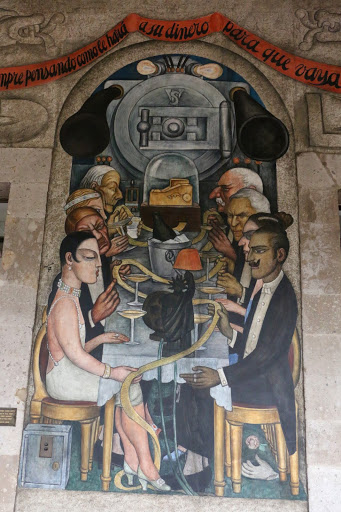
Banquete de Wall Street
Note the Statue of Liberty lamp
The banner overhead says,
"They are always thinking of their money."


Using his style of caricature painting which we saw in his Bellas Artes murals, Rivera portrays the self-satisfied, self-centered bourgeois capitalist class, and his contempt for them.


Los Sabios
The Wise Ones

Rivera's disdain extends to the apparent "thinkers" of capitalism. Why he puts a Confucius-like figure in the center remains a mystery. And here, in the background, watching and waiting, are the worker-soldiers of the Revolution and a campesino, peasant farmer, with the wheat that is the source of food for all.


La Orgia-La Noche de los Ricos
The Orgy-The Night of the Rich


In The Orgy, Rivera goes all out in portraying the debauchery and dissipation of the wealthy. Again, the soldiers of the imminent Revolution loom in the background.


La Cena del Capitalista
The Capitalist's Supper


The Capitalist's Supper carries a message of Revolutionary justice and revenge. The family that once enjoyed banquets is left with little to eat, while the Revolutionary soldiers, the workers of the land and the factories, hold a cornucopia of the bread and fruits that are the results of their labor.

It is interesting that one soldier appears to be African and the other Chinese. When Rivera was painting these murals, in 1927 and 1928, was the very moment that the Chinese Civil War was beginning between the Chinese Communist Party, led by Mao Zedong and the Nationalists led by Chiang Kai-shek


El Sueño-La Noche de los Pobres
The Dream-the Night of the Poor

Meanwhile, the poor have but one dream: to obtain work by which they can feed themselves and their children.


The Union
"Union is the holy force"

The call to Revolution is a call to Unity, between worker and peasant, as we saw in The Embrace downstairs, but also between the indigenous and the urban middle class. There will be bread for all.

The Revolution Arrives


Worker and farmer threw off the yoke that they suffered
and burned the malignant vice of the bourgeois oppressor

The ballad continues with the eruption of armed rebellion.


El Arsenal
The Arsenal
Frida Kahlo, with her inimitable eyebrows, 

wearing the red shirt and star of Communism,
distributes weapons.

Frida Kahlo met Diego Rivera in 1927 when she came to where he was working on the murals of the Secretariat of Public Education. She was twenty and only partially recovered from a near-fatal bus accident two years earlier that was to leave her partially crippled for life. Rivera was forty. They were married two years later. In The Arsenal, Rivera places the young Kahlo at the center of his revolutionary vision.

What is portrayed is clearly not the Mexican Revolution that took place between 1910 and 1917. Kahlo was only ten at the time that ended. And there was no Communist Party in Mexico until 1919. We are seeing here Rivera's dream of a future rebellion modeled after the Revolution in Russia.


Diego Rivera looks on
Wearing the Red Star of Communism

When Rivera painted this Communist Revolution, the Mexican Communist Party was outlawed. How he managed to paint such an explicit Communist message on the top floor of José Vasconcelos's Secretariat of Public Education is another mystery.


En La Trinchera
In the Trenches


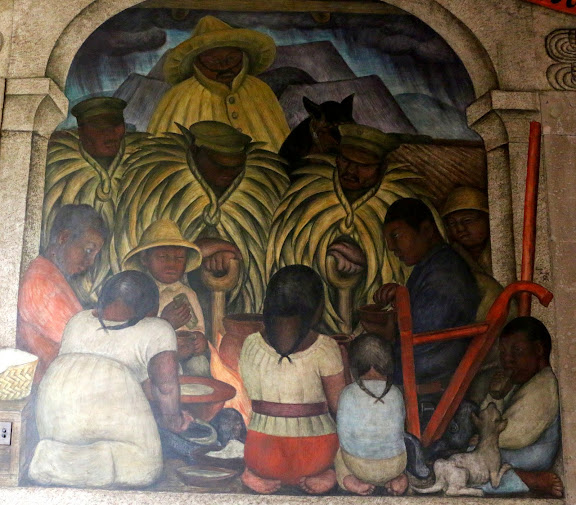
La Lluvia
The Rain

Soldiers wearing capes made of plant fronds
take shelter with an indigenous camepsino family

Messages of Revolution


El Que Quiere Comer Que Trabaje
He Who Wants to Eat Has to Work
"Lazybones: He that wants to eat has to work"


Interestingly, a fine artist painter/musician is pushed to the floor 
by a soldier in his blue work overalls.
Rivera saw the vocation of art to be serving the common people.


Garantias, Desechos del Capitalismo
Rights, the Garbage of Capitalism

At the top, a wealthy priest is hit with a worker's hammer as he exits his money safe,
while a peasant uses his sickle to cut off the head of another capitalist.


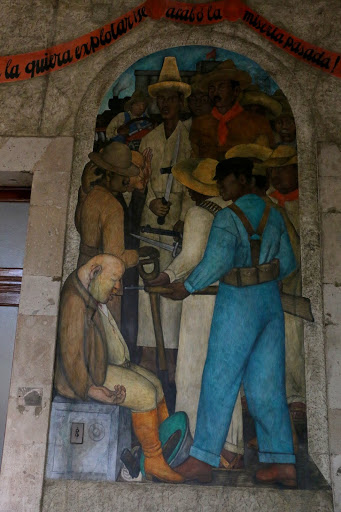
La Muerte del Capitalista
The Death of the Capítalist
"Whoever wants to exploit, the misery of the past is finished"


Un Solo Frente
A Single Front
"...they made a single front"

Note: The unifier is a "güero", 
a blond, light-skinned Russian Communist


La Cooperativa
factories "managed in cooperatives, without bosses"

Fruits of Revolution

El Pan Nuestro
Our Bread
"...bread for all the naked..."

and all the fruits of labor.


Alfabetización-Aprendiendo a Leer
Literacy-Learning to Read


Los Frutos de la Tierra
The Fruits of the Earth,

including knowledge, are shared

Coda

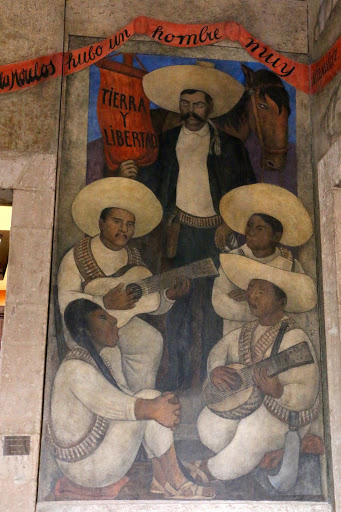
Emiliano Zapata
"In Morelos there was a very singular man."
Land and Liberty

The Ballad of the Revolution ends in the corner of the Patio of Labor, next to where its telling began. There stands Emiliano Zapata while musician-warriors sing his story:
"In Morelos there was a very singular man."
We are not told the words of their ballad. As for what actually happened with Zapata, see the Mexican Revolution link below.