In June of 2010, already living in Mexico, we joined a delegation of U.S. citizens sponsored by the NGO Witness for Peace traveling to Oaxaca in southern Mexico. The objective was to learn from leaders of migrant support organizations and migrants themselves about the economic dynamics pushing the migration and the challenges faced by migrants to the U.S. from that state and those who passed through there from Central America. We traveled to the Isthmus of Tehuantepec, a narrow, relatively flat region at Oaxaca's southern border with Chiapas — the narrow end of the funnel that migrants from Central America had to pass through to cross Mexico and try to reach the U.S.
Our host in the town of Matías Romero was a Catholic Church which sponsored a shelter for these migrants who passed through on "The Beast", a freight train that traversed the Isthmus. We were the guests of honor, placed in the front pews at a Sunday morning Mass. During the Mass, a group of preadolescent girls and boys, dressed in the traditional clothing of the Isthmus, acted out a New Testament parable of the rich helping the poor. They then performed a traditional dance.
When the dance was finished, they approached each of us in the delegation and gave us several small gifts of local, indigenous artisanry. This gesture of hospitality and good will towards "Americans" brought me to tears, for I was well aware of our country's government's hostility toward Mexican and Central American migrants and also of the severe damage that our "war against drugs" was doing to people of the country. Seeing my tears, the youth gathered around me and gave me abrazos, hugs, of comfort. That touched me even more.
One of the gifts given to us were bandanas, also called paliacates or pañoletas (from pañuelo, handkerchief). They were bright reds and oranges, covered with a design I knew as paisley. I wondered, at the time, how bandanas from southern Mexico came to bear a design I had always assumed came from Asia. I valued them as a touching gift, but having no use for them, kept them in a drawer at home. Recently, Jane and I were looking for small gifts from Mexico to take to our two grandchildren, Caroline and William, in Chicago. The bandanas or kerchiefs struck me as perfect for this purpose.
In the process, the question of how an Asian design ended up on a Mexican bandana came back to my mind. So I began to research the history of what I knew as paisley. I knew it from paisley ties, which I loved in the 1970s. The short answer is that the pattern came originally from Persia where it appeared before the 6th century.
The shawls' next champion was Akbar the Great, the third Mogul ruler of India (reigned 1556–1605), who made the shawls central to the Kashmiri practice of khil’at, “robes of honor”, ceremonially exchanged in political and religious contexts to establish a clear pecking order. Being on the receiving end made one indebted to, and therefore submissive to the giver.
Shawls given as khil’at were decorated with all sorts of patterns, but some scholars speculate that the paisley motif came to predominate because it resembled the jigha, a crown jewel pinned to the ruler's turban. The shape is called “boteh" in Persian, "buta" (bud) in Hindu and is variously seen as representing buds on a date palm, traditionally, the "Tree of Life", associated with fertility in general, including human sexual potency, or as the convergence of a stylized floral spray and a cypress tree: a Zoroastrian symbol of life and eternity.
The shawls became popular in Europe when trade by the British East India Company with India developed in the 16th century. Handwoven of cashmere wool, they were prohibitively expensive. Upper-class European women adopted these precious imported shawls as a fashion statement. A town named Paisley in Scotland adapted the Jacquard loom (invented in 1804 by Frenchman Joseph Marie Jaquard), one that used sets of punched cards to produce predesigned patterns (a predecessor of computers) and therefore replaced handlooms, thus enabling mass production. Thus, it became the center of shawl manufacturing in England and the source of its English name. In Spanish, the pattern is called cachemir(a) (cah-che-mír), i.e., from Kashmir.
Along with English and French, well-to-do Spanish women adopted these cachemir shawls for wearing to church in the 18th century. Evidently, some of these women brought them to Mexico.
In the meantime, a much cheaper version of the pattern printed on cotton became available, so any woman could wear paisley or cachemir. How it became the preferred if not the requisite pattern on Mexican campesino bandanas remains unknown. One possible link appears in a photo of the Mexican Revolutionary leader, Pancho Villa, himself from the peón, campesino class.
Our host in the town of Matías Romero was a Catholic Church which sponsored a shelter for these migrants who passed through on "The Beast", a freight train that traversed the Isthmus. We were the guests of honor, placed in the front pews at a Sunday morning Mass. During the Mass, a group of preadolescent girls and boys, dressed in the traditional clothing of the Isthmus, acted out a New Testament parable of the rich helping the poor. They then performed a traditional dance.
When the dance was finished, they approached each of us in the delegation and gave us several small gifts of local, indigenous artisanry. This gesture of hospitality and good will towards "Americans" brought me to tears, for I was well aware of our country's government's hostility toward Mexican and Central American migrants and also of the severe damage that our "war against drugs" was doing to people of the country. Seeing my tears, the youth gathered around me and gave me abrazos, hugs, of comfort. That touched me even more.
One of the gifts given to us were bandanas, also called paliacates or pañoletas (from pañuelo, handkerchief). They were bright reds and oranges, covered with a design I knew as paisley. I wondered, at the time, how bandanas from southern Mexico came to bear a design I had always assumed came from Asia. I valued them as a touching gift, but having no use for them, kept them in a drawer at home. Recently, Jane and I were looking for small gifts from Mexico to take to our two grandchildren, Caroline and William, in Chicago. The bandanas or kerchiefs struck me as perfect for this purpose.
In the process, the question of how an Asian design ended up on a Mexican bandana came back to my mind. So I began to research the history of what I knew as paisley. I knew it from paisley ties, which I loved in the 1970s. The short answer is that the pattern came originally from Persia where it appeared before the 6th century.
The pattern was brought to the Indian province of Kashmir in the 15th century by Zain-ul-Abidin, who ruled Kashmir from 1459 to 1470. There the shawls (shal in Hindu) were handwoven out of cashmere wool, the finest of wool that came from the belly of wild sheep in the Himalayas. Grown in the winter, in the summer the animals scraped it off against rocks, where weavers collected it. It could take a year for one weaver to complete a shawl. Sometimes multiple weavers worked on sections of a shawl, which were then deftly sewn together, thus decreasing production time and increasing quantity (and profit).The following history comes from the article, "A History of Paisley", Slate magazine, Oct. 20, 2015, excerpted from Patternalia: An Unconventional History of Polka Dots, Stripes, Plaid, Camouflage, & Other Graphic Patterns by Jude Stewart, published by Bloomsbury Press.
The shawls' next champion was Akbar the Great, the third Mogul ruler of India (reigned 1556–1605), who made the shawls central to the Kashmiri practice of khil’at, “robes of honor”, ceremonially exchanged in political and religious contexts to establish a clear pecking order. Being on the receiving end made one indebted to, and therefore submissive to the giver.
 |
| Akbar the Great Note the "paisley" teardrop set ruby, called the jigha in Hindu, on his royal turban. Wikipedia |
Shawls given as khil’at were decorated with all sorts of patterns, but some scholars speculate that the paisley motif came to predominate because it resembled the jigha, a crown jewel pinned to the ruler's turban. The shape is called “boteh" in Persian, "buta" (bud) in Hindu and is variously seen as representing buds on a date palm, traditionally, the "Tree of Life", associated with fertility in general, including human sexual potency, or as the convergence of a stylized floral spray and a cypress tree: a Zoroastrian symbol of life and eternity.
The shawls became popular in Europe when trade by the British East India Company with India developed in the 16th century. Handwoven of cashmere wool, they were prohibitively expensive. Upper-class European women adopted these precious imported shawls as a fashion statement. A town named Paisley in Scotland adapted the Jacquard loom (invented in 1804 by Frenchman Joseph Marie Jaquard), one that used sets of punched cards to produce predesigned patterns (a predecessor of computers) and therefore replaced handlooms, thus enabling mass production. Thus, it became the center of shawl manufacturing in England and the source of its English name. In Spanish, the pattern is called cachemir(a) (cah-che-mír), i.e., from Kashmir.
Along with English and French, well-to-do Spanish women adopted these cachemir shawls for wearing to church in the 18th century. Evidently, some of these women brought them to Mexico.
In the meantime, a much cheaper version of the pattern printed on cotton became available, so any woman could wear paisley or cachemir. How it became the preferred if not the requisite pattern on Mexican campesino bandanas remains unknown. One possible link appears in a photo of the Mexican Revolutionary leader, Pancho Villa, himself from the peón, campesino class.
 |
| Mexican Revolutionary leader Pancho Villa wearing a patterned bandanna, possibly in a cachemir (paisley) pattern. Wikipedia |
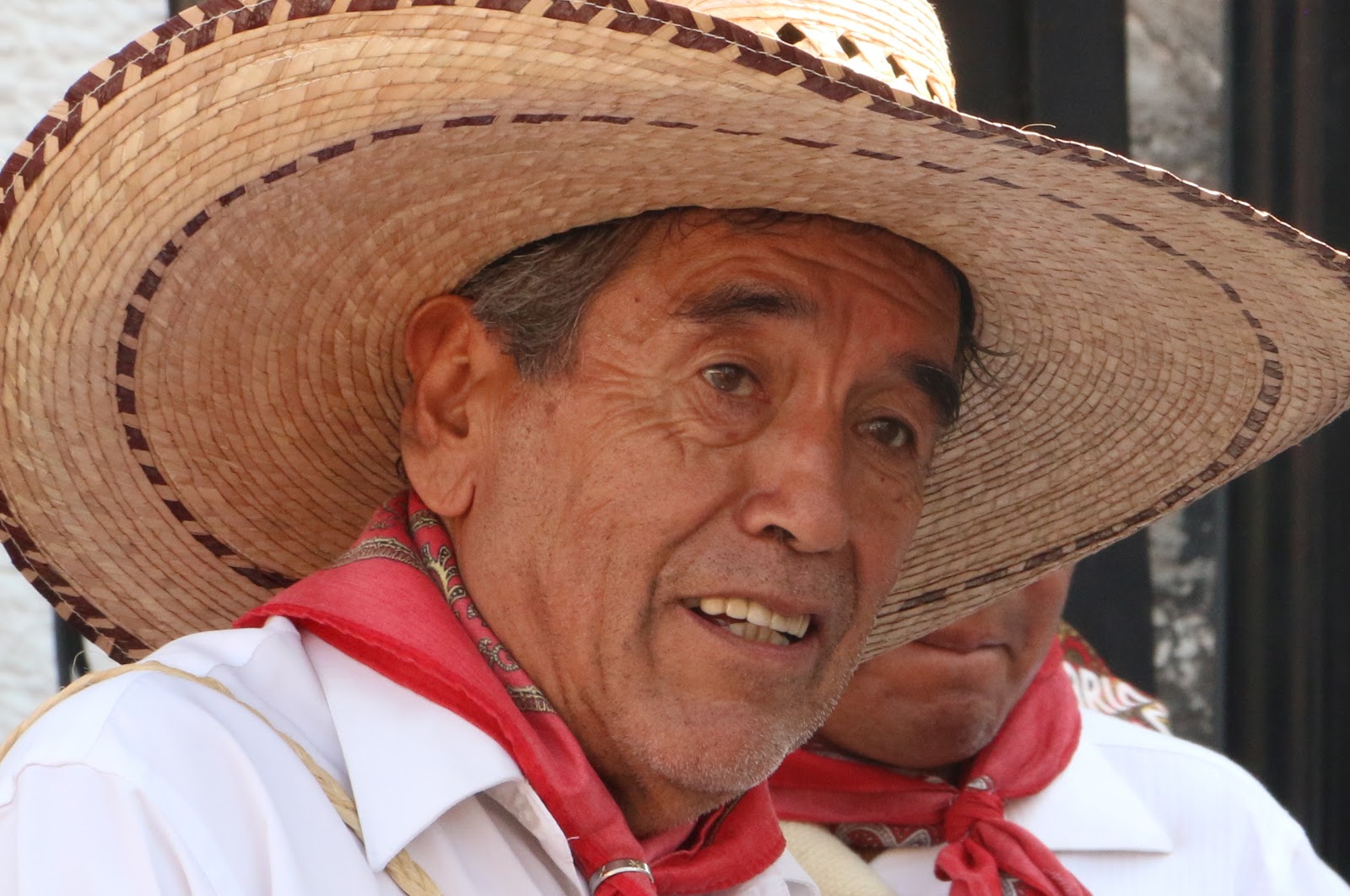
In any case, it is clear that in Mexico, this once royal pattern from Kashmir and mark of upper-class Western Europeans is the sine qua non of identifying as or with the rural campesino class. Perhaps, it is an identification with the populist portion of the Mexican Revolution or only something like the "Western cowboy" dress of an urban aficionado in the U.S. We have come across the cachemir bandana in a number of fiestas in working-class pueblos and other events celebrating Mexico's rural and/or revolutionary past. Here are some examples:
 |
| Cuadrilla de Arrieros, team of mule drivers, participating in a religious fiesta. |
 |
| Arriero |
 |
| Arriero |
  |
| Arriero (left) and participant in Cinco de Mayo, May 5 re-creation of the battle against the French in 1862 |
 |
| Participant in popular, "folk", festival of "son" [Sp. pronunced "sohn"], "sound" in the sense of the regional rural music styles of Mexico in Mexico City |
 |
| Participants in popular "son" festival. These are jóvenes, youth, from Mexico City. |
 |
| Participants in popular "son" festival. More jóvenes, youth, from Mexico City. He is a musician for a record company. |
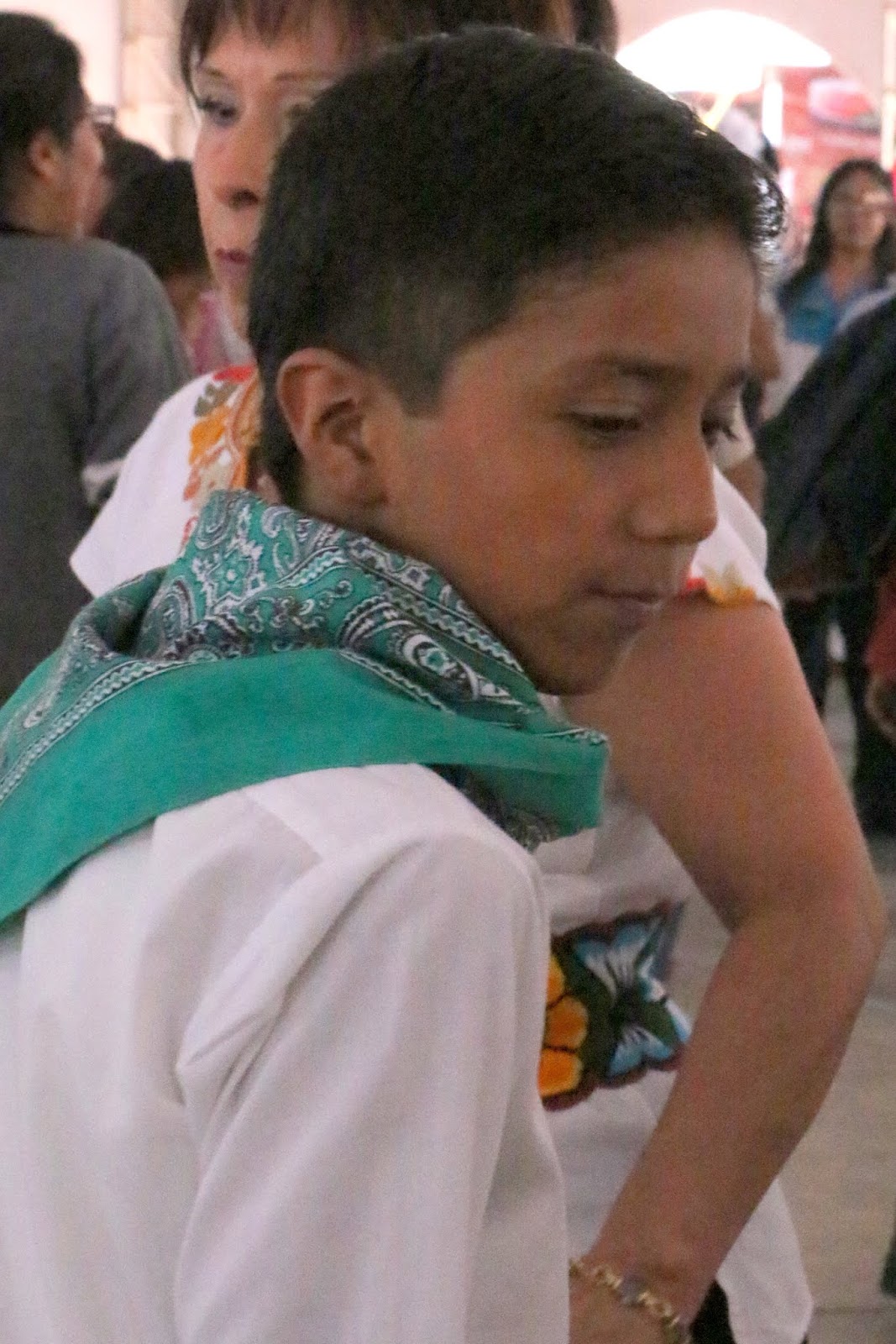 |
The tradition of "son" country music
and the cachemir bandana being passed on to an urban youth. |
 |
| Granddaughter Caroline... |
 |
...and Grandson William, "the pirate",
with Oaxaca bandanas
in Chicago. |