Showing posts with label Mexican modern architecture. Show all posts

Monday, November 13, 2017

Diego Rivera's and Frida Kahlo's 'Twin Houses' and Studios

Revolutionary Architecture


Nothing Diego Rivera or Frida Kahlo did was remotely conventional. So when Diego set out to build a house to be shared with his wife, Frida, in Colonia San Ángel, it is not surprising that he asked his friend and fellow muralist, the young architect Juan O'Gorman, to design it.

A recent graduate of the National Autonomous University of Mexico, O’Gorman began his architectural career designing spare, rectilinear houses and buildings in the style of the Functionalist architect Le Corbusier. The result: completion in 1932 of the Casas Gemelas, Twin Houses. Diego's is the red and white house; Frida's is the blue. A bridge famously connects the two houses. The building is distinguished for being one of the first constructed in the Functionalist style in Latin America.

'Twin Houses' of Diego Rivera (red and white) and Frida Kahlo (blue) 
famously connected by a  footbridge!
The cactus fence is traditional in Mexican rural pueblos.

Functionalism sought to meet the basic needs of its users, but it was also a movement in rebellion against the excessive ornamentation of the 19th century. During the Porfiriato, the reign of dictator Porfirio Díaz (1876-1911), who was an avid Francophile, the preferred styles in Mexico City were ornate French Second Empire and Beaux Arts. Wealthy Mexicans even continued to build homes in these styles after the Revolution (1910-17) in La Roma and other neighborhoods west of Centro that had been created at the beginning of the 20th century. O'Gorman and other leftist architects sought to break with these traditions and create a post-revolutionary, modern style. 

The embodiment of this radical change in the "Twin Houses" is strikingly evident in their contrast with their neighbors in Colonia of San Ángel, due west of Coyoacán. As in Coyoacán, the dominant architectural style in San Ángel is Spanish Colonial. Remarkably, the houses are not particularly jarring aesthetically vis-a-vis the surrounding ones, perhaps because of the traditional Mexican cactus fence that separates the house and property from the street.

Ornate Spanish Colonial door—
the very ornamentation 
the Functionalists rebelled against.

Historical Context


When the Mexican Revolution (1910-1917) led to the development of a new government during the 1920s, it was time not only to rebuild the country but to generate a new image of unity and change. An earlier post discussed Diego's time in Europe and his return (1921) to Mexico at the request of President Obregón and Secretary of Public Education Vasconcelos in order to develop a public art to foster national identity. Diego threw himself passionately into the work, which resulted in what is recognized today as the Mexican Mural Movement.

It makes sense that all the arts would be called upon to contribute to this national project. As a new architectural concept, Functionalism seemed to serve not only these interests, but the needs of a new generation as well. Not only did the Functionalists seek to use new construction materials (cement, glass and metal), but they tended toward an aesthetic that was industrial and modern—an aesthetic that could open the door to new construction methods and new styles of life for a new age.

Diego Rivera's Studio at Casas Gemelas


One enters the property facing Diego's House. When I saw the ascending spiral, I immediately thought of Frida's severe mobility issues and thought, "Oh, this is great—no stairs!"

Spiral Entryway to Rivera's House-Studio
But I was wrong!
Spiral Staircase.

On both first and second floors, doors open from landings to give entry to the house. All I could think was, "How on earth did Frida Kahlo—with her serious mobility issues—ever manage these stairs?" The short answer is: She didn't—or at least, she didn't for very long. (See: Frida Kahlo House Museum for the full story)

Walking into Diego's studio, I had an unexpected—and very positive—visceral reaction to the space. The studio is two stories tall, and the light is extraordinary. The east wall is glass, but light also enters the room from windows mounted in soffit-like structures next to the roof. The effect is nearly indescribable—diffuse yet remarkably full.

Diego Rivera's Studio
floor to ceiling windows, 
and full of Diego's collected art objects.

The hardwood floors are brilliantly waxed. I had the feeling the artist was expected to return at any moment.

Diego's Studio is upstairs; 
in the window are Judas figures.

Diego had a large collection of papier mache Judas figures (ritually burned the night before Easter Sunday) and calaveras (skeletons).

Judas figure

Calaveras, skeleton figures

Lovers of everything 'Mexican', Diego and Frida collected prehispanic pieces (about 59,000!); folk art from all parts of Mexico; Judas and calaveras figures; and many juguetes (toys, miniatures). 

Many prehispanic pieces are now in the garden of Frida Kahlo's Casa Azul, Blue House, in Coyoacán, but the majority of the pieces are housed in the Diego Rivera Anahuacalli Museum, also in Coyoacán. One exception is this object, below, exhibited in Diego's studio. It must have been in the studio when Rivera was alive because it appears in the painting he made of his own studio (below).

Cha'ac mool (Mayan name)
prehispanic altar for hyman sacrific

Diego's painting of the jumble in his studio, including the cha'ac mool (bottom right), calaveras, Judas figures, and a beautiful, reclining woman—possibly Dolores Olmedo?

Rivera's painting of his studio

Rivera's Painting 


In this studio, Diego Rivera painted over 3,000 portraits and portrayals of everyday Mexican life. Of Rivera's style, it has been said:
Rivera defines his solid, somewhat stylized human figures by precise outlines rather than by internal modeling. The flattened, simplified figures are set in crowded, shallow spaces and are enlivened with bright, bold colours. The Indians, peasants, conquistadores, and factory workers depicted combine monumentality of form with a mood that is lyrical and at times elegiac.
Indigenous Woman
a painting in the studio

Niña, little girl

Diego lived and worked in this house until his death in 1957.

Frida Kahlo at Casas Gemelas


When in 1934 Diego and Friday returned from a three-year stay in the United States, they moved into Diego's houses. Frida lived and painted there for six years. I actually asked a guard how on earth Frida managed all the stairs. The guard smiled as she answered—clearly, it was not the first time she had answered the question! She said that Diego had full-time help whose job it was to make it easier for Frida to move around the house.


Frida Kahlo at Casas Gemelas

But Frida did important work at the Casas Gemelas, including her paintings Lo que el agua me dio (What the water gave me), El ojo avizor (The Lookout), and El difunto Dimas (Dead Dimas). Only one of Frida's paintings remains in her house at Casas Gemelas:

Frida painted this surreal set of images 
while sitting in the bathtub. 
Her feet are reflected in the water. 

The Empire State Building 
rises from an erupting volcano; 
Below, left, is one of her corseted dresses.
She lies nude beside it. 
Her German father and Mexican mother 
are portrayed standing (lower right). 
In front of them is a couch 
where Frida reclines with a woman 
(Frida was bisexual). 

Days after her father's death in 1941, Frida moved back to the Casa Azul in Coyoacán, where she had grown up and where she died in 1954.

Originally published in Jenny'a Journal of Mexican Culture.

Still Curious?

Related Jenny's Journal posts:
Interesting discussion of Diego Rivera's impact on public art in the United States.

The Rivera-Kahlo House Museum
(red/yellow star)
is in Colonia San Ángel Inn,
just east of Colonia San Ángel (red)
in Delegación Álvaro Obregón,
in western Mexico City.

Monday, February 8, 2016

Mexican Muralists at National Autonomous University: Grandeur of Mexico's Supreme House of Studies

Following the Trail of Mexican Muralists

In our most recent ambles around Mexico City, we've been seeking out how Mexican history is represented in its architecture and public art. More specifically, we've been tracking outgrowths of the Mexican Revolution. In our explorations, we learned how at the Academy of San Carlos during the Revolution, Gerardo Murillo, aka Dr. Atl, aroused his students—including José Clemente Orozco and David Alfaro Siqueiros—with a vision of the synthesis of art and education of the people via the creation of grand murals in public spaces.

At the Secretariat of Public Education, we saw how José Vasconcelos, as its first Secretary in the early 1920s, took up this vision and—calling Diego Rivera and Siqueiros back from Europe and Orozco from the United States—put the three to work in the Secretariat and the National Preparatory School (former College of San Ildefonso).

From there, we followed Siqueiros' artistic and political odyssey in and out of Mexico City and the country. Eventually, this brought us back to Chapúltepec Castle, where Siqueiros painted his vision of the Revolution in the National Museum of History. Following the trail of the artist's work has now led us to another grand outcome of the Revolutionary vision: Ciudad Universitaria, University City, where education and public mural art were once again joined.

Vision of a University for a New Latin America

Although the National Autonomous University of Mexico (Universidad Nacional Autónoma de México, UNAM)  was founded on September 22, 1910, by Justo Sierra, Secretary of Education under President and dictator Porfirio Díaz, to be a modern, liberal, scientifically based institution, it is really a creature of the Mexican Revolution and the political dynamics that emerged from that series of conflicts.

Vision of the National University on walls at
University Station of Metro Line 3
Artist: Arturo García Bustos, 1989 

The merged raptors, the Andean condor and the Mexican golden eagle,
represent the envisioned bond of Mexico and South America,
fostered by the National University. 
The map of Latin America conveys the same vision.
Together, they form the crest for the National University,
designed by Jóse Vasconcelos (at right, arms raised).

On the white ribbon the University motto: 
"The spirit will speak for my race."

The outstretched arms of the nude female are reminiscent 
of Diego Rivera's two "new" post-Revolutionary men
in murals in Bellas Artes and San Ildelfonso.

Right: Behind professors in traditional robes,
students protest for University autonomy,
freedom from government control, granted in 1929.
Hence, National Autonomous University of Mexico, UNAM.

Crest of the University

Supreme House of Studies

Mexicans frequently refer to the UNAM as la máxima casa de estudios, the supreme house of studies. the largest, most important and best public institution of higher education in Mexico and, possibly in Latin America, the realization of the vision of José Vasconcelos, briefly its Rector in the early 1920s.

Organized into faculties, rather than departments, offering both undergraduate and graduate studies, the UNAM also operates the Escuela Nacional Preparatoria (National Preparatory School, system of high schools), and the Colegio de Ciencias y Humanidades (CCH) (College of Science and Humanities), which consists of several other high schools around Mexico City. Counting all its high schools, undergraduate and graduate students, the UNAM enrolls more than 324,400 students, making it the largest university in Latin America and one of the largest in the world.

Faculty, students and all Mexicans are fiercely proud of the UNAM as the embodiment of their efforts to build a modern, educated, sovereign country with its own, unique place in the world.

¡La Revolución Sigue! The Revolution Continues!

True to its revolutionary roots, UNAM students have frequently protested and gone on strike to get the university to change various educational and administrative policies. An early strike in 1929 won the university freedom from direction by the Secretariat of Public Education and established its much valued autonomy, i.e., leadership by a Rector elected by a governing council.

Other major protests and strikes took place in the 1930s and again in the 1960s, culminating in the multi-university protests of 1968, which were suppressed by the government in the Massacre of Tlatelolco, a plaza in northern Mexico City. Most recently, UNAM students were active in the #YoSoy132 protests against Enrique Peña Nieto's election to the Presidency in 2012.

Faculty, especially in the Faculty of Political Sciences and some in the Faculty of Law are Marxist oriented and—consonant with Diego Rivera's "Ballad of the Revolution" murals and David Alfaro Siqueiros' murals of the Mexican Revolution—are vociferously critical of capitalism and its latest embodiment, global, free-market neoliberalism.

Ciudad Universitaria, University City

Originally, the university occupied buildings in the Centro Histórico, northeast of the Zócalo, that had belonged to the former Royal and Pontifical University of Mexico founded in 1551 by the royal decree of Charles V, Holy Roman Emperor and closed in 1867 by the liberal Reform government of Benito Juárez. UNAM is viewed as its successor and still owns those buildings, including San Ildefonso (original National Preparatory School) and the Academy of San Carlos (art school).

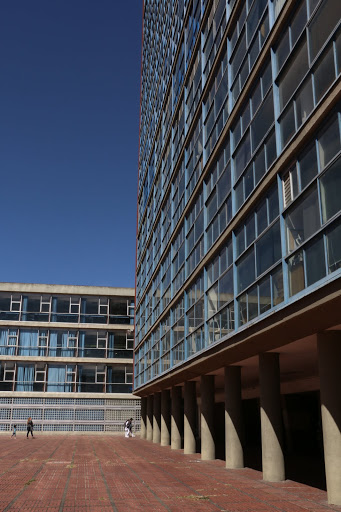
In 1943 the decision was made to move the university from the city center to a new campus, the Ciudad Universitaria (University City) in the delegación, borough, of Coyoacán, in the southern part of Mexico City. University City was sited atop an ancient lava bed resulting from the eruption of Xitle volcano around 100 CE. The buildings were designed by architects Mario Pani, Enrique del Moral, Domingo García Ramos, Armando Franco Rovira, Ernesto Gómez Gallardo and others.

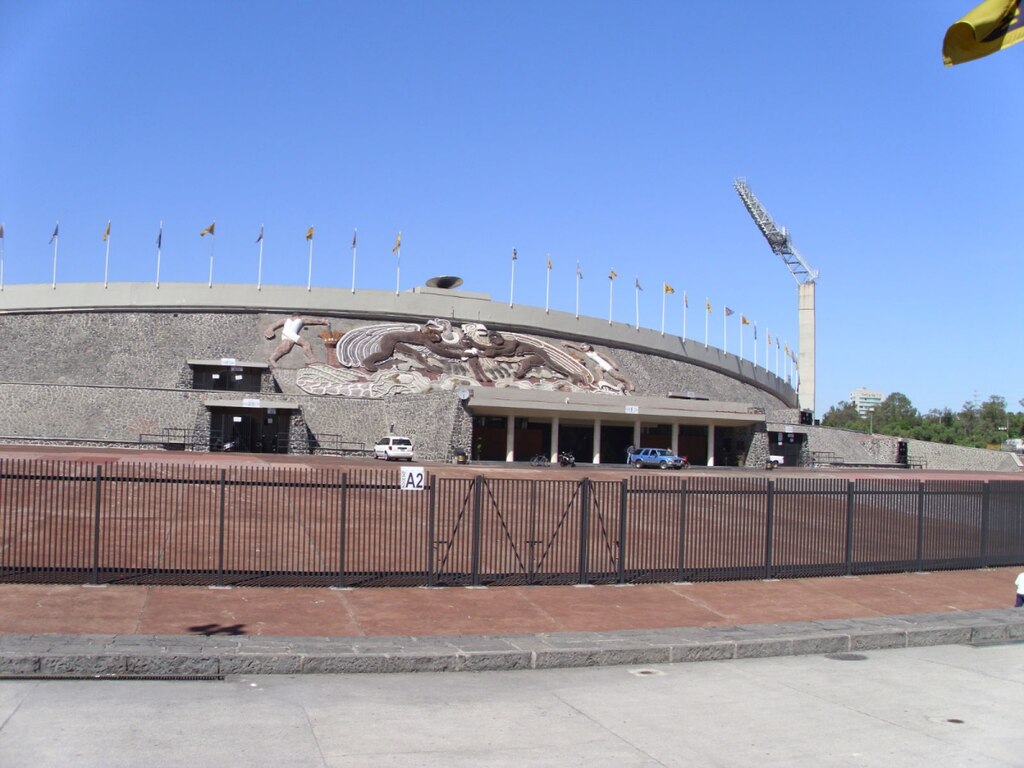
Completed in 1954, the campus includes buildings for some 40 faculties and institutes, the Rectory (Administrative Center), Central Library, Cultural Center [three performing arts theaters and contemporary art museum], other museums, the Olympic Stadium (used for 1955 Pan American Games and the 1968 Olympics), and an ecological reserve.

Mexican Muralists: Given Grandest Canvas

In constructing the campus, it was decided to have leading Mexican muralists create massive works for the facades of some buildings. Diego Rivera created a mosaic for the entrance to Olympic Stadium; it was his last public work before his death in 1957.


Mosaic by Diego Rivera
Wikipedia

David Alfaro Siqueiros created three murals for the Rectory. Juan O´GormanJosé Chávez Morado and Francisco Eppens designed works for other buildings.


The Rectory,
from Main Entrance plaza


The People to the University, The University to the People
From the rear: el Pueblo, the People, offer the tools of learning to students 
who, in turn, offer the results of their education to the People.
David Alfaro Siqueiros

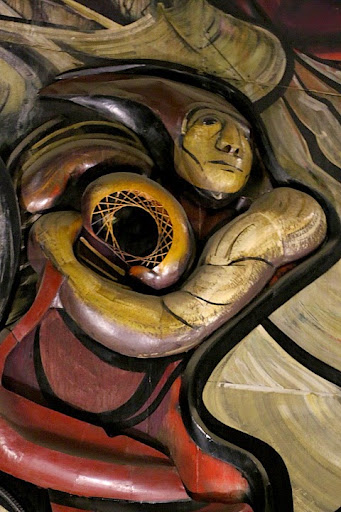
Siqueiros—whose vision was the true integration of murals with their surrounding structure—wasn't pleased at being unable to participate in the building's design, but the facade did give him the opportunity to fulfill another of his desires: create an outdoor mural.


The Revolutions
1520: Spanish Conquest of México
1810: Mexico's War of Independence from Spain
1857: War of Reform
1910: Mexican Revolution
19??: The Next Revolution?
David Alfaro Siquieros


Andean Condor and Mexican Golden Eagle
From University Crest:
Symbolizing Mexico's Cultural Union with Latin America.
David Alfaro Siqueiros


Central Library
Mural by Juan O´Gorman is a mosaic in natural stones.
Covering the Library's four sides, it is the world's largest outdoor mural.

Juan O'Gorman (July 6, 1905 – January 17, 1982), son of an Irish immigrant father and Mexican mother, studied art and architecture at that fountainhead of Mexican muralism and art: Academy of San Carlos. At age 24, he designed Diego Rivera's and Frida Kahlo's studios and houses in the Colonia San Ángel; they were the first functionalist structures in Latin America. He worked primarily as an architect and designed the Library building itself. The murals are mosaics composed of natural stone from all over Mexico. 
                                                                            

Mural is Loaded with Symbols.
Large left circle: Ptolemy's geocentric universe.

Large right circle: Copernicus's heliocentric universe.
Top left corner:  Sun, masuculine force; Top right corner: Moon, feminine force.
Top center: Crest of Royal and Pontifical University of Mexico, UNAM's predecessor.
At each side of Crest:  Cross and Sword of the Spanish Conquest.
Lower center: Greek temple representing Classic learning.
Bleeding hands of Christ
Church.
Left side: various religious figures, including archangels, saints and priests.
Right side, top: Devils dispersed by Christianity.
Right side, bottom: Island City of Tenochtitlán (circle), Spanish conquistadores.


UNAM crest
Top to bottom:
Mexican Eagle, between Moon and Sun,
New power of atomic energy,
 between Aztec gods.
Aztec ruler
Lower left: "Long live the Revolution!"
Lower right: "Land and Liberty",
the Zapatista demand.


Schematic depiction of the geographic and political divisions of 
Valley of Anáhuac before arrival of the Spanish.
Bottom center: symbolic Teotihuacán
with mythic eagle mounted on a cactus with a rattlesnake in its beak.
Seven areas, divided by water, are seven "altepetls",

city-states with their rulers, warriors and gods.

Beyond the Rectory and Library, a wide ramp gives passage to the main quadrangle.

Main Quadrangle,
known as "the Islands", for its tree-shaded areas.

At the far end of the quadrangle are located the Faculty of the Humanities, the Alfonso Caso Auditorium and the Faculty of Medicine, among other buildings.


Faculty of the Humanities 
Faculty of the Humanities
(viewed from lower quadrangle)
                                                 

Alfonso Caso Auditorium

The Conquest of Energy
From Conquest of Fire to Nuclear Energy.

In the 1950s, nuclear energy was the new great hope.
Mosaic by José Chávez Morado


This theme of human progress reminds us of 
both Rivera's Man at the Crossroads in Bellas Artes
and Siqueiros' later March of Humanity
at the Siqueiros Cultural Polyforum

José Chávez Morado (January 4, 1909 – December 1, 2002) was born in the state of Guanajuato to a family that owned a small store. He worked at various jobs, including on the railroad. In 1925, at age 16, he went to California as a migrant worker. While there, he studied art at the Chouinard Art Institute and met José Clemente Orozco, who was painting murals at Pomona College. In 1930, he returned to Mexico and subsequently moved to Mexico City, where he entered the National School of Fine Arts (Bellas Artes). He became an active member of the Mexican Communist Party, whose members included Diego Rivera and David Alfaro Siqueiros.

In addition to his murals at the UNAM, Chávez Morado also created murals on the exterior walls of the Secretariat of Communications and Transportation in the delegación, borough, of Benito Juárez, which had been damaged in the 1985 earthquake, and in the National Museum of Anthropology and History. He also executed murals in Veracruz, Guadalajara and Guanajuato.


Science and Work
Portraying transition of the "Pedregal", stony volcanic area, 
from a region of farmers to construction site for University City.
José Chávez Morado


The New Man
rises from indigenous roots, represented by Quetzalcóatl, the Plumed Serpent.
In the background, wings of the Mexican golden eagle
and hooded figure of a Franciscan monk.
Francisco Eppens

We have seen this theme of the New Adam as part of the post-Revolution ideology
in Rivera's Creation at San Ildefonso and Man at the Cross Roads at Bellas Artes.


Francisco Eppens' (February 1, 1913 - September 6, 1990) paternal grandfather, Adolfo Dietrich Eppens, was born in Basel, Switzerland, and moved to Mexico in 1863, where he married Eloísa Campillo of Hermosillo, Sonora. They moved back to Switzerland, where Francisco Eppens Campillo, the artist's father, was born in 1888. Subsequently, the family returned to Mexico, to San Luis Potosí, where they operated a hardware business. The artist's father married Mercedes Helguera of San Luis Potosí, Mexico, where Eppens was born.

In 1920, the family moved to Mexico City, where Eppens received his primary education. In 1927, he enrolled in an engineering and architecture program at the National Preparatory School (San Ildefonso), but the following year he enrolled in School of Plastic Arts, the former and famous Academy of San Carlos.

The Gods of Mexico
Faculty of Medicine

Francisco Eppens
Photo: Wikipedia

(Mural was being restored when we visited)

On wall of the Faculty of Medicine, Francisco Eppens created what is, perhaps, the most dramatic of the renowned UNAM murals:
At center, focusing the mural: Three-sided, Janus-like face, symbolizes Humanity looking to the Past, the Present and the Future. 
At border, framing the mural: Quetzlcóatl, the plumed serpent, symbolizing creation from chaos, surrounds the earth. Note serpent's head at lower left corner.
At bottom: Tlaloc, goggle-eyed god of the waters, releases a flow of the essential liquid. Death (brown skull behind Tlaloc) is being eaten by a maize cob, from whose paste the gods fashioned human beings. 
At top: Coatlicue, Aztec mother goddess, is represented by her hands, which hold the twin symbols of the origins of life: left hand holds germinating corn seedling; right hand holds pollen.
La Grandeza

In 2007, University City was designated a World Heritage Site. The citation extolls it as an ingenious example of urban architectural design, with its integration of modern architecture and Mexican muralism portraying traditional Mexican symbols and history.

La máxima casa de estudios is yet another manifestation of la grandeza mexicana, Mexican grandeur.

Saturday, January 2, 2016

Mexican Revolution and Mexican Muralists - Part X: David Siqueiros Cultural Polyforum


The Siqueiros Cultural Polyforum:
The murals are about 30' high
Photo: Alejandro Linares Garcia (Wiki Commons)

The Siqueiros Cultural Polyforum is the last major work of David Siqueiros (1896-1974). For the artist, it was the culmination of a lifetime of vision and work, the fulfillment of his desire to realize what he called the "fourth stage of Mexican Muralism" by creating a three-dimensional work completely integrated with the design of the building in which it was situated and executed by an international team of artists. It is located on Avenida Insurgentes in Colonia Nápoles, Delegación Benito Juárez.

Completed in 1971, twice the size of the Sistine Chapel, it is the world's largest mural assemblage ever painted. An integrated structure, the building was specifically designed to display the murals.

The exterior consists of 12 panels of sculptured painting. The walls and ceiling of the nave-like interior space are covered with "The March of Humanity on Earth and Toward the Cosmos" which is composed of two murals, one on each side, and on the ceiling.

Two Thousand Years of Context

It is a grand, even overwhelming, edifice and work of art. Trying to make sense of it is a challenging, if not presumptuous effort. After visiting it twice, reading—and more or less digesting—a biography of Siqueiros (see our Page: David Siqueiros: Twentieth Century Odysseus, based on Siqueiros, Biography of a Revolutionary Artist by D. Anthony White) and experiencing, face to face or vicariously, other of the artist's works, it strikes us that to be understood it needs to be placed in the context of other works of la grandeza, grandness or grandeur, that are central to the history of Mexican culture and art.

Mesoamerican Sacred-Political Spaces

This history begins with the great cities of the Mesoamerican civilizations, where we are surrounded by monumental architectural and artistic statements that totally dominate and define sensory experience. As complete environments, they were aesthetic and physical statements situating the common folk—and us—in the presence of unified sacred and political power, the reign of gods and kings. Murals were an integral part of that message.


Teotihuacán: "Avenue of the Dead" looking toward
Pyramid of the Moon
(500 BCE to 500 CE)


Mountain Lion Mural
Teotihuacán Mural Museum


Plaza of Monte Albán, Oaxaca
(500 BCE to 500 CE)


Plaza of Cacaxtla, Tlaxcala
(700-900 CE)
Mural Spans Entire Palace Front


Detail of Cacaxtla mural,
Depicting Battle, Central Warrior Spears Prostrate Enemy

Fragment of mural from Aztec Templo Mayor,
Teotihuacán (aka Mexico City)
(1325 to 1521 
CE)

Spanish Catholic Empire

Then there are the Spanish Baroque Colonial cathedrals and churches of all sizes, found from the major cities to the smallest rural villages, which—though on a lesser scale—nonetheless still seek to surround and define the experience of those who enter. Their message, like that of the earlier Mesoamerican cities, is that you are in the presence of God, supported by a State that is both His chosen instrument and defender.

On a personal level, Siqueiros's father was a devout, almost mystical Catholic who, every Sunday, took his children on a kind of pilgrimage from one Mexico City Baroque church to another to hear a series of masses. He was also knowledgeable about the painters who had decorated them in the dynamic, dramatic Baroque style. 


Metropolitan Cathedral,
Mexico City

Sacristry of the Cathedral
Paintings by Cristóbal de Villalpando and Juan Correa,
17th Century Mexican Baroque artists
Photo: Wikipedia

Baroque Chapel of the Rosary,
Church of Santo Domingo,
Puebla


Ceiling of Church of Santiago, St. James the Apostle,
in Nuria, Purhépecha (indigenous people) Highlands,
Michoacán, 1639


Santiago, St. James, Patron Saint of Spain, Slays the Moors.
Ceiling of Church of St. Bartholomew,
Cocucho, Purhépecha Highlands, Michoacán
1600s

"Siqueiros Chapel": Secular, Quasi-Marxist Cathedral

With this historical context of Mexican art in mind, we are somewhat less perplexed by what the Polyforum's patron, businessman Manuel Suárez y Suárez called "The Siqueiros Chapel". As further indication of the grand vision in play, he called the artist "Michelangelo" and himself "Pope Julius II".

Siqueiros had even attempted an earlier version of painting a three-dimensional mural in a chapel. In the 1940s, he was invited to teach a class in mural painting in San Miguel de Allende, in the state of Guanajuato. Invoking his teaching principle that students learn mural painting by painting one, he took on the chapel of a former convent. Because of differences with the art school director, who seems to have been a scam artist who didn't pay the artist, the mural was not finished. (During Jane's and my visit to San Miguel in 2007 to scope out a place to "retire", we literally stumbled in the dark into this chapel. Then someone turned on the lights. ¡Híjole! Wow!)


Mural in Bellas Artes School,
San Miguel de Allende, Guanajuato
Photo: Wikiart

So think of the Polyforum as a modern, secular, quasi-Marxist version of a Spanish Baroque cathedral, which presents a double challenge to those of us with a Puritan Protestant and "bourgeois democratic" heritage.

Exterior "Windows"

The twelve murals on the exterior can be seen as painted versions of stained-glass windows. Like the windows of a cathedral or large church, most of them represent a central archetypical theme: human conflict, struggle, death and rebirth. There are also a couple of saints. These murals are in a variety of styles reflecting the personal history of Siqueiros's painting styles.

Two of the murals are on the theme of the Spanish Conquest of the indigenous peoples of Mexico, linking us to their ancient grandeza and their "mestizaje", merger, with the grandeur of the Spanish Empire. Siqueiros was an apostle of José Vasconcelos' belief that Mexicans were a new race, arising from the antithesis between—and merger of—indigenous and Spanish blood to create a cultural synthesis composed of the best of both worlds.


The Mestizaje,
The Interbreeding
Spaniard is Naked, Exposed,
like Cortés of Orozco in San Ildefonso.
Grand Pyramid Stands at Rear.
                     
 
Indigenous Dance of Death
Before the Divine.
Vitality of Movement Echoes
Mesoamerican Murals.


Other murals speak of more generic dangers:


The Flight
Stop the Aggression


Three murals are on the theme of The Leader, which becomes central inside:


The Leader
(Seemingly half-simian. Artist's comment on
Evolution of Humans or
Ambivalence about Leadership?)
Christ, the Leader
(While the Polyforum was being constructed,
Siqueiros also did a portrait of Christ for the Vatican,
using himself as the model.)


Moses Breaking the Tablets of the Law
(Note the geometric construction, 

especially of the face and hands.
Siqueieros sought to "break the laws" 

of painting composition.)
                     
Other murals are more abstract in style and content:


Dry Tree and Tree Reborn
This symbolic theme is repeated inside.
Circus Acrobat
A comment, perhaps, on the talents
of the artist as performer.


Inner Sanctum

Entering the 1970s-style lobby, all sleek curves (think Danish Modern), we ascend a circular stairway and emerge into a huge, nave-like space. At the end of the oblong space—where the altar of a church would be, and extending out from the wall—is a pair of huge, sculpted hands.


Woman's Hands of Peace, Culture and Harmony

Along the curving side walls are spread the two murals, overwhelming in their complexity and the force of their colors and shapes. Each one is framed with a proscenium-like arch, as if they were scenes in some Grand Opera, where we have a front row orchestra seat.

Instead, we move past them, as if we were walking past some monumental murals in ancient Teotihuacán or Cacaxtla, or around the aisles of a cathedral, past its various chapels. Over Siqueiros's objections, Suaréz actually had a circular, rotating floor built so viewers can sit passively and watch the murals move by them.

We take a close look to try to sort out the details of the panoramas.


March of Humanity Toward the Democratic, Bourgeois Revolution


March of Humanity Toward the Democratic, Bourgeois Revolution
Top: Primitive Man, Pregnant Proletariat Woman, March of the Mothers, with their burdens
Bottom: The Embrace and Mixing of Races, Lynched Black Man, Crow Man of the Pimas and Yaquis (indigenous peoples)

Primitive, Uncivilized Man

Embrace and Mixing of Races, Lynched Black Man, Crow Man

March of the Mothers and Women
Time of Slavery and Oppression


Women Bearing Burdens


Masses Rise Up in Rebellion


False Leader:
A Skeleton Clown


Outcome, however, is Hollow,
Child Eviscerates the Masses.

The theme is archetypical: Man, woman, the masses, oppression, rebellion, leaders, martyrs, traitors. It is a Marxist drama, not unlike the Christian one.

March of Humanity Toward a Future Revolution


This mural is more clearly divided into sections than the first. Five sections are created by a series of four trees, or tree trunks, which also symbolize a progression from despair to hope. 
Section I: Capitalism Devours Humanity

Woman, representing Humanity, is devoured
by Monster of Capitalism


Section II: Tree of Despair, Volcano of Hope

Man Chops Down Poison Tree of Despair.
Above: Volcano erupts, producing a Seed of Hope

Section III: First Couple and New Couple

Below: The Ancestors (man in blue; woman in red)
Above: New Couple, new Adam and Eve, born of fire.
Tree (left) is Dead. 
Tree (right) shows some Green of New Life.

Section IV: Demagogue and New Generation

Above (left): The Demagogue
Below: The New Generation
Man and Woman


The Demagogue
always a threat

New Man of Technology

Transition: Fig Tree  Tree of Life


Amate Fig Tree ( Ficus tecolutensis)
sacred to indigenous people
A Tree of Life

Section V: New Leaders Emerge

New Leader Emerges


New, Female Leader Emerges


Hope in Individuals and New Leaders

After the disappointment and despair of the Bourgeois Democratic Revolution, there is the hope of a new revolution, the rebirth of life, as symbolized in the succession of trees ending with the Tree of Life.

Interestingly, there are no peasant or laboring masses either suffering repression or rising up against it. Here are a series of individuals, symbolic representatives of archetypical human roles, the New Adams and New Eves, but individuals, nonetheless. It is not a specifically Marxist message, but more universal, more generic, virtually religious.

Most notably—as in the murals on the outside of the building and in the March of Humanity Toward the Democratic, Bourgeois Revolution—the theme of leaders is repeated. There are false leaders and demagogues, but there are also new leaders, women as well as men who will, somehow, initiate a renaissance of political and social life.

When questioned about his painting of a portrait of Christ for the Vatican, Siqueiros replied that, Christ
"was the first revolutionary of history, who rebelled against oppression for the benefit of all humanity,...a combatant in the struggle for the transformation of human life."
Siqueiros considered Jesus a partner of Lenin in the fight against imperialist aggression, be it Roman, European or "from north of the Río Bravo (Rio Grande)".

Of the figures in the March of Humanity Toward a Future Revolution, Siqueiros said,
"They return, anew, to having enthusiasm. They return to having faith. Those who say 'It's not sufficient, it's not enough' come from different places. The great movements do not stop; they take new steps and seize new moments in the struggle. Let's continue moving forward."
Certainly, moving forward is what David Alfaro Siqueiros did all his life.

See our other posts on Mexican Revolution and Mexican Muralists:
Part I: Bellas Artes 
Part II: The Academy of San Carlos and Dr. Atl 
Part III: Secretariat of Education, José Vasconcelos and Diego Rivera 
Part IV: Secretariat of Education and Diego Rivera's Vision of Mexican Traditions 
Part V:  Secretariat of Education and Diego Rivera's Ballad of the Revolution 
Part VI: Diego Rivera at the College of San Ildefonso 
Part VII: José Clemente Orozco Comes to San Ildefonso 
Part VIII: College of San Ildefonso and José Clemente Orozco - Continued 
Part IX: David Siqueiros, Painter and Revolutionary
Part XI: The Abelardo Rodríguez Market 
See also our short biography: David Siqueiros: Twentieth Century Odysseus

For story of Mexican Revolution, see: Mexican Revolution: Its Protagonists and Antagonists