Following the Trail of Mexican Muralists
In our most recent ambles around Mexico City, we've been seeking out how Mexican history is represented in its architecture and public art. More specifically, we've been tracking outgrowths of the Mexican Revolution. In our explorations, we learned how at the Academy of San Carlos during the Revolution, Gerardo Murillo, aka Dr. Atl, aroused his students—including José Clemente Orozco and David Alfaro Siqueiros—with a vision of the synthesis of art and education of the people via the creation of grand murals in public spaces.
At the Secretariat of Public Education, we saw how José Vasconcelos, as its first Secretary in the early 1920s, took up this vision and—calling Diego Rivera and Siqueiros back from Europe and Orozco from the United States—put the three to work in the Secretariat and the National Preparatory School (former College of San Ildefonso).
From there, we followed Siqueiros' artistic and political odyssey in and out of Mexico City and the country. Eventually, this brought us back to Chapúltepec Castle, where Siqueiros painted his vision of the Revolution in the National Museum of History. Following the trail of the artist's work has now led us to another grand outcome of the Revolutionary vision: Ciudad Universitaria, University City, where education and public mural art were once again joined.
Vision of a University for a New Latin America
Although the National Autonomous University of Mexico (Universidad Nacional Autónoma de México, UNAM) was founded on September 22, 1910, by Justo Sierra, Secretary of Education under President and dictator Porfirio Díaz, to be a modern, liberal, scientifically based institution, it is really a creature of the Mexican Revolution and the political dynamics that emerged from that series of conflicts.
Supreme House of Studies
Mexicans frequently refer to the UNAM as la máxima casa de estudios, the supreme house of studies. the largest, most important and best public institution of higher education in Mexico and, possibly in Latin America, the realization of the vision of José Vasconcelos, briefly its Rector in the early 1920s.
Organized into faculties, rather than departments, offering both undergraduate and graduate studies, the UNAM also operates the Escuela Nacional Preparatoria (National Preparatory School, system of high schools), and the Colegio de Ciencias y Humanidades (CCH) (College of Science and Humanities), which consists of several other high schools around Mexico City. Counting all its high schools, undergraduate and graduate students, the UNAM enrolls more than 324,400 students, making it the largest university in Latin America and one of the largest in the world.
Faculty, students and all Mexicans are fiercely proud of the UNAM as the embodiment of their efforts to build a modern, educated, sovereign country with its own, unique place in the world.
¡La Revolución Sigue! The Revolution Continues!
True to its revolutionary roots, UNAM students have frequently protested and gone on strike to get the university to change various educational and administrative policies. An early strike in 1929 won the university freedom from direction by the Secretariat of Public Education and established its much valued autonomy, i.e., leadership by a Rector elected by a governing council.
Other major protests and strikes took place in the 1930s and again in the 1960s, culminating in the multi-university protests of 1968, which were suppressed by the government in the Massacre of Tlatelolco, a plaza in northern Mexico City. Most recently, UNAM students were active in the #YoSoy132 protests against Enrique Peña Nieto's election to the Presidency in 2012.
Faculty, especially in the Faculty of Political Sciences and some in the Faculty of Law are Marxist oriented and—consonant with Diego Rivera's "Ballad of the Revolution" murals and David Alfaro Siqueiros' murals of the Mexican Revolution—are vociferously critical of capitalism and its latest embodiment, global, free-market neoliberalism.
Ciudad Universitaria, University City
Originally, the university occupied buildings in the Centro Histórico, northeast of the Zócalo, that had belonged to the former Royal and Pontifical University of Mexico founded in 1551 by the royal decree of Charles V, Holy Roman Emperor and closed in 1867 by the liberal Reform government of Benito Juárez. UNAM is viewed as its successor and still owns those buildings, including San Ildefonso (original National Preparatory School) and the Academy of San Carlos (art school).
In 1943 the decision was made to move the university from the city center to a new campus, the Ciudad Universitaria (University City) in the delegación, borough, of Coyoacán, in the southern part of Mexico City. University City was sited atop an ancient lava bed resulting from the eruption of Xitle volcano around 100 CE. The buildings were designed by architects Mario Pani, Enrique del Moral, Domingo García Ramos, Armando Franco Rovira, Ernesto Gómez Gallardo and others.
Completed in 1954, the campus includes buildings for some 40 faculties and institutes, the Rectory (Administrative Center), Central Library, Cultural Center [three performing arts theaters and contemporary art museum], other museums, the Olympic Stadium (used for 1955 Pan American Games and the 1968 Olympics), and an ecological reserve.
Mexican Muralists: Given Grandest Canvas
In constructing the campus, it was decided to have leading Mexican muralists create massive works for the facades of some buildings. Diego Rivera created a mosaic for the entrance to Olympic Stadium; it was his last public work before his death in 1957.
David Alfaro Siqueiros created three murals for the Rectory. Juan O´Gorman, José Chávez Morado and Francisco Eppens designed works for other buildings.
Siqueiros—whose vision was the true integration of murals with their surrounding structure—wasn't pleased at being unable to participate in the building's design, but the facade did give him the opportunity to fulfill another of his desires: create an outdoor mural.
Juan O'Gorman (July 6, 1905 – January 17, 1982), son of an Irish immigrant father and Mexican mother, studied art and architecture at that fountainhead of Mexican muralism and art: Academy of San Carlos. At age 24, he designed Diego Rivera's and Frida Kahlo's studios and houses in the Colonia San Ángel; they were the first functionalist structures in Latin America. He worked primarily as an architect and designed the Library building itself. The murals are mosaics composed of natural stone from all over Mexico.
At the far end of the quadrangle are located the Faculty of the Humanities, the Alfonso Caso Auditorium and the Faculty of Medicine, among other buildings.
José Chávez Morado (January 4, 1909 – December 1, 2002) was born in the state of Guanajuato to a family that owned a small store. He worked at various jobs, including on the railroad. In 1925, at age 16, he went to California as a migrant worker. While there, he studied art at the Chouinard Art Institute and met José Clemente Orozco, who was painting murals at Pomona College. In 1930, he returned to Mexico and subsequently moved to Mexico City, where he entered the National School of Fine Arts (Bellas Artes). He became an active member of the Mexican Communist Party, whose members included Diego Rivera and David Alfaro Siqueiros.
In our most recent ambles around Mexico City, we've been seeking out how Mexican history is represented in its architecture and public art. More specifically, we've been tracking outgrowths of the Mexican Revolution. In our explorations, we learned how at the Academy of San Carlos during the Revolution, Gerardo Murillo, aka Dr. Atl, aroused his students—including José Clemente Orozco and David Alfaro Siqueiros—with a vision of the synthesis of art and education of the people via the creation of grand murals in public spaces.
At the Secretariat of Public Education, we saw how José Vasconcelos, as its first Secretary in the early 1920s, took up this vision and—calling Diego Rivera and Siqueiros back from Europe and Orozco from the United States—put the three to work in the Secretariat and the National Preparatory School (former College of San Ildefonso).
From there, we followed Siqueiros' artistic and political odyssey in and out of Mexico City and the country. Eventually, this brought us back to Chapúltepec Castle, where Siqueiros painted his vision of the Revolution in the National Museum of History. Following the trail of the artist's work has now led us to another grand outcome of the Revolutionary vision: Ciudad Universitaria, University City, where education and public mural art were once again joined.
Vision of a University for a New Latin America
Although the National Autonomous University of Mexico (Universidad Nacional Autónoma de México, UNAM) was founded on September 22, 1910, by Justo Sierra, Secretary of Education under President and dictator Porfirio Díaz, to be a modern, liberal, scientifically based institution, it is really a creature of the Mexican Revolution and the political dynamics that emerged from that series of conflicts.
 |
Vision of the National University on walls at
University Station of Metro Line 3
Artist: Arturo García Bustos, 1989
The merged raptors, the Andean condor and the Mexican golden eagle,
represent the envisioned bond of Mexico and South America,
fostered by the National University.
The map of Latin America conveys the same vision.
Together, they form the crest for the National University,
designed by Jóse Vasconcelos (at right, arms raised).
On the white ribbon the University motto:
"The spirit will speak for my race."
The outstretched arms of the nude female are reminiscent
of Diego Rivera's two "new" post-Revolutionary men
in murals in Bellas Artes and San Ildelfonso.
Right: Behind professors in traditional robes, students protest for University autonomy, freedom from government control, granted in 1929. Hence, National Autonomous University of Mexico, UNAM. |
 |
| Crest of the University |
Supreme House of Studies
Mexicans frequently refer to the UNAM as la máxima casa de estudios, the supreme house of studies. the largest, most important and best public institution of higher education in Mexico and, possibly in Latin America, the realization of the vision of José Vasconcelos, briefly its Rector in the early 1920s.
Organized into faculties, rather than departments, offering both undergraduate and graduate studies, the UNAM also operates the Escuela Nacional Preparatoria (National Preparatory School, system of high schools), and the Colegio de Ciencias y Humanidades (CCH) (College of Science and Humanities), which consists of several other high schools around Mexico City. Counting all its high schools, undergraduate and graduate students, the UNAM enrolls more than 324,400 students, making it the largest university in Latin America and one of the largest in the world.
Faculty, students and all Mexicans are fiercely proud of the UNAM as the embodiment of their efforts to build a modern, educated, sovereign country with its own, unique place in the world.
¡La Revolución Sigue! The Revolution Continues!
True to its revolutionary roots, UNAM students have frequently protested and gone on strike to get the university to change various educational and administrative policies. An early strike in 1929 won the university freedom from direction by the Secretariat of Public Education and established its much valued autonomy, i.e., leadership by a Rector elected by a governing council.
Other major protests and strikes took place in the 1930s and again in the 1960s, culminating in the multi-university protests of 1968, which were suppressed by the government in the Massacre of Tlatelolco, a plaza in northern Mexico City. Most recently, UNAM students were active in the #YoSoy132 protests against Enrique Peña Nieto's election to the Presidency in 2012.
Faculty, especially in the Faculty of Political Sciences and some in the Faculty of Law are Marxist oriented and—consonant with Diego Rivera's "Ballad of the Revolution" murals and David Alfaro Siqueiros' murals of the Mexican Revolution—are vociferously critical of capitalism and its latest embodiment, global, free-market neoliberalism.
Ciudad Universitaria, University City
Originally, the university occupied buildings in the Centro Histórico, northeast of the Zócalo, that had belonged to the former Royal and Pontifical University of Mexico founded in 1551 by the royal decree of Charles V, Holy Roman Emperor and closed in 1867 by the liberal Reform government of Benito Juárez. UNAM is viewed as its successor and still owns those buildings, including San Ildefonso (original National Preparatory School) and the Academy of San Carlos (art school).
Completed in 1954, the campus includes buildings for some 40 faculties and institutes, the Rectory (Administrative Center), Central Library, Cultural Center [three performing arts theaters and contemporary art museum], other museums, the Olympic Stadium (used for 1955 Pan American Games and the 1968 Olympics), and an ecological reserve.
Mexican Muralists: Given Grandest Canvas
In constructing the campus, it was decided to have leading Mexican muralists create massive works for the facades of some buildings. Diego Rivera created a mosaic for the entrance to Olympic Stadium; it was his last public work before his death in 1957.
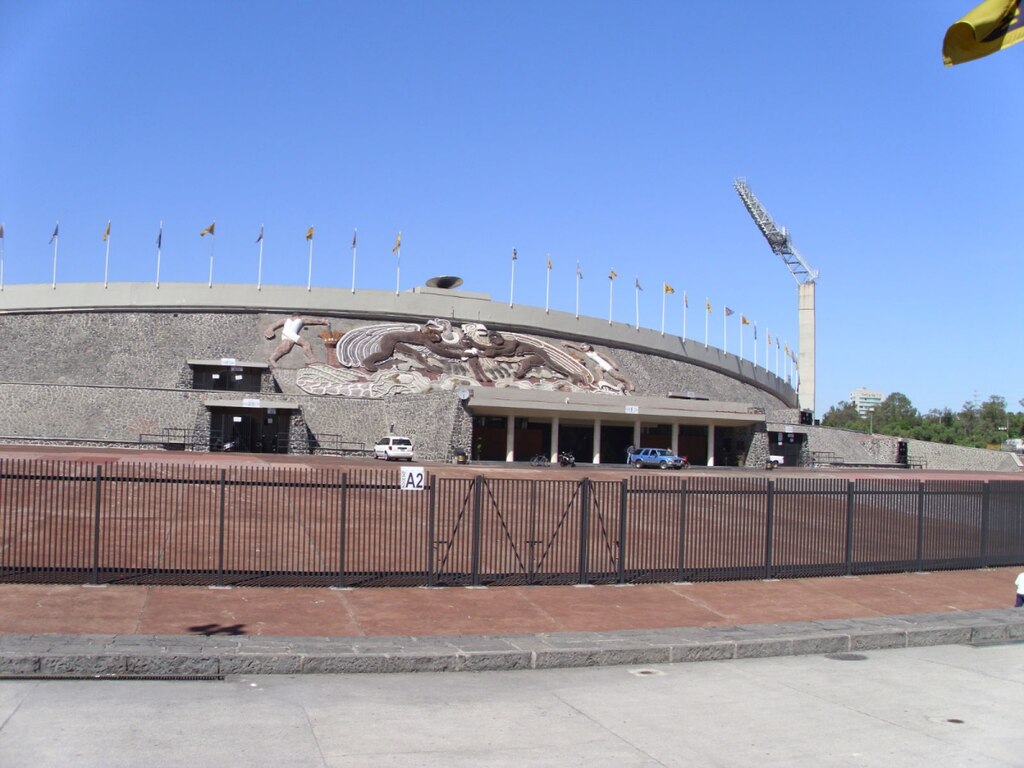 |
| Mosaic by Diego Rivera Wikipedia |
David Alfaro Siqueiros created three murals for the Rectory. Juan O´Gorman, José Chávez Morado and Francisco Eppens designed works for other buildings.
 |
| The Rectory, from Main Entrance plaza |
 |
The People to the University, The University to the People
From the rear: el Pueblo, the People, offer the tools of learning to students
who, in turn, offer the results of their education to the People.
David Alfaro Siqueiros |
Siqueiros—whose vision was the true integration of murals with their surrounding structure—wasn't pleased at being unable to participate in the building's design, but the facade did give him the opportunity to fulfill another of his desires: create an outdoor mural.
 |
| The Revolutions 1520: Spanish Conquest of México 1810: Mexico's War of Independence from Spain 1857: War of Reform 1910: Mexican Revolution 19??: The Next Revolution? David Alfaro Siquieros |
 |
| Andean Condor and Mexican Golden Eagle From University Crest: Symbolizing Mexico's Cultural Union with Latin America. David Alfaro Siqueiros |
 |
| Central Library Mural by Juan O´Gorman is a mosaic in natural stones. Covering the Library's four sides, it is the world's largest outdoor mural. |
Juan O'Gorman (July 6, 1905 – January 17, 1982), son of an Irish immigrant father and Mexican mother, studied art and architecture at that fountainhead of Mexican muralism and art: Academy of San Carlos. At age 24, he designed Diego Rivera's and Frida Kahlo's studios and houses in the Colonia San Ángel; they were the first functionalist structures in Latin America. He worked primarily as an architect and designed the Library building itself. The murals are mosaics composed of natural stone from all over Mexico.
 |
| Mural is Loaded with Symbols. Large left circle: Ptolemy's geocentric universe. Large right circle: Copernicus's heliocentric universe. Top left corner: Sun, masuculine force; Top right corner: Moon, feminine force. Top center: Crest of Royal and Pontifical University of Mexico, UNAM's predecessor. At each side of Crest: Cross and Sword of the Spanish Conquest. Lower center: Greek temple representing Classic learning. Bleeding hands of Christ Church. Left side: various religious figures, including archangels, saints and priests. Right side, top: Devils dispersed by Christianity. Right side, bottom: Island City of Tenochtitlán (circle), Spanish conquistadores. |
 |
| UNAM crest |
 |
| Top to bottom: Mexican Eagle, between Moon and Sun, New power of atomic energy, between Aztec gods. Aztec ruler Lower left: "Long live the Revolution!" Lower right: "Land and Liberty", the Zapatista demand. |
 |
| Schematic depiction of the geographic and political divisions of Valley of Anáhuac before arrival of the Spanish. Bottom center: symbolic Teotihuacán with mythic eagle mounted on a cactus with a rattlesnake in its beak. Seven areas, divided by water, are seven "altepetls", city-states with their rulers, warriors and gods. |
Beyond the Rectory and Library, a wide ramp gives passage to the main quadrangle.
 |
| Main Quadrangle, known as "the Islands", for its tree-shaded areas. |
At the far end of the quadrangle are located the Faculty of the Humanities, the Alfonso Caso Auditorium and the Faculty of Medicine, among other buildings.
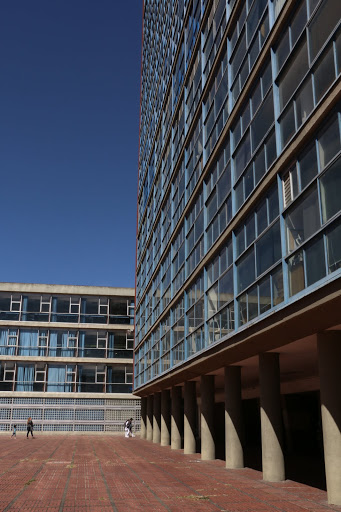 |
| Faculty of the Humanities |
 |
| Faculty of the Humanities (viewed from lower quadrangle) |
 |
| Alfonso Caso Auditorium |
 |
| The Conquest of Energy From Conquest of Fire to Nuclear Energy. In the 1950s, nuclear energy was the new great hope. Mosaic by José Chávez Morado This theme of human progress reminds us of both Rivera's Man at the Crossroads in Bellas Artes and Siqueiros' later March of Humanity at the Siqueiros Cultural Polyforum |
In addition to his murals at the UNAM, Chávez Morado also created murals on the exterior walls of the Secretariat of Communications and Transportation in the delegación, borough, of Benito Juárez, which had been damaged in the 1985 earthquake, and in the National Museum of Anthropology and History. He also executed murals in Veracruz, Guadalajara and Guanajuato.

In 1920, the family moved to Mexico City, where Eppens received his primary education. In 1927, he enrolled in an engineering and architecture program at the National Preparatory School (San Ildefonso), but the following year he enrolled in School of Plastic Arts, the former and famous Academy of San Carlos.
On wall of the Faculty of Medicine, Francisco Eppens created what is, perhaps, the most dramatic of the renowned UNAM murals:
In 2007, University City was designated a World Heritage Site. The citation extolls it as an ingenious example of urban architectural design, with its integration of modern architecture and Mexican muralism portraying traditional Mexican symbols and history.
La máxima casa de estudios is yet another manifestation of la grandeza mexicana, Mexican grandeur.
 |
| Science and Work Portraying transition of the "Pedregal", stony volcanic area, from a region of farmers to construction site for University City. José Chávez Morado |
 |
| The New Man rises from indigenous roots, represented by Quetzalcóatl, the Plumed Serpent. In the background, wings of the Mexican golden eagle and hooded figure of a Franciscan monk. Francisco Eppens We have seen this theme of the New Adam as part of the post-Revolution ideology in Rivera's Creation at San Ildefonso and Man at the Cross Roads at Bellas Artes. |
Francisco Eppens' (February 1, 1913 - September 6, 1990) paternal grandfather, Adolfo Dietrich Eppens, was born in Basel, Switzerland, and moved to Mexico in 1863, where he married Eloísa Campillo of Hermosillo, Sonora. They moved back to Switzerland, where Francisco Eppens Campillo, the artist's father, was born in 1888. Subsequently, the family returned to Mexico, to San Luis Potosí, where they operated a hardware business. The artist's father married Mercedes Helguera of San Luis Potosí, Mexico, where Eppens was born.
In 1920, the family moved to Mexico City, where Eppens received his primary education. In 1927, he enrolled in an engineering and architecture program at the National Preparatory School (San Ildefonso), but the following year he enrolled in School of Plastic Arts, the former and famous Academy of San Carlos.
 |
| The Gods of Mexico Faculty of Medicine Francisco Eppens Photo: Wikipedia (Mural was being restored when we visited) |
At center, focusing the mural: Three-sided, Janus-like face, symbolizes Humanity looking to the Past, the Present and the Future.
At border, framing the mural: Quetzlcóatl, the plumed serpent, symbolizing creation from chaos, surrounds the earth. Note serpent's head at lower left corner.
At bottom: Tlaloc, goggle-eyed god of the waters, releases a flow of the essential liquid. Death (brown skull behind Tlaloc) is being eaten by a maize cob, from whose paste the gods fashioned human beings.
At top: Coatlicue, Aztec mother goddess, is represented by her hands, which hold the twin symbols of the origins of life: left hand holds germinating corn seedling; right hand holds pollen.La Grandeza
La máxima casa de estudios is yet another manifestation of la grandeza mexicana, Mexican grandeur.


