Island of the Herons
Semi-secluded in what is now the northeast corner of Colonia Roma, in the southwest corner of Delegación Cuauhtémoc, is a barrio that, when the Spanish arrived, was a fishing village on an island in Lake Texcoco. Now known as La Romita, Little Rome, it was originally the pueblo of Aztacalco, House of the Herons in Nahuatl.
About halfway between Tenochtitlan and Chapultepec on the western lakeshore, Aztacalco was just south of the aqueduct built by the Mexicas in the 15th century, later rebuilt by the Spanish, to bring fresh water from the springs of Chapultepec to their island city. Avenida Chapultepec now follows the path of the former aqueduct.

Semi-secluded in what is now the northeast corner of Colonia Roma, in the southwest corner of Delegación Cuauhtémoc, is a barrio that, when the Spanish arrived, was a fishing village on an island in Lake Texcoco. Now known as La Romita, Little Rome, it was originally the pueblo of Aztacalco, House of the Herons in Nahuatl.
About halfway between Tenochtitlan and Chapultepec on the western lakeshore, Aztacalco was just south of the aqueduct built by the Mexicas in the 15th century, later rebuilt by the Spanish, to bring fresh water from the springs of Chapultepec to their island city. Avenida Chapultepec now follows the path of the former aqueduct.
 |
| Aztacalco (orange star) was an island in Lake Texcoco southwest of Tenochtitlan |
 |
| Aztacalco appears on this map west of the original islands (yellow) incorporated into Tenochtitlan via landfill, cimentación, (light orange) and enlarged via chinampas, man-made islands for growing produce. (dark orange). Características edáficas y ecológicas presentes en la isla de Tenochtitlan-Tlatelolco. Soil and ecological characteristics of the Island of Tenochtitlan-Tlatelolco (based on data from Calnek 1972, 1976; González Aparicio 1980, Reyes García et al. [eds.] 1996, Filsinger 2005, Sánchez Vázquez et al. 2007) from: SAN PABLO TEOPAN: PERVIVENCIA Y METAMORFOSIS VIRREINAL DE UNA PARCIALIDAD INDÍGENA DE LA CIUDAD DE MÉXICO by ROSSEND ROVIRA MORGADO San Pablo Teopan: Survival and Metamorphosis of an Indigenous Quarter of Mexico City During the Viceroy Period by Rossend Rovira Morgado |
Following the Conquest led by Hernán Cortés came the process known now as the Spiritual Conquest, the conversion of the indigenous to Catholicism and Spanish European culture. So that meant, of course, the building of a church on the island of Aztacalco (not to be confused with either the Indian quarter in Tenochtitlan, San Sebastián Atazacoalco, or the altepetl, city-state of Azcapotzalco, which the Mexicas of Tenochtitlan defeated in 1428).
 |
| Santa Maria de la Natividad de Aztacalco, St. Mary of the Nativity 1530 Now the Parish Church of San Francisco Javier |
In front of the church is a traditional Mexican plaza that could be in any traditional provincial pueblo anywhere in Mexico—and culturally far from cosmopolitan Roma.

Aztacalco kept its name and retained relative social and cultural autonomy, even after Lake Texcoco was drained and it was no longer an island. Up to the beginning of the 20th century, the area—like most of that outside what is now Mexico City's Centro Histórico—remained rural. Then, with the development of new upper class subdivisions during and after the Porfiriato, Aztacalco was incorporated into La Roma and became known as La Romita.
As a "popular", i.e., working class, indigenously-based barrio, it kept itself apart from the new La Roma of los de arriba (those from above)—as those from above stayed away from La Romita. The delightfully independent and keenly observant pubescent boy hero of José Emilio Pacheco's “Las batallas en el desierto” (The Battles in the Desert), who lives with his upper middle class family in La Roma, speaks of the danger of entering La Romita.
As a "popular", i.e., working class, indigenously-based barrio, it kept itself apart from the new La Roma of los de arriba (those from above)—as those from above stayed away from La Romita. The delightfully independent and keenly observant pubescent boy hero of José Emilio Pacheco's “Las batallas en el desierto” (The Battles in the Desert), who lives with his upper middle class family in La Roma, speaks of the danger of entering La Romita.
To distinguish their ancient, but now otherwise anonymous barrio, the residents have turned to a long-standing tradition in Mexican art.

Ancient Roots of Mural Art
The pueblo, the people of this place, have transformed the featureless walls of their houses with paint. Wall painting, mural art, is an ancient Mexican means of cultural expression and continuity going back to the indigeous civilizations of such cities as Teotihuacán, Cacaxtla, Bonampak and Tenochtitlán.
 |
| Bird god of Teotihuacan 1st century C.E. |
 |
| Battle Scene, Cacaxtla 7th century C.E. |
 |
| Lords of Bonampak 8th century C.E. |
 |
| Tenochtitlan 15th century C.E. |


From Ancient Cities to Modern Streets via a Revolution
The vital link between the indigenous past and this contemporary urban street art is, of course, the Mexican Mural Movement, triggered in the context of the Mexican Revolution (1910-1917). In exploring the work of that Movement around Mexico City, including in its Metro stations, we have seen how these revolutionary artists sought to break through the bounds of European classic art in which they had been trained and find native Mexican roots for their work. They sought to create large scale, public art. Murals gave them the medium. To learn how to do frescos, painting on wet plaster, they had to turn to indigenous artists in rural Mexico who still knew the technique.
Diego Rivera deliberately chose to portray traditional customs.
 |
| Viernes de Dolores en el Canal de Santa Anita Friday of Sorrows (prior to Palm Sunday) on the Santa Anita (aka La Viga) Canal, Mexico City on a wall in the Secretariat of Education, Centro Histórico |
David Alfaro Siqueiros commited himself to taking murals into the streets, where el pueblo, the common people, could experience them as part of their everyday life. In Mexico City his work is present inside famous historical buildings, but his only outdoor composition is on the University City campus of the National Autonomous University of Mexico (UNAM), not exactly an ordinary urban street.
 |
| The People to the University, The University to the People From the rear: el Pueblo, the People, offer the tools of learning to students who, in turn, offer the results of their education to the People. On the Rectory (Administration) building, UNAM |
As we noted in our final post on the Mural Movement, it is in the Street Art of the City, such as that of La Romita, the ancient pueblo of Aztacalco, that this ancient tradition continues to be vitally present.
 |
| Delegación Cuauhtémoc (light tan area) was the site of ancient Tenochtitlan, now Centro Histórico, in north central Mexico City |
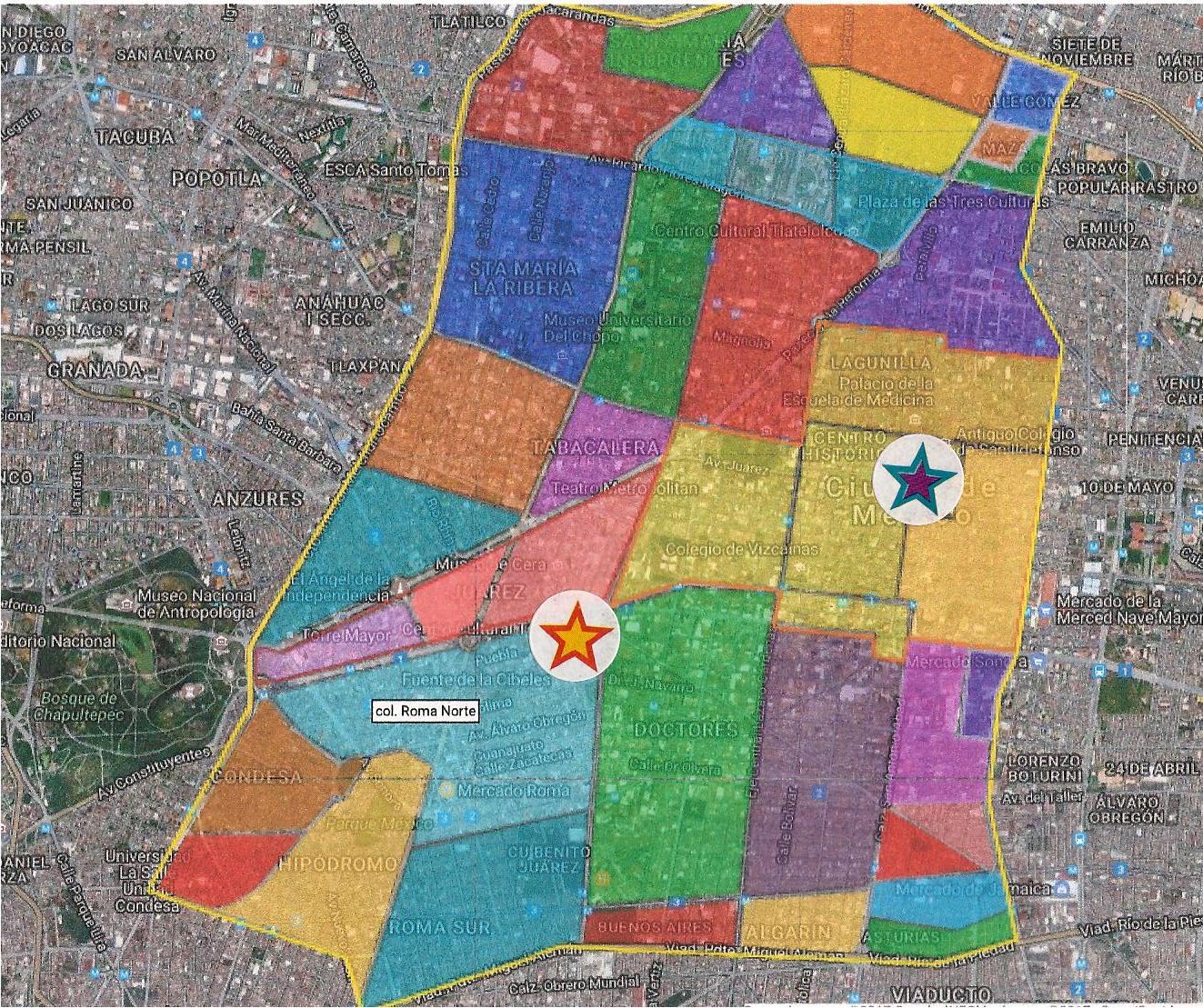 |
| Delegación Cuauhtémoc Aztacalco, now "La Romita", (red and orange star) is a little less than two miles southwest of the Templo Mayor of Tenochtitlan (green and purple star). Another two miles further west is Chapultepec Woods, (dark green area) The Mexicas built an aqueduct from the springs of Chapultepec to Tenochtitlan. Its pathway is now Avenida Chapultepec, which passes along the north side of Aztacalco/La Romita. |
See also:


