Wednesday, May 10, 2017

Original Villages | Xochimilco: Santa Cruz Acalpixca's Fiesta of the Holy Cross

Seeking a Fiesta of the Holy Cross


May 3rd, on the Catholic religious calendar, is the Feast Day of Santa Cruz, the Holy Cross. It celebrates the cross on which Jesus the Christ was crucified (we recently witnessed the Passion Play of Iztapalapa). Because of His Resurrection, the cross has been given a meaning beyond pain and death, transformed into a symbol of life and liberation from death.

May 3rd also coincides with the mid-point of Spring and, in Mexico, with the return of the rains that ceased in the preceding Fall. It thus also marks the beginning of the planting season (think the pre-Christian May Day celebrations in Europe).

So, continuing our exploration of the original indigenous villages of the Valley of Mexico that we began a year ago, we check our version of the religious calendar, which we have cross referenced to each delegación (borough) of the City and its respective colonias, pueblos and barrios, to see which ones will be celebrating the Feast of the Holy Cross. We find that there are two pueblos in Xochimilco dedicated to la Santa Cruz. Xochimilco is one of the delegaciones that most maintains their indigenous roots and customs, so fiestas there are likely to be rich in tradition and full of vitality.

Google Maps helps us locate the church of Santa Cruz Acalpixca, located on the eastern side of the delegación. Various research paths (many Mexican pueblos and churches have Facebook pages, a modern form of maintaing traditional communal bonds and identity) do not lead to locating the church of Santa Cruz Xochitepec, on the west side, so we decide to investitgate Acalpixca (Ah-kahl-PISH-kah). As fiestas generally last some days before or after the primary date, depending on where it falls in the week, and include the nearest weekend, we assume the fiesta of Santa Cruz will still be in progress on the Sunday following May 3rd. So, when that morning arrives, we head for Xochimilco, using a combination of taxis and the Light Rail.

Exiting the Xochimilco Light Rail station, we hail a cab and tell the driver our destination. He responds, "Oh, yes, the feria (fair) in Santa Cruz", and we head east from the center of the delegación. After various turns, we end up on a four-lane street with a camellón (tree-filled median). Soon he tells us that if we get out at the next corner and walk down the side street, we will reach the church and the fair.

Following his instructions, we head down the narrow side street. Almost immediately we spot signs of the fair, booths selling "fair bread" and other foods, and mechanical rides.

Plaza of Santa Cruz Acalpixca,
filled with fair rides

As is often the case with such pueblo fiestas, the plaza and the church are virtually hidden behind puestos (stalls) selling food and mechanical fair rides. We spot the church steeple and the wall of its atrio (atrium) and search for the entrance.

Venerating the Holy Cross


Three Santa Cruces, Holy Crosses

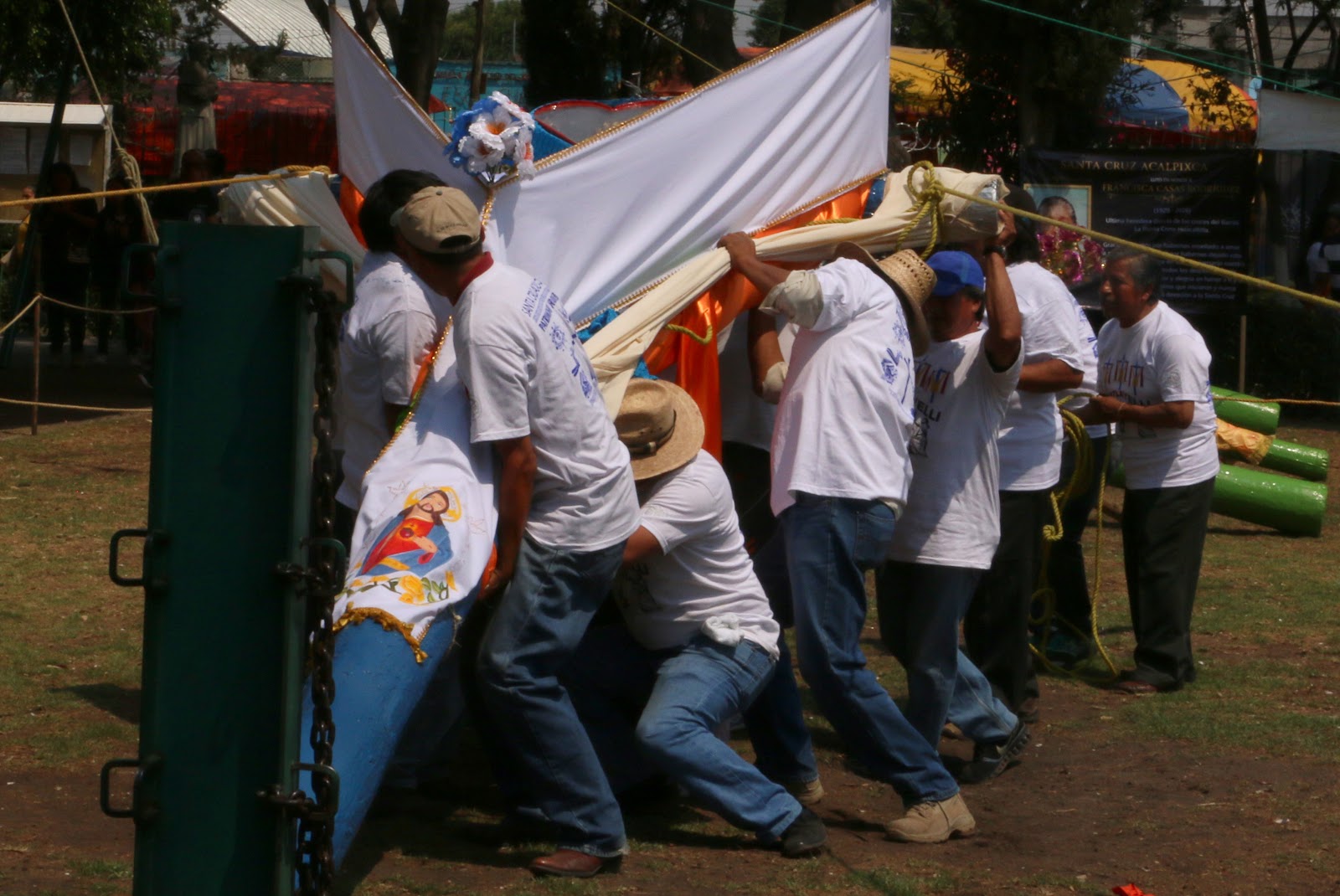
Entering the atrio, we encounter a row of three large crosses, made from substantial poles and freshly painted in blue, lying on the walkway. They are covered with wide white cloths forming a 'V' shape and numerous other strips of brightly colored cloth. A group of men seems to be preparing them for some activity. They all wear T-shirts identifying them as volunteers for the fiesta. 

To the right side of the church a Mass is in progress in a covered outdoor space, reminiscent of the outdoor masses held by the Franciscans and other orders before they could replace their first small chapels with larger churches.

Team of men lifts one cross and begins to carry it across the atrio.


At the far side of the atrio, they place the base of the cross in a
green steel frame permanently set in the ground.

They raise the cross erect.

The Holy Cross,
dressed in splendor.

Walking back across the atrio towards the church, intending to explore it and the Mass being celebrated, we are surprised to see three more large crosses lying in a corner of the atrio. They are painted green instead of the blue of the first three, and wear brightly patterned 'Vs' in place of white ones.


Back in  front of the church is another surprise. Aztec dancers are blessing one of the crosses with copal incense. We can hear the drumming of such dancers, whom we know from past Ambles, are frequent participants in such fiestas. It is coming from the plaza and we will have to check it out later.


Conch shell 'horn' is blown
 as part of the ritual.
It is an ancient Mesoamerican tradition.

A Sanctuary in Bloom | A Congregation Celebrating


Church of Santa Cruz Acalpixca

We enter the church. Typical of patron saint fiestas, it is filled with fresh flowers.

The altar and the arch in front of it are covered with lillies of many colors.
Still more are draped along the side walls.


The sanctuary is small, with a single file of pews. We can see why the Mass is being held outside.

A fairly young priest,
accompanied by a group of youth, child musicians and singers,
leads the congregation in song.
(We note that hundreds of other  lillies haven't quite yet managed to bloom.)

The Mass being celebrated is very upbeat and contemporary, with folk-style songs sung by a group of youth and children and enthusiastically joined by the congregation.

Three Crosses Times Two


Meanwhile, a second cross has been raised
next to the first one
.

In front of the chruch, the third cross is prepared.


Three Holy Crosses,
as two thieves were crucified with Jesus.

We understand the three crosses are a recollection that Jesus was crucified between two thieves. But we wonder why the doubling to six. So we ask one of the men assisting. He explains that the three crosses that have been raised in the atrio will be carried, next Tuesday afternoon, up the hill we can see from the atrio and raised there, where they will stay until next Easter, like guards watching over the pueblo. The second three, which rest on the ground, will be carried to a site in the pueblo and raised there.

The three crosses will be carried to the top of the hill seen in the background,
where they will keep watch over the pueblo for a year.

Aztec and Conchero Dancers 

Mexican pueblo fiestas are always something of a three-ring circus, with multiple activities happening simultaneously. Out on the plaza, drums have been beating all the time we have been witnessing the raising of the crosses and the outdoor Mass. In the plaza, people in Aztec dress are intently, energetically dancing to the rhythm of the drums. Other groups await their turns. 

Cuailama
may be a barrio in Acalpixca.
Corporation of Concheros
of Santa Cruz Acalpixca.
Concheros are dancers
who play lute-like instruments.


We have seen and written about these Aztec dancers in other of our Ambles in original villages. Although they may seem a modern attempt to get in touch with ancient but weakened indigenous roots, we have learned that they have a continuous history from the time of the Spanish Conquest, when Franciscans and other religious allowed the natives to adapt their dances and drumming to Christian themes so they could be incorporated into the celebrations of the new faith. Such adaptation was part of the key principal of compromise in the Spiritual Conquest in order to gain "heathen" acceptance of Spanish Catholic Christianity. (Wikipedia)

Today, we notice dancers wearing a style of attire different from the more or less bare-skinned style we have seen before. Seeking an explanation, we approach a couple of their members.


They generously and happily explain that they are members of la Corporación de Concheros Sociedades Unidas, the Corporation of United Societies of Concheros, a group that has existed in Mexico City since the 1920s. This jibes with what we have read about such groups, that they were introduced from the more rural provinces (states) into Mexico City after the Revolution as a manifestation of the revolutionary goal of reviving the indigenous basis of Mexican culture and society. 

They tell us that their attire, which consists of a long skirt and a kind of vest, trimmed with fur, is the dress the Franciscans allowed the indigenous to wear, covering themselves with European imposed modesty, but still expressing indigenous symbolism and tradition.

The two men also tell us that their families have been involved in the concheros since the group's beginnings. Señor Encarnación Rodriguez (pictured on the right) says he is the fifth generation of his family to belong. We comment how we always see children involved in the dance groups, and he replies that his grandchildren are dancers, making the seventh generation. All this is said with very evident pride. They also want us to know that, like many Mexican community groups, they have a Facebook page, and we can communicate with them through it.

Other concheros de la Corporación de Concheros Sociedades Unidas

Traditional and classy.


Not so traditional, but interesting:
This gentleman is dressed
in black felt shirt and pants,
trimmed with red fringe.
We ask him about his unique attire.
He says he also dances
with one of the groups.

Knights of St. James


As if there weren't already a great variety of traditions being expressed in this fiesta, at this point another one comes dancing across the plaza and enters the atrio.

We have seen these medieval-style dancer/sword fighters
last year in a fiesta in Pueblo Candelaria, in Coyoacán,
but have no idea what they are supposed to portray.


So when they stop to rest outside the church, in our usual manner, we approach one of them and ask, "What do you represent?

Knight of St. James

He replies, "We are Knights of Santiago (St. James)." The light goes on in our brain: "Of course!" Santiago, St. James, is the patron saint of Spain. One of the disciples of Jesus, he is believed to have come to Spain from Roman Judea to preach the Gospel and found the Christian Church, separate from St. Peter and Rome. He returned to Judea and was martyred. 

Centuries later, when Christians were driving the Islamic Moors from the Iberian Peninsula, St. James showed up and, riding a white horse, enabled them to win a major battle. He then became Santiago Matamoros, St. James the Moor Slayer. Even more centuries later, he is believed to have shown up in what is now Mexico to help Cortés defeat one of the indigenous tribes that opposed him. 

We wish we could have found out
who these intriguing charaters are.
We are particularly fascinated by the king in "shades".

Again, children are actively involved
in continuing a tradition


The Knights of St. James
pose for a formal portrait in front of the three Holy Crosses.

Congregation of the Holy Cross of Acalpixca


While we are both puzzling and marveling over the Knights, cohetes, rocket-style fire crackers that are an essential part of fiestas, start to be set off.


They are announcing the approach of yet another personaje (primary character) in the drama of the Fiesta of the Holy Cross.

The Crucified Christ,
but on a green cross, symbolizing life.

The arrival of the Crucified Christ marks the beginning of another Mass in the open sanctuary. This time the space is full to the brim with the faithful. Again, the songs are folk-style and the congregation sings and claps enthusiastically. We are reminded of the vitality of Black churches in New York.


Some parishioners carry their own
Holy Cross to be blessed by the priests.


La Gente, the People


As always in our Ambles, we are most interested in the people we encounter.


Once Again | Vitality of  Faith and Continued Communal Identity


So another of our Ambles to an original village in the Valley of Mexico has once again led to encountering a vital community of everyday Mexicans celebrating their traditions with vigor. This time, during the Easter Season, the celebration is focused on a central Catholic symbol, the Cross of Christ as the means to His Resurrection and, thus, the hope of eternal life. And we once again witness the pride in shared communal identity. The three crosses that will be raised on the hill above Santa Cruz Acalpixca bespeak of the community's faith in their God and and its commitment to maintaining communal identity.  

P.S. On the Tuesday after our visit, we check the parish Facebook page and find the community has posted a video of the three crosses being carried to the top of the hill, where they will stand vigil over Santa Cruz Acalpixca for another year.

Watch the Video. It´s best viewed on full screen. Listen for the haunting sound of the ancient conch shell horn announcing the crosses' arrival.

Delegación Xochimilco
is large pink area in southeast Mexico City
        
Pueblos and Colonias of Xochimilco

Green and yellow star marks the central barrios of the original indigenous city.
Yellow and orange star marks Santa Cruz Acalpixca,
to the east, which originally stood on the shore of Lake Xochimilco to its north.

The dark green area to the north are the chimalpas, man-made islands, 
in what remains of Lake Xochimilco.
The dark green area to the south are the foothills of the mountains
that form Mexico City's southern boundary.

Tuesday, May 2, 2017

A "General Store" Display of 20th Century Mexico: Carlos Monsiváis's "Corner Store" Musuem

Time for a Change


Exploring history via cityscape, and vice versa


For the past two years Mexico City Ambles has been exploring the City. As our ambles evolved, it became apparent that in exploring this urban space, we were also exploring time, the city's history. The Spanish Colonial Ciudad de México was built atop the Mexica (aka Aztec) city of Tenochtitlan and the landscape around it was dramatically changed by draining Lake Texcoco, so the City was no longer an island.

When Nueva España gained its independence from Spain in 1821, another process of modification of the City began, which was accelerated during the Porfiriato, the thirty-five year rule of President Porfirio Díaz (1876-1911). The Mexican Revolution (1910-17) and the political changes that it triggered brought other changes to the cityscape. So our ambles have been a dialogue between space and time, architecture and history.

However, our ambles forward in time inevitably led to a kind of historical deadend in post World War II Mexico City. Although there are many architecturally remarkable late 20th century and early 21st century buildings in the City, they are glass and steel skyscrapers which, along with multi-lane highways full of cars, are manifestations of the globalization of Mexico City that began in the 1950s and was greatly accelerated in the 1990s with the establishment of the North American Free Trade Agreement.

Paseo de la Reforma
seen from Chapultepec Castle.

A view from the 19th century to the 21st.
Six White Columns are
Monument to the Boy Heroes
who resisted the U.S. Invasion of Mexico (1846-48)
Photo by Carlos Cortés
Wikipedia

With the economic opening of Mexico to the world, and in particular, the United States, multinational companies moved into the City, many erecting skyscrapers along Paseo de la Refoma and then, other main arteries, that are little different from their clones in any other major city of the world. We saw no apparent way to approach the late 20th century from our perpective of seeking out how the unique history of Mexico is embodied in its buildings, cityscape and public art. Perhaps, like the author of a late 20th century book, we had arrived, at the end of history. But we did not want it to be the end of our Ambles.

Returning to the starting point


So we returned to our and Mexico's geographic and historic beginning point, el Centro Historico, to explore a related question that also meant turning back in time to the moment when indigenous Tenochtitlan became Spanish Mexico City. We wondered: how did the Mexica city of Tenochititlan get transformed into the Spanish Colonial Ciudad de México? It was not a simple matter of tearing down the first and building the second on top.

We discovered that the answer lay in searching out the remaining landmarks, usually 16th century churches built by Franciscans and other religious orders of monks, that continue to stand in the original indigenous quarters of the city and the many villages around what had been Lake Texcoco that predated the Spanish invasion. This has been our focus and passion for the past year. 

However, that search also brought a complication. While we are continuing this exploration of the landmarks of the so-called Spiritual Conquest, the process is constrained by the fact that the best time to visit these now-hidden villages is when el pueblo, the village people, hold their annual patron saint fiesta or some other fiesta determined by the Catholic religious calendar, such as Easter. This takes the scheduling of our ambles out of our control and puts it under the control of the religious calendar.

That requires frequent checking of the calendar we are building of the sacred year, cross referenced to all the delegaciones (boroughs) and their colonias, neighborhoods, and the patience to await the next opportunity offered. This also means accepting that when we arrive in a barrio on the fiesta day listed on some website, there may be no such fiesta. The always amable, considerate, residents tell us, "Oh, we haven't had that for, maybe, five years. But we do have a fiesta on such and such date" (three months from now) or, "We already had our fiesta this year. It was last month."

Seeking Another path


So we have been pondering in what other ways we might focus our ambles in order to add to our chronicles of the City while we await the next fiesta. It occurred to us that one vehicle might be the museums. Mexico City touts itself to tourists (and chilangos, city residents) as having one of the greatest number of musuems of any city in the world, over 150.

These include not only the world-famous Museum of Anthropology and History, San Ildefonso, which houses Orozco's powerful murals, and the "Blue House" of Frida Kahlo, but also such museums as that of the Old School of Medicine, and museums of chocolate, beer, the economy, light, cars, trains and miscellaneous "objects", among many others. Hence, the wheat, so to speak, needs to be separated from the chaff. Also, the mission of Mexico City Ambles is to be a window into lesser known, even unknown areas and dimensions of the City, not a clone of the normal tourist guidebook pointing the reader to the obvious destinations. 

But, we thought, it was worth a shot to reconsider the list of musuems. After all, our historical perspective has led us to explore, among others, the Palacio de Bellas Artes, San Ildefonso and the Museum of National History (Chapultepec Castle).

Museum of the Corner Store


Consulting a "complete list of museums" provided by an online magazine, MXCity, we came across el Museo del Estanquillo. We were familiar with the building, an ornate French Second Empire building that sits in Centro Histórico, at the corner of Madero (honoring Francisco Madero, president during the Mexican Revolution) and Isabel la Católica Streets (honoring Queen Isabela, the first Catholic queen of a united Spain), a couple blocks west of the Zócalo.

Museo del Estanquillo

We included a photo of the wonderful oval windows protruding from its quintessentially French mansard roof in our post about 19th century Porfirian architecture in Centro. The building spoke dramatically of the Francophile passions of Porfirio Díaz and his bourgeois supporters.


We had also been intriqued that the Museum housed the permanent collection of Carlos Monsiváis, a Mexican writer, critic, political activist and journalist who died in 2010 and, at the time, received eulogies from virtually every leading Mexican author and political critic. He was clearly respected and beloved by his intellectual and political compatriots. We were curious as to what kind of collection he had and also what the meaning of estanquillo was. But being focused at the time on the late 19th century, the era of the building, we did not pursue finding out what was inside or the meaning of the name.

So, on a recent sunny weekday, we take our Line 2 of the Metro to the Zócalo and, coming up to the street, head west on Madero to Isabel la Católica (a symbolic crossroads of the 15th and the 20th centuries). Before we left home, we had looked up estanquillo. It has several uses, but in reference to the building, it means, "corner store". Examining the building more closely this second time, we notice that a bookstore occupies the ground floor, with its wide entrance diagonally facing the corner. We stick our head in the door to take a look at this "corner store". We ask the staff person at the door if we can take photos. Happily, he says, "Yes." 

Ceiling beams are ornate, Neogothic and Beaux Arts combo.
We are confident Porfirio Díaz loved them.

We then ask him if he knows the history of the building. He calls another man over who says it was originally "La esmeralda", a jewelry store, built near the end of the 19th century. We know from our investigation of 19th century Centro, that a number of ornately decorated French-inspired and French-stocked stores opened in the area near the end of that century. 

Thanking our hosts, we return to the street and find the museum entrance, a single glass door at the end of the building on the Isabel la Católica side. A narrow, utilitarian hallway leads to a stairway and an elevator. On one wall is a large photo of Carlos Monsiváis.

Carlos Monsiváis
We notice he seems to be looking at some kind of model scene with miniature figures.
We wonder what that is about.

A poster by the elevator informs us that there are currently three exhibts, one on each of the three floors above us. We take the easy way up. Figuring we will start at the top and work our way down, we go to the fourth floor. Getting off, we see that the exhibit is of Nota Roja, literally Red Reports, police stories and graphic photos in the newspapers of the early to mid-20th century about such violent events as murders and fatal car accidents. Evidently, as a journalist and chronicler of the city, Monsiváis was interested in the underside of city life. Good for him, but this is not our thing, so we go down in the elevator and happen to end up on the "first", i.e. second floor (in Mexico, the ground floor is the planta baja; the "primer piso", first floor, is one flight up). 

Los rituales del Carlos. Homenaje a Monsiváis y sus manías - Carlos' Rituals, Homage to Monsiváis and His Manias


The words "rituals" and "manias" in the sign identifying the exhibit give us pause. Given Monsiváis' interest in Nota Roja, manifested on the top floor, we wonder what other idiosyncratic inquietudes, interests, he had.

Mexican Types and Archetypes: 19th Century


We don't have long to worry. We are greeted by drawings and illustrations in various forms that are a kind of overview of the history of independent Mexico. A sign on the wall quotes Monsiváis about the struggle for and defense of its national soverignty having been a key theme in the history of Mexico. This section of the exhibit is subtitled "Mexican Types and Archetypes".

Father Miguel Hidalgo,
"Father" of Mexican Independence
from Spain (1810)
José María Morelos,
who led the fight for Independence
after Hidalgo and Allende were
captured and executed (1811).

A maquette of Father Hidalgo ringing the bell of the church in Dolores, Guanajato,
calling the pueblo to begin the rebellion against the Spanish viceroy.
This action is repeated every September 15 by the nation's president,
governors and mayors
in their respective jurisdictions. 

The prints of Father Hidalgo and Morelos, who are certainly Mexican archetypes—the "insurgents" who gained Mexican Independence from Spain—are somewhat different from others we have seen. Hidalgo is usually portrayed in a priest's frock with bald head and gray hair at his temples. Otherwise, they are traditional images.

However, the maquette portraying the "Grito", Shout for Independence, is something different. As a miniature, it has an almost playful quality, like a child's set of play figures. We are also reminded of the miniature scenes of everyday life made of clay and found in the shaft tombs of western Mexico. Thousand of years old, they convey the same sense of honoring daily life in a playful manner.

Triumph of the Republic
President Benito Juárez (top, right), another Mexican archetype,
and other Heroes of the Reform,
a period of liberal government, 1857-75.

President Porfirio Díaz (1876-1911), sits on the Presidential Silla, Chair, 
like a king on a throne,
within a classic Greco-Roman temple,
surrounded by numerous goddesses.

An archetypical image if ever we saw one.

So we are presented with four glorified (at least by their supporters) archetypical leaders of Mexico, three liberals and one liberal turned reactionary conservative. 

Mexican Types and Archetypes: 20th Century


"Grand Fandango and Revelry of the Living and the Walking Dead
in the Cemetery of Sorrow,
with Music and Drink"
By José Guadalupe Posada

Suddenly, instead of the exalted (and fallen) heroes of the 19th century, we are confronted with an image of skeletons having a party. It is the work of José Guadalupe Posada, an engraver and printmaker whose adult life (born 1852, died 1913) spanned the years from the Porfiriato dictatorship to the opening years of the Revolution. In his political cartoons, he was a fierce critic of the hypocricies and damage to el pueblo, the common folk, that characterized the Porfiriato. 

Diego Rivera and José Clemete Orozco, while they were students at the Academy of San Carlos art school at the turn of the century, were enamored by his implicitly revolutionary work, which they saw daily as they passed Posada's shop on Moneda Street, just a block from the Academy and behind the National Palace, where Díaz held court.

Mexican Revolution (1910-1917)


Francisco Madero,
President 1911-13

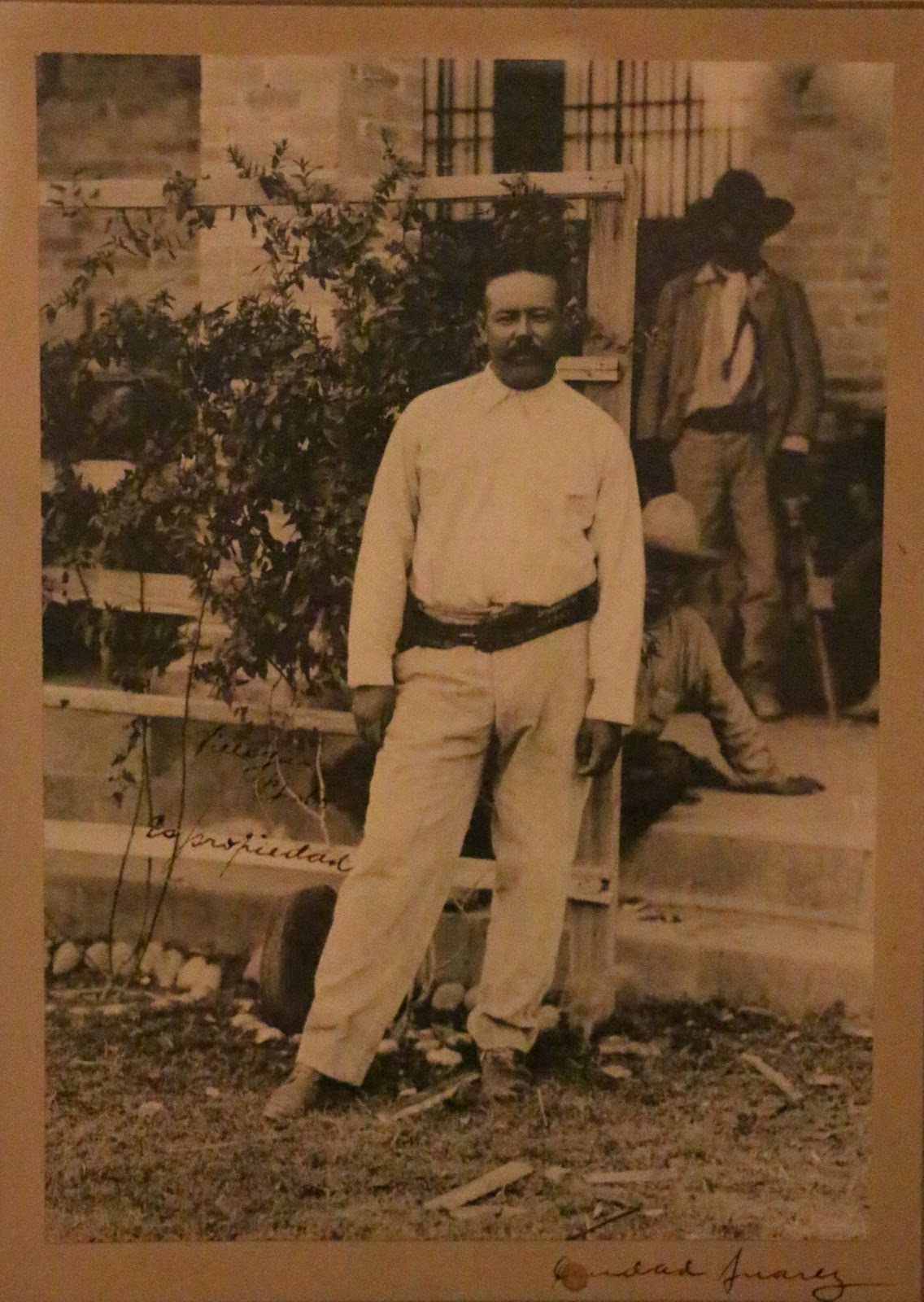
Francisco "Pancho" Villa
Emiliano Zapata

Venustiano Carranza,
in light gray uniform and hat to left of center.

Zapata and the Revolutionaries
By Leopoldo Mendez

So we are plunged (at least imaginatively) into the Mexican Revolution (1910-17), with its archetypical heroes: 
  • Francisco Madero, a well-to-do intellectual liberal who started the Revolution, became its first president and was overthrown in a coup de etat and assassinated by General Victorino Huerta; 
  • "Pancho" Villa, a mestizo, of mixed Indian and Spanish blood, from the north; an outcast who became a bandit and then a brilliant general of a peoples' army;
  • Emilano Zapata, also mestizo, from the southern state of Morelos, and leader of a campesino (traditional, indigenous and mestizo farmers) uprising to retake land expropriated by wealthy criollos, pure-blooded Spanish; 
  • Venustiano Carranza, well-to-do northern rancher who sought political power under Díaz, was rejected by Díaz, so when Madero was killed, he organized troops to overthow Huerta in 1914 and then, when Villa and Zapata would not agree to his being president, took them on, defeated them and then became president (1917-20).

The U.S. Meddles in Mexico


Next, Monsiváis confronts us with some broadsides protesting U.S. interventions during the Mexican Revolution. They recite the text of corridos, politically oriented ballads.

In 1914, President Woodrow Wilson ordered the Navy
to blockade the port of Veracruz
to prevent the possible delivery by Germany
of war supplies to Victoriano Huerta,
who had, with U.S. support,
overthrown President Francisco Madero in Feb. 1913.
Wikipedia


Here, the Uncle Sam moon gobbles up the Mexican sun.
This is based on an archetypical indigenous Mexican image 
of the eclipse of the sun by the moon, seen as their marriage
which, in one myth, gives birth to Mother Nature.
                     
The Pursuit of Pancho Villa

On 9 March 1916, Villa attacked
Columbus, New Mexico
, apparently seeking supplies.

In response, President Woodrow Wilson sent 5,000 Army troops,
under the command of John Pershing, to pursue Villa in Mexico.
Employing aircraft and trucks for the first time in U.S. Army history,
Pershing's forces chased Villa until February 1917.
Villa, being a guerrilla, always escaped. Wikipedia

Ballad of the "Good Neighbor"

President Franklin D. Roosevelt,
with Eleanor Roosevelt,
tries to change the U.S. relationship with Mexico
and Latin America
by announcing a "Good Neighbor" policy
of no further U.S. intervention. Wikipedia

The broadside portrays Mexican dubiousness.

A cartoon, in 1930's Art Deco style,
portrays a dapper Uncle Sam
trying to woo Mexico,
presented as an attractive maiden.
By Ernesto García Cabral

In 1938, President Lázaro Cárdenas
(1934-40)
expropriated control of Mexican oil fields
from U.S. and British companies.
The U.S. government protested
but ended up acceding because of
the beginning of WW II.

Most Mexicans view Cárdenas as an
archetypical hero because of this
achievement vis-a-vis the U.S.

By Alredo Zalce (1908-2003),
leading Mexican artist.

President Vicente Fox (2000-2006)

Fox, a former Coca-Cola executive,
was the first president from a party
other than the Party of the Institutional
Revolution (PRI), which had ruled Mexico
since 1930.

The PRI administration of
Carlos Salinas (1988-94)
achieved the signing of the
North American Free Trade Agreement,
essentially tying the Mexican economy
to that of the U.S.

By José Hernández

Some Mexican types


Monsiváis (or his curator) then takes us on another twist in the theme of Archetypes and Types, returning to cartoons, but with a far different style and message than those of José Posada. 

Mexican Family
By Andrés Audiffred

1920s-30s upper middle class, urban family
with child dressed as archetypical
19th century charro, cowboy.

On national political holidays,
dressing children this way
is still the custom. 

"The Last Breakfast"
a spoof of Da Vinci's "The Last Supper"
attended by a wide range of Mexican "types"
By Eduardo del Río, aka "Rius"
Mexican cartoonist who died on Aug. 8, 2017, age 83.

La Familia Barrón
The Barron Family, 
created in 1937 by Gabriel Vargas (1915-2010)

Windshield washers and newspaper vendors are still features of intersections.

"Disco bar"
Minature created from newpaper cartoon series, "La Familia Burrón"
The Burron Family, 
by Gabriel Vargas

Then yet another sharp turn:

Portrait of a Mexican
By Roberto Montenegro (1885-1968)
1930

We are stunned by its powerful realism.
(We will have to investigate the work of Roberto Montenegro)

The City as Personal


The next part of the "Rituals and Manias" of Monsiváis, takes yet another sharp turn, to the cotidianiedad, the everday life, of city residents, and its continuities reaching from earlier centuries right up to the mid-20th century.

Miniature of a botica shop,
selling herbal and other types of medicines,
precursor of a pharmacy.

Butcher shop

Fruits and vegetables shop

Clockwise from upper left:
19th c. water carrier, 20th c. softdrink deliveryman,
Palm Sunday: indigenous woman
weaving palm fronds for sale (just as they do today),
Public scribe (they still work in Plaza Santo Domingo),
Tianguis (open-air market; today's stalls have plastic shading),
Sereno, (night watchman; one patrols our neighborhood on a bicycle).

The exhibit ends with a Gallery of Portraits of famous Mexicans of the 20th century


Mexican personajes, public personalities, of the 20th century

Clockwise from upper left:
José Vasconcelos, first secretary of public education after the Revolution,
initiated program of creating public murals.
Drawing of Vasconcelos (why snakes protrude from underneath him is a mystery)
Diego Rivera drawing Elena Poniatowska, leading Mexican author,
David Siqueiros,
José Clemente Orozco,
Graciano Sánchez, post-revolutionary agrarian leader,
Juan Rulfo, novelist and short story writer.

Twists and Turns of an Idiosyncratic View of Mexico, and of Mexican History


So Carlos Monsiváis (or the curator of this exhibition of parts of the author's collection) has taken us on a tour that is the intersection of his idiosyncratic view of Mexico -combining serious portraits with cartoons and toy-like maquettes- and the twists and turns of modern Mexican history, from the War for Independence through the Revolution to its ambivalent relationship with its northern neighbor, Uncle Sam, and from leading personajes, public figures, to the everyday life of city residents shopping in neighborhood tiendas, shops. 

After an initial sense of disorientation, we find that we are both charmed by its quirky alternation between serious and playful perspectives and enlightened by a very Mexican portrayal of Mexico and the many facets and faces that make it uniquely Mexico. El Museo de la Estanquillo is definitely a corner store or, better, a general store of Mexican life. And quite worth a visit.