The Savior Who Goes Visiting His People
A little over a year ago, on a sunny Sunday morning in the spring, we were drawn onto our apartment's balcony by the sound of exploding cohetes, rocket-style firecrackers. They were announcing a nearby fiesta, so we decided to investigate their source, a pueblo not far to the south of us in Delegación Coyoacán, Following the sound of the explosions led us to the pueblo originario, the original village, of los Tres Santos Reyes, the Pueblo of the Three Sacred Kings, aka Los Reyes. It's full name is Tres Santos Reyes Hueytlilac. Hueytlilac (place of the swampy waters) is its original Nahua name, now rarely mentioned. It was first inhabited some 3,000 years ago.
When we arrived at the parish church, we wondered what saint was being honored, as the Three Kings of the Christmas Story are the formal patron saints of the pueblo and are celebrated on January 6. But on this Sunday in April, shortly after Easter, it was honoring el Señor de la Misericoridia, the Lord of Compassion, a figure representing Christ in His Passion—His suffering during Semanta Santa, Holy Week. He, in fact, had become the pueblo's main protector because he was seen as the source of a miracle a few centuries ago, after the Spanish Conquest, in which prayers to him had saved el pueblo, the people, of the various indigenous villages in what is now the borough of Coyoacán, from an epidemic,
Versions of such miracles against plagues are common throughout Mexico. The Spanish brought many diseases, such as smallpox, to which the indigenous had no immunity. Each miraculous salvation has its own representation of the Christ that performed the miracle. We recall that in Tzintzuntzan, a Purépecha pueblo in Michoacán, near where we initially lived in Pátzcuaro, he is el Señor de la Rescate, the Lord of the Rescue.
Intertwining Communal Roots
That day at Tres Reyes, we also learned that every summer, El Señor is carried forth from el pueblo to visit several of these other pueblos and barrios, where he is received by their respective saints, gives his blessing on the people and receives their adoration and thanks. He spends one to two weeks asentado, seated, in the church of each pueblo before moving on to the next. Hence, a series of bienvenidas and despedidas, welcomes and farewells, to El Señor are festejados, celebrated, across Coyoacán from late May to early September.
 |
| El Señor de la Misericordia, the Lord of Compassion, ready for his departure from Los Reyes in late May, 2016. |
We spent many Sundays last summer meeting up with El Señor as he was transferred, with much communal animo, spirit, from one pueblo to the next. The climax came on the first Sunday in September, when el Señor was returned with much ceremony to Tres Reyes. Through these encounters, it became very clear to us that the function of this ritual journey is to link together the borough's original villages in a manifestation of common belief, custom and history which maintains the bonds of a shared identity that is muy arraigo, very rooted, in their pre-hispanic past.
However, for various reasons, including our energy level, we did not attend every transfer. So this summer, when we learned that one Sunday in August the Lord of Compassion was moving between two pueblos in southern Coyoacán that we had not visited last year, we were excited to have the opportunity to renew and add to our experience of them.
Colonia Pedregal Santo Domingo and the Church of the Holy Founders
We learned that a procession going to meet and receive el Señor was scheduled to leave la Parroquia de los Santos Fundadores, the Parochial Church of the Holy Founders, in la Colonia Pedregal Santo Domingo, at 10 AM. Last year, we had learned the hard way, when we arrived late at one such transfer, that these events occur pretty much on time, as two pueblos are coordinating the meeting and transfer of El Señor. Pedregal Santo Domingo is just southeast of Pueblo Tres Reyes, and not far from our base in Parque San Andrés, so we call for a taxi at 9:30 and arrive at the church just before 10.
 |
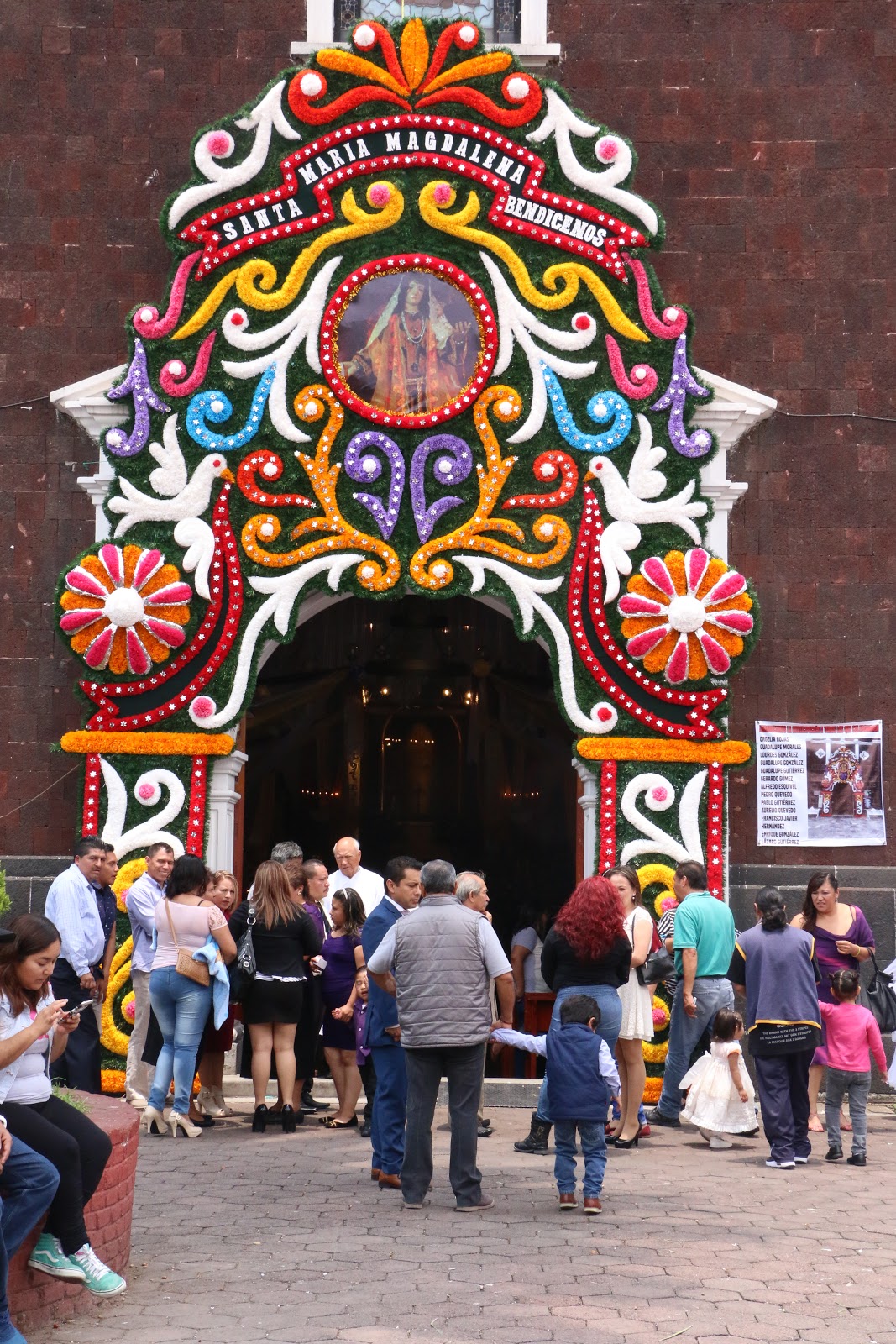
| Portada of fresh flowers at entrance to the church atrio honors two priestly saints and the Lord of Compassion, who will be received here today. "First, contemplate, then teach, and preach, always." Motto of the Dominican order |
Clearly, the procession is about to begin. The statues of two saintly friars and the Virgin Mary are in place on an anda, movable platform, covered with fresh flowers, waiting below the floral portada at the entrance to the church atrio, atrium. A priest is moving among the crowd, checking that all is ready. He is wearing the green robes of the Season of Trinity, the summertime period between Pentecost, the day of the descent of the Holy Spirit onto the disciples after Christ's Ascension to Heaven, forty days after His Resurrection on Easter, and Advent, in the fall, preparing for Christmas.
When we first learned that the name of the church was the Holy Founders, we were puzzled, as a single saint is usually the patron of a parish. So we approach one of the men attending the anda and ask about the two saints: "This is St. Francis (in the front) and that is St. Dominic."
  |
| St. Francis of Assisi and St. Dominic, with the Virgin Mary |
 |
| Parish priest in Trinity's green robes |
 |
| Tapete de asserín, sawdust carpet. crosses the atrio to the church entrance. |
 |
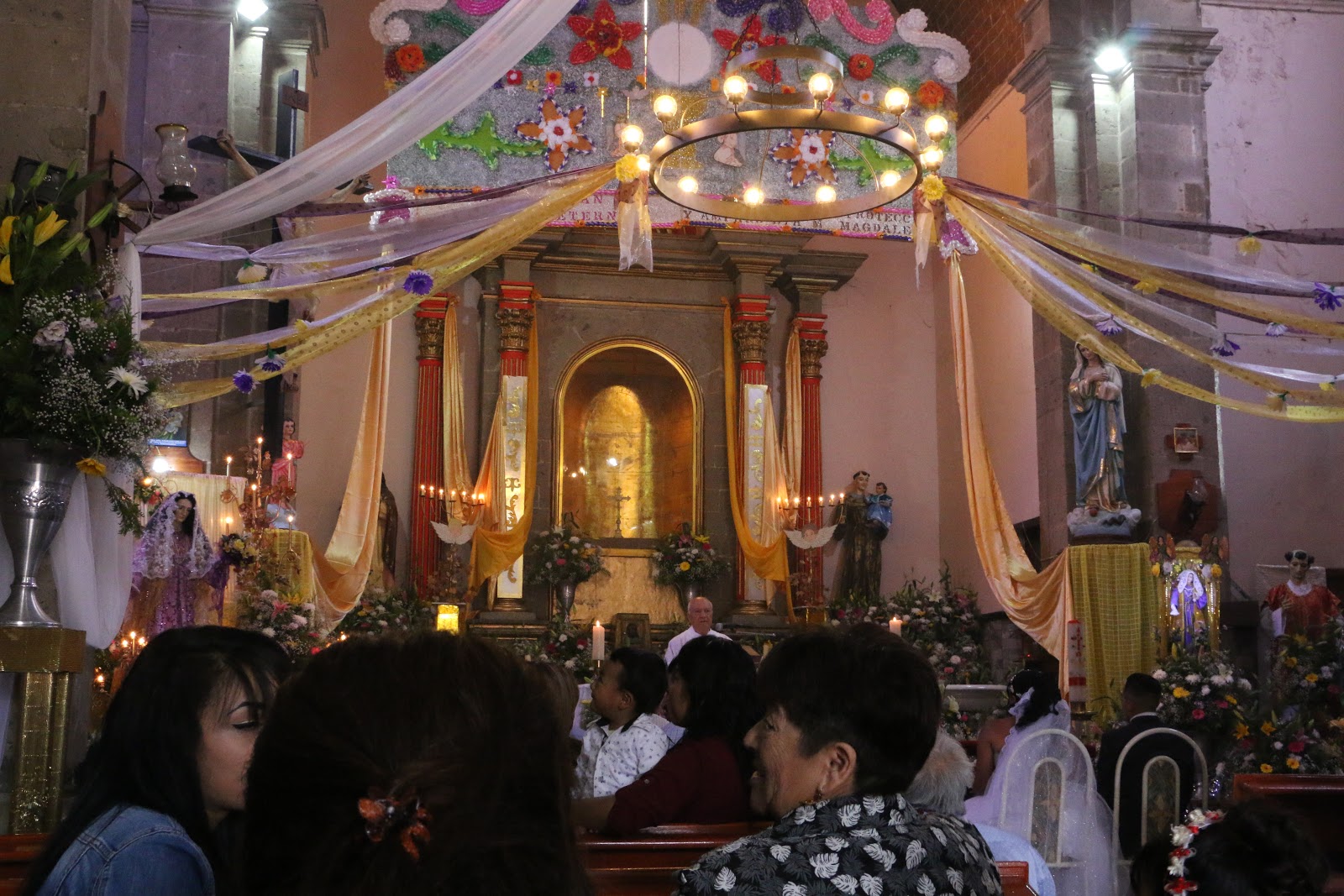
| Sanctuary The church is obviously 20th century modern, a replacement of the original but filled will flowers, as is traditional. |
As has happened so many times with us in our ambles into an original pueblo of Mexico City, the light dawns on us. Of course, St. Francis was the founder of the Franciscans, the first religious order to come to Nueva España to evangelize, i.e., convert, the indigenous people into Spanish Catholics. St. Dominic was the founder of the Dominicans in the early 13th century. His order was the second to arrive in the New World. So the Holy Founders are the founders of the first two orders to come to save souls in Nueva España, the initiators of that massive socio-cultural transformation now called the Spiritual Conquest. We are here today to witness yet another still living manifestation of that process.
St. Dominic's feast day is August 8; hence this fiesta in mid-August in this, his Colonia Pedegral Santo Domingo. (Pedregal is the name of the stony area in southwestern Coyoacán, consisting of volcanic rock that resulted from the eruption of the volcano Xitle about 100 CE. which buried the nearby first city in the Valley, Cuicuilco.)
Los Indios
Just outside the atrio are a group of women and girls dressed in long red skirts edged with rows of wooden tubes, a form of ceremonial dress we haven't seen before in our adventures. Inveterate questioner that we are, we ask one young woman about her attire. She shyly directs us to speak to a middle-aged woman wearing the attire and a grey shirt, instead of a white one which all the others wear.
 |
| Los Indios Danzantes In addition to the wooden tubes on their skirts that sound as they dance, they carry rattles and miniature bows and arrows. The leader is front and center. |
The lady politely tells us they are "Los Indios Danzantes¨, the Indian Dancers. Knowing that such groups participating in processions often come from other pueblos, I ask where they are from. "We are of Santo Domingo", she says with that quiet but firm Mexican pride. I ask about the traje tradicional, the traditional dress, as it is new to me. She tells me that it originates from the state of Zacatecas, far to the north of Mexico City. She then excuses herself to begin the dance. Los Indios (yes, the masculine form of the noun) have the major responsibility of leading the procession.
As I watch them begin their obviously well practiced moves, I recall having learned from seeing many other traditional indigenous dances at such fiestas, that they arrived in a more Europeanized Mexico City from las provincias, the provinces, i.e. the outlying, more traditional states, only after the Mexican Revolution, which opened up of the issue of Mexican identity rooted in the complex of indigenous civilizations now known as Mesoamerican. So here is yet another such dance, apparently brought to the city from Zacatecas, another indigenous element in the mixture that is Mexican Catholic ritual.
The Procession
The priest blesses all the participants with holy water (including this observer and our camera) and the procession starts off, led by Los Indios, with the tempo set by a drummer. There is no usual brass banda.
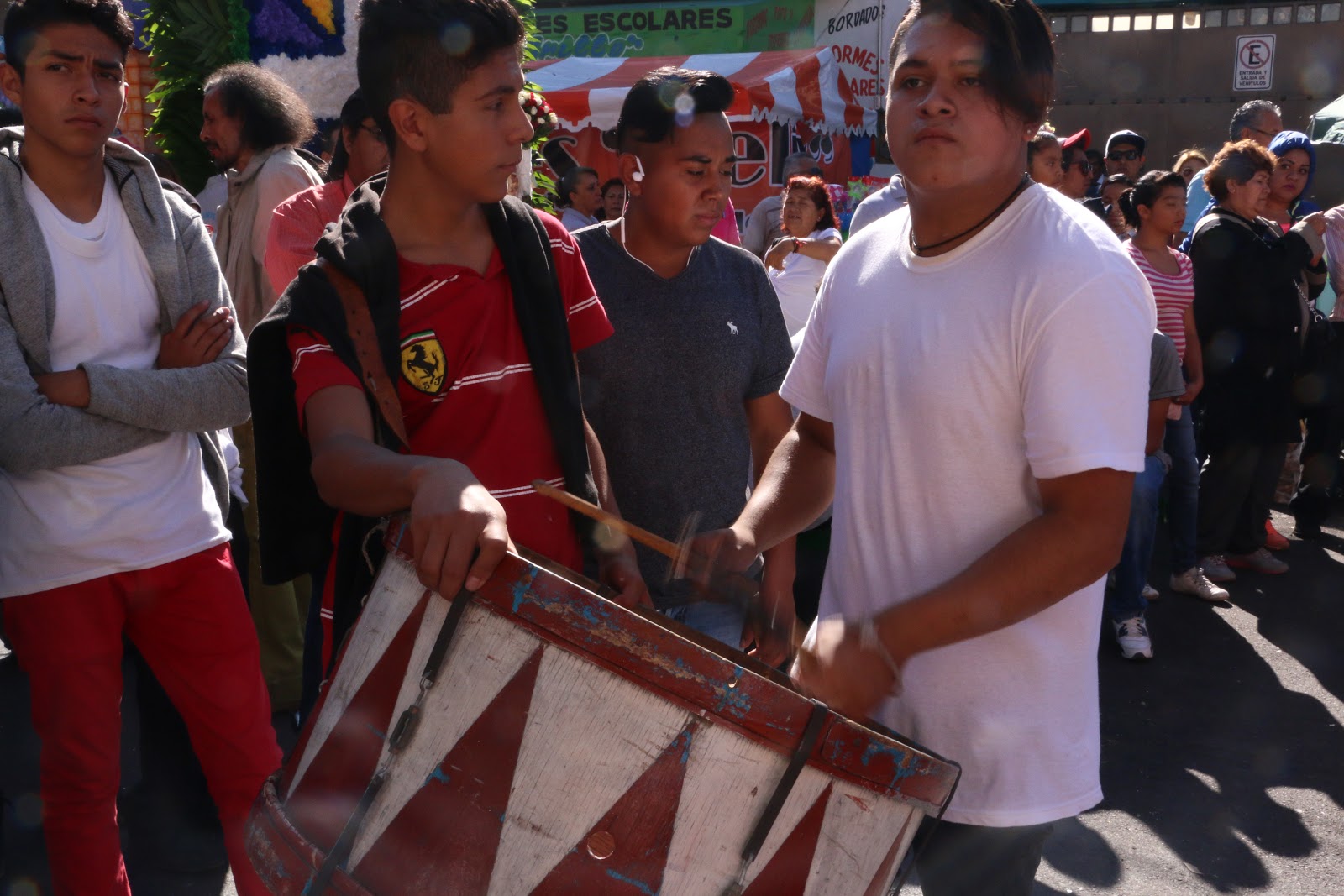 |
| Drummer sets the tempo for the dancers and the procession. His rhythms vary and at times are complex. |
 |
| The men of the parish cofradia, brotherhood, lift and carry the anda forward. The empty space below the circular canopy is reserved for the Lord of Compassion. |
 |
| "Family that prays is united." (Carnival rides for the fiesta's evening fun can be seen to the rear.) |
 |
| Two representations of the Christ in his Passion, follow: "The (crucifed) Lord of Chalma" Chalma is a shrine several miles west of Mexico City, in the State of Mexico, to which peregrinaciones, walking pilgrimages, are made. Pueblos from Coyoacán participate in them. To the rear is the Lord of the Column, Jesus, tied to a post, where he was beaten before being crucified. |
 |
| The red shirts worn by the bearers of the Lord of Chalma indicate, on the back, that they have participated in this year's pilgrimage to the shrine, thus earning the right to bear his image in this prosession. |
 |
| At one street corner in the colonia, another saint, el Niño Jesús, the Child Jesus, joins the procession. |
 |
| This young man, who is supervising el Niño, tells us, with pride, that his group is from a town in the state of Puebla, miles to the east. The network of indigenous pueblos spreads far and wide. |
 |
| As the procession winds through the callejas, narrow streets of the colonia, Los Indios keep up their disciplined dance. |
 |
| When they stop, while the bearers of the heavy andas are resting, they shoot their miniature (cross) bows and arrows. |
 |
| The words on the bow say, "Long live Santo Domingo" We are sure this refers not just to the eternal saint, but also to his pueblo, this community of the faithful. |
 |
| If you have any doubts about the strength of tradition and belief, this leader's face should end them. |


 |
| Bearers of the anda of St. Francis and St. Dominic show their pride during a rest stop. |


Some of el pueblo, the people, attending the procession.

More signs of pride in indigenous tradition
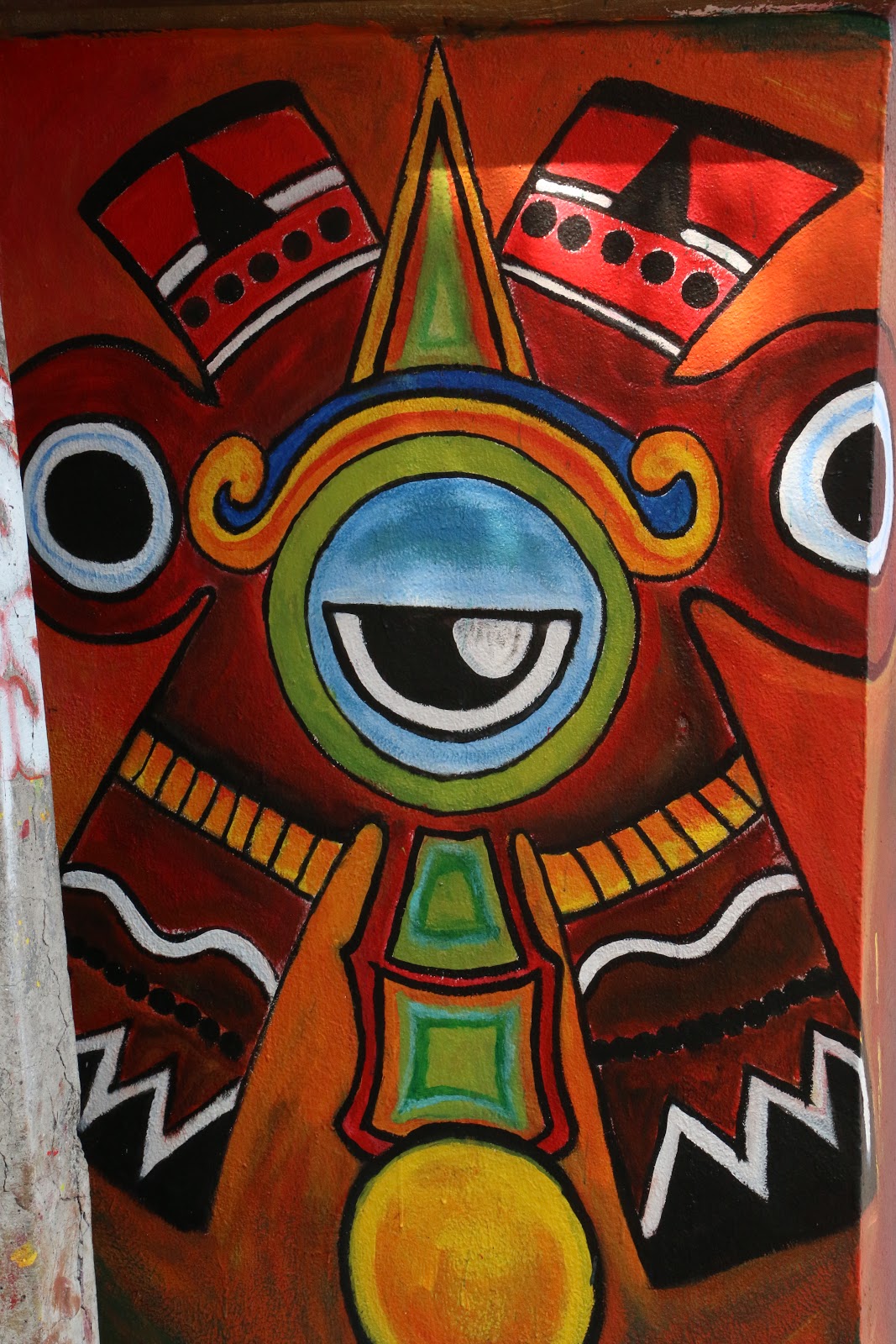
As we follow the procession winding through the colonia's steets, at one point, we happen to look away from the march to the buildings around us. There, painted on walls are murals of ancient images.
 |
| We think this is either the Nahua "Old" god, or the god of fire. |
 |
| The harvesting of maiz, corn, the basis of indigenous and contemporary Mexican life. |
 |
| The modern version of grinding corn to produce masa, corn dough, to then press into tortillas. Maiceria is a corn grinding mill. |
 |
| "Without corn there is no country! (This is a basic Mexican declaration.) It is our sacred food gift of the Mother Earth, root of our culture; We are men and women of corn! ...it arrives at the mill, green white, red and various colors. From early in the morning until the nightime, the torillería (tortilla-making shop) of Migueil "The Paleface" supplies the population of Santo Domingo. Fernando Díaz Enciso |
 |
| Catty-cornered across the street from the torillería stands the likely source of the murals: The Center of Arts and Trades, Union of the Residents of Santo Domingo. The man portrayed to the right, holding a rifle, is Emiliano Zapata, who led the Mexican Revolution in the state of Morelos, just south of Mexico City, seeking return of land from Spanish hacienda owners to his indigenous people. |
 |
| The Center of Arts and Trades, Union of the Residents of Santo Domingo. The red banner, adds: "The Little School of Emiliano Zapata" The mural on the interior wall intrigues us, as it represents a continuation of the post-revolutionary Mural Movement, which we explored in depth earlier in our Ambles. Apparently, vestiges of the Revolution and the Mural Movement still live here in Santo Domingo. We will have to return someday to explore it further. |
Meeting the Lord of Compassion
After about an hour and a half of walking through the streets of Santo Domingo, with many stops for the anda bearers and the dancers to rest, we finally come out onto a wide avenue filled with a crowd of people, a long tapete de asserín running some distance up the middle and the usual temporary puestos, stalls, selling food that come with a fiesta. This is where the pueblo of Santo Domingo will meet the adjoining pueblo of Ajusco, who will deliver the Lord of Compassion into their caring hands.
 |
| Calle Mixquic, part of the boundary between Colonias Santo Domingo and Ajusco. Ready and waiting the Lord's arrival. |
 |
| Tapete de asserín The Lord of Compassion awaits under the canopy at the far end. |
 |
| The people of Ajusco protectively await the transfer of el Señor. |
 |
| El Señor is brought forward. Ajusco's patron saint, The Lord of the Miracles, another crucified Christ, stands to the rear left. |

 |
| He is carefully set in His place of honor, beneath the circular canopy, on the Santo Domingo anda. |
 |
| The Lord of Compassion, together with St. Francis. |
 |
| The Saints begin their return to the Church of the Holy Founders in Santo Domingo. |
 |
| The anda from Ajusco, now without the Lord of Compassion, follows behind. |
 |
| The procession from the Colonia of Ajusco is led by a brass banda. |
 |
| And a comparsa, dance troupe of concheros, Aztec-style dancers we have seen at other fiestas. |
 |
| Concheros del Señor del Chalma |
It's All About el Pueblo, the Community of People Sharing and Passing on Their Traditions
 |
| Rostros, faces of el pueblo. |
 |
| Delegaciones of Mexico City Coyoacan is dark purple area in the middle. |
 |
| Colonias, Pueblos and Barrios of Coyoacán Colonia Pedregal Santo Domingo (green star) is just southwest of Pueblo Tres Santos Reyes (dark green area), home of the Lord of Compassion; Colonia Ajusco is light reddish area to southeast of Santo Domingo. The National Autonomous University of Mexico (UNAM) is just west of Santo Domingo. Colonia Parque San Andrés (upper right) is Mexico City Ambles' homebase. |